
Conditions · Coral Springs & Parkland
Carpal tunnel treatment in Coral Springs (non-surgical)
Numb fingers at 3 a.m., a grip that drops the coffee cup, tingling that spreads up the forearm — the median nerve is being squeezed, and often in more than one place. We trace the whole nerve from neck to hand and take the pressure off, drug-free.
Quick answer
Non-surgical carpal tunnel treatment relieves pressure on the median nerve at the wrist — and anywhere else along its path. At our Coral Springs clinic that means a neck-to-hand exam, Graston soft-tissue work on the forearm, cold laser for swelling, gentle wrist, elbow and cervical mobilization and nerve-glide rehab. Surgery is reserved for severe or non-responding cases.
What is actually happening to the median nerve
Effective carpal tunnel treatment starts with the anatomy. The carpal tunnel is a narrow passage on the palm side of the wrist, floored by the small carpal bones and roofed by a thick band called the transverse carpal ligament. Nine flexor tendons and one nerve — the median nerve — pass through it. There is no spare room.
When anything swells or thickens inside that tunnel — irritated tendon sheaths, fluid retention, a wrist held bent for hours — the median nerve is compressed. The result is the classic pattern: numbness and tingling in the thumb, index and middle fingers, symptoms that wake you at night, a clumsy or weakening grip, and sometimes an ache that travels up the forearm. The American Academy of Orthopaedic Surgeons describes carpal tunnel syndrome as one of the most common nerve compressions in the body (AAOS OrthoInfo).
What is often missed is that the median nerve begins in the neck. It is formed from nerve roots at C6, C7, C8 and T1, travels through the shoulder, past the elbow and under the forearm muscles before it ever reaches the wrist. Irritation at any of those points lowers the nerve’s tolerance for pressure at the tunnel — which is why a wrist-only plan so often disappoints.

Is it really carpal tunnel? Double-crush and the look-alikes
Hand numbness has several possible sources, and the pattern tells them apart before any nerve test does:
- Carpal tunnel syndrome: numbness and tingling in the thumb, index, middle and half of the ring finger; worse at night and while driving or holding a phone; shaking the hand brings relief; grip weakens over time. The little finger is spared.
- Cervical radiculopathy (pinched nerve in the neck): numbness that follows a stripe from the neck or shoulder blade down the arm into specific fingers, often with neck pain and symptoms that change when you turn or tilt your head.
- Cubital tunnel syndrome: numbness in the ring and little fingers from the ulnar nerve at the inside of the elbow — worse with a bent elbow, as when holding a phone.
- Pronator syndrome: the median nerve pinched by forearm muscles below the elbow; similar finger numbness plus forearm aching, and night symptoms are less typical.
- Double-crush: a mildly irritated nerve root in the neck plus mild pressure at the wrist. Neither alone would cause symptoms; together they do. This is the most common pattern we see in desk workers, and it is why we examine the neck on every carpal tunnel visit.
Good to know
Carpal tunnel syndrome is more common in people with diabetes, thyroid conditions and during pregnancy, when fluid retention narrows the tunnel. We factor those into the plan and coordinate with your physician when needed.
How we approach carpal tunnel treatment at TSAWC
Our carpal tunnel treatment follows the 4R Method — Repair, Rebuild, Regenerate, Refine — applied along the whole length of the median nerve rather than only at the wrist. Taking pressure off first and correcting the mechanics second is what turns short-term relief into a durable result.
R1 · Repair — take the pressure off the nerve
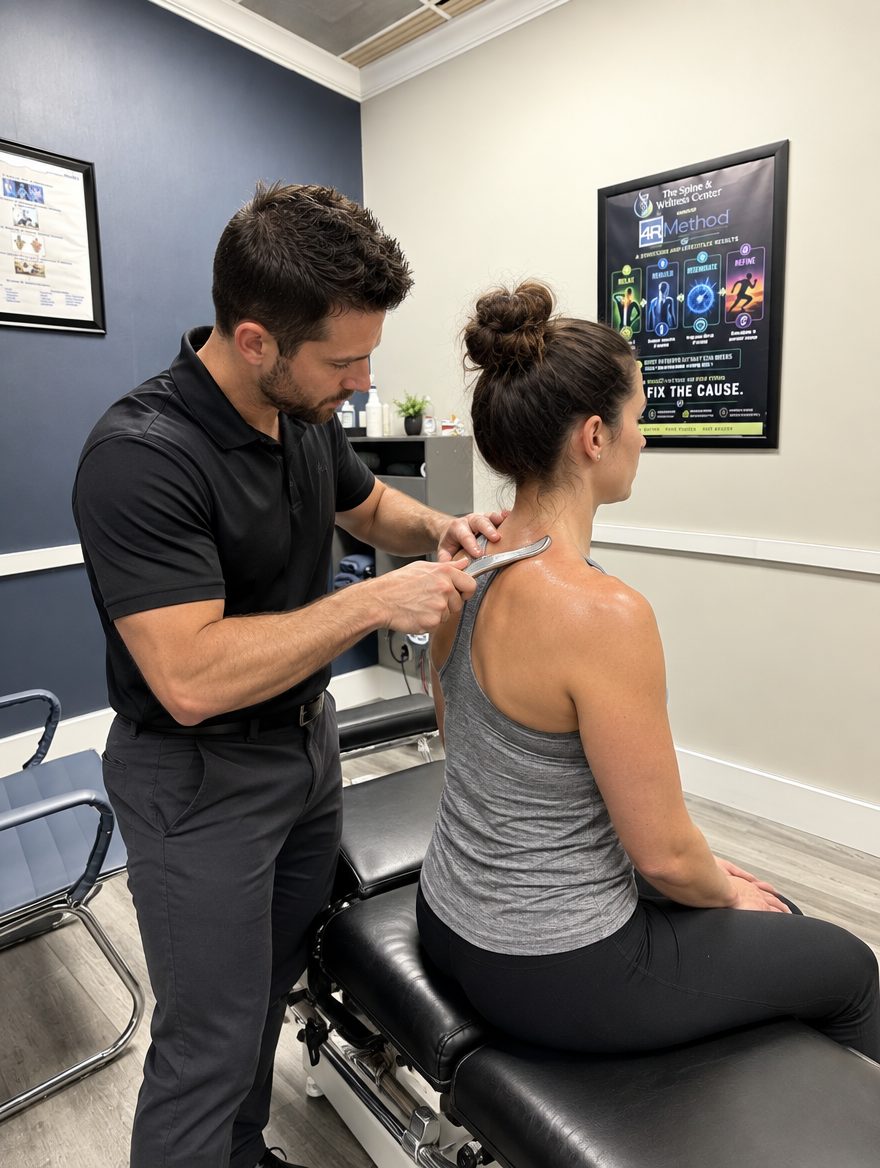
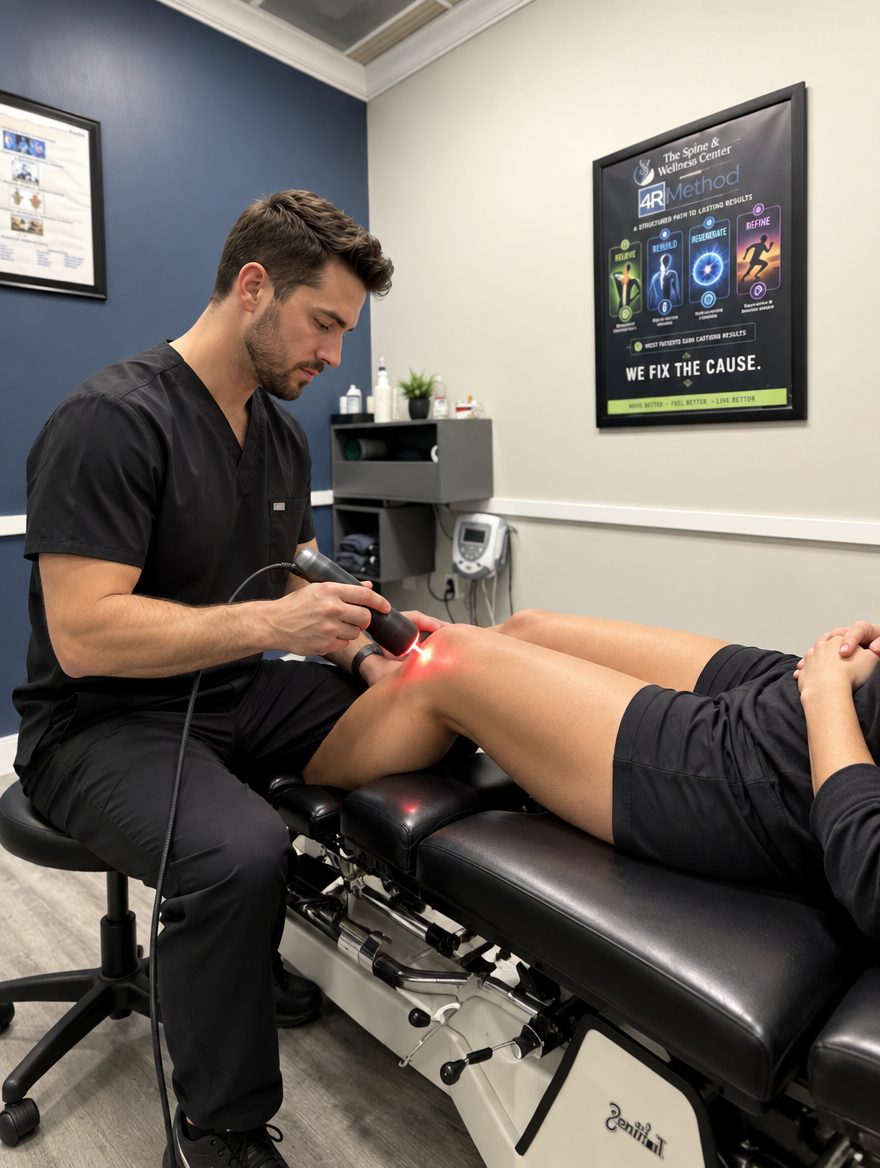
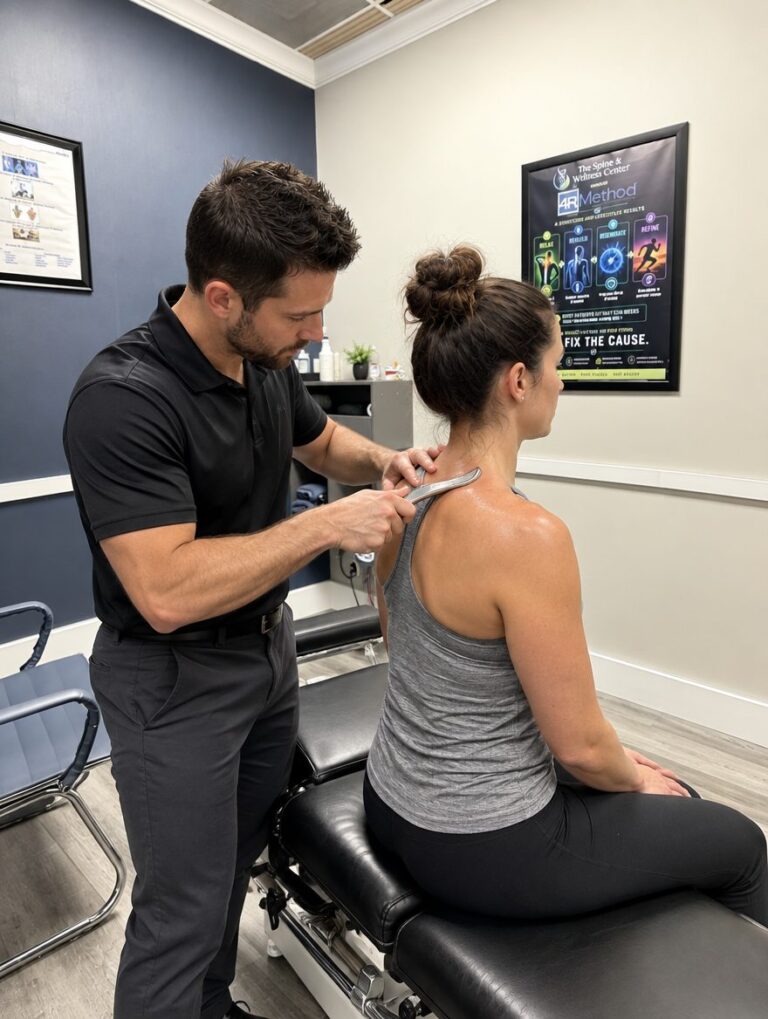
The Repair phase decompresses the nerve wherever it is crowded. Graston Technique releases the thickened forearm flexor tissue and the tunnel’s roof; cold laser therapy calms swelling around the nerve inside the wrist; gentle mobilization restores glide to the small carpal bones and the elbow; and specific cervical adjustments address the neck-side contribution when the exam finds one. Typical commitment is 3–5 visits a week for 4–8 weeks, and night symptoms are usually the first to settle — often within two to three weeks.
R2 · Rebuild — fix why the tunnel got crowded
Once the nerve is quieter, we correct the upstream causes: nerve-glide exercises that teach the median nerve to slide rather than catch, forearm and grip strengthening through physical therapy, and posture correction for the rounded-shoulder, forward-head desk position that loads the nerve roots in the neck. Rebuild usually runs 2–3 visits a week for 8–16 weeks.
R3 and R4 · Regenerate and Refine
Nerves recover slowly. Regenerate supports that recovery with PEMF and red light therapy at about 2 visits a week for two months or more. Refine is a brief tune-up every month or two — especially for people whose work keeps their hands busy — so the tunnel stays open and the gains hold.
Graston Technique
Instrument-assisted soft-tissue work that releases the fibrotic forearm tissue crowding the median nerve.
Learn moreCold laser therapy
Low-level laser reduces swelling around the nerve inside the wrist — painless, drug-free.
Learn moreChiropractic care
Gentle wrist, elbow and cervical adjustments free the joints that pinch the nerve along its path.
Learn morePhysical therapy
Nerve-glide and strengthening rehab that keeps the tunnel open and the grip strong.
Learn more5 proven non-surgical steps for carpal tunnel (in order)
Carpal tunnel treatment works best as a sequence rather than a single fix. This is the order we follow:
- Find every compression point. Wrist, forearm, elbow, shoulder and neck are each tested on visit one. Treating only the wrist in a double-crush case is the most common reason conservative care fails.
- Calm the swelling. Cold laser inside the tunnel and a neutral-wrist night splint for the first weeks reduce the pressure on the nerve while it recovers.
- Release the soft tissue. Graston Technique and targeted massage loosen the forearm flexors and the fascia that tug on the tunnel.
- Restore joint motion. Gentle mobilization of the carpal bones, the elbow and the lower cervical spine gives the nerve room along its entire path.
- Retrain and strengthen. Nerve glides, grip and forearm strengthening, and ergonomic changes at your desk, tools or phone keep it from coming back.
What is not on the list as a first step: repeated steroid injections or surgery. According to the AAOS, non-surgical care — bracing, activity modification and exercise — is appropriate for most mild to moderate cases, and carpal tunnel release surgery is considered when symptoms are severe, there is constant numbness or thumb-muscle wasting, or conservative treatment has not helped. If you fall into that group, we will tell you and refer you to a hand surgeon.
What to expect at your first two visits
We measure before we treat, so your carpal tunnel treatment targets where the nerve is actually being squeezed.
Visit one — we measure (and usually begin care)
- A real conversation. Which fingers go numb, when it started, whether it wakes you, what your hands do all day, and any pregnancy, thyroid or diabetes history that affects the nerve.
- A hands-on structural exam. Sensation mapping finger by finger, grip and thumb strength, Tinel’s and Phalen’s tests at the wrist, nerve-tension tests, elbow and shoulder screening, and cervical range of motion with nerve root testing.
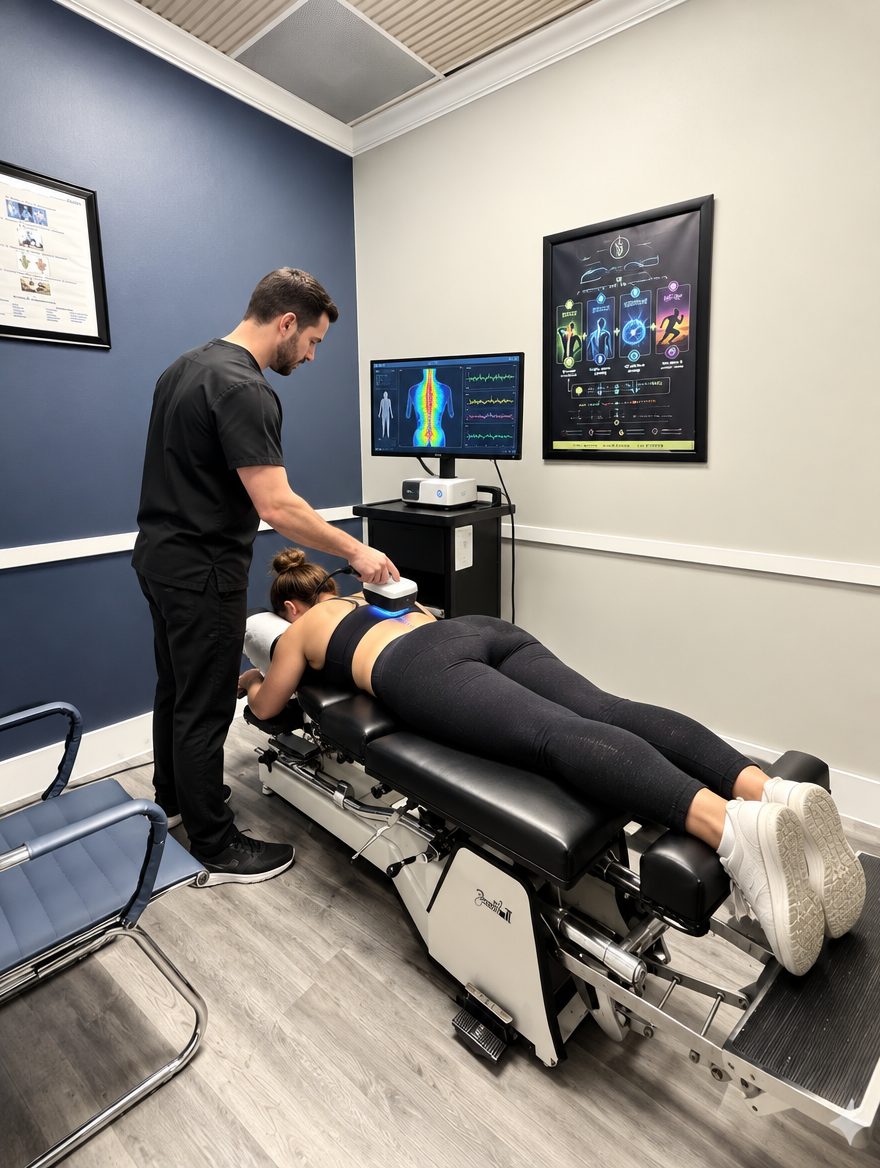
- Surface scanning: sEMG + thermal. Surface EMG shows muscle guarding along the cervical spine; thermal scanning maps nerve irritation from neck to hand. Painless and repeatable for tracking progress.
- Digital X-rays, when indicated. Of the neck, to check disc spacing and alignment at the C6–T1 roots that form the median nerve. We review any nerve conduction study or imaging you already have.
Visit two — your findings and your plan
Everything explained plainly with your scans in front of you: where the nerve is compressed, whether the neck is contributing, and a phase-by-phase plan with a realistic timeline. Treatment begins at this visit. If your neck is part of the picture, take the 60-second spine assessment before you come in.
Carpal tunnel treatment at home: habits that protect the nerve
Between visits, small changes take real pressure off the median nerve:
- Keep the wrist neutral. Typing, mousing and sleeping with the wrist straight — not bent up or down — keeps the tunnel at its widest. A neutral splint at night helps in the early weeks.
- Set the desk, not just the wrist. Screen at eye height, elbows near 90 degrees, shoulders relaxed. A forward-head posture loads the neck roots that feed the nerve.
- Loosen the grip. Steering wheels, tools, phones and racquets are usually held two or three times harder than needed.
- Move every 30–45 minutes. Shake out the hands, roll the shoulders, turn the head — short breaks matter more than long ones.
- Do the nerve glides. The gliding exercises from your plan are the quiet workhorse of lasting carpal tunnel treatment; two minutes, a few times a day.
When carpal tunnel needs a specialist instead
Some signs mean the nerve needs medical evaluation rather than conservative care first: constant numbness that no longer comes and goes, visible wasting of the muscle at the base of the thumb, rapidly worsening weakness, numbness after a wrist fracture or fall, or hand symptoms with neck pain, fever or arm weakness. If any of these apply, please see a doctor or urgent care today — we will be here for the recovery afterwards.
For the far more common picture — intermittent numbness, night symptoms, a grip that is fading, a desk job in Coral Springs or a trade in Parkland — this is routine work for us, and most carpal tunnel patients avoid surgery. If your symptoms involve the whole arm, start with the neck pain guide; if your elbow aches too, see tennis and golfer’s elbow or the repetitive strain injury page.
Serving carpal tunnel patients across North Broward
Our clinic at 5675 Coral Ridge Drive, Coral Springs, FL 33076 serves Coral Springs, Parkland, Coconut Creek, Margate, Boca Raton, Tamarac, Pompano Beach and Deerfield Beach. Same-day appointments are usually available — call (954) 341-2256 or book online. Most patients from Parkland and Coral Springs are here in under 15 minutes.
Medically reviewed by Dr. Jared Cohen, DC — Co-Founder & Clinical Director, The Spine and Wellness Center. Last reviewed October 2026.
Frequently asked questions
Can carpal tunnel be treated without surgery?
Often, yes. Mild to moderate carpal tunnel syndrome usually responds to conservative care that reduces swelling, releases the forearm tissue, restores wrist and neck motion and retrains the nerve to glide. Surgery is reserved for severe cases with constant numbness, thumb-muscle wasting or no response to non-surgical treatment.
Why is my hand numbness worse at night?
Most people sleep with the wrist curled, which narrows the tunnel for hours and squeezes the median nerve. A neutral-wrist splint at night plus treatment of the underlying compression usually quiets night symptoms within the first few weeks of care.
Can a pinched nerve in the neck cause carpal tunnel symptoms?
Yes. The median nerve is formed from the C6–T1 nerve roots in the neck. Irritation there lowers the nerve's tolerance to pressure at the wrist — the 'double-crush' pattern. That is why we examine and, when needed, treat the neck as part of carpal tunnel treatment.
How long does carpal tunnel treatment take to work?
Night symptoms often improve within two to three weeks of the Repair phase. Full recovery depends on how long and how severely the nerve has been compressed; nerves heal slowly, so the Rebuild phase typically runs several more weeks. We map a realistic timeline after your evaluation.
Does Graston Technique help carpal tunnel?
Graston Technique is instrument-assisted soft-tissue work that breaks up the thickened, fibrotic tissue in the forearm flexors and around the tunnel that crowds the median nerve. Combined with cold laser, joint mobilization and nerve-glide exercises, it is one of the most useful tools in non-surgical carpal tunnel treatment.
Do you treat carpal tunnel patients from Parkland and Coconut Creek?
Yes. Our clinic on Coral Ridge Drive in Coral Springs is minutes from Parkland, Coconut Creek, Margate and Tamarac, and same-day appointments are usually available.
Same-day appointments
Let's build your plan.
Find out what's actually going on and get a clear path forward. Same-day appointments available.
- Same-day appointments are usually available
- Our team calls you back to confirm your visit
- Coral Springs, serving Parkland & North Broward since 2005
Prefer to talk now? Call or text (954) 341-2256