

Athletes · Coral Springs & Parkland
Tennis injury treatment in Coral Springs & Parkland
Thousands of forehands, an explosive serve, and a rally that asks your ankles and knees to brake and cut on a dime. We find the link in the chain that is actually failing, calm it, rebuild it and clear you back to full matches on objective criteria.
Quick answer
Tennis injury treatment at The Spine and Wellness Center begins with measurement — a structural exam, movement screen, surface EMG and GaitScan — then follows the 4R Method: calm the irritated tendon, shoulder, back or ankle, restore the rotation the serve and groundstrokes depend on, rebuild strength under load, and return to full play on objective criteria rather than a calendar. Most players keep training, modified, throughout.
What are the most common tennis injuries?
Tennis injury treatment in Coral Springs and Parkland centers on five regions: the elbow and wrist, the serving shoulder, the lower back and hips, the knee, and the ankle and calf. Tennis is beautifully repetitive, and that is exactly what makes it hard on the body — the same tendons and joints are loaded thousands of times a week.
By body region, in the order we see them in our clinic:
- Elbow and wrist. Tennis elbow — lateral epicondylitis — is an overuse tendinopathy of the forearm extensor tendons where they attach on the outside of the elbow. It builds from repeated gripping and off-center backhand contact and often drags the wrist into the story.
- Shoulder. Rotator cuff strain, impingement and a stiff, painful shoulder from the serve and overhead, usually with a shoulder blade that has stopped moving well.
- Lower back and hips. Lumbar strain, facet irritation and disc-related pain from the extension and rotation of the serve and the open-stance forehand.
- Knee. Patellar tendon pain, knee tracking problems and meniscus irritation from constant split-steps, lunges and direction changes on hard courts.
- Ankle and calf. Lateral ankle sprains from a rolled plant, and calf or Achilles strains from explosive push-offs — the classic ‘chasing a drop shot’ injury.

Why does tennis cause these injuries?
Tennis injures players through repetition at speed, with the load concentrated at the links in the kinetic chain that move least well. Every stroke is a chain from the ground up — legs, hips, trunk, shoulder, elbow, wrist — and when one link is stiff or weak, the next one pays for it.
- The serve. The serve drives the shoulder into extreme external rotation and then accelerates it forward, loading the rotator cuff and the labrum, while the trunk arches and rotates and the lumbar spine takes extension plus rotation at the same time. A stiff mid-back or hip pushes that load straight into the shoulder and low back.
- Groundstrokes and grip. Thousands of forehands and backhands keep the forearm extensors under tension. Off-center contact, a grip that is too small, string tension that is too high, and a late, wristy backhand all concentrate load at the outer elbow.
- Footwork. Tennis is a cycle of sprint, split-step, plant and cut. Hard courts and the South Florida heat make the braking forces on the knee, ankle and calf relentless, and a fatigued calf is the one most likely to strain.
- Compensation. A guarded shoulder changes how you serve, which loads the back; a sore ankle changes how you push off, which loads the knee. Many players arrive with pain in two or three places for one underlying reason.
The American Academy of Orthopaedic Surgeons describes tennis elbow as an overuse injury in which repeated gripping and wrist extension cause microtears in the extensor tendon at the lateral epicondyle, and notes that most cases improve with non-surgical care (AAOS OrthoInfo, Tennis Elbow). On the public courts and club courts across Coral Springs and Parkland, where league and junior play runs year-round, the tissue rarely gets the quiet weeks it needs — so the mechanics have to be fixed, not just rested.
How do we assess a tennis injury?
We measure before we treat, because the spot that hurts is often not the spot that failed. Your first visit is a measurement visit, and your tennis injury treatment plan is built on what we find.
Visit one — we measure (and usually begin care)
- A real conversation. How often you play and practice, singles or doubles, which strokes hurt, your racket, grip and string setup, what you have tried, and what you are training for.
- A hands-on structural exam and movement screen. Shoulder range and rotator cuff strength, shoulder-blade control, thoracic and hip rotation, a single-leg squat and hop screen for the knee and ankle, and orthopedic tests for the lumbar discs, facets and SI joint. For elbow pain, resisted wrist extension and grip testing isolate the tendon.
- Surface EMG and thermal scanning. A painless MyoVision surface EMG scan shows where the muscles along the spine are guarding — in servers the dominant side almost always lights up.
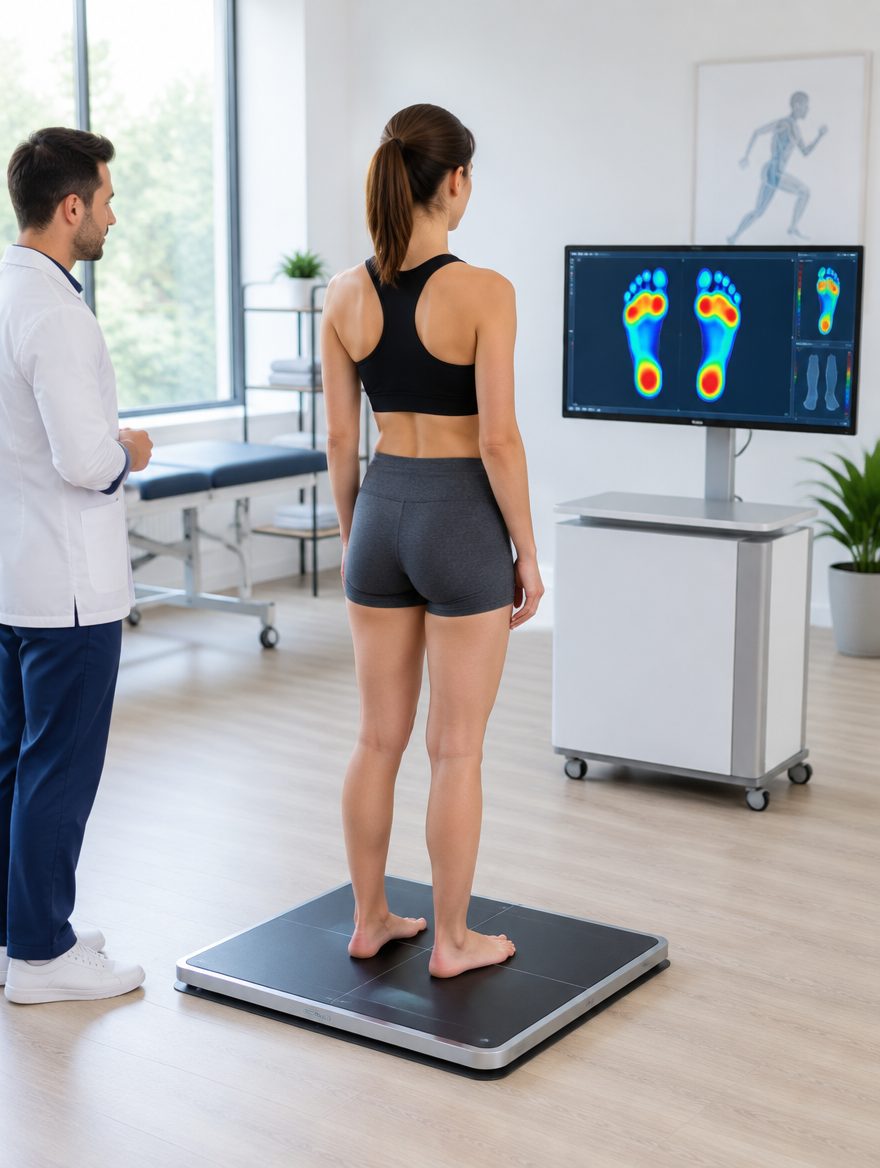
- GaitScan. A digital foot-pressure analysis with GaitScan shows how you load each foot and whether an old ankle sprain or a collapsing arch is driving the knee and hip.
- Digital X-rays, when indicated. For persistent low back pain, radiating leg symptoms or a history of disc problems we look at the actual architecture.
Visit two — your findings and your plan
We walk through the scans and movement findings in plain English, map them to the phases of the 4R Method, and explain what we recommend, how often and for how long. Treatment begins at this visit. For a head start, take the 60-second spine assessment before you come in.
How does tennis injury treatment work through the 4R Method?
Tennis injury treatment at our clinic follows the 4R Method — Repair, Rebuild, Regenerate, Refine — because the order matters. Settling the pain without restoring rotation and strength gives you a few good matches and then the same injury. Loading an angry tendon before it has calmed down just stirs it back up.
R1 · Repair — calm the tissue (3–5 visits a week, 4–8 weeks)
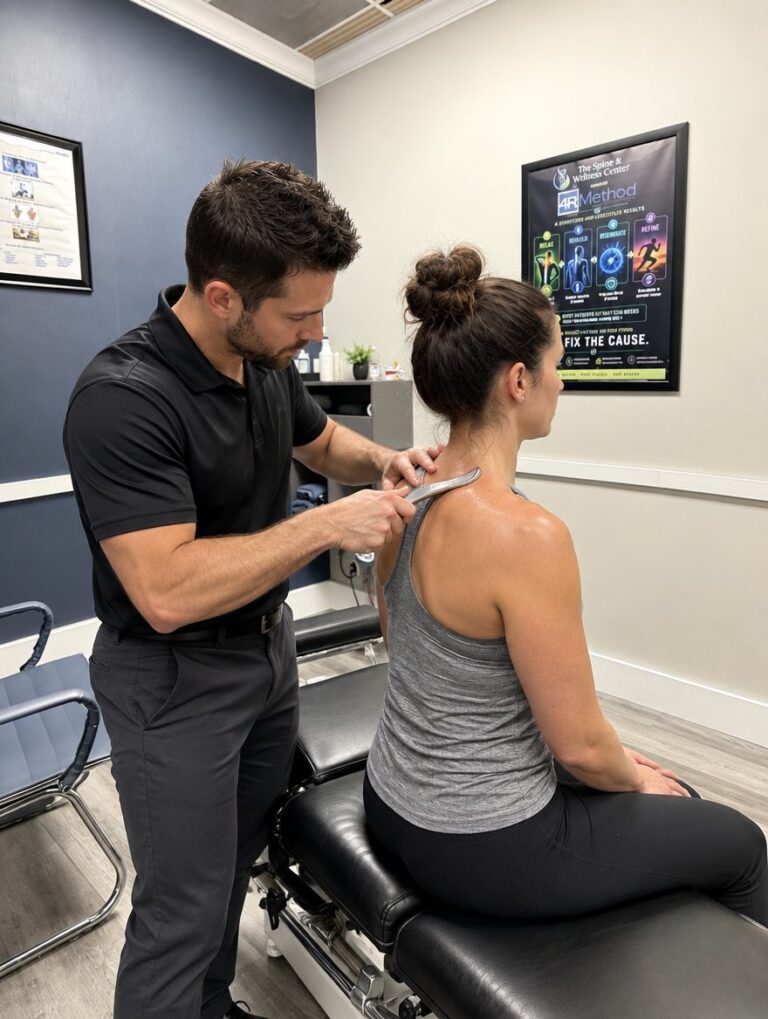
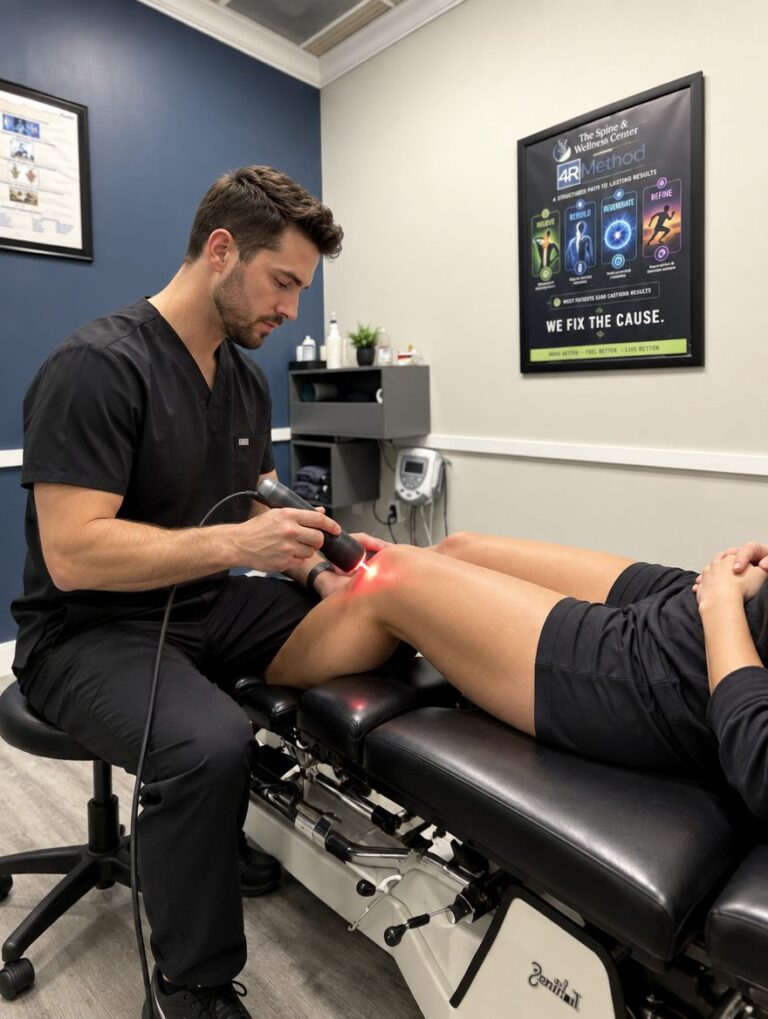
The Repair phase quiets the irritated tissue. For tennis elbow that means the Graston Technique along the extensor tendon, cold laser to settle inflammation, and acoustic shockwave for the chronic, stubborn cases. For the shoulder, back and hip it means precise chiropractic adjustments to the segments that have locked up, and non-surgical spinal decompression when a lumbar disc is involved. Ankle sprains get joint mobilization, laser and early protected loading. Most players notice a difference within two to three weeks.
R2 · Rebuild — restore rotation and load tolerance (2–3 visits a week, 8–16 weeks)
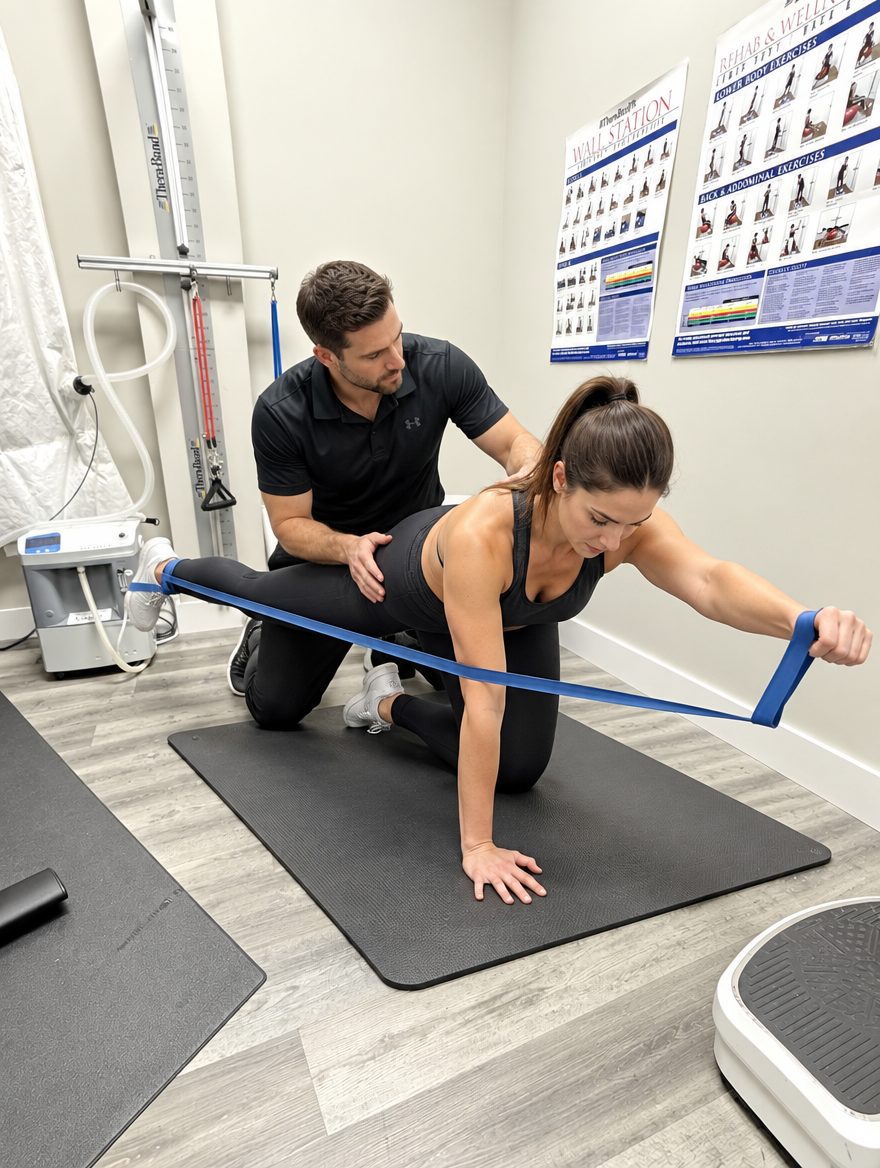
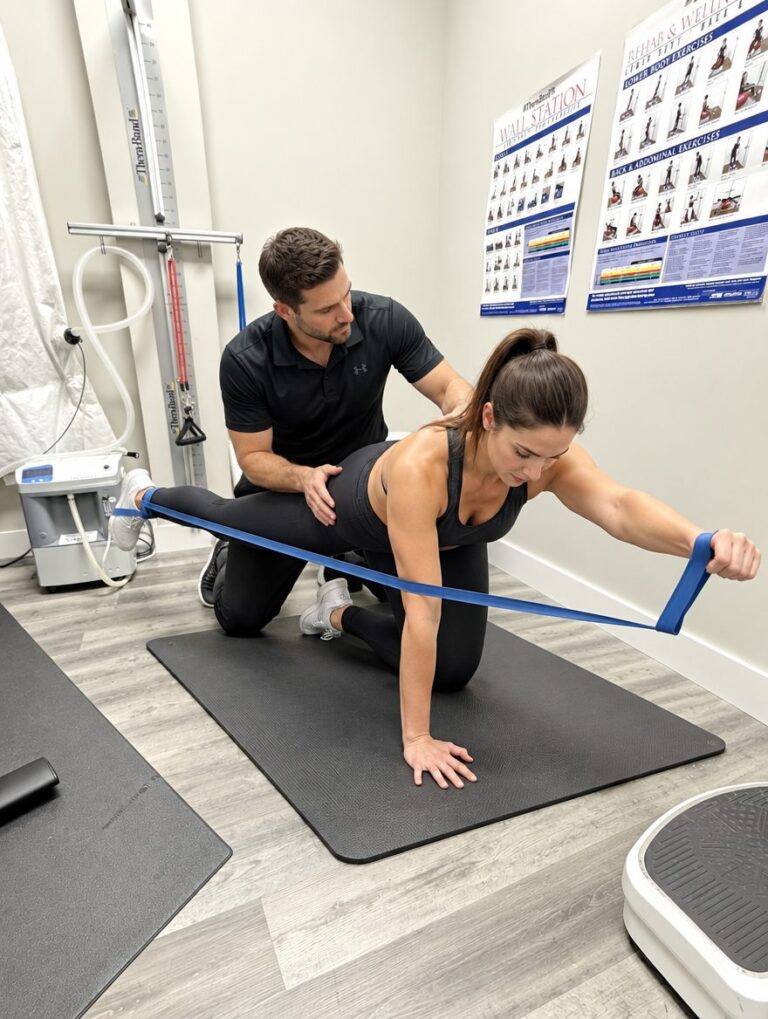
Once the tissue is quiet we correct what caused the injury. Physical therapy rebuilds shoulder-blade control and rotator cuff endurance for the serve, thoracic and hip rotation so the lumbar spine stops absorbing every forehand, and single-leg strength and balance for the knee and ankle. For the elbow, a graded forearm loading program reloads the tendon so it comes back sturdier than it was. This is the phase that decides whether the injury returns.
R3 and R4 · Regenerate and Refine
The Regenerate phase (about twice a week for two or more months) supports tissue quality and recovery between matches with red light, PEMF, massage therapy and cupping for the forearm, shoulder and calf. Refine is a brief structural tune-up every month or two through the season — a quick visit that catches a grumbling elbow or a stiff shoulder before it costs you a month.
Sports injury rehab
The staged progression we use for every injured player — calm, mobilize, stabilize, strengthen, return.
Learn moreTennis and golfer's elbow
Graston, cold laser and shockwave for the tendon, plus a loading program that holds up over a full match.
Learn moreShoulder pain treatment
Rotator cuff, impingement and shoulder-blade mechanics behind a serve that hurts.
Learn moreKnee pain treatment
Patellar tendon, tracking and meniscus patterns from split-steps and lunges on hard courts.
Learn moreWhen can you get back on the court?
You return to full matches when you meet objective criteria, not when a date arrives. For most overuse injuries we keep you playing in a modified way — shorter hitting sessions, no serving, doubles instead of singles — rather than stopping you altogether. Full return is staged:
- Pain-free daily movement. Gripping, lifting, sleeping and walking without the elbow, shoulder, back or ankle speaking up.
- Symmetry on re-test. Shoulder rotation and hip and thoracic rotation within roughly 10 percent side to side; a surface EMG re-scan showing the guarding has settled.
- Strength benchmarks. Pain-free resisted wrist extension and grip near the uninjured side for the elbow; a single-leg hop test within 90 percent of the other side for the knee and ankle.
- Graded stroke progression. Mini-tennis and volleys, then groundstrokes at 50–70 percent, then full groundstrokes, then serves — with 24 hours between steps to see how the tissue responds.
- Volume before intensity. A full practice before a full match, and a full match before back-to-back days or a weekend tournament.
If any step flares the injury, we back up one stage rather than push through. Good tennis injury treatment returns you a week later and confident rather than a week early and fragile.
How do we prevent re-injury and improve your game?
The best tennis injury treatment looks forward. Once you are moving well, the goal is to keep the elbow, shoulder, back and legs durable through a long season — and the same work that protects them usually adds pace, because power starts coming from the legs and trunk instead of the arm.
- Warm up before you hit. Five minutes of movement, shoulder circles, trunk rotations and mini-tennis beats serving cold.
- Check the equipment. Grip size, string tension, racket weight and court shoes quietly drive elbow, shoulder and ankle problems. We talk through all of them.
- Keep the hips and mid-back mobile so the shoulder and lumbar spine are not forced to make up the difference on the serve.
- Build shoulder-blade, forearm and single-leg strength off the court. Two short sessions a week is enough to change how your body absorbs a match.
- Manage volume. Spread hard sessions and matches through the week; a tournament weekend after a month off is how calves and elbows get hurt.
- Catch early aches. A grumbling elbow or a shoulder that aches the night after serving is the time to come in — a Refine-phase tune-up is far shorter than a full Repair phase.
Junior players and adult players: what changes?
Tennis injury treatment is scaled to age and stage, because a junior training five days a week and a league regular in their fifties load the body very differently.
Junior and high-school players. Young competitors in Coral Springs and Parkland are still growing, and their elbows, shoulders and backs are vulnerable when volume climbs faster than their bodies adapt. Growth-plate stress at the shoulder and spine is a real concern in heavy servers. We use gentle, age-appropriate techniques, keep parents involved, and coach volume and mechanics. Our high-school and college athlete programs build on the same assessment.
Adult league and club players. The heart of the tennis community here arrives with a mix of overuse and the wear of a busy life off the court. For them it is about staying in the game they schedule their week around — easing a nagging elbow or shoulder and shoring up the back and knees. Players returning after a layoff do well with a gradual, guided rebuild rather than coming back too hard and tweaking something in the first week.
When should a tennis injury see a doctor first?
A small number of injuries are not conservative-care problems. If you heard or felt a pop in the calf, Achilles or knee and cannot bear weight, the ankle is severely swollen or looks deformed, the shoulder dislocated or will not move, you have numbness in the groin or loss of bladder or bowel control, or chest pain or shortness of breath during a match, please see a doctor or urgent care today. We will be here for the recovery afterwards.
For everything else — the elbow that aches after every session, the serve that costs you a night of sleep, the low back that locks up after an open-stance forehand, the ankle you keep taping — this is what we do every day for players from Coral Springs and Parkland, and same-day appointments are usually available. If your pain is mainly in the low back, start with our lower back pain guide. We also treat pickleball and padel players, who share many of the same patterns.
Serving tennis players across North Broward
Our clinic at 5675 Coral Ridge Drive, Coral Springs, FL 33076 serves Coral Springs, Parkland, Coconut Creek, Margate, Boca Raton, Tamarac, Pompano Beach and Deerfield Beach. Same-day appointments are usually available — call (954) 341-2256 or book online. Most patients from Parkland and Coral Springs are here in under 15 minutes.
Medically reviewed by Dr. Jared Cohen, DC — Co-Founder & Clinical Director, The Spine and Wellness Center. Last reviewed October 2026.
Frequently asked questions
What are the most common tennis injuries you treat?
Tennis elbow (lateral epicondylitis) and wrist pain lead the list, followed by rotator cuff and impingement pain from the serve, low back and hip pain from rotation and extension, patellar tendon and knee tracking pain from footwork, and ankle sprains and calf strains from explosive push-offs. Many players have two or three at once because the body compensates.
Do I have to stop playing during tennis injury treatment?
Usually not. For most overuse injuries we modify your play — shorter hitting sessions, no serving for a period, doubles instead of singles — and progress you back through a graded stroke protocol. A short period of relative rest is sometimes needed for an acutely irritated tendon, sprain or disc, and we tell you honestly when that is the case.
Can a chiropractor treat tennis elbow?
Yes, as part of a plan. Tennis elbow is a tendon problem, so we pair Graston Technique with cold laser or shockwave and a graded forearm loading program, and we correct the shoulder, wrist and grip mechanics that keep re-aggravating it. Treating only the elbow rarely holds.
How long does tennis injury treatment take?
It depends on the tissue. A fresh calf strain or a mild ankle sprain often settles in three to four weeks; a chronic tennis elbow, a rotator cuff strain or a disc-related back injury typically needs the full Repair and Rebuild phases, roughly 12–20 weeks to a confident full-match return. We give you a realistic range at your report of findings.
Why does my shoulder hurt only when I serve?
The serve is the only stroke that takes the shoulder into extreme external rotation and then accelerates it forward under load. If the shoulder blade is not controlling that motion, or the mid-back and hips are not contributing rotation, the rotator cuff absorbs the difference. Our movement screen finds which of those is the driver.
Do you treat tennis players from Parkland and Boca Raton?
Yes. Our clinic on Coral Ridge Drive in Coral Springs is minutes from Parkland, Coconut Creek, Margate, Tamarac and Boca Raton, and we see league, junior and club players from courts across North Broward. Same-day appointments are usually available.
Same-day appointments
Let's build your plan.
Find out what's actually going on and get a clear path forward. Same-day appointments available.
- Same-day appointments are usually available
- Our team calls you back to confirm your visit
- Coral Springs, serving Parkland & North Broward since 2005
Prefer to talk now? Call or text (954) 341-2256