
Conditions · Coral Springs & Parkland
Prenatal chiropractic care in Coral Springs & Parkland
A shifting center of gravity, loosening ligaments, a lower back curve that deepens week by week — pregnancy asks a lot of the spine and pelvis. Gentle, pregnancy-safe care keeps you comfortable through every trimester, without medication.
Quick answer
Prenatal chiropractic care uses gentle, low-force techniques and pregnancy-safe positioning to ease the back, hip, pelvic and sciatic pain that comes with a changing body. At our Coral Springs clinic that includes Webster-technique pelvic balancing, soft-tissue work, supportive stretching and cold laser — adapted to each trimester and coordinated with your OB or midwife.
Why pregnancy makes the back and pelvis hurt
Prenatal chiropractic care exists because pregnancy changes the mechanics of the spine and pelvis in three predictable ways. First, the hormone relaxin softens the ligaments that normally hold the pelvis steady, so the sacroiliac (SI) joints and the pubic symphysis move more than they are used to. Second, a growing belly pulls the center of gravity forward and deepens the curve of the lower back. Third, the muscles of the core and pelvic floor stretch and lose some of their ability to stabilize.
The result is familiar to most expecting moms in Coral Springs and Parkland: a deep ache across the low back and hips, one-sided pelvic pain that flares rolling over in bed or climbing stairs, sciatica-like pain down a leg, round ligament pulls in the groin, and upper back and neck strain as posture adapts. The Cleveland Clinic notes that back pain affects a majority of pregnancies, most often in the second and third trimesters (Cleveland Clinic, Back Pain During Pregnancy).
None of this is a problem to be ‘fixed’ — it is a healthy body doing remarkable work. The goal of care is to help the pelvis and spine adapt to that work smoothly, so the strain does not settle into one aching joint.

Low back, SI joint, sciatica or round ligament? Telling pregnancy aches apart
Where it hurts and what triggers it points to the structure, and that decides where we focus:
- Lumbar back pain: a broad ache across the low back, worse after standing or sitting long, eased by changing position — the deepening lumbar curve and tired back muscles.
- Sacroiliac (SI) joint pain: one-sided pain just off-center at the dimple above the buttock, sharp when rolling over in bed, standing on one leg, getting out of the car or climbing stairs — the most common pelvic girdle pattern.
- Pubic symphysis pain: pain at the front of the pelvis, worse walking, parting the legs or turning in bed; sometimes a clicking feel.
- Pregnancy ‘sciatica’: pain, tingling or numbness down the back of one leg. In pregnancy it is more often the piriformis muscle or an SI joint irritating the nerve than a disc.
- Round ligament pain: a brief, sharp pull low in the belly or groin with sudden movement, coughing or standing up — ligaments stretching as the uterus grows.
Good to know
Pelvic girdle pain is not something to simply ‘wait out’ until delivery. It responds well to gentle pelvic balancing, and keeping the SI joints moving evenly in the third trimester tends to make the final weeks much easier to move through.
Is prenatal chiropractic care safe?
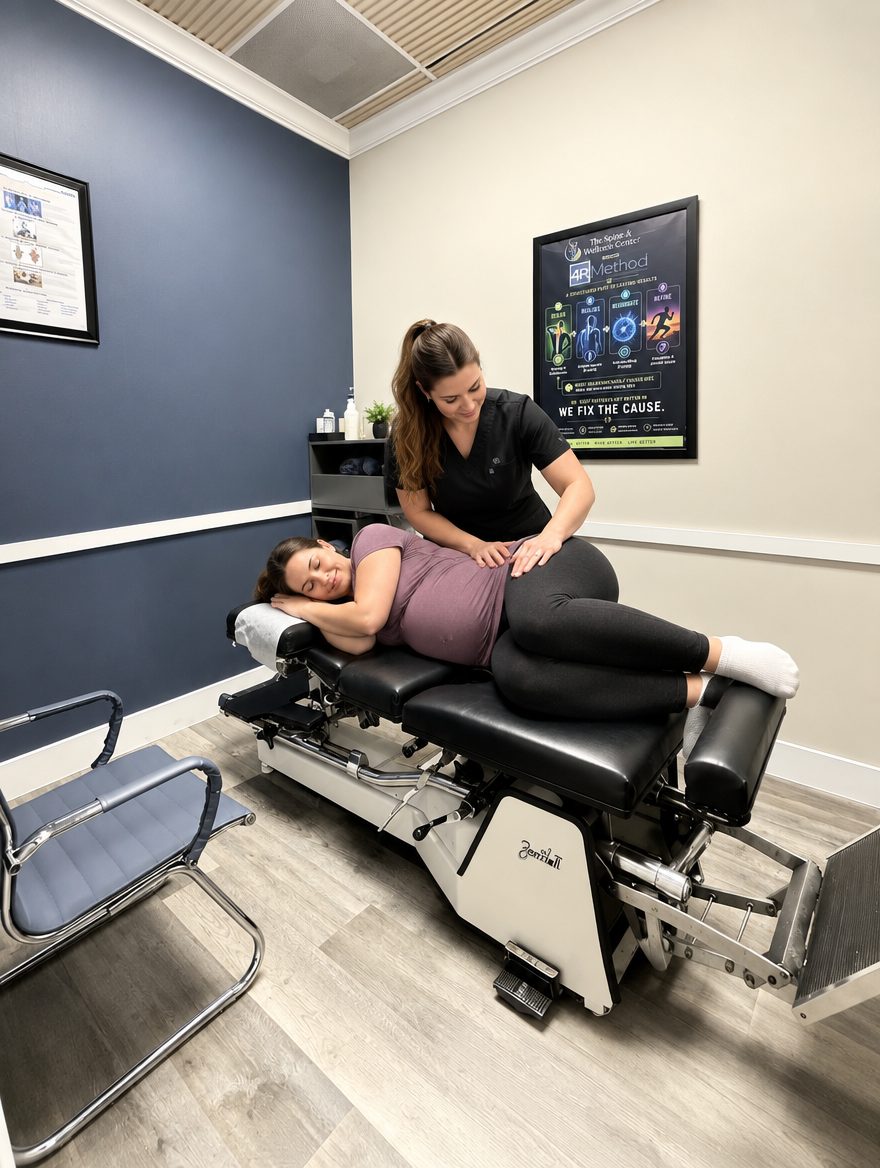
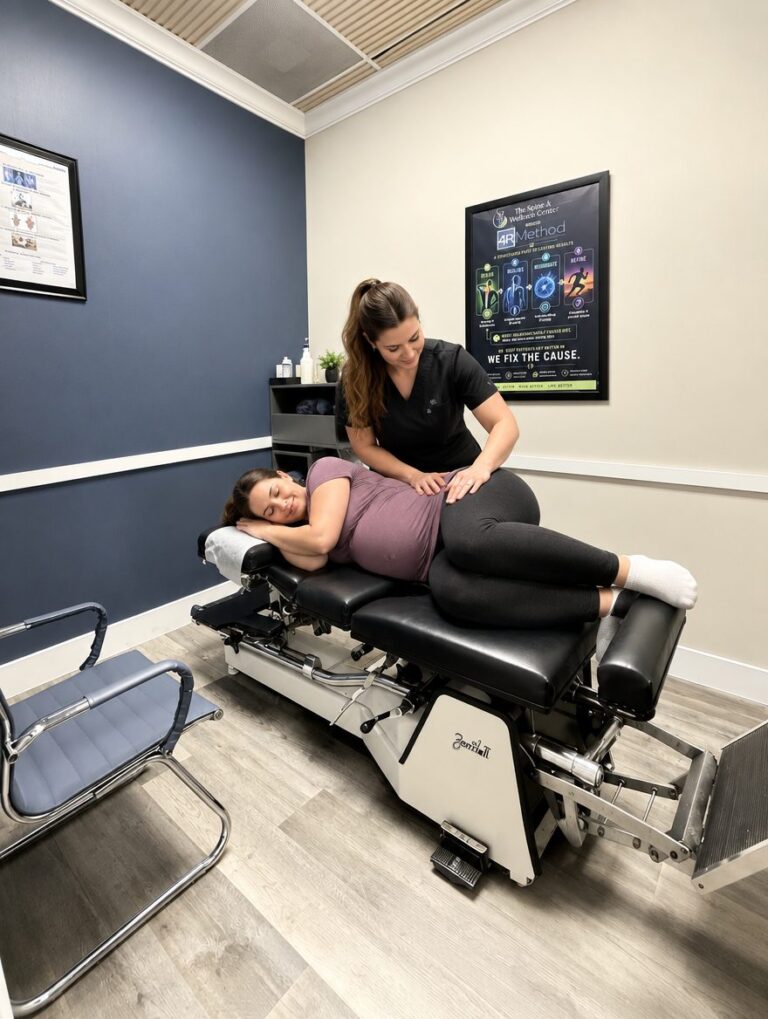
For most pregnancies, yes — and safety is what every visit is built around. Prenatal chiropractic care relies on gentle, low-force techniques, not the deep twisting maneuvers people sometimes picture. Pregnancy pillows and tables with a drop-away belly section mean there is never pressure on the abdomen, and the amount of force is matched to your trimester and how you feel that day.
- Low-force only. Light, specific contacts and gentle mobilization; instrument-assisted techniques where appropriate.
- Pregnancy-safe positioning. Side-lying, supported seated and belly-supported tables; no lying flat on the back for long in later trimesters.
- No X-rays during pregnancy. The structural exam, surface scanning and your history guide the plan instead.
- Coordinated care. If your pregnancy is high-risk, or you have placenta previa, vaginal bleeding, pre-eclampsia or other complications, we coordinate with your OB or midwife first and may defer care.
Because the care is drug-free, it fits alongside everything else in your prenatal routine and gives you a way to ease discomfort without reaching for medication you would rather avoid. It never replaces your prenatal medical appointments — it complements them.
How prenatal chiropractic care works at TSAWC
Our prenatal chiropractic care follows the 4R Method — Repair, Rebuild, Regenerate, Refine — with the pace and techniques adapted to pregnancy. Dr. Yael Porat provides much of the prenatal care in our Coral Springs office, and every plan is shaped around your trimester, your comfort and your delivery goals.
R1 · Repair — ease the aching joint
The Repair phase relieves the structure that hurts. Gentle, specific adjustments restore motion to a locked SI joint or stiff lumbar segment; Webster-technique pelvic balancing — a specific, gentle protocol that evens the alignment of the pelvis and releases tension in the round and sacrotuberous ligaments that support the uterus — addresses one-sided pelvic pain; soft-tissue work eases tight glutes, hips and the piriformis; and cold laser therapy calms inflamed muscle and ligament without heat or medication. Early visits are typically 1–2 a week for a few weeks, adjusted to how you respond.
R2 · Rebuild — support the changing body
Once the pain is quieter, we build the support that keeps it that way: prenatal-safe stretching and stability exercises for the hips, glutes and deep core, posture coaching for the upper back and neck strain that comes with a changing shape, and simple home routines for the hours between visits.
R3 and R4 · Regenerate and Refine
Through the third trimester, Refine means a steady, gentle rhythm — often weekly or every two weeks — keeping the pelvis balanced and the lower back mobile as delivery approaches. Prenatal massage therapy pairs naturally with adjustments here. After birth, many moms continue with gentle postpartum care as the pelvis settles, and bring the baby in for a gentle check when they are ready — see our pediatric and prenatal chiropractic page.
Gentle prenatal adjustments
Low-force corrections that relieve back, hip, pelvic and sciatic pain safely in every trimester.
Learn morePrenatal massage therapy
Side-lying, belly-supported massage that eases tight hips, glutes and the lower back.
Learn moreCold laser therapy
Calms inflamed muscle and ligament without heat, needles or medication.
Learn morePregnancy-safe stretching and stability
Simple exercises that build the support your pelvis needs for the third trimester and delivery.
Learn more5 proven ways prenatal chiropractic care eases pregnancy pain
These are the five things gentle prenatal care does for a pregnant body, and what each one helps with:
- Balances the pelvis. Webster-technique pelvic balancing evens the SI joints and releases the ligaments that support the uterus — the core of care for one-sided pelvic pain and a comfortable third trimester.
- Restores lumbar motion. Gentle adjustments keep the lower back moving as its curve deepens, easing the broad ache that comes with standing and sitting.
- Relaxes the hips and piriformis. Soft-tissue work on the glutes and deep hip rotators takes pressure off the sciatic nerve — the usual cause of pregnancy ‘sciatica.’
- Supports posture. Upper back and neck care, plus coaching for sleeping, sitting and lifting, prevents the strain a changing center of gravity puts on the shoulders and neck.
- Builds stability. Pregnancy-safe stretching and gentle strengthening give the pelvis and core the support they need for the final weeks and for delivery.
What we do not claim: that chiropractic care shortens labor, turns a breech baby or prevents complications. Pelvic balancing creates even alignment and relaxed ligaments; your OB or midwife manages everything about delivery.

What to expect at your first two prenatal visits
We measure before we treat — gently, and with your pregnancy at the center of every decision.
Visit one — we measure (and usually begin care)
- A real conversation. How far along you are, your due date, where you feel discomfort, how you are sleeping and moving, any complications or concerns, and anything your OB or midwife has shared.
- A gentle, pregnancy-safe structural exam. Posture, pelvic balance and SI joint motion, lumbar and hip range of motion, leg-length and piriformis checks, and a screen for nerve involvement — all in supported, comfortable positions.
- Surface scanning: sEMG + thermal. Surface EMG shows where the muscles along your spine are guarding; thermal scanning maps irritation. Both are touch-free, painless and pregnancy-safe.
- No X-rays. Imaging is not used during pregnancy; the exam and your history guide the plan.
Visit two — your findings and your plan
Your findings explained plainly, with a plan matched to your trimester — how often to come in, what we will do, and what you can do at home. Treatment begins at this visit, gently. For a head start, take the 60-second spine assessment before you come in.
Prenatal chiropractic care trimester by trimester
First trimester
Care is about comfort and a good foundation: easing early back or hip tension, supporting posture, and helping the body adapt as the first changes begin. Starting early gives the pelvis a head start, though it is never too late to begin.
Second trimester
As the belly grows and the center of gravity moves forward, the focus shifts to keeping the pelvis balanced and the lower back mobile. This is usually when pelvic balancing becomes a regular part of care, along with simple home stretches for the hips.
Third trimester
The final stretch is about staying comfortable and keeping the pelvis open and balanced as delivery approaches. Many expecting moms continue gentle care right up to their due date, and we adjust how often you come in to how your body feels week to week.
- Sleep on your side with a pillow between the knees and one under the belly.
- Sit tall with support behind the low back; stand and walk every 30–45 minutes.
- Roll, don’t twist getting out of bed — knees together, roll to the side, push up with the arms.
When pregnancy pain needs your OB instead
Some symptoms are not musculoskeletal and need your OB, midwife or urgent care the same day: vaginal bleeding, fluid leakage, regular contractions or cramping, severe or sudden abdominal pain, fever, a severe headache with vision changes or swelling, or decreased fetal movement. If any of these apply, please contact your OB or see a doctor or urgent care today.
For the familiar aches — the low back that tires by evening, the hip that catches rolling over, the sciatica, the pelvic pressure of the last trimester — this is what we do for expecting moms across Coral Springs and Parkland. If your pain is centered in the hip and SI joint, our hip and SI joint guide explains the mechanics in more depth.
Serving expecting moms across North Broward
Our clinic at 5675 Coral Ridge Drive, Coral Springs, FL 33076 serves Coral Springs, Parkland, Coconut Creek, Margate, Boca Raton, Tamarac, Pompano Beach and Deerfield Beach. Same-day appointments are usually available — call (954) 341-2256 or book online. Most patients from Parkland and Coral Springs are here in under 15 minutes.
Medically reviewed by Dr. Jared Cohen, DC — Co-Founder & Clinical Director, The Spine and Wellness Center. Last reviewed October 2026.
Frequently asked questions
Is chiropractic care safe during pregnancy?
For most pregnancies, yes. Prenatal chiropractic care uses gentle, low-force techniques, pregnancy pillows and belly-supported tables so there is never pressure on the abdomen, and no X-rays are taken. If your pregnancy is high-risk or has complications, we coordinate with your OB or midwife before beginning.
What is the Webster technique?
The Webster technique is a specific, gentle chiropractic protocol that balances the pelvis and releases tension in the round and sacrotuberous ligaments that support the uterus. It is widely used in prenatal care for one-sided pelvic and SI joint pain and for keeping the pelvis balanced through the third trimester.
Can a chiropractor help with pregnancy sciatica?
Usually, yes. In pregnancy, leg pain most often comes from a tight piriformis or an irritated SI joint pressing on the sciatic nerve rather than a disc. Gentle pelvic balancing, soft-tissue work on the hips and simple stretches typically ease it without medication.
When should I start prenatal chiropractic care?
You can begin at any point — first trimester, third trimester or anywhere between. Starting early helps the pelvis adapt as your posture and balance change, but it is never too late to find relief and prepare the pelvis for delivery.
How often will I need to come in during pregnancy?
It depends on your symptoms and trimester. Many expecting moms come in once or twice a week while pain is active, then settle into a gentle rhythm of every one to two weeks through the third trimester. We adjust the schedule to how your body feels week to week.
Do you see expecting moms from Parkland and Coconut Creek?
Yes. Our clinic on Coral Ridge Drive in Coral Springs is minutes from Parkland, Coconut Creek, Margate and Boca Raton, and same-day appointments are usually available.
Keep reading
From the blog
Same-day appointments
Let's build your plan.
Find out what's actually going on and get a clear path forward. Same-day appointments available.
- Same-day appointments are usually available
- Our team calls you back to confirm your visit
- Coral Springs, serving Parkland & North Broward since 2005
Prefer to talk now? Call or text (954) 341-2256