
Athletes · Coral Springs & Parkland
Wrestling injury treatment in Coral Springs & Parkland
Wrestling asks the neck, shoulders, knees and low back to do things no other sport does. When a strained neck, a jammed shoulder, an aching knee or a stiff back is keeping a wrestler off the mat, we treat the cause — drug-free.
Quick answer
Effective wrestling injury treatment screens the neck for anything serious first, then calms the strained tissue, restores motion in the cervical spine, shoulders, hips and knees, and rebuilds the strength and mobility the mat demands. We combine chiropractic care, Graston, cold laser and progressive sports rehab inside the 4R Method and stage the return to live wrestling.
Why wrestling loads the body like no other sport
Good wrestling injury treatment starts with respect for what the sport asks. Shots, sprawls, takedowns and scrambles combine explosive effort with awkward, twisting positions, and the neck bears loads most athletes never experience — bridging out of a pin, driving into a tie-up, absorbing a hard landing. Add a long season of daily live wrestling, drilling and conditioning, and the same joints take that stress week after week.
Over time it shows up as a neck that will not turn, a shoulder that catches, a knee that swells after mat work, or a low back that is tight every morning. In Coral Springs and Parkland we see wrestlers from youth club programs through competitive high school teams, and most arrive with a mix of one acute injury and several months of accumulated mat stress.
Our job is to sort out what is happening, make sure nothing dangerous is being missed, and then rebuild the wrestler’s mobility, strength and recovery so they can compete with confidence.

Neck, shoulder, knee or low back? Common wrestling injuries and how they feel
Most of what we treat falls into four regions. Each has a clear mechanism on the mat and a conservative path back once serious injury has been ruled out:
- Neck and cervical strain. No joint takes more in wrestling than the neck. Bridging, snap-downs in a tie-up and awkward takedown landings load the cervical spine in ways it rarely sees elsewhere. Most of what we treat is muscular strain, stiffness and facet joint irritation — the neck that will not rotate fully or aches after a hard practice. See our neck pain page.
- Shoulder and AC joint. Constant pulling, posting and levering, and positions like a defended arm or a whizzer, push the joint to its limit. Wrestlers describe a shoulder that catches, feels loose or aches with overhead reach — rotator cuff irritation, AC joint sprain or labral stress. See shoulder pain treatment.
- Knee. Shots, sprawls and scrambling on the mat load the knee in deep flexion and rotation: MCL and meniscus-region sprains, patellar tendinitis and post-practice swelling. Any locking, giving way or rapid swelling is referred for imaging first — see knee pain treatment.
- Low back and hips. Live wrestling is constant flexion, rotation and lifting. A low back that is tight every morning, hip flexors that never loosen, and the occasional disc flare in an older wrestler — see lower back pain relief.
Skin, ear and hand injuries are part of the sport too, but they belong with the athletic trainer and the physician; we stay in our lane with the musculoskeletal side.
Good to know
A 10-year analysis of national youth wrestling injury data found the shoulder (14.6%), head (13.8%) and knee (10.2%) were the most injured body parts (Orthopaedic Journal of Sports Medicine, 2024, via NCBI). That is why a careful head-and-neck screen opens every wrestling evaluation here.
How we approach wrestling injury treatment at TSAWC
Our wrestling injury treatment follows the 4R Method: Repair, Rebuild, Regenerate, Refine. Calming a sore neck and sending a wrestler straight back to live goes is how a two-week strain becomes a season-long one. We settle the tissue first, correct the mechanics second, and protect the gains across the season.
R1 · Repair — screen, calm and restore motion
The Repair phase begins with a red-flag screen of the neck and nerve function. When it is safe to proceed, gentle chiropractic adjustments restore motion in the cervical and thoracic spine, shoulder girdle, hips and knees; cold laser therapy calms irritated tissue; and light soft-tissue work settles the muscle guarding. Typical commitment is 3–5 visits a week for 2–4 weeks in an acute injury, 4–8 weeks when the problem has been building all season.
R2 · Rebuild — strength the mat can trust
Rebuild is the sports rehab phase: deep neck flexor and upper-back strength so the neck is protected in a bridge, rotator cuff and scapular stability so the shoulder holds under a lever, hip mobility for deeper shots, and the core, hip and leg strength that protects the low back in every position. Graston Technique clears the fibrous tissue in the neck, traps and hip flexors. Usually 2–3 visits a week for 6–12 weeks.
R3 and R4 · Regenerate and Refine
Regenerate is recovery between hard sessions — red light, PEMF and massage therapy for a body that is drilled and conditioned daily. Refine is maintenance: a brief tune-up every month or two across the season, and a pre-season movement screen.
Sports injury rehab
Neck, shoulder, hip and knee strength staged back to live wrestling.
Learn moreChiropractic care
Restore cervical, thoracic, hip and shoulder motion after bridging, tie-ups and hard landings.
Learn moreGraston Technique
Instrument-assisted soft-tissue work for the traps, neck, cuff and hip flexors.
Learn moreSpinal decompression
Gentle, computer-controlled traction for disc-related neck and back pain in older wrestlers.
Learn more6 proven treatments for wrestling injuries (and when each one fits)
No single tool covers wrestling injury treatment on its own. These are the six we use most, matched to what they work best on:
- Chiropractic adjustments. Best for the stiff, guarded neck after bridging, a locked thoracic spine and hips that will not open for a shot. Gentle, low-force techniques for the cervical spine.
- Sports rehab and physical therapy. Best for every injury on this page; see physical therapy. Neck strengthening in particular is the single best protection a wrestler has.
- Graston Technique and cupping. Best for the dense, fibrous tissue in the traps, neck and hip flexors after a long season; cupping helps during heavy tournament stretches.
- Cold laser therapy. Best in the first days and weeks after a sprain or strain — drug-free inflammation control.
- Non-surgical spinal decompression. Best for disc-related neck or low back pain with arm or leg symptoms in older wrestlers, on the Triton DTS table.
- Myovision sEMG scanning. Best for recurring neck and back pain: a surface EMG scan shows where the muscles along the spine are guarding and whether the pattern is improving.
Mobility, recovery and weight-class season: the performance side
Wrestling injury treatment is not only about fixing what hurts — it is about helping a wrestler move well and recover so they perform. Good hip, shoulder and spine mobility supports deeper shots, quicker sprawls and stronger bridges, and the joints that move freely are the ones least likely to get hurt. We assess where a wrestler is stiff, open those areas with hands-on care, and pair it with mobility and strength work they can carry into practice.
Recovery matters as much. A long season of daily live wrestling and conditioning is hard on the body, and structured recovery care — easing muscle tightness, restoring motion and calming overworked joints — helps a wrestler show up fresher for the next session or match.
Many wrestlers manage a weight class, and a hard training and competition week can leave the body stiff, fatigued and beaten up. We support that musculoskeletal recovery. To be clear about our lane: we do not provide diet, weight-cutting or dehydration advice. Nutrition and safe weight management belong with the wrestler’s physician and coaching staff, following league and state guidelines.
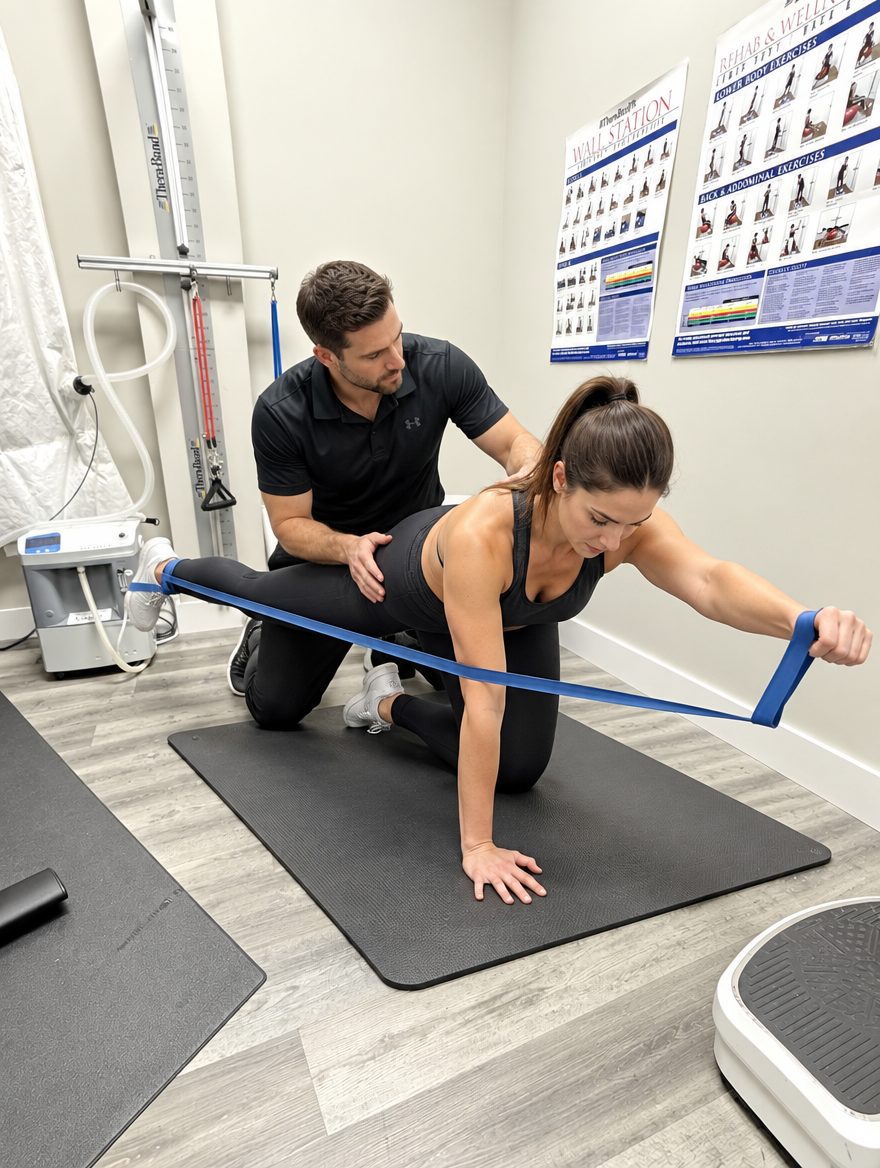
In-season maintenance for wrestlers runs through our high school athlete program and the wider athletic performance program.
What to expect at the first two visits
We measure before we treat, and with wrestlers the first measurement is always the neck.
Visit one — we measure (and usually begin care)
- A real conversation. How the injury happened, weight class and level, weekly mat time, what the wrestler can and cannot do, and the next competition date.
- A hands-on structural exam. A red-flag screen of the cervical spine and nerve function first; then neck, shoulder, hip and knee range of motion, ligament and rotator cuff tests, and a look at how the wrestler squats, shoots and bridges.
- Surface scanning: sEMG + thermal. A painless scan along the spine that shows where the paraspinal muscles are guarding — especially useful for the neck and low back patterns wrestling produces.
- Digital X-rays when indicated. Particularly for the neck after a hard landing, or to rule out a growth-plate or stress injury. We refer for MRI and an orthopedic opinion when the exam calls for it.
Visit two — findings and plan
Findings explained in plain language to the wrestler and the parents, mapped to the four phases of the 4R Method with timelines against the season. Treatment begins at this visit. The 60-second spine assessment gives us a head start on neck and back patterns before you arrive.
Home care, and when an acute neck or head injury needs a doctor first
Between visits, a few habits speed wrestling injury treatment along or stall it:
- Neck strength every week. Isometric holds and controlled bridging progressions, coached in the clinic, are the best protection a wrestler has.
- Do not force a stiff neck. Gentle range-of-motion within comfort; no cranking or self-manipulation.
- Ice a fresh knee or shoulder sprain for the first 48 hours, then move it gently.
- Protect sleep and recovery days during the heaviest part of the season.
- Work with your coach and physician on weight management; we handle the musculoskeletal recovery.
We take neck and head injuries seriously. A hard slam, an awkward landing or a failed bridge can, in rare cases, cause a serious cervical injury, and a blow to the head can cause a concussion. Severe neck pain, numbness or tingling, weakness in the arms or legs, an inability to move the neck, or any head injury with headache, dizziness, confusion, nausea, memory trouble or loss of consciousness means the wrestler should stop immediately, be kept still, and please see a doctor or urgent care today. We do not diagnose, clear or manage acute cervical trauma or concussions.
Once a physician has ruled out serious injury, we help with the strained, stiff neck and the muscle guarding that so often linger afterward.
Serving youth and high school wrestlers across North Broward
Our clinic at 5675 Coral Ridge Drive, Coral Springs, FL 33076 serves Coral Springs, Parkland, Coconut Creek, Margate, Boca Raton, Tamarac, Pompano Beach and Deerfield Beach. Same-day appointments are usually available — call (954) 341-2256 or book online. Most patients from Parkland and Coral Springs are here in under 15 minutes.
Medically reviewed by Dr. Jared Cohen, DC — Co-Founder & Clinical Director, The Spine and Wellness Center. Last reviewed October 2026.
Frequently asked questions
Can a chiropractor treat a wrestler's neck strain?
Yes, once serious injury has been ruled out. We screen the cervical spine and nerve function first, then use gentle, low-force techniques, soft-tissue work and laser to settle the strain, followed by deep neck flexor and upper-back strengthening so the neck is protected in a bridge or tie-up.
How long does wrestling injury treatment take?
An acute strain or sprain usually settles in two to four weeks of Repair-phase care, with another six to twelve weeks of Rebuild to restore strength before unrestricted live wrestling. Chronic, season-long problems take longer. We stage the return and re-check at each step.
Do you help with weight cutting?
No. We do not provide diet, weight-cutting or dehydration advice; that belongs with the wrestler's physician and coaching staff under league and state rules. What we do is help the body recover from the stiffness, soreness and fatigue a hard competition week leaves behind.
My son's shoulder catches and feels loose. Is that serious?
It can be a rotator cuff or AC joint irritation that responds well to conservative care, or a labral or instability problem that needs imaging. The exam on the first visit sorts that out, and we refer for an orthopedic opinion whenever the pattern suggests more than soft-tissue strain.
Is this safe for a 12-year-old club wrestler?
Yes. Techniques are scaled to a growing body — gentle adjustments, soft-tissue work and rehab appropriate to age and growth stage — and we screen for growth-plate involvement first, referring for imaging or a physician's opinion whenever a stress injury is possible.
Do you see wrestlers from Parkland and Coconut Creek?
Yes. Our Coral Springs clinic on Coral Ridge Drive is minutes from Parkland, Coconut Creek, Margate and Boca Raton, and we see youth club and high school wrestlers from across North Broward. Same-day appointments are usually available during the season.
Same-day appointments
Let's build your plan.
Find out what's actually going on and get a clear path forward. Same-day appointments available.
- Same-day appointments are usually available
- Our team calls you back to confirm your visit
- Coral Springs, serving Parkland & North Broward since 2005
Prefer to talk now? Call or text (954) 341-2256