
Advanced therapies · Coral Springs & Parkland
Electrical muscle stimulation therapy in Coral Springs
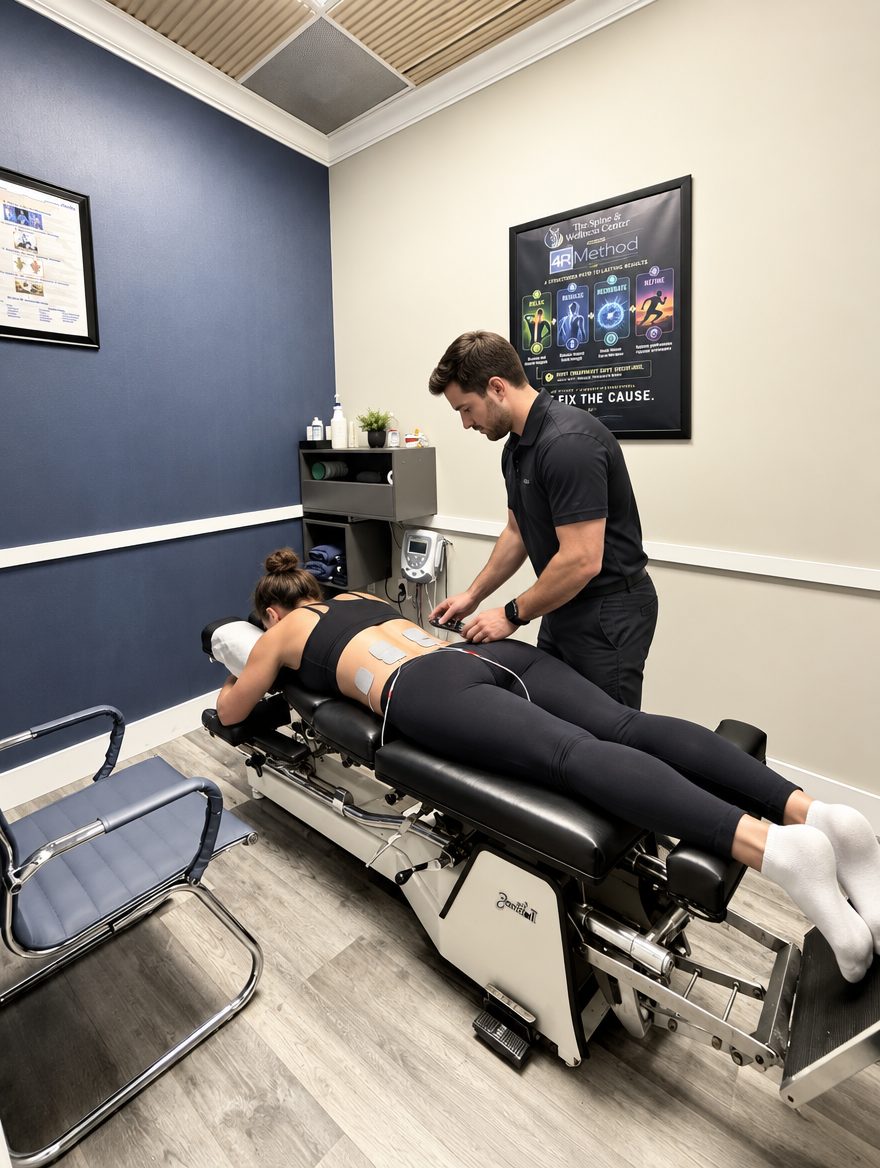
Gentle electrical pulses that make a guarded muscle let go and a shut-down muscle switch back on. Usually the first ten minutes of a Repair-phase visit, right before your adjustment.
Quick answer
Electrical muscle stimulation (EMS) uses small adhesive electrodes to send low-level electrical pulses into a muscle, causing it to contract and relax rhythmically. It relieves spasm, reduces pain, improves circulation and re-educates muscles that have switched off after injury. A session takes 10–15 minutes, feels like a firm tingling or tapping, and is typically done just before a chiropractic adjustment.
What is electrical muscle stimulation and how does it work?
Electrical muscle stimulation (EMS), also called neuromuscular electrical stimulation or simply e-stim, delivers controlled electrical pulses through electrode pads placed on the skin over a muscle. The pulses mimic the signal a nerve would normally send, so the muscle contracts and then relaxes in a steady rhythm set by the machine.
That rhythmic contraction does several useful things at once. It pumps blood and fluid through the muscle, which clears the waste products that build up in a muscle locked in spasm. It fatigues the overactive fibers so the spasm releases. It also gives a muscle that has gone quiet after injury a clear, repeated signal to fire again, which is the basis of muscle re-education.
At the same time the pulses stimulate the sensory nerves in the area, which closes the ‘gate’ on pain signals travelling to the brain and encourages the release of the body’s own pain-relieving chemicals. That is why most people feel noticeably looser and more comfortable at the end of a 10-minute session.
EMS vs. TENS — what is the difference?
- Electrical muscle stimulation (EMS / NMES): targets the motor nerves so the muscle actually contracts. Used for spasm, weakness, re-education and circulation.
- TENS (transcutaneous electrical nerve stimulation): targets the sensory nerves only, at a level that does not contract muscle. Used purely for pain relief, often with a home unit. The Cleveland Clinic has a clear overview of how TENS works (Cleveland Clinic, TENS).
- Interferential current (IFC): two medium-frequency currents that cross in the tissue to reach deeper muscles with less skin discomfort. The setting we use most for low back and hip spasm.
- In the clinic we choose the setting for the job: muscle-contracting EMS for spasm and re-education, sensory-level stimulation when pain relief alone is the goal.

Who benefits from electrical muscle stimulation?
Electrical muscle stimulation helps whenever a muscle is doing the wrong thing — locked in spasm, guarding a painful joint, or switched off and weak. The people we use it for most in Coral Springs and Parkland are:
- People with acute lower back or neck spasm — the ‘my back went out’ or ‘I can’t turn my head’ episode, where guarding is so strong an adjustment would be uncomfortable without releasing it first. See our guides to lower back pain relief and neck pain relief.
- Disc and sciatica patients whose paraspinal muscles clamp down around the irritated segment, used before spinal decompression.
- Car accident and whiplash patients with widespread neck and upper-back guarding in the first weeks.
- Post-injury and post-surgical patients whose quadriceps, glutes or deep core muscles have shut down and need re-education before strengthening works.
- Athletes recovering from strains in our sports injury rehab programs, where EMS keeps a resting muscle active without loading the injury.
- Desk workers with chronic upper trapezius and shoulder tension, often combined with massage therapy.
Good to know
EMS relaxes the muscle; it does not fix the reason the muscle was guarding. A muscle in spasm is usually protecting a joint that is not moving or a disc that is irritated, which is why we follow it with a chiropractic adjustment or decompression in the same visit.
What does an electrical muscle stimulation session feel like?
An EMS session is one of the most relaxing parts of a visit, and it usually comes first.
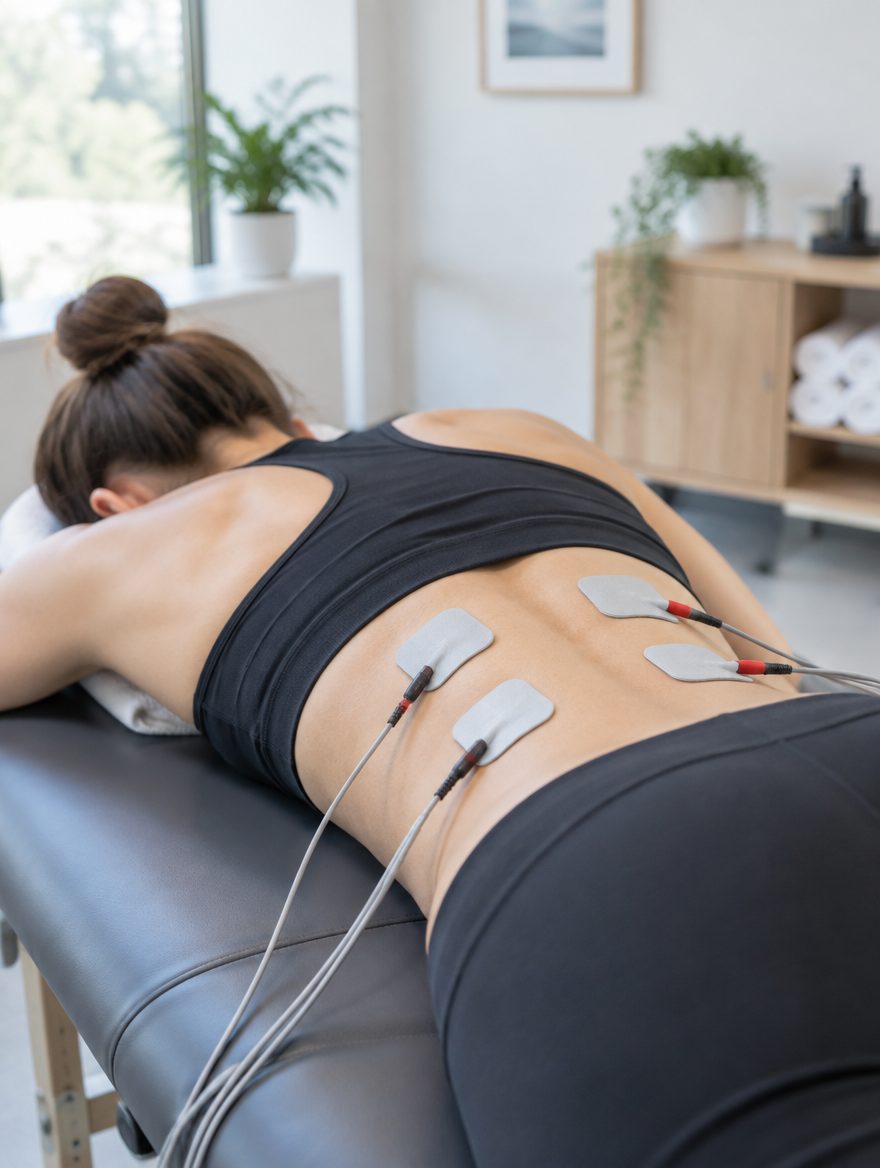
- Pad placement. Two or four adhesive electrodes are placed on the skin around the tight or weak muscle — for example, either side of the lumbar spine or along the upper trapezius.
- Ramp up. The intensity starts at zero and rises slowly until you feel a strong but comfortable tingling, tapping or pulsing. For muscle re-education it is raised until you see and feel the muscle contract.
- Ten to fifteen minutes. You lie still, often with heat or ice over the pads, while the current cycles. Most people describe it as a deep, buzzing massage.
- Adjustment or decompression. With the muscle released, you move straight to the treatment table.
It should never be painful or produce a sharp, pinching sensation; if it does, the intensity is lowered or the pads repositioned. There is no downtime. Occasionally skin under a pad is slightly pink for a few minutes afterward.
Where does electrical muscle stimulation fit in the 4R Method?
Every plan at The Spine and Wellness Center follows the 4R Method — Repair, Rebuild, Regenerate, Refine. EMS is used most heavily in Repair and shifts its job in Rebuild.
R1 · Repair — release the guarding
In the Repair phase (3–5 visits a week for 4–8 weeks) EMS at a spasm-relief setting often opens each visit, paired with heat and sometimes therapeutic ultrasound, so the adjustment or decompression that follows is comfortable and effective. The frequency tapers as the spasm resolves, typically within the first two to three weeks.
R2 · Rebuild — re-educate the weak muscles
In the Rebuild phase (2–3 visits a week for 8–16 weeks) the setting changes. Now the goal is to wake up muscles that switched off — the deep core, the glutes, the lower trapezius — and EMS is applied while you perform the exercise so the brain relearns how to recruit the muscle. This pairs with physical therapy and is phased out as voluntary strength returns. By the Regenerate and Refine phases it is rarely needed.
Chiropractic care
The adjustment that follows EMS and addresses the joint the muscle was guarding.
Learn moreSpinal decompression
For disc and sciatica patients once the paraspinal spasm has released.
Learn moreTherapeutic ultrasound
Deep heat often applied alongside EMS for stiff, guarded tissue.
Learn morePhysical therapy
Strengthening that makes muscle re-education permanent.
Learn moreIs EMS safe? Contraindications to know
EMS is a low-risk, widely used physical-medicine modality. The currents are small, the pads are on the skin only, and the most common side effect is mild skin redness under a pad that fades within minutes. The main safety concern is interference with implanted electronic devices and use over sensitive structures, so the exam on your first visit screens for every item below.
We do not use EMS
- On anyone with a cardiac pacemaker, implantable defibrillator or other implanted electrical device — the current can interfere with it.
- Across the chest or over the heart, over the front of the neck (carotid sinus), or over the eyes.
- Over the abdomen or low back during pregnancy.
- Over a known blood clot (DVT), active infection, tumor, or an area of active bleeding.
- Over broken, irritated or numb skin, where you cannot feel the intensity accurately.
- In people with uncontrolled epilepsy, without their physician’s input.
If you have a pacemaker, we still have good options for spasm and pain — cold laser, ultrasound in pulsed mode, massage and hands-on care — so tell us at your first visit and we will build the plan around it.
What to expect at your first two visits
We measure before we treat, so EMS is prescribed for a muscle that is confirmed to be guarding or weak, not applied by default.
Visit one — we measure (and usually begin care)
- A real conversation about your pain, your history and any implanted devices or medical conditions.
- A hands-on structural exam — range of motion, palpation for spasm and trigger points, muscle strength testing and orthopedic tests to find the joint or disc the muscle is protecting.
- Surface EMG and thermal scanning along the spine. Surface EMG directly measures the electrical activity of the muscles beside each vertebra, showing exactly which levels are guarding — the same muscles EMS will target.
- Digital X-rays when indicated, to see the alignment and disc spacing underneath the muscle pattern.
Visit two — your findings and your plan
We walk you through the scan and exam results and explain where EMS fits in your 4R plan, what setting we will use and what it will be paired with. Treatment begins at this visit. For a head start, take the 60-second spine assessment before you come in.
Home care between EMS sessions
- Heat for spasm, ice for fresh swelling. A heat pack for 15 minutes keeps a guarded muscle loose between visits; ice only an area that is hot and swollen.
- Move little and often. Short walks and gentle range-of-motion work stop the spasm re-setting; prolonged bed rest makes it worse.
- Do the re-education exercises. In Rebuild, the daily activation drills we give you are what turn a stimulated contraction into a muscle that fires on its own.
- Home TENS units can help with pain between visits; ask us about pad placement and settings rather than guessing.
- Watch the skin. If an area under a pad stays red or itchy, tell us so we can change pads or placement.
If muscle spasm comes with new loss of bladder or bowel control, rapidly worsening leg weakness, or follows a serious fall or accident, please see a doctor or urgent care today.
Serving electrical muscle stimulation patients across North Broward
Our clinic at 5675 Coral Ridge Drive, Coral Springs, FL 33076 serves Coral Springs, Parkland, Coconut Creek, Margate, Boca Raton, Tamarac, Pompano Beach and Deerfield Beach. Same-day appointments are usually available — call (954) 341-2256 or book online. Most patients from Parkland and Coral Springs are here in under 15 minutes.
Medically reviewed by Dr. Jared Cohen, DC — Co-Founder & Clinical Director, The Spine and Wellness Center. Last reviewed October 2026.
Frequently asked questions
Does electrical muscle stimulation hurt?
No. The intensity is raised slowly to a strong but comfortable tingling or tapping — most people describe it as a deep, buzzing massage. It should never feel sharp or pinching; if it does, we lower the intensity or move the pads. There is no soreness afterward and no downtime.
What is the difference between EMS and TENS?
EMS targets the motor nerves so the muscle actually contracts, which relieves spasm, improves circulation and re-educates weak muscles. TENS targets sensory nerves only, below the level that contracts muscle, and is used purely for pain relief. In the clinic we choose the setting that fits the goal of that visit.
How long does an EMS session take?
The stimulation itself runs 10 to 15 minutes, usually at the start of a visit with heat or ice over the pads. It is followed by an adjustment, decompression or rehab in the same appointment, so the whole visit typically takes 30 to 45 minutes.
Can I use EMS if I have a pacemaker?
No. Electrical stimulation can interfere with pacemakers, implanted defibrillators and other implanted electronic devices, so we do not use it on anyone with one. We have good alternatives for spasm and pain — cold laser, pulsed ultrasound, massage and hands-on care — and we build your plan around them.
Will EMS build muscle on its own?
Not in a meaningful way. Its strength value is re-education — teaching a muscle that has switched off after injury to fire again so that exercise can then build it. That is why in the Rebuild phase we apply it while you perform the exercise, and phase it out as voluntary strength returns.
Why is EMS done before the adjustment?
A muscle locked in spasm is protecting a joint or disc. Releasing the spasm first makes the adjustment or decompression more comfortable and more effective, because the joint can move without fighting the muscle. It also means the correction tends to hold better between visits.
Do you see EMS patients from Parkland and Coconut Creek?
Yes. Our clinic on Coral Ridge Drive in Coral Springs is a short drive from Parkland, Coconut Creek, Margate, Tamarac and Boca Raton, and same-day appointments are usually available.
Same-day appointments
Let's fix the cause.
Measure first, then treat — a plan built on your actual structure.
- Same-day appointments are usually available
- Our team calls you back to confirm your visit
- Coral Springs, serving Parkland & North Broward since 2005
Prefer to talk now? Call or text (954) 341-2256