
Conditions · Coral Springs & Parkland
Knee pain treatment in Coral Springs (non-surgical)
Stairs that ache, a knee that swells after a walk, a kneecap that grinds — the knee is usually the victim of how the hip above and the foot below are loading it. We find the driver, calm the joint and rebuild the support, without injections or surgery.
Quick answer
Non-surgical knee pain treatment at our Coral Springs clinic identifies what is overloading the joint — kneecap tracking, a meniscus or IT band problem, osteoarthritis, or hip and foot mechanics — then treats it. GaitScan analysis, acoustic shockwave, cold laser, gentle adjustments and targeted rehab inside the 4R Method reduce pain and restore pain-free stairs, walks and sport.
What is actually causing your knee pain
Real knee pain treatment starts with a simple fact: the knee is a hinge caught between two more complicated joints. It absorbs several times your body weight on every stair and every stride, and it depends on the hip above and the foot below to deliver that load straight. When the hip is weak or the arch collapses, the knee twists under load — and the kneecap, cartilage, meniscus and tendons pay for it.
Four structures account for most of the knee pain we see in Coral Springs and Parkland: the patellofemoral joint (where the kneecap glides in its groove), the menisci (the two C-shaped shock absorbers inside the joint), the iliotibial band on the outside of the knee, and articular cartilage wearing into osteoarthritis. Each has its own pattern, and each responds to a different emphasis in care.
The common thread is load. Pain is the knee’s report that it is being asked to absorb force it is not positioned or supported to absorb. That is why a plan that only treats the knee — ice, a brace, an injection — so often gives temporary relief. Durable knee pain treatment corrects the hip and foot mechanics driving the overload as well.
Kneecap, meniscus, IT band or arthritis? How to tell the patterns apart
Where and when the knee hurts points to the structure before any MRI does:
- Patellofemoral pain (runner’s knee): a dull ache around or behind the kneecap, worse on stairs — especially going down — squatting, kneeling and after long sitting (the ‘movie-theater sign’); sometimes a grinding feel. Usually driven by weak hips and a kneecap that tracks outward. The American Academy of Orthopaedic Surgeons notes it is one of the most common knee complaints and typically responds to non-surgical care (AAOS OrthoInfo).
- Meniscus tear: pain along the joint line on the inside or outside of the knee, worse twisting and squatting deeply; swelling that builds over a day; catching, clicking or a knee that ‘locks.’ Sudden tears follow a twist; degenerative tears creep in after 40.
- Iliotibial band syndrome: sharp pain on the outside of the knee that starts at a predictable point in a run or ride and eases with rest; tenderness just above the outer joint line. A hip-strength problem wearing a knee costume.
- Knee osteoarthritis: an ache along the inner or front of the knee that builds with use, stiffens after rest for a few minutes, swells after activity and grinds. See our osteoarthritis guide for the full picture.
- Patellar tendinopathy (jumper’s knee): pain just below the kneecap, worse jumping, landing and stairs — common in volleyball and basketball players.
Good to know
A knee that locks and cannot fully straighten, or gives way and buckles, needs a hands-on exam promptly — those are the two meniscus and ligament signs we do not watch and wait on.
How we approach knee pain treatment at TSAWC
Our knee pain treatment follows the 4R Method — Repair, Rebuild, Regenerate, Refine. Calming the joint comes first; correcting the hip, pelvis and foot mechanics that overloaded it comes second; strength and durability are built on top.
R1 · Repair — calm the joint and the tendon
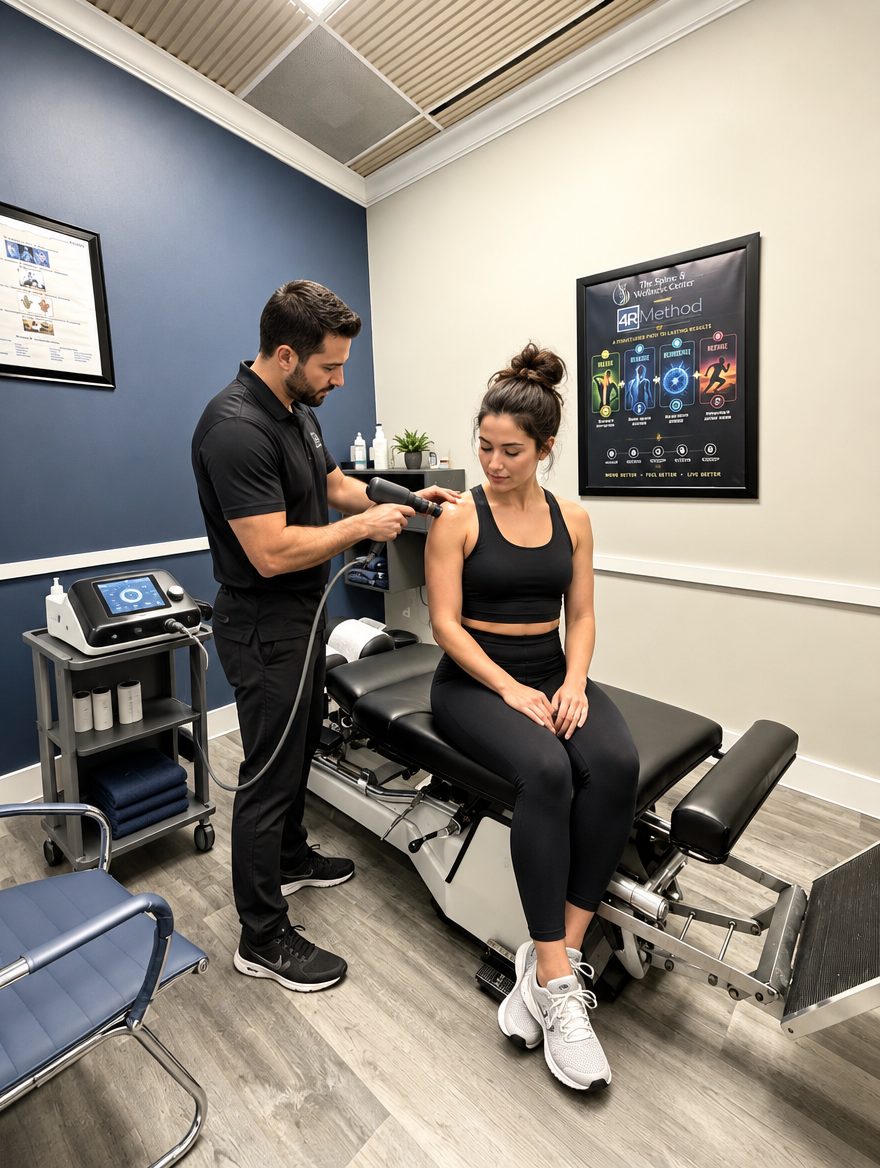
The Repair phase settles the painful structure. Cold laser therapy reduces inflammation inside the joint and around an irritated tendon; acoustic shockwave therapy restarts healing in a stubborn patellar tendon or IT band; Graston Technique releases the tight quad, IT band and calf tissue pulling the kneecap off line; and gentle adjustments of the pelvis, hip, knee and foot restore the motion that lets load travel straight. Typical commitment is 3–5 visits a week for 4–8 weeks, with swelling and stair pain usually easing in the first two to three weeks.
R2 · Rebuild — fix the hip and foot drivers
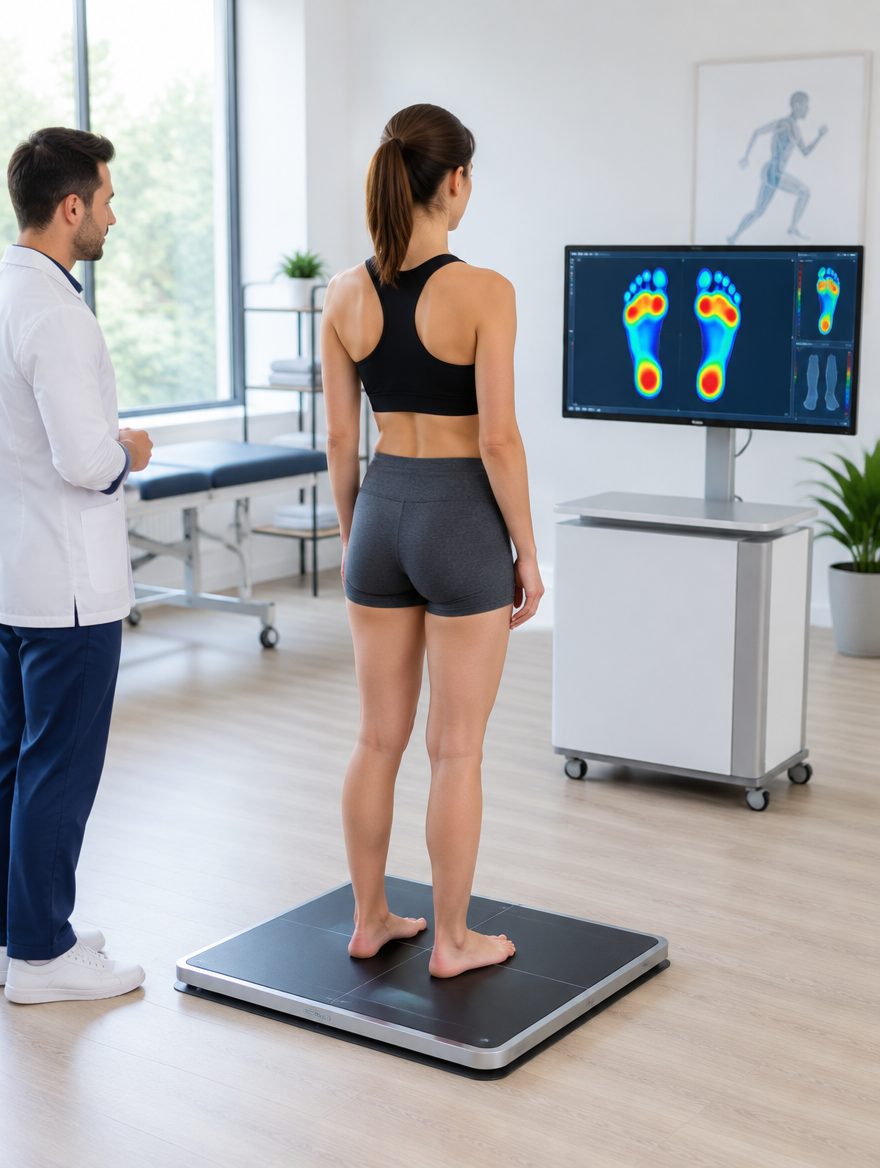
Once the knee is quieter, GaitScan analysis shows exactly how your feet load, and physical therapy rebuilds the glutes, hip rotators, quads and foot stabilizers that keep the kneecap tracking straight and the joint landing square. Custom orthotics are added when the scan shows a collapsing arch is the driver. Rebuild usually runs 2–3 visits a week for 8–16 weeks.
R3 and R4 · Regenerate and Refine
Cartilage and tendon remodel slowly. Regenerate supports that with PEMF and red light therapy at about 2 visits a week for two months or more. Refine is a brief tune-up every month or two so the gains hold — the difference between a knee that is better for a season and a knee that stays better.
GaitScan analysis
Digital foot-pressure mapping that shows whether the arch and stride are driving the knee off line.
Learn moreAcoustic shockwave therapy
Focused acoustic pulses restart healing in patellar tendons and IT bands that have stalled.
Learn moreCold laser therapy
Low-level laser reduces swelling and inflammation inside the joint — painless, drug-free.
Learn morePhysical therapy
Hip, quad and foot strengthening that keeps the kneecap tracking straight for good.
Learn more6 proven non-surgical options for knee pain (and which pattern each suits)
These are the six tools we reach for most in knee pain treatment, matched to the problem they solve:
- Hip and foot correction. Best for patellofemoral pain and IT band syndrome. Strengthening the glutes and restoring arch support fixes the reason the kneecap drifts — the single highest-yield step for most knees.
- Cold laser therapy. Best for swollen, inflamed joints and acute flares of osteoarthritis or a meniscus irritation; about 10–15 minutes, painless.
- Acoustic shockwave therapy. Best for chronic patellar tendinopathy and IT band pain that rest has not fixed.
- Graston Technique. Best for a tight lateral quad, IT band or calf that pulls the kneecap outward and loads the outer knee.
- Gentle joint mobilization. Best for a stiff knee after injury or in osteoarthritis, and for the pelvis and foot joints that set the knee’s alignment.
- Movement rehab and return to sport. Best for every knee. Progressive loading, landing mechanics and running form through our sports injury rehab program make the relief hold.
What is not on the list as a first step: cortisone injections or arthroscopy. A knee that locks, a ligament that is unstable, or a joint that has failed a proper course of conservative care needs an orthopedic opinion — and we will say so and refer you.

What to expect at your first two visits
We measure before we treat, so your plan targets the structure that is hurting and the mechanics that are loading it.
Visit one — we measure (and usually begin care)
- A real conversation. How it started, where exactly it hurts, what makes it worse, whether it swells, locks or gives way, what you run, play or climb, and what you want back.
- A hands-on structural exam. Range of motion, swelling, kneecap tracking, meniscus and ligament tests, patellar and IT band palpation, a single-leg squat to watch the hip control the knee, and a check of hip, pelvis and ankle mechanics.
- GaitScan and surface scanning. GaitScan maps foot pressure through every step; surface EMG and thermal scanning show guarding and inflammation along the spine and pelvis that change how the leg loads. All painless and repeatable.
- Digital X-rays, when indicated. To stage osteoarthritis, check alignment and rule out fracture. We review any MRI you already have.
Visit two — your findings and your plan
- Your findings explained plainly with the scans and images in front of you: which structure is hurting and what is loading it.
- A phase-by-phase plan with a realistic timeline, including the home exercises and any orthotic recommendation.
- Treatment begins at this visit. For a head start, take the 60-second spine assessment before you come in.
Knee pain treatment at home: what helps and what makes it worse
Between visits, these habits decide whether the knee settles or keeps flaring:
- Keep moving, change the dose. Walking and cycling keep cartilage nourished; cut the volume and the hills rather than stopping entirely.
- Strengthen the hip, not just the quad. Side-lying leg raises, bridges and clamshells from your plan do more for a kneecap than any knee brace.
- Mind the shoes. Worn-out running shoes and flat sandals let the arch collapse and the knee roll inward — a real issue in South Florida’s flip-flop season.
- Ice after, warm before. Fifteen minutes of ice on a swollen knee after activity; warmth before stretching a stiff one.
- Avoid deep squats and twisting early on. Loaded deep flexion and pivoting are what a meniscus or irritated kneecap tolerates least during the Repair phase.
When knee pain needs a doctor instead
A few patterns need same-day medical evaluation: a knee that is deformed, cannot bear weight or cannot straighten after an injury; a hot, red, swollen joint with fever; a calf that is swollen, warm and tender (possible blood clot); or numbness and weakness in the lower leg. If any of these apply, please see a doctor or urgent care today.
For everything else — the stairs, the swelling, the grinding kneecap, the run that ends at the same mile — this is daily work for us with knee pain patients across Coral Springs and Parkland. If your pain is hip-centered, start with the hip and SI joint guide; if it is a wear-and-tear joint, the arthritis hub.
Serving knee pain patients across North Broward
Our clinic at 5675 Coral Ridge Drive, Coral Springs, FL 33076 serves Coral Springs, Parkland, Coconut Creek, Margate, Boca Raton, Tamarac, Pompano Beach and Deerfield Beach. Same-day appointments are usually available — call (954) 341-2256 or book online. Most patients from Parkland and Coral Springs are here in under 15 minutes.
Medically reviewed by Dr. Jared Cohen, DC — Co-Founder & Clinical Director, The Spine and Wellness Center. Last reviewed October 2026.
Frequently asked questions
Can a chiropractor help with knee pain?
Yes. Most knee pain is driven by how the hip, pelvis and foot load the joint. Correcting that alignment, restoring motion to the knee itself, calming inflammation with cold laser and shockwave, and rebuilding hip and quad strength addresses the cause rather than masking it. Unstable ligaments and locked knees are referred for an orthopedic opinion.
Do I need an MRI for knee pain?
Usually not at first. Most knee problems can be identified with a thorough hands-on exam and gait analysis, and treatment can begin without imaging. An MRI is useful when the knee locks, gives way, or does not respond to a proper course of conservative care — and we will tell you when that point is reached.
Can a meniscus tear heal without surgery?
Many can be managed without surgery, especially degenerative tears in adults over 40, where studies show rehab performs as well as arthroscopy for most people. Tears that lock the knee or come with instability are the exception. We treat the swelling, restore motion and strengthen the hip and quad, then reassess.
Why does my knee hurt going down stairs?
Descending stairs loads the patellofemoral joint — the kneecap in its groove — with several times your body weight while the quad works eccentrically. Pain there usually means the kneecap is tracking off line because the hip is weak or the foot collapses. Strengthening the hip and correcting the arch is the fix.
How long does knee pain treatment take?
Swelling and stair pain usually ease within two to three weeks of the Repair phase; the strength that keeps it away is built over the following two to three months. Osteoarthritis and chronic tendinopathy take longer. We map a realistic timeline after your evaluation.
Do you see knee pain patients from Parkland and Coconut Creek?
Yes. Our clinic on Coral Ridge Drive in Coral Springs is minutes from Parkland, Coconut Creek, Margate, Tamarac and Boca Raton, and same-day appointments are usually available.
Keep reading
From the blog
Same-day appointments
Let's build your plan.
Find out what's actually going on and get a clear path forward. Same-day appointments available.
- Same-day appointments are usually available
- Our team calls you back to confirm your visit
- Coral Springs, serving Parkland & North Broward since 2005
Prefer to talk now? Call or text (954) 341-2256