

Athletes · Coral Springs & Parkland
Golf injury treatment in Coral Springs & Parkland
The swing loads the same side of the low back, the lead hip and the trail elbow hundreds of times a week. We measure where the chain is breaking down, calm the tissue, rebuild the rotation and get you back on the course with objective criteria — not a guess.
Quick answer
Golf injury treatment at The Spine and Wellness Center starts with measurement — a structural exam, surface EMG and GaitScan — then follows the 4R Method: calm the irritated back, elbow or hip, restore rotation through the hips and mid-back, rebuild trunk and grip strength, and return to full swings on objective criteria. Most golfers keep playing at a modified volume while they recover.
What are the most common golf injuries?
Golf injury treatment in Coral Springs and Parkland is mostly about four regions: the lower back, the lead hip, the trail elbow and the shoulders. A full swing is one of the most demanding rotational movements in sport, repeated hundreds of times a week on courses that are open nearly year-round in South Florida.
Here is where golfers get hurt, by body region, in the order we see it in our clinic:
- Lower back (most common). Lumbar strain, facet joint irritation and disc-related pain from compression, side-bending and rotation at impact. An irritated disc often produces sciatica that flares after a round.
- Elbow and forearm. Golfer’s elbow — medial epicondylitis — is an overuse tendinopathy on the inner elbow of the trail arm, aggravated by grip pressure and turf contact.
- Lead hip. The lead hip takes the post-up and rotation on every downswing; limited internal rotation and lateral hip pain are the usual result.
- Shoulders. Rotator cuff strain and impingement — the lead shoulder at the top of the backswing, the trail shoulder through follow-through.
- Neck, mid-back and ribs. Stiffness from the rotated head position, plus rib pain in golfers who have lost mid-back rotation and compensate at the ribs.

Why does the golf swing cause these injuries?
The golf swing injures golfers because it is one-sided, high-speed and repeated without rest. In roughly a quarter of a second the body coils and fires, sending force from the ground through the hips, spine and shoulders into the hands. That whip sends the ball down the fairway, and it wears tissue down when the same motion repeats day after day.
Three mechanics matter most:
- Asymmetric loading. A right-handed golfer loads the same side of the low back, the same lead hip and the same lead shoulder on every swing, and the lumbar spine ends up as the hinge between two sides that have adapted differently.
- The ‘crunch factor’. Separation between hip turn and shoulder turn creates power, but it also creates shear and side-bend through the lumbar facets at impact. Golfers who have lost hip or thoracic rotation generate that separation at the low back instead.
- Grip and impact. A tight grip and repeated turf contact overload the flexor-pronator tendons on the inner elbow. Add tight shoulders and poor wrist mechanics and the elbow becomes the weakest link in a chain that is not sharing the load.
The American Academy of Orthopaedic Surgeons notes that most golf injuries are overuse injuries of the back, elbow, shoulder and wrist, with poor swing mechanics and inadequate warm-up the leading contributors (AAOS OrthoInfo, Golf Injury Prevention). Many of our Coral Springs and Parkland patients play three or four rounds a week on the country-club courses near Heron Bay and Parkland, so there is little downtime for tissue to recover — which is why the mechanics have to be corrected rather than just rested.
How do we assess a golf injury?
We measure before we treat. A five-minute look at a sore elbow tells you very little about why the elbow is sore; the swing does. Your first visit is a measurement visit, and your golf injury treatment plan is built on what we find.
Visit one — we measure (and usually begin care)
- A real conversation. Your handicap, how often you play and practice, which part of the swing hurts, and your goals for the season.
- A hands-on structural exam and movement screen. Hip and thoracic rotation on both sides, a single-leg balance and squat screen, shoulder range and rotator cuff strength, and orthopedic tests for the lumbar discs, facets and SI joint. For elbow pain, resisted wrist flexion and grip testing isolate the tendon.
- Surface EMG and thermal scanning. A painless MyoVision surface EMG scan along the spine shows where the paraspinal muscles are guarding and which side is overworking — in golfers the asymmetry is usually obvious.
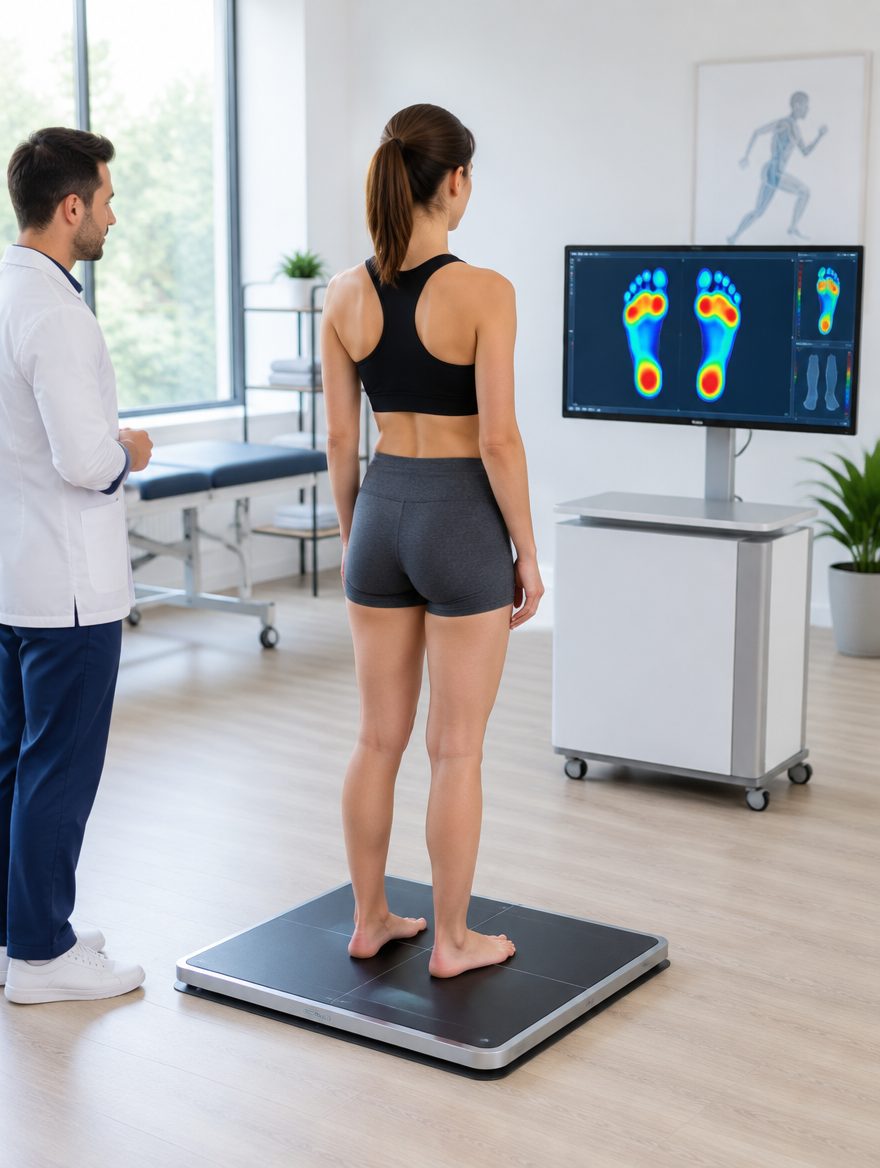
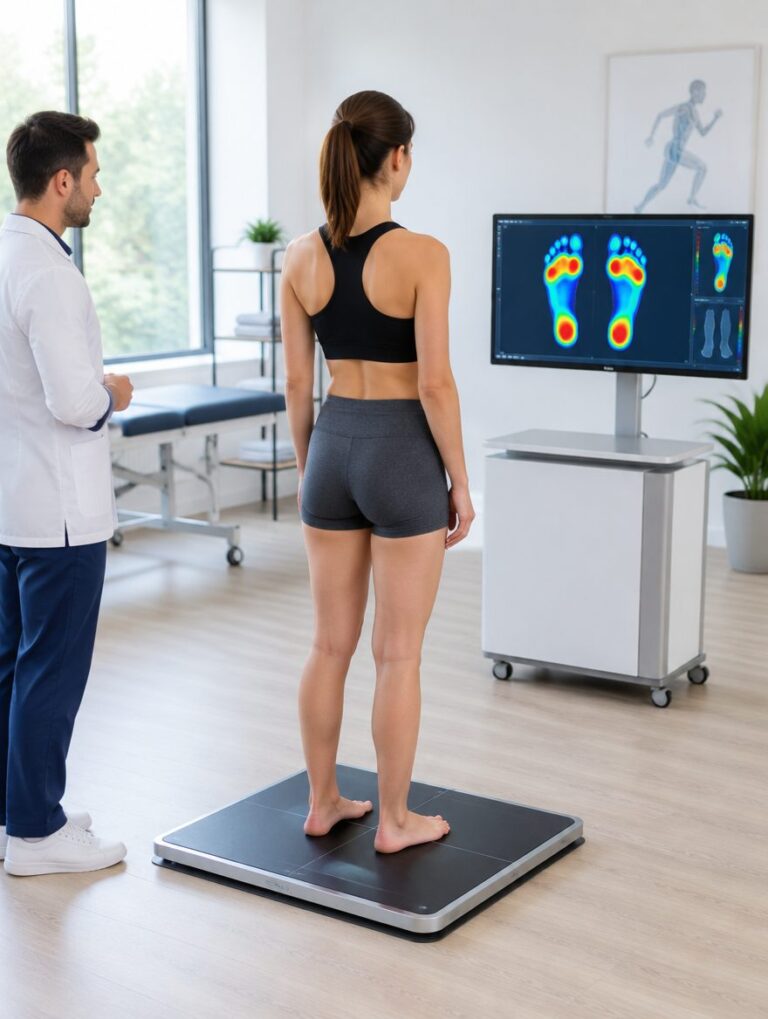
- GaitScan. A digital foot-pressure analysis with GaitScan shows how you load each foot. Golfers who collapse through the lead foot or cannot post up on the lead hip often show it here first.
- Digital X-rays, when indicated. For persistent low back pain, radiating leg symptoms or a history of disc problems we look at disc spacing, curvature and wear.
Visit two — your findings and your plan
We walk through the scans and the movement findings in plain English, map them to the phases of the 4R Method, and explain what we recommend, how often and for how long. Treatment begins at this visit. If you would like a head start, take the 60-second spine assessment before you come in.
How does golf injury treatment work through the 4R Method?
Golf injury treatment at our clinic follows the 4R Method — Repair, Rebuild, Regenerate, Refine — because the order matters. Calming the pain without restoring rotation gives you a few good rounds and then the same injury. Trying to strengthen an irritated tendon or disc before it has calmed down just stirs it up.
R1 · Repair — calm the tissue (3–5 visits a week, 4–8 weeks)
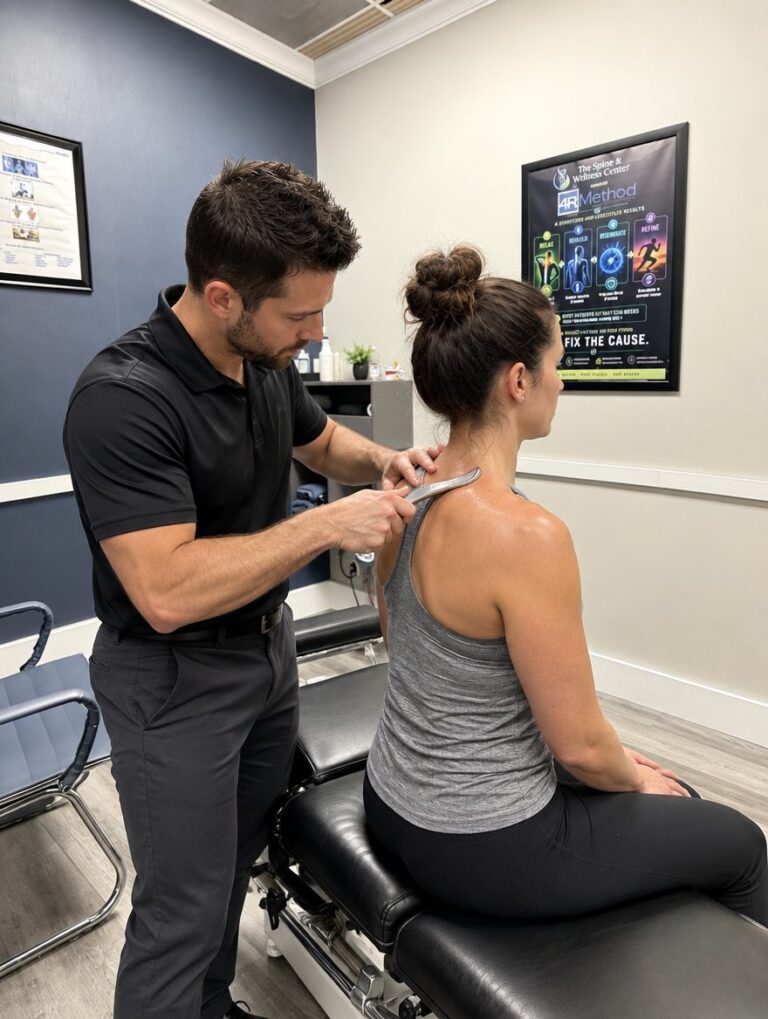
The Repair phase takes the irritation out of whatever is hurting. For disc-related low back pain or sciatica that means non-surgical spinal decompression on the Triton DTS table paired with precise chiropractic adjustments at the lumbar segments and SI joint that have locked up. For golfer’s elbow we use the Graston Technique along the flexor-pronator tendon, cold laser to settle inflammation, and acoustic shockwave for stubborn chronic cases. Most golfers swing, sit and sleep more comfortably within two to three weeks.
R2 · Rebuild — restore rotation and strength (2–3 visits a week, 8–16 weeks)
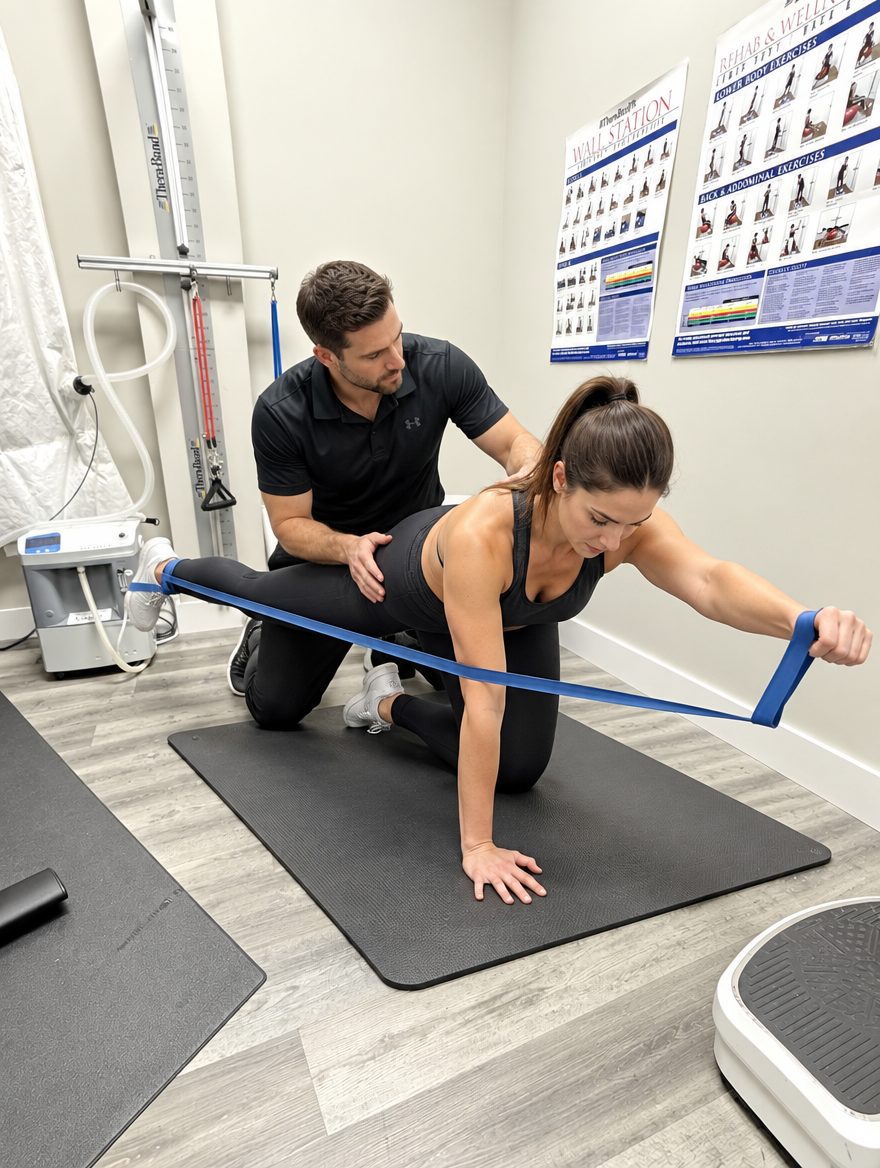
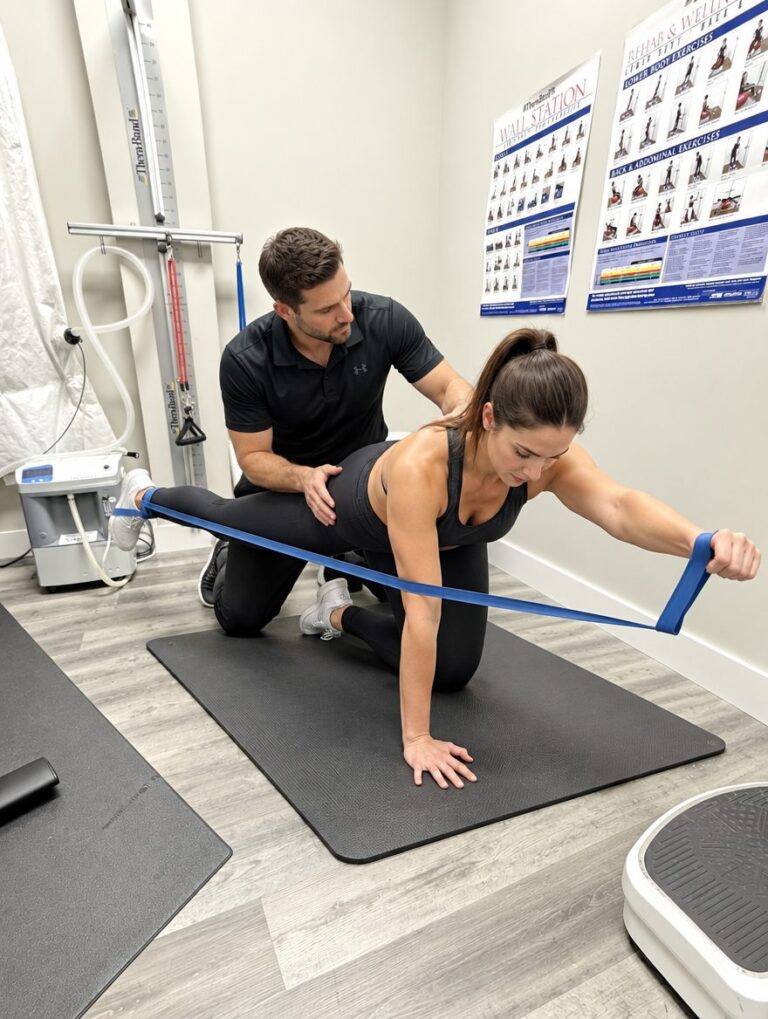
Once the tissue is quiet we correct what caused the injury. Physical therapy rebuilds hip internal rotation, thoracic rotation and the anti-rotation strength of the deep core so the lumbar spine stops being the hinge. For the elbow, progressive forearm and grip loading reloads the tendon so it tolerates impact again. This is the phase most clinics skip — and why their golfers come back every spring with the same back.
R3 and R4 · Regenerate and Refine
The Regenerate phase (about twice a week for two or more months) supports tissue quality between rounds with red light, PEMF, massage therapy and cupping. Refine is a brief structural tune-up every month or two through the season — a short visit that catches a stiff hip or guarded low back before it becomes the reason you sit out.
Sports injury rehab
The staged progression we use for every injured golfer — calm, mobilize, stabilize, strengthen, return.
Learn moreGolfer's and tennis elbow
Graston, cold laser and shockwave for the inner-elbow tendon, plus a loading program that holds.
Learn moreLower back pain relief
Decompression and adjustments for the disc, facet and SI patterns the swing aggravates.
Learn moreHip and SI joint pain
Restore lead-hip rotation and pelvic balance so the low back stops absorbing the downswing.
Learn moreWhen can you get back on the course?
You return to full swings when you meet objective criteria, not when a calendar says so. In most cases we keep you playing at a modified volume — shorter range sessions, half-swings, walking nine — rather than benching you outright. Full return is staged:
- Pain-free daily movement. Sitting, sleeping, bending and walking without the back, hip or elbow speaking up.
- Symmetry on re-test. Hip and thoracic rotation within roughly 10 percent side to side, and a surface EMG re-scan showing the guarding has settled.
- Strength benchmarks. Pain-free resisted wrist flexion and grip strength near the uninjured side; a single-leg squat and balance test for hip and back cases.
- Graded swing progression. Putting and chipping, then wedges, then mid-irons at 50–70 percent, then driver, with 24 hours between steps.
- Volume before intensity. A full bucket before a full round, and a full round before back-to-back days.
If any step flares the injury, we back up one stage rather than push through. Good golf injury treatment returns you a week later and confident rather than a week early and fragile.
How do we prevent the next golf injury and add distance?
The best golf injury treatment looks forward. Once you are moving well, the goal is to keep the back, hip and elbow durable through a long season — and the same work that protects them usually adds clubhead speed, because power starts coming from the hips and trunk instead of the arms.
- Warm up before you swing. Five minutes of hip circles, trunk rotations and half-swings beats cold-topping your first drive.
- Keep the hips and mid-back mobile so the lumbar spine and elbow are not forced to make up the difference.
- Build anti-rotation core and grip strength off the course. Two short sessions a week changes how the body absorbs the swing.
- Ease the grip and stop swinging out of your shoes. Grip pressure and over-swinging are the two habits that keep golfer’s elbow alive.
- Mind the volume. A large bucket of range balls is more swings than a round; spread practice through the week.
- Catch early aches. A stiff back on the back nine or a twinge after range work is the time to come in — a Refine tune-up is far shorter than a full Repair phase.
Junior golfers and adult golfers: what changes?
Golf injury treatment is scaled to age and stage, because a 15-year-old building swing volume and a 65-year-old protecting a lifetime of rounds load the body very differently.
Junior and high-school golfers. Young players in Coral Springs and Parkland tend to add practice volume faster than their bodies adapt, and growth plates at the elbow and spine are more vulnerable than adult tissue. We use gentle, age-appropriate techniques, keep parents in the loop, and coach volume and mechanics. Our high-school and college athlete programs build on the same assessment.
Adult and senior golfers. Weekend players whose backs tighten by the back nine, and retirees protecting a lifetime of rounds, benefit most from work that keeps the spine and hips mobile and a realistic look at disc health on X-ray. Golfers returning after a layoff do well with a gradual reloading plan that rebuilds tolerance before chasing distance.
When should a golf injury see a doctor first?
A small number of symptoms are not conservative-care problems. If you have numbness in the groin or inner thighs, loss of bladder or bowel control, rapidly worsening leg weakness, a sudden pop at the elbow with inability to grip, chest pain or shortness of breath during a round, or back pain with fever or unexplained weight loss, please see a doctor or urgent care today. We will be here for the recovery afterwards.
For everything else — the low back that locks up on the back nine, the elbow that aches after range work, the lead hip that will not post up — this is what we do every day for golfers from Coral Springs and Parkland, and same-day appointments are usually available. If your pain is mainly in the shoulder, start with our shoulder pain guide; for the knee, see knee pain treatment. We also treat tennis and pickleball players, who share many of the same patterns.
Serving golfers across North Broward
Our clinic at 5675 Coral Ridge Drive, Coral Springs, FL 33076 serves Coral Springs, Parkland, Coconut Creek, Margate, Boca Raton, Tamarac, Pompano Beach and Deerfield Beach. Same-day appointments are usually available — call (954) 341-2256 or book online. Most patients from Parkland and Coral Springs are here in under 15 minutes.
Medically reviewed by Dr. Jared Cohen, DC — Co-Founder & Clinical Director, The Spine and Wellness Center. Last reviewed October 2026.
Frequently asked questions
What are the most common golf injuries you treat?
Low back pain from the rotational load of the swing is first by a wide margin, followed by golfer's elbow (medial epicondylitis), lead-hip restriction, rotator cuff and shoulder impingement, and neck, rib and mid-back stiffness. Most golfers have more than one, because a stiff hip or mid-back shifts load to the low back and elbow.
Do I have to stop golfing during golf injury treatment?
Usually not. For most overuse injuries we modify your volume — fewer range balls, half-swings, walking nine — rather than stopping you altogether, and we progress you back through a graded swing protocol. A short period of relative rest is sometimes needed for an acutely irritated disc or tendon, and we tell you honestly when that is the case.
Can chiropractic care help golfer's elbow?
Yes, as part of a plan. Golfer's elbow is a tendon problem, so we pair Graston Technique and cold laser or shockwave with a progressive forearm and grip loading program, and we correct the shoulder and wrist mechanics and grip pressure that keep re-aggravating it. Treating only the elbow rarely holds.
How long does golf injury treatment take?
It depends on the tissue. A fresh lumbar strain often settles within a few weeks of the Repair phase; a chronic golfer's elbow or disc-related back injury typically needs the full Repair and Rebuild phases, roughly 12–20 weeks to a confident full-swing return. We give you a realistic range at your report of findings.
What is GaitScan and why does it matter for golf?
GaitScan is a digital foot-pressure analysis that shows how you load each foot when you stand and walk. Golfers who collapse through the lead foot or cannot post up on the lead hip often show the asymmetry here first, and it tells us whether golf injury treatment needs to start from the ground up.
Do you treat golfers from Parkland and Boca Raton?
Yes. Our clinic on Coral Ridge Drive in Coral Springs is minutes from Parkland, Coconut Creek, Margate, Tamarac and Boca Raton, and we see golfers from the country-club courses across North Broward. Same-day appointments are usually available.
Same-day appointments
Let's build your plan.
Find out what's actually going on and get a clear path forward. Same-day appointments available.
- Same-day appointments are usually available
- Our team calls you back to confirm your visit
- Coral Springs, serving Parkland & North Broward since 2005
Prefer to talk now? Call or text (954) 341-2256