

Athletes · Coral Springs & Parkland
College athlete performance care in Coral Springs
Heavy training loads, a long competitive season and constant repetitive stress wear a collegiate body down. We keep you moving well, recovering faster and ready to compete — so a nagging injury never costs you a season.
Quick answer
College athlete performance care keeps a collegiate body healthy enough to train hard and compete week after week. We combine chiropractic care and sports rehab with a recovery stack — red light, PEMF, IHHT oxygen therapy and BrainTap — programmed differently for the off-season and the in-season, and coordinated with your team athletic trainer.
What college athlete performance care actually includes
College athlete performance is built on one thing: staying healthy enough to train hard and compete week after week. The demands are unlike anything an athlete faced in high school. Lifting, conditioning, skill work, film, travel and academics stack on top of one another, and the volume rarely lets up. That relentless, repetitive load is what drives the overuse injuries — tendinopathy, low back pain, shin splints, hip and shoulder tightness — that quietly erode performance.
Our approach has two halves. The first is keeping the spine and joints moving efficiently and treating the cause of breakdowns when they happen. The second is recovery: giving the body what it needs to absorb hard training and bounce back for the next session. Both are individualized to your sport, position and where you are in the calendar.
Our Coral Springs clinic is an easy drive from Florida Atlantic University and the region’s colleges, and we see scholarship athletes protecting their status, walk-ons fighting for reps, club competitors training year-round, and collegiate athletes home for the summer who need to arrive back on campus in better shape than they left.

Off-season vs. in-season: how the programming changes
The biggest mistake we see is treating a collegiate athlete the same way in July as in October. The body’s capacity to adapt is different, and so is the goal.
Off-season — rebuild
The off-season and summer are when restrictions get corrected. A hip that does not fully extend robs sprint power; a stiff thoracic spine limits how far a pitcher or swimmer can rotate; a weak, poorly controlled trunk leaks force with every rep. We run a full structural evaluation, then use the Rebuild phase of the 4R Method — corrective adjustments, Graston for fibrotic tissue, and sports rehab — at 2–3 visits a week for 8–12 weeks to remove the asymmetries that capped last season.
In-season — maintain
In season, the fastest way to lose a year is to let small problems accumulate. A tight hip that changes how you sprint, a stiff mid-back that limits your throwing motion, a hamstring that never quite recovers — none is dramatic alone, but under a heavy load they compound. In-season maintenance is shorter, focused visits scheduled around practice and game days: adjustments, soft-tissue work and recovery modalities to reduce soreness, keep movement clean and catch minor complaints before they become time on the sideline. Typically one visit a week, or every other week, through the season.
Good to know
An evidence review of return-to-play criteria after ACL reconstruction concluded that progression should be based on goals achieved in the previous phase and confirmed with objective measures — strength symmetry, hop testing and movement quality — rather than time alone (Annals of Translational Medicine, 2019, via NCBI). That milestone-driven structure is how every comeback here is built.
5 proven pillars of our college athlete performance program
There is no single treatment that keeps an athlete healthy across a season. The program rests on five pillars, matched to what your exam and training schedule call for:
- Structural care. Chiropractic adjustments restore joint motion in the spine, hips, shoulders and ankles so you move efficiently under load.
- Sports rehab. Corrective exercise to rebuild strength and control where the evaluation shows a leak — see physical therapy.
- Tissue tools. Acoustic shockwave for stubborn tendinopathy, cold laser for irritated tissue, Graston and cupping for dense, overworked muscle.
- The recovery stack. Red light, PEMF, IHHT oxygen therapy and BrainTap, programmed around the training week (below).
- Return-to-play planning. Graded progressions with objective checkpoints, coordinated with your athletic trainer or team physician.
Sports injury rehab
Criteria-based progressions from pain control to full practice and competition.
Learn moreAcoustic shockwave therapy
Targets chronic patellar, Achilles, hamstring and rotator cuff tendinopathy.
Learn moreSpinal decompression
Computer-controlled traction for disc-related low back pain from heavy lifting and contact.
Learn moreChiropractic care
Keep the spine, hips and shoulders moving cleanly under season-long load.
Learn moreThe recovery stack: red light, PEMF, IHHT and BrainTap
Recovery technology plays a supporting role throughout the program. None of it is magic on its own, and we are careful not to promise outcomes, but used deliberately alongside adjustments and rehab it can shorten the gap between when you train and when you are ready to train again. For a scholarship athlete whose availability is everything, that margin matters.
- Red light therapy. Full-body photobiomodulation to support tissue repair and reduce post-training soreness; typically 10–20 minutes, often scheduled the day after a heavy session.
- PEMF therapy. Pulsed electromagnetic fields in the recovery chair to support circulation and recovery between hard sessions.
- IHHT oxygen therapy. Intermittent hypoxic-hyperoxic training on a bike with a mask — alternating lower- and higher-oxygen air to support aerobic capacity and recovery; used in the off-season and in reduced doses in season.
- BrainTap. Guided audio-visual relaxation sessions for sleep quality, stress and nervous-system recovery — the piece most college athletes are missing between film, travel and exams.
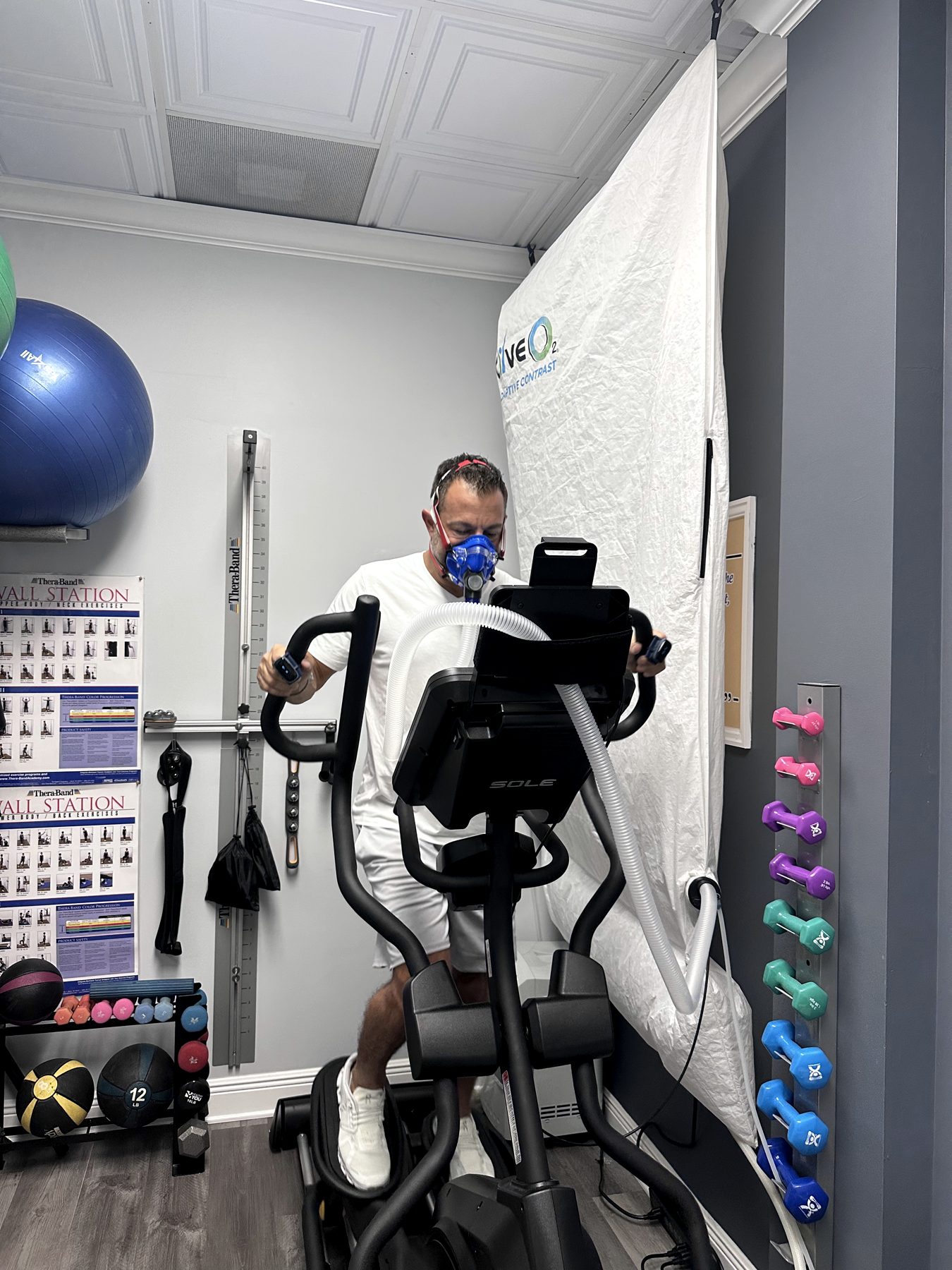
In the 4R sequence this is the Regenerate phase — typically 2 visits a week for two or more months in the off-season, then folded into in-season maintenance.
Overuse injuries and return-to-play: what we help with
Collegiate athletes rarely walk in with a single dramatic injury. More often it is the slow accumulation of repetitive stress: chronic low back and neck pain from heavy training; overuse tendinopathy in the shoulder, elbow, hip or knee; recurring hamstring, hip flexor and calf strains; shin splints; and reduced mobility that limits sprinting, throwing or lifting.
When an injury does happen, how you come back matters as much as the injury itself. Rushing back invites re-injury; waiting too long costs conditioning and confidence. We use a graded return-to-play process — assessing pain, range of motion, strength and sport-specific movement, then progressing load in stages so the tissue can handle each demand before the next is added. With your permission we coordinate with your athletic trainer or team physician so everyone is aligned, and every plan starts with an exam, not an assumption; if your presentation needs imaging or a specialist, we say so and help coordinate it.
Sport-specific detail lives on our baseball, football, soccer, volleyball and wrestling pages, and the full program overview on the athletic performance page.
What to expect at your first two visits
We measure before we treat — in-season demands are very different from an off-season rebuild, and the plan has to match.
Visit one — we measure (and usually begin care)
- A real conversation. Sport, position, training schedule, competition calendar, injury history and what your athletic trainer is already doing.
- A hands-on structural exam. Joint mechanics, soft tissue, strength and sport-specific movement patterns — how you squat, hinge, rotate, land and sprint — plus a neurological screen when the spine is involved.
- Surface scanning: sEMG + thermal. A painless scan along the spine that shows where muscles are guarding and compensating, re-scannable to track progress through the season.
- Digital X-rays when indicated, and review of any imaging the team has already done.
Visit two — findings and plan
What we found, what we recommend and how it fits your season, mapped to the 4R Method. Treatment begins at this visit, and we reassess at each milestone against your competition calendar. The 60-second spine assessment gives us a head start on back and neck patterns before you arrive.
Training-week habits that protect college athlete performance
- Schedule recovery like a session. The athletes who stay available treat red light, PEMF or a maintenance visit as part of the training week, not an afterthought.
- Report the small stuff early. A hip that feels ‘off’ in week two is a ten-minute fix; in week eight it is a strain.
- Sleep is the main recovery tool. Everything else supports it.
- Keep your athletic trainer in the loop about what we are doing, and vice versa.
- Use the summer. Home for three months is the best window of the year to correct what the season exposed.
Some situations need medical care first: a suspected concussion, a joint that pops and swells rapidly, a limb you cannot bear weight on, or sudden numbness or weakness — please see a doctor or urgent care today, or your team physician. Once cleared, we help with the reconditioning that follows.
Serving collegiate and club athletes across North Broward
Our clinic at 5675 Coral Ridge Drive, Coral Springs, FL 33076 serves Coral Springs, Parkland, Coconut Creek, Margate, Boca Raton, Tamarac, Pompano Beach and Deerfield Beach. Same-day appointments are usually available — call (954) 341-2256 or book online. Most patients from Parkland and Coral Springs are here in under 15 minutes.
Medically reviewed by Dr. Jared Cohen, DC — Co-Founder & Clinical Director, The Spine and Wellness Center. Last reviewed October 2026.
Frequently asked questions
Do you work with team athletic trainers?
Yes, with your permission. We share findings and the plan with your athletic trainer or team physician so return-to-play criteria, practice volume and treatment are consistent between the clinic and the training room.
How often should a college athlete come in during the season?
For in-season maintenance, most athletes do a shorter focused visit once a week or every other week, scheduled around practice and game days. Off-season rebuilds run 2–3 visits a week for 8–12 weeks, then taper.
What is IHHT and is it safe?
Intermittent hypoxic-hyperoxic training alternates lower- and higher-oxygen air through a mask during light exercise to support aerobic capacity and recovery. It is well tolerated by healthy athletes; we screen for cardiac and respiratory conditions first and adjust the dose to your season.
Can I come in while home for the summer?
Yes, and it is the best time. Three months at home is the window to run a full structural evaluation, correct the asymmetries last season exposed and build the recovery habits that carry into the fall. Many of our collegiate athletes from Coral Springs and Parkland do exactly this.
Will you tell me if I need imaging or a specialist?
Yes. Every plan starts with an exam, not an assumption. If your presentation suggests something that needs imaging, medical management or an orthopedic specialist, we say so plainly and help coordinate that care rather than treating around it.
Where are you relative to FAU and the local colleges?
Our clinic at 5675 Coral Ridge Drive in Coral Springs is minutes from Parkland, Coconut Creek and Margate, and an easy drive from Boca Raton and Florida Atlantic University. Same-day appointments are usually available.
Keep reading
From the blog

Same-day appointments
Let's build your plan.
Find out what's actually going on and get a clear path forward. Same-day appointments available.
- Same-day appointments are usually available
- Our team calls you back to confirm your visit
- Coral Springs, serving Parkland & North Broward since 2005
Prefer to talk now? Call or text (954) 341-2256