
Sports & Performance · 6 min read
Chiropractic for athletes and peak performance
A stiff thoracic spine costs a golfer rotation; a locked hip costs a sprinter stride. Here is how athletes in Coral Springs and Parkland use chiropractic to move better, recover faster and stay in the game.


Quick answer
Chiropractic for athletes restores motion to joints that training has restricted, so power transfers through the body efficiently instead of being lost to compensation. Combined with soft-tissue work, corrective exercise and recovery tools, it improves movement quality, shortens recovery between sessions and reduces the overuse strain behind many sports injuries. It is tuned to the demands of your sport and your season.
Why chiropractic for athletes makes a measurable difference
Chiropractic for athletes is about one thing above all: a body that moves freely performs better and recovers faster. Sport demands repeated, often one-sided movement, and over a season that builds restrictions. A pitcher’s throwing shoulder, a golfer’s lead hip, a soccer player’s kicking side; each adapts to the load by stiffening somewhere, and the body compensates somewhere else.
Small restrictions ripple outward. A thoracic spine that will not rotate forces the low back to make up the difference in a golf swing. A hip that will not extend shortens a sprinter’s stride and overloads the hamstring. The athlete feels it as lost power, altered mechanics and, eventually, an injury that seems to come from nowhere. Restoring motion at the restricted joint is the point of the adjustment.
Professional and collegiate teams across most sports keep chiropractors on staff for that reason, and the same principles apply to the weekend padel player and the travel-ball shortstop. At The Spine and Wellness Center in Coral Springs our athletic performance program is built around them.
6 ways athletes benefit
- Better movement quality. Restored joint motion lets the body access its full range, so effort becomes output instead of being lost to restriction.
- Cleaner mechanics under load. When each segment does its own job, force spreads evenly instead of piling onto one vulnerable joint.
- Faster recovery between sessions. Hands-on care eases guarding, supports circulation and restores motion to overworked areas, and we pair it with cryotherapy, red light and PEMF; see Cryotherapy for Recovery.
- Lower overuse risk. Finding and clearing restrictions before they cause problems reduces the strain behind tendinopathy, stress reactions and muscle pulls.
- A faster, safer return from injury. When something does break down, sports injury rehab treats the injury and the movement pattern behind it, as we described in Recovering From a Sports Injury the Right Way.
- Objective tracking. Surface EMG, thermal scanning and GaitScan give numbers to compare preseason, midseason and after a setback.

What a performance program includes
A program of chiropractic for athletes is individualized, but it generally blends five elements into one coordinated approach. The aim is not to treat a symptom but to tune how the whole system works together.
- A movement and posture assessment specific to your sport, including surface EMG and thermal scanning on visit one and digital X-rays only when indicated
- Targeted adjustments to restore joint motion where the sport has taken it
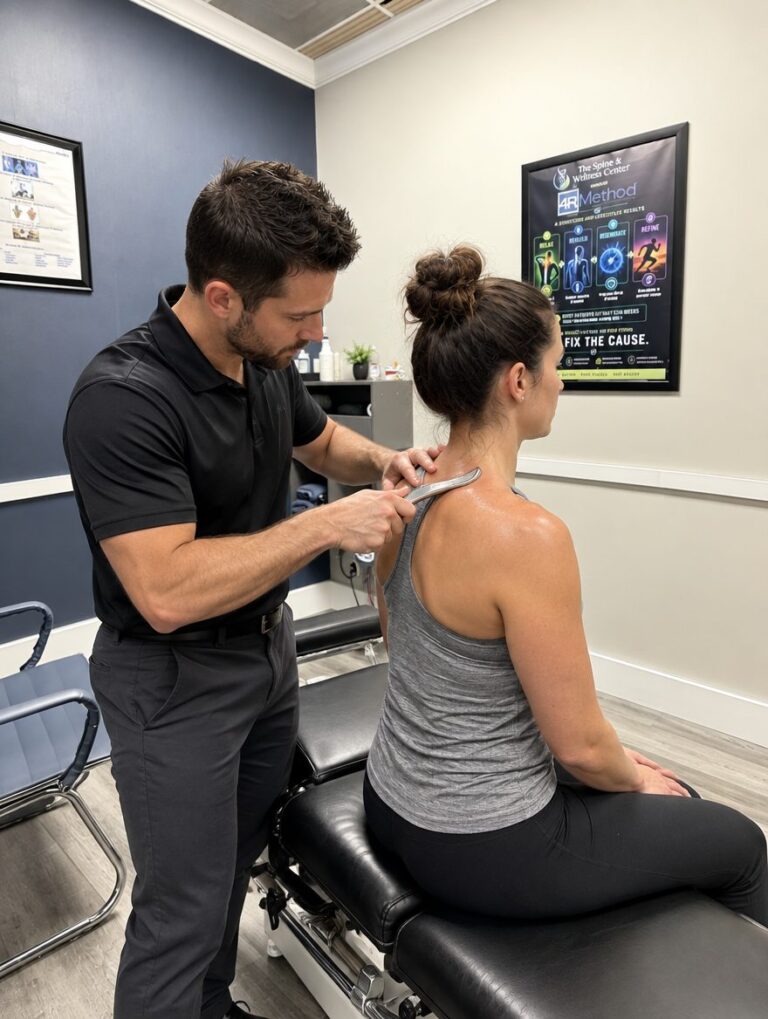
- Soft-tissue work, including Graston Technique and massage, to release the thickened fascia and guarded muscle that restrict a joint
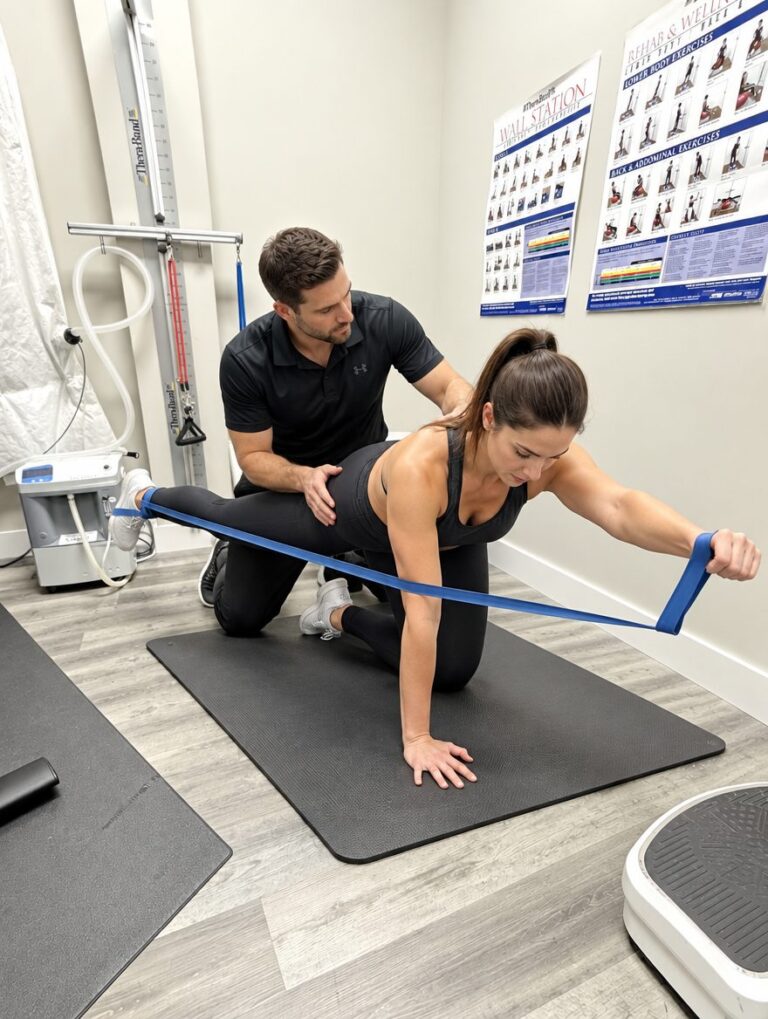
- Mobility, stability and corrective-exercise programming you do between visits
- A recovery stack and load-management advice matched to your season
The sport decides the emphasis. Golfers usually need thoracic and lead-hip rotation; pitchers and tennis players, shoulder-blade control and thoracic extension; runners and soccer players, hip extension and ankle mobility; wrestlers, neck strength and shoulder stability. The assessment tells us which of these your body has quietly given up.
Inside the 4R Method, an injured athlete starts in Repair (3–5 visits a week for 4–8 weeks) and moves into Rebuild (2–3 visits a week for 8–16 weeks). A healthy athlete in season skips straight to Regenerate and Refine: recovery sessions twice a week during heavy blocks and a monthly tune-up otherwise. Visit one measures, visit two is the findings and the plan; the full plan starts (care usually started on visit one) from there.
What the evidence supports, and what it does not
The evidence for spinal manipulation is strongest for low back and neck pain, which is where most athletes’ complaints live; the National Center for Complementary and Integrative Health summarizes it fairly. The evidence that chiropractic for athletes raises performance by itself in a healthy athlete is thinner, and we do not oversell it.
What we can say honestly: restoring lost range of motion, correcting a movement compensation and managing load reliably help athletes train more and miss less. The performance gain is the result of moving well, not of the adjustment alone. That is why exercise and recovery are built into every plan rather than bolted on.
Good to know
The best time to see us is not after the injury. A preseason assessment finds the restricted hip or stiff mid-back before the schedule does, and the numbers give us a baseline to compare if something flares.
Train smart between visits
Care in the office is amplified by what you do on your own. The habits that keep athletes in Coral Springs, Parkland and Boca Raton durable through a long Florida season:
- Warm up dynamically before training and cool down afterward; static stretching belongs after, not before.
- Progress load gradually. Most overuse injuries follow a sudden jump in volume or intensity.
- Prioritize sleep and hydration; both drop pain sensitivity and speed tissue repair.
- Address a minor ache in the first week rather than training through it for a month.
- Build mobility and core work into the weekly plan, not just the rehab plan.
Sudden severe pain, a joint that gives way, a visible deformity, or numbness after a hit are reasons to please see a doctor or urgent care today. For everything else, from a nagging hip to a swing that has lost its rotation, a spine assessment is where the plan starts. Why Physical Therapy + Chiropractic Work Better Together explains the rehab side of the partnership.
Serving athletes across North Broward
Our clinic at 5675 Coral Ridge Drive, Coral Springs, FL 33076 serves Coral Springs, Parkland, Coconut Creek, Margate, Boca Raton, Tamarac, Pompano Beach and Deerfield Beach. Same-day appointments are usually available — call (954) 341-2256 or book online. Most patients from Parkland and Coral Springs are here in under 15 minutes.
Medically reviewed by Dr. Jared Cohen, DC — Co-Founder & Clinical Director, The Spine and Wellness Center. Last reviewed October 2026.
Frequently asked questions
How does chiropractic help athletic performance?
By restoring motion to joints that training has restricted, so force transfers through the body efficiently instead of being lost to compensation. Paired with soft-tissue work and corrective exercise, that improves movement quality and mechanics under load. The performance gain comes from moving well; the adjustment is the tool that makes it possible.
How often should an athlete see a chiropractor?
With chiropractic for athletes it depends on the sport, the training load and whether you are injured. An injured athlete starts at 3–5 visits a week in the Repair phase and tapers. A healthy athlete in a heavy block may come twice a week for recovery; in the off-season a monthly tune-up is typical. We set the rhythm from your season, not a template.
Can chiropractic care prevent sports injuries?
No approach prevents every injury, but clearing movement restrictions and imbalances before they cause problems, and managing training load, reduces the overuse strain behind many of them. A preseason assessment gives a baseline so small changes are caught early.
Do you treat youth and high school athletes?
Yes. Our athletic performance program covers high school and college athletes across golf, tennis, pickleball, padel, baseball, football, soccer, volleyball and wrestling. Techniques and loads are adapted to age and development, and parents are part of the plan.

Same-day appointments
Reading about it is step one.
Step two is a measurement. Visit one we measure — and usually begin care; visit two you get your full findings and plan.
- Same-day appointments are usually available
- Our team calls you back to confirm your visit
- Coral Springs, serving Parkland & North Broward since 2005
Prefer to talk now? Call or text (954) 341-2256