

Athletes · Coral Springs & Parkland
Football injury treatment in Coral Springs & Parkland
Football is a collision sport, and the hits add up. We screen for what needs a physician first, then measure the neck, back, shoulder and legs, calm the tissue, rebuild it and stage a return to contact on objective criteria.
Quick answer
Football injury treatment at The Spine and Wellness Center starts with a red-flag screen — any suspected concussion goes to a physician, we never manage head injuries — then measurement: a structural exam, movement screen, surface EMG and GaitScan. Care follows the 4R Method: calm the stinger, neck, back, shoulder or knee, restore motion, rebuild strength and stage a return to contact on objective criteria.
What are the most common football injuries?
Football injury treatment in Coral Springs and Parkland covers the neck and shoulders, the lower back, the knee, and the hips and hamstrings — the regions that absorb acceleration, contact and sudden changes of direction on every snap. Head injuries are the exception: a suspected concussion is a medical matter that belongs to a physician or athletic trainer, and we do not diagnose, clear or manage it.
By body region, in the order we see them from youth, middle-school and high-school programs across North Broward:
- Neck and shoulder nerves. Stingers and burners — a hot, electric jolt down the arm after a hit that stretches or compresses the nerves of the brachial plexus — plus neck strain and whiplash-type injuries from contact.
- Lower back. Lumbar strain, facet irritation and disc-related pain from blocking, tackling and the constant flexion-and-rotation of line play. Adolescent linemen with back pain that is worse arching backward are screened for a stress reaction.
- Shoulder. AC joint sprains from landing on the point of the shoulder, rotator cuff strain, and shoulder instability after a stiff-arm or a tackle with the arm out.
- Knee. MCL sprains from a hit to the outside of the knee, meniscus irritation from cutting and pile-ups, patellar tendon pain, and swelling after every game. A suspected ACL or significant ligament injury is referred for imaging first.
- Hips and hamstrings. Hamstring strains in receivers and backs sprinting at speed, hip flexor and groin strains, and general soft-tissue tightness from a season of conditioning.

Why does football cause these injuries?
Football injures players because every snap combines acceleration, collision and sudden direction change, and the same joints take that load week after week through a Florida season that runs from summer conditioning into the playoffs.
- Stingers. A tackle that drives the shoulder down while the head goes the other way stretches the brachial plexus; a hit that compresses the neck toward the shoulder pinches it. Players with a stiff neck, weak shoulder-blade muscles or a narrow cervical canal get them more often — and a stinger that keeps coming back is the one to take seriously.
- Line play. Linemen fire out of a flexed stance and absorb a collision on nearly every snap, loading the lumbar discs and facets with compression plus rotation. Over a season the low back that is tight every morning becomes the back that locks up on Monday.
- Speed and cutting. Receivers, backs and defensive backs sprint, plant and cut at full speed, then get twisted or tackled mid-stride. That is how hamstrings strain and how knees take a blow from the outside.
- Contact on the shoulder. Stiff-arms, jamming into the turf and tackling with the arm out load the AC joint and the rotator cuff, and repeated hits can leave a shoulder that will not cock back the same way.
- Fatigue and compensation. A guarded neck changes how a player tackles; a sore knee changes how he plants. Load moves to the next joint.
The American Academy of Orthopaedic Surgeons describes burners and stingers as injuries to the nerve network of the brachial plexus that are common in contact sports, and notes that an athlete should not return to play until symptoms have fully resolved and strength and range of motion are normal (AAOS OrthoInfo, Burners and Stingers). That is exactly the standard our football injury treatment uses.
How do we assess a football injury?
We screen first, then measure. Before any hands-on care we look for the red flags that mean a player needs a physician, imaging or the emergency room — head symptoms, numbness or weakness that persists, severe pain, a joint that looks wrong. When it is safe to proceed, your first visit is a measurement visit, and your football injury treatment plan is built on what we find.
Visit one — we screen and measure
- A real conversation. How the injury happened, position and level, what the athlete can and cannot do, any head symptoms at the time, and the season calendar — with parents in the room for younger players.
- Red-flag screen. Any blow to the head with headache, dizziness, confusion, nausea or memory trouble stops the visit and goes to a physician. Persistent arm weakness or numbness after a stinger, bilateral symptoms, or neck pain with limited motion is referred for imaging before we treat.
- A hands-on structural exam and movement screen. Neck range and nerve function, shoulder and shoulder-blade strength, AC joint and rotator cuff testing, knee ligament and meniscus testing, hip rotation, hamstring length, a single-leg squat and hop screen, and orthopedic tests for the lumbar discs and facets.
- Surface EMG and thermal scanning. A painless MyoVision surface EMG scan shows where the muscles along the neck and spine are guarding after a hit.
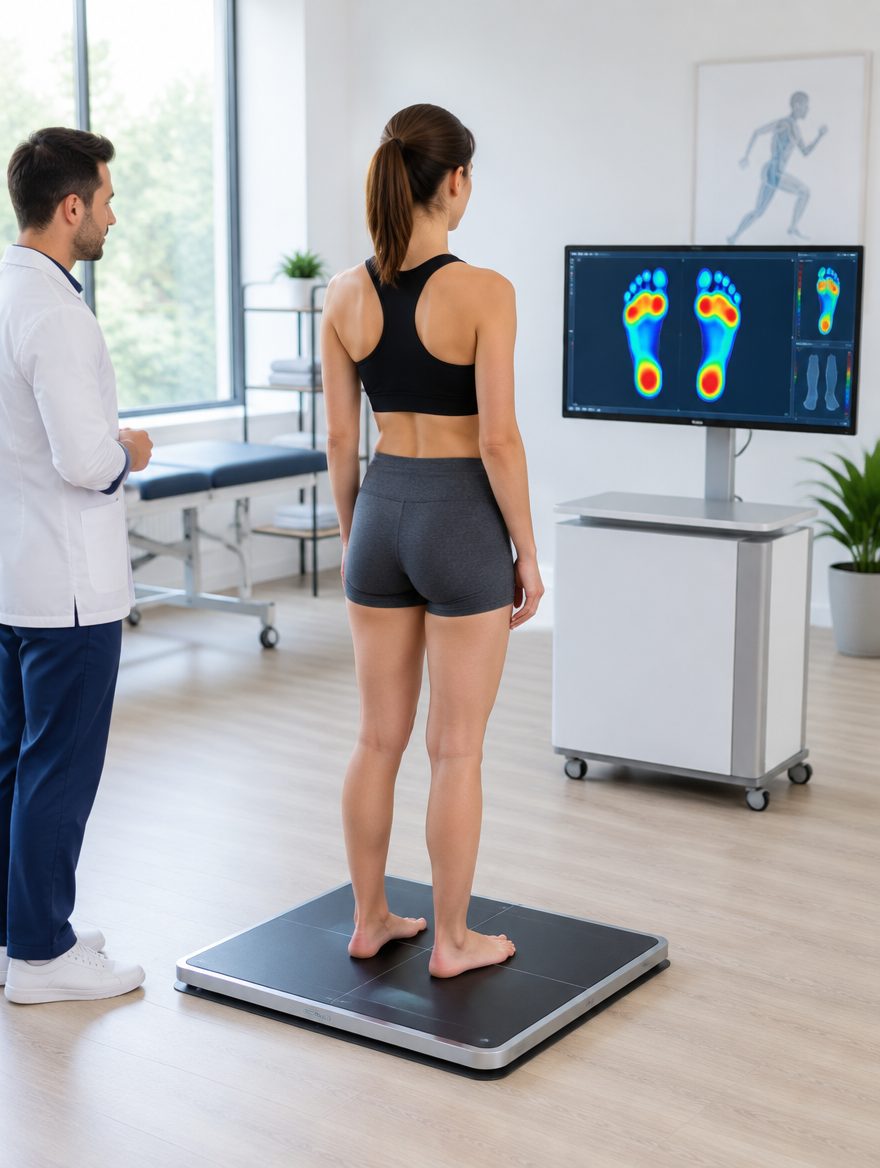
- GaitScan. A digital foot-pressure analysis with GaitScan shows how the player loads each foot — a knee or hamstring that keeps flaring often traces to an asymmetry here.
- Digital X-rays, when indicated. For persistent neck or low back pain, radiating symptoms or a significant contact injury we look at the actual architecture.
Visit two — findings and plan
We walk through the scans and movement findings in plain English, map them to the phases of the 4R Method, and explain what we recommend, how often and for how long. Treatment begins at this visit. For a head start, take the 60-second spine assessment before you come in.
How does football injury treatment work through the 4R Method?
Football injury treatment at our clinic follows the 4R Method — Repair, Rebuild, Regenerate, Refine — because the order matters. Skipping ahead is how a small problem becomes a lingering one: calming the pain without restoring motion and strength sends a player back to contact with the same weak link.
R1 · Repair — calm it down (3–5 visits a week, 4–8 weeks)
The Repair phase reduces pain and protects the injured area. For a stinger or neck strain that means gentle chiropractic care to restore protected neck motion, soft-tissue work for the guarded muscles, and cold laser to settle irritated tissue. For a locked-up low back it means precise adjustments to the lumbar segments and SI joint, and non-surgical spinal decompression when a disc is involved. Shoulder, knee and hamstring injuries get the Graston Technique, laser and early protected loading. Visits are closer together here, and most players feel the edge come off within two to three weeks.
R2 · Rebuild — restore motion and strength (2–3 visits a week, 8–16 weeks)
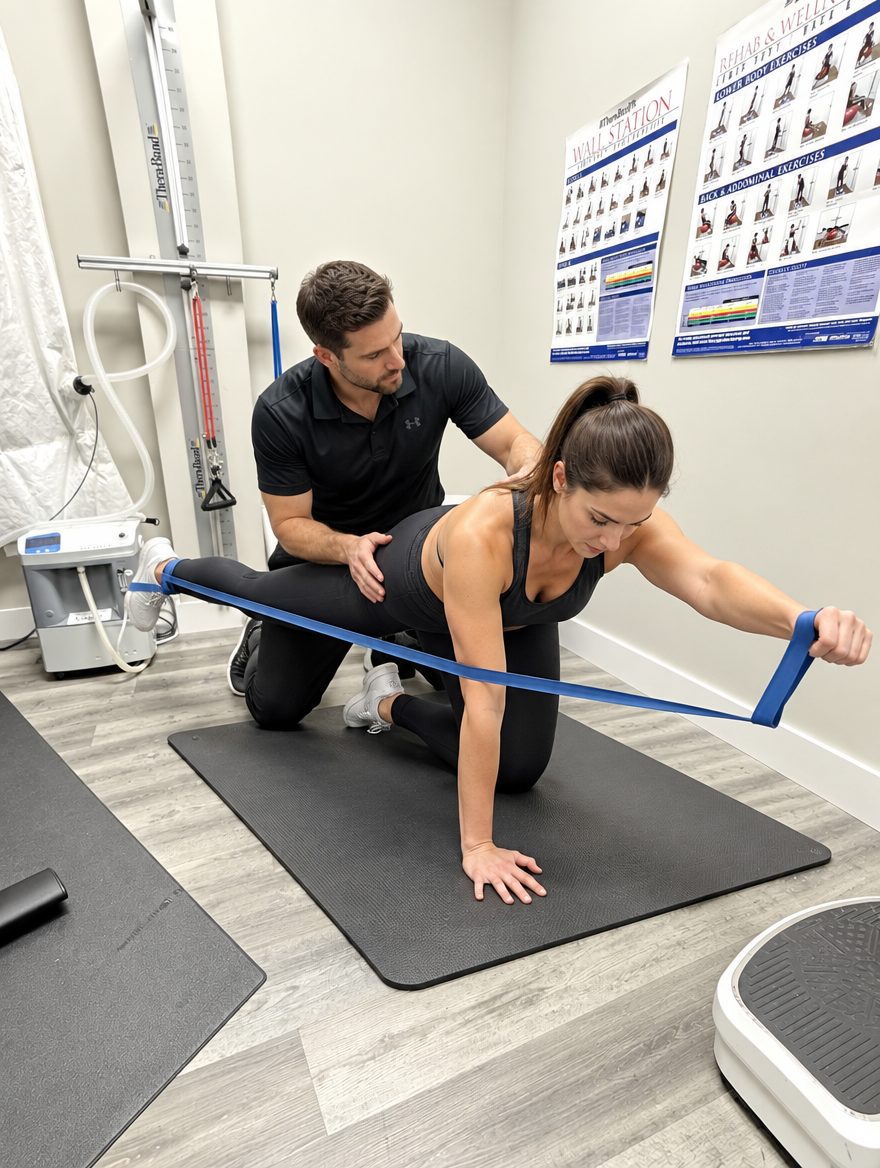
Once the tissue is quiet we rebuild what the hit cost. Physical therapy restores full neck motion and the shoulder-blade and neck strength that protect against the next stinger, deep core and hip strength so the lumbar spine can absorb line play, shoulder stability for tackling and blocking, and single-leg strength, hamstring capacity and cutting mechanics for the knee. This is the phase that decides whether the injury returns when contact resumes.
R3 and R4 · Regenerate and Refine
The Regenerate phase (about twice a week for two or more months) supports recovery between games with red light, PEMF, massage therapy and cupping for the neck, shoulders and hamstrings. Refine is a brief structural tune-up every month or two during the season — a short visit that catches a stiff neck or a tight low back before it costs a player game time.
Sports injury rehab
The staged progression we use for every injured player — calm, mobilize, stabilize, strengthen, return.
Learn moreLower back pain relief
Decompression and adjustments for the disc and facet patterns that line play aggravates.
Learn moreShoulder pain treatment
AC joint, rotator cuff and stability work for a shoulder that will not cock back after contact.
Learn moreKnee pain treatment
MCL, meniscus and patellar tendon patterns from cutting, planting and pile-ups.
Learn moreWhen can a player return to contact?
A player returns to contact when he meets objective criteria, not when the schedule says so. Conditioning and non-contact skill work usually continue, modified, throughout. Full return is staged — and we coordinate with the athletic trainer when the school has one:
- Pain-free daily movement. Full, pain-free neck motion with no arm symptoms; sleeping, sitting and walking without the back, shoulder or knee speaking up.
- Symmetry on re-test. Neck, shoulder and hip motion within roughly 10 percent side to side; a surface EMG re-scan showing the guarding has settled.
- Strength benchmarks. Full arm strength and sensation after a stinger; shoulder and shoulder-blade strength near the uninjured side; a single-leg hop within 90 percent of the other side for the knee and hamstring.
- Graded activity progression. Jogging and straight-line running, then cutting and sprinting, then non-contact drills, then limited contact, then full contact — with 24 hours between steps to see how the tissue responds.
- Volume before intensity. A full practice before a full game, and a full game before a short week.
If any step flares the injury, we back up one stage rather than push through. Good football injury treatment returns a player a week later and confident rather than a week early and fragile.
How do we prevent the next football injury?
The best football injury treatment looks forward. Once a player is back to full strength, a little upkeep goes a long way toward keeping him there through a long season.
- Neck and shoulder-blade strength. A strong neck and upper back is the best protection against repeat stingers. Two short sessions a week is enough.
- Hips, core and hamstrings. Deep core and hip strength protect a lineman’s low back; hamstring strength and sprint exposure protect a skill player’s legs.
- Warm up properly. Dynamic movement, not static stretching, before practice and games.
- Technique and equipment. Heads-up tackling and blocking, properly fitted pads and helmet, cleats suited to the surface.
- Catch early aches. A neck that is stiff after every game or a low back that is tight every Monday is the time to come in — a Refine-phase tune-up is far shorter than a full Repair phase.
Youth, high-school and adult players: what changes?
Football injury treatment is scaled to age, position and stage, because a youth-league player, a varsity lineman and an adult flag or semi-pro player load the body very differently.
Youth and middle-school players. Growing bones and growth plates are more vulnerable than adult tissue, and the threshold for referring to a physician is lower. We use gentle, age-appropriate techniques, keep parents in every decision, and never clear a head injury — that belongs to the athlete’s doctor.
High-school and college players. Friday-night programs across Coral Springs and Parkland bring us stingers, line-play backs and skill-position hamstrings. Our high-school and college athlete programs build on the same assessment and coordinate with athletic trainers, strength coaches and physicians so there is one plan. Adult players — flag, semi-pro and former linemen still carrying the low back — get the same measured approach with more aggressive strength work.
When should a football injury see a doctor first?
Head injuries always. Any blow to the head with headache, dizziness, confusion, nausea, memory trouble, unusual behavior or loss of consciousness is a suspected concussion: the athlete should stop playing immediately and be evaluated by a physician, and coaches should follow their league’s return-to-play protocol. We do not diagnose, clear or manage concussions. Once a physician has taken the lead on the head injury, we can support the neck and upper back that absorbed the same hit — easing the whiplash-type strain and muscle guarding that often linger.
Also see a doctor or urgent care today for: a stinger with weakness or numbness that does not clear within minutes, or symptoms in both arms; neck pain with limited motion after a hit; a knee that gave way, popped or swelled immediately; a shoulder that dislocated or will not move; numbness in the groin or loss of bladder or bowel control; or chest pain or shortness of breath.
For everything else — the stinger that cleared but left a stiff neck, the low back that locks up on Monday, the shoulder that will not cock back, the knee that swells after every game — this is what we do every day for players from Coral Springs and Parkland, and same-day appointments are usually available. If the main complaint is the neck, start with our neck pain guide. We also treat baseball athletes and other sports.
Serving football players across North Broward
Our clinic at 5675 Coral Ridge Drive, Coral Springs, FL 33076 serves Coral Springs, Parkland, Coconut Creek, Margate, Boca Raton, Tamarac, Pompano Beach and Deerfield Beach. Same-day appointments are usually available — call (954) 341-2256 or book online. Most patients from Parkland and Coral Springs are here in under 15 minutes.
Medically reviewed by Dr. Jared Cohen, DC — Co-Founder & Clinical Director, The Spine and Wellness Center. Last reviewed October 2026.
Frequently asked questions
Can you treat a concussion?
No. A suspected concussion or any head injury is a medical matter that must be evaluated by a physician or athletic trainer first — we do not diagnose, clear or manage concussions. Once a doctor has managed the head injury, we can support recovery of the neck and upper back that often absorbed the same impact.
My son got a stinger at practice — what should we do?
A stinger that clears within minutes with full strength and no neck pain is common in contact sports. Any weakness or numbness that lasts, symptoms in both arms, neck pain or a stinger that keeps coming back needs to be checked before returning to play. We evaluate the neck and shoulder, refer for imaging when indicated, and rehab the area once serious injury is ruled out.
What football injuries does football injury treatment cover?
Stingers and neck strain, low back pain and lineman overuse, AC joint and rotator cuff injuries, MCL sprains, meniscus irritation and patellar tendon pain, and hamstring, hip flexor and groin strains. Head injuries and suspected major ligament tears are referred to a physician first.
How soon after a football injury should a player come in?
Once any emergency has been ruled out, sooner is better for lingering pain, stiffness or reduced motion — early evaluation guides safe activity and rehab. For severe pain, head symptoms, loss of feeling, or an inability to move a limb or bear weight, see a physician or urgent care first.
How long does football injury treatment take?
It depends on the tissue. A simple stinger or a mild neck strain often settles in two to four weeks; a hamstring strain, an MCL sprain or a disc-related low back injury typically needs the full Repair and Rebuild phases, roughly 8–16 weeks to a confident return to contact. We give you a realistic range at your report of findings and update it at each re-test.
Do you work with youth and high-school football players from Parkland?
Yes. We care for youth, middle-school and high-school players from across Coral Springs, Parkland, Coconut Creek and Margate, using age-appropriate techniques, keeping parents involved, and coordinating with athletic trainers and physicians. Same-day appointments are usually available.
Same-day appointments
Let's build your plan.
Find out what's actually going on and get a clear path forward. Same-day appointments available.
- Same-day appointments are usually available
- Our team calls you back to confirm your visit
- Coral Springs, serving Parkland & North Broward since 2005
Prefer to talk now? Call or text (954) 341-2256