

Athletes · Coral Springs & Parkland
Baseball injury treatment in Coral Springs & Parkland
A throw is not an arm motion — it is a chain from the legs through the hips and trunk to the hand. When one link is stiff or weak, the shoulder and elbow pay for it. We measure the chain, calm the tissue, rebuild it and return you to throwing on objective criteria.
Quick answer
Baseball injury treatment at The Spine and Wellness Center starts with measurement — a structural exam, a throwing-chain movement screen, surface EMG and GaitScan — then follows the 4R Method: calm the irritated shoulder, elbow, back or hamstring, restore hip and trunk rotation, rebuild rotator cuff and scapular endurance, and return to throwing on objective criteria and a graded program. Sharp elbow pain in a young thrower is referred to a physician first.
What are the most common baseball injuries?
Baseball injury treatment in Coral Springs and Parkland centers on the throwing chain: the shoulder, the elbow, the lower back, the hips and the hamstrings. Overhead throwing produces some of the highest joint loads in all of sport, and in a South Florida travel-ball and high-school calendar that runs nearly year-round, the arm rarely gets a true off-season.
By body region, in the order we see them in our clinic:
- Shoulder. Rotator cuff strain and tendinopathy, impingement, and loss of internal rotation in the throwing shoulder — often with a shoulder blade that has stopped controlling the arm. In youth throwers, growth-plate stress at the upper arm (Little League shoulder) is the concern.
- Elbow. Inner-elbow pain from flexor-pronator strain and ulnar collateral ligament (UCL) overload — ‘pitcher’s elbow’. In young throwers, inner-elbow pain can mean growth-plate irritation (Little League elbow) and always gets a physician’s evaluation first.
- Lower back. Lumbar strain, facet irritation and disc-related pain from the repetitive rotation of pitching and hitting; stress reactions in the back of the spine are a real concern in adolescent players with back pain.
- Hips. Limited hip internal rotation and hip flexor tightness that shorten the stride and shift rotation into the low back and arm.
- Hamstrings and calves. Strains from sprinting out of the box, base running and sudden stops; catchers add knee and hip stiffness from thousands of squats.

Why does baseball cause these injuries?
Baseball injures players because the throw concentrates enormous force at the shoulder and elbow, and because volume in South Florida is relentless. A pitch is a chain that starts in the legs and hips, travels through the trunk and shoulder blade, and finishes at the hand. When one link is stiff or weak, the others overwork to make up for it.
- Late cocking and acceleration. At the top of the throw the shoulder reaches extreme external rotation and the inner elbow takes a valgus load that the UCL and flexor-pronator muscles must resist on every pitch. Fatigue, poor mechanics and too many pitches are what push that load past what the tissue can tolerate.
- Lost internal rotation. Throwers gain external rotation and lose internal rotation over a season. When the deficit gets large, the shoulder and elbow absorb what the arm can no longer decelerate.
- Hips and trunk that do not contribute. A pitcher with tight hips or limited mid-back rotation generates velocity at the arm instead of the legs — the arm is paying for what the core could not deliver.
- Rotation on repeat. Every pitch and every swing rotates the lumbar spine under load, and hitting adds hip and hamstring demand on the lead leg.
- Volume and no off-season. Travel ball, school ball, showcases and lessons stack up. Pitching while fatigued and pitching for more than one team at a time show up in almost every elbow case we see.
The American Academy of Orthopaedic Surgeons notes that elbow injuries in throwing athletes are overuse injuries caused by the repetitive stress of throwing, and that pitching too much, pitching with fatigue and poor mechanics are the major risk factors (AAOS OrthoInfo, Elbow Injuries in the Throwing Athlete). That is why our baseball injury treatment always starts with the whole chain and the workload, not just the sore joint.
How do we assess a baseball injury?
We measure before we treat. A sore elbow is often a stiff hip or a tired shoulder blade sending the bill downstream, and the only way to know is to measure the chain. Your first visit is a measurement visit, and your baseball injury treatment plan is built on what we find.
Visit one — we measure (and usually begin care)
- A real conversation. Position, age, teams, pitch counts and innings, how the pain started, what has been tried, and the season calendar you are working with.
- A hands-on structural exam and throwing-chain screen. Shoulder internal and external rotation on both sides, rotator cuff strength and endurance, shoulder-blade control, elbow stability and flexor-pronator testing, thoracic and hip rotation, a single-leg balance and squat screen, hamstring length, and orthopedic tests for the lumbar discs and facets.
- Surface EMG and thermal scanning. A painless MyoVision surface EMG scan shows where the muscles along the spine are guarding — in pitchers and hitters the dominant side almost always lights up.
- GaitScan. A digital foot-pressure analysis with GaitScan shows how you load each foot — a lead foot that collapses on landing or a push-off leg that does not drive is often where arm stress begins.
- Digital X-rays, when indicated. For persistent low back pain or a history of disc problems we look at the actual architecture. Sharp or persistent inner-elbow pain in a young thrower is referred to a physician for imaging before we treat.
Visit two — your findings and your plan
We walk through the scans and movement findings in plain English — with parents in the room for younger players — map them to the phases of the 4R Method, and explain what we recommend, how often and for how long. Treatment begins at this visit. For a head start, take the 60-second spine assessment before you come in.

How does baseball injury treatment work through the 4R Method?
Baseball injury treatment at our clinic follows the 4R Method — Repair, Rebuild, Regenerate, Refine — because the order matters. Strengthening an irritated shoulder or elbow too soon just stirs it back up, and calming the pain without restoring hip and trunk rotation gives you a few good outings and then the same arm.
R1 · Repair — calm the tissue (3–5 visits a week, 4–8 weeks)
The Repair phase settles pain and restores easy motion. For the throwing shoulder and elbow that means the Graston Technique for the tight cuff, forearm and posterior shoulder, cold laser to settle inflamed tendon, and acoustic shockwave for stubborn tendinopathy. For the back and hips it means precise chiropractic adjustments to the segments that have locked up, and non-surgical spinal decompression when a lumbar disc is involved. Hamstring strains get soft-tissue work, laser and early protected loading. This is usually the shortest phase, but skipping it makes everything after harder.
R2 · Rebuild — restore the chain (2–3 visits a week, 8–16 weeks)
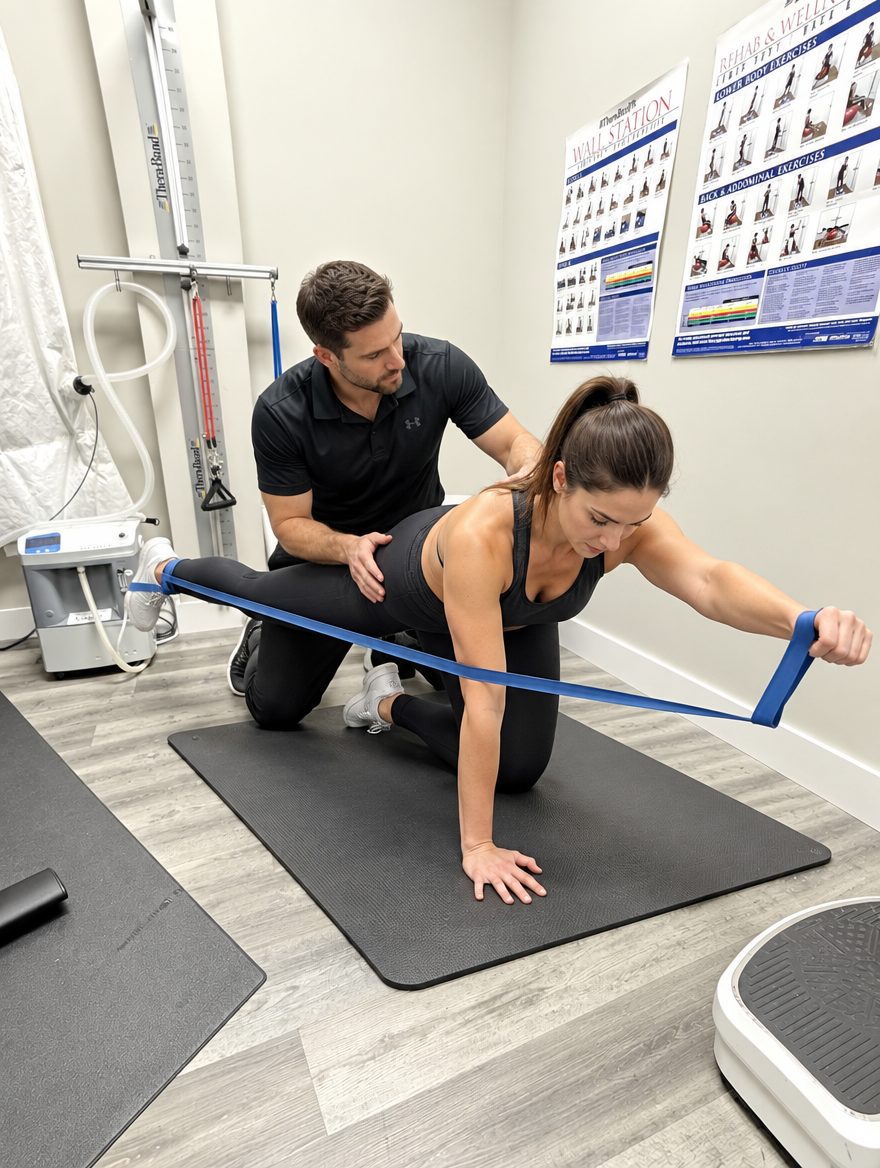
Once the tissue is quiet we rebuild what the injury cost. Physical therapy restores shoulder internal rotation, rotator cuff endurance and shoulder-blade control, hip internal rotation and trunk rotation so velocity comes from the legs again, and hamstring and single-leg strength for the stride and base running. For the elbow, progressive forearm and grip loading reloads the flexor-pronator tendon. This is the heart of the work and where most players spend their time.
R3 and R4 · Regenerate and Refine
The Regenerate phase (about twice a week for two or more months) supports recovery between outings with red light, PEMF, massage therapy and cupping for the forearm, cuff and posterior shoulder. Refine is a brief structural tune-up every month or two through the season — a short visit that catches a stiff hip or a shoulder losing internal rotation before it becomes an elbow problem.
Sports injury rehab
The staged progression we use for every injured player — calm, mobilize, stabilize, strengthen, return.
Learn moreShoulder pain treatment
Rotator cuff, impingement and shoulder-blade mechanics behind a throwing shoulder that hurts.
Learn moreTennis and golfer's elbow
Graston, cold laser and shockwave for the inner-elbow flexor-pronator tendon, plus a loading program that holds.
Learn moreHip and SI joint pain
Restore hip rotation and pelvic balance so the low back and arm stop absorbing the throw.
Learn moreWhen can a player return to throwing?
A player returns to throwing when they meet objective criteria, not when a tournament is scheduled. Position players usually keep hitting, running and fielding in a modified way while the arm recovers; pitchers follow a graded throwing program. Full return is staged:
- Pain-free daily movement and sleep. No shoulder or elbow pain reaching overhead, carrying a bag or sleeping on the side.
- Range of motion on re-test. Shoulder internal rotation within roughly 10–15 degrees of the non-throwing side, full elbow extension, and hip rotation symmetric side to side.
- Strength and endurance benchmarks. Rotator cuff and shoulder-blade strength near the non-throwing side on testing, pain-free resisted wrist flexion and grip, and a single-leg balance and hop test within 90 percent of the other side.
- Graded throwing program. Flat-ground throwing starting around 45 feet and building distance over two to four weeks, then mound work at reduced effort, then full effort, then game innings — with a day between steps to see how the arm responds.
- Volume before intensity. Bullpens before innings, and innings before a doubleheader or a showcase weekend.
If any step flares the injury, we back up one stage rather than push through. Good baseball injury treatment returns a player a week later and confident rather than a week early and fragile.
How do we prevent the next arm injury and add velocity?
The best baseball injury treatment looks forward. Once the arm is moving well, the goal is to keep it durable through a long season — and the same work that protects it usually adds velocity, because power starts coming from the legs and trunk instead of the arm.
- Warm up before catch. Five minutes of movement, band work for the cuff and shoulder blade, and hip and trunk rotations before the first throw.
- Honest pitch counts and rest days. Age-appropriate pitch limits, no pitching for two teams in one season, no pitching through fatigue, and two to three months a year away from competitive throwing.
- Keep internal rotation. A short posterior-shoulder and hip mobility routine after throwing prevents the deficit that drives elbow problems.
- Build the cuff, the shoulder blade and the legs off the field. Two short sessions a week changes how the body absorbs a pitch.
- Catch early aches. A shoulder that is sore the next morning or an elbow that tightens after bullpens is the time to come in — a Refine-phase tune-up is far shorter than a full Repair phase.
Youth, high-school and adult players: what changes?
Baseball injury treatment is scaled to age and stage, because a 12-year-old travel-ball pitcher, a high-school arm chasing a scholarship and an adult-league hitter load the body very differently.
Youth and travel-ball players. Growth plates at the shoulder and elbow are the weak link in a growing thrower, so inner-elbow or shoulder pain in a young player gets a physician’s evaluation and imaging before any hands-on care. Once serious injury is ruled out, we use gentle, age-appropriate techniques, keep parents in every decision, and talk honestly about pitch counts and the tournament calendar at the sports complexes around Coral Springs and Parkland.
High-school and college players. Volume and showcase pressure are the drivers; our high-school and college athlete programs build on the same assessment and coordinate with athletic trainers and coaches. Adult-league players arrive with years of throwing plus a desk job; for them it is about restoring rotation and keeping the shoulder and back durable.
When should a baseball injury see a doctor first?
A small number of injuries are not conservative-care problems. If a young thrower has sharp or persistent inner-elbow pain, a pop was felt in the elbow or shoulder during a throw, the arm is numb or tingling after throwing, a joint is severely swollen or looks deformed, an adolescent has back pain that is worse with arching, or there is a blow to the head with headache, dizziness or confusion, please see a doctor or urgent care today. We will be here for the recovery afterwards and coordinate with the physician.
For everything else — the shoulder that aches after every outing, the elbow that tightens after bullpens, the back that locks up on the swing, the hamstring that grabs out of the box — this is what we do every day for players from Coral Springs and Parkland, and same-day appointments are usually available. If your pain is mainly in the low back, start with our lower back pain guide. We also treat football and golf athletes, who share many of the same rotational patterns.
Serving baseball players across North Broward
Our clinic at 5675 Coral Ridge Drive, Coral Springs, FL 33076 serves Coral Springs, Parkland, Coconut Creek, Margate, Boca Raton, Tamarac, Pompano Beach and Deerfield Beach. Same-day appointments are usually available — call (954) 341-2256 or book online. Most patients from Parkland and Coral Springs are here in under 15 minutes.
Medically reviewed by Dr. Jared Cohen, DC — Co-Founder & Clinical Director, The Spine and Wellness Center. Last reviewed October 2026.
Frequently asked questions
What baseball injuries do you treat?
Rotator cuff and throwing-shoulder pain, inner-elbow and UCL-related pain (pitcher's elbow), low back strain from rotation, hip mobility limits that shorten the stride, and hamstring strains from base running. Because these are linked along the throwing chain, we evaluate the whole pattern rather than one sore spot.
Can chiropractic care help a young pitcher's throwing arm?
Often, yes, as part of a plan. Much of a pitcher's arm stress traces back to limited hip and mid-back rotation or a fatigued rotator cuff, which forces the elbow and shoulder to work harder. Restoring motion up the chain and rebuilding cuff and scapular control reduces that load. Sharp, persistent elbow pain in a youth thrower is evaluated by a physician first.
Do I have to stop throwing during baseball injury treatment?
For an irritated shoulder or elbow, yes — a short period away from throwing is usually needed while the tissue calms, though hitting, running and conditioning typically continue. Pitchers then return through a graded flat-ground and mound program with objective criteria at each step rather than a fixed date.
How long does baseball injury treatment take?
It depends on the tissue. A hamstring strain or a mild cuff irritation often settles in three to six weeks; a chronic elbow tendinopathy, a significant internal-rotation deficit or a disc-related back injury typically needs the full Repair and Rebuild phases, roughly 12–20 weeks to a confident return to full throwing. We give you a realistic range at your report of findings.
Do you treat youth and travel-ball players?
Yes. We see players from Little League and travel ball through high school, college and adult leagues. Care is scaled to age and stage — gentle, age-appropriate techniques for younger athletes, parents involved in every decision, and workload guidance for busy South Florida tournament schedules.
Do you treat baseball players from Parkland and Coconut Creek?
Yes. Our clinic on Coral Ridge Drive in Coral Springs is minutes from Parkland, Coconut Creek, Margate, Tamarac and Boca Raton, and we see players from youth, travel-ball, high-school and adult programs across North Broward. Same-day appointments are usually available.
Same-day appointments
Let's build your plan.
Find out what's actually going on and get a clear path forward. Same-day appointments available.
- Same-day appointments are usually available
- Our team calls you back to confirm your visit
- Coral Springs, serving Parkland & North Broward since 2005
Prefer to talk now? Call or text (954) 341-2256