

Athletes · Coral Springs & Parkland
Pickleball injury treatment in Coral Springs & Parkland
The fastest-growing sport in South Florida asks tissue that has not sprinted, pivoted or swung overhead in years to do all three in one game. We measure where it is breaking down, calm it, rebuild it and get you back to the kitchen line on objective criteria.
Quick answer
Pickleball injury treatment at The Spine and Wellness Center starts with measurement — a structural exam, movement screen, surface EMG and GaitScan — then follows the 4R Method: calm the irritated elbow, calf, shoulder, knee or low back, restore the mobility the game demands, rebuild strength for push-offs and overheads, and return to full play on objective criteria. Most players keep playing, modified, while they recover.
What are the most common pickleball injuries?
Pickleball injury treatment in Coral Springs and Parkland is mostly about five regions: the elbow and wrist, the calf and Achilles, the shoulder, the knee and the lower back. Courts have gone up at parks, clubs and HOAs across North Broward, and many of the players filling them are active adults in their 50s, 60s and 70s who love the fast, social game but have not sprinted or swung overhead in years.
Most pickleball injuries fall into two buckets — overuse problems that build over weeks of play, and acute strains and sprains from one bad lunge or reach. By body region:
- Elbow and wrist. ‘Pickleball elbow’ — lateral epicondylitis — from repetitive paddle strokes and gripping, plus wrist sprains from off-balance shots, dinks and the occasional fall.
- Calf and Achilles. Calf strains and Achilles tendinopathy from hard push-offs, backpedaling for a lob and sudden stops at the kitchen line. This is the signature acute injury of the sport in adults over 50.
- Shoulder. Rotator cuff irritation and impingement from overhead serves, smashes and reaching volleys.
- Knee. Patellar tendon pain, tracking problems and meniscus irritation from pivoting, lunging and cutting side to side on a hard court.
- Lower back. Lumbar strain and facet or disc irritation from rotation, bending for low balls and hours on your feet.

Why does pickleball cause these injuries?
Pickleball injures players because it combines sudden demand with long-dormant tissue. The game looks gentle from the sidelines, but it asks the body for short, repeated bursts — dozens of times a game, several games in a row, three or four days a week.
- Push-off and backpedal. You push off hard to reach a dink, backpedal for a lob and stop against your own momentum. Those accelerations load the calf and Achilles more than almost any other recreational sport, and a calf that has not been trained for it is the one that tears.
- Plant and pivot at the kitchen line. Quick direction changes on a hard court load the knee and ankle, and a knee that tracks poorly or a hip that does not rotate sends the stress to the joint.
- Paddle strokes and overheads. Repetitive gripping and flicking irritate the forearm extensors; serves and smashes drive the shoulder overhead with a shoulder blade that often has not moved well in years.
- Rotation and bending. Reaching low for a dink and rotating through a drive load the lumbar discs and facets, especially in players who sit most of the day and then play for two hours.
- Heat, surface and enthusiasm. The South Florida heat, hard courts and the very human temptation to play through soreness turn small irritations into real injuries.
The American Academy of Orthopaedic Surgeons describes Achilles tendinitis as an overuse injury driven by a sudden increase in the amount or intensity of activity and by tight calf muscles — exactly the profile of a new pickleball player (AAOS OrthoInfo, Achilles Tendinitis). That is why our pickleball injury treatment always begins with the movement pattern behind the pain, not just the sore spot.
How do we assess a pickleball injury?
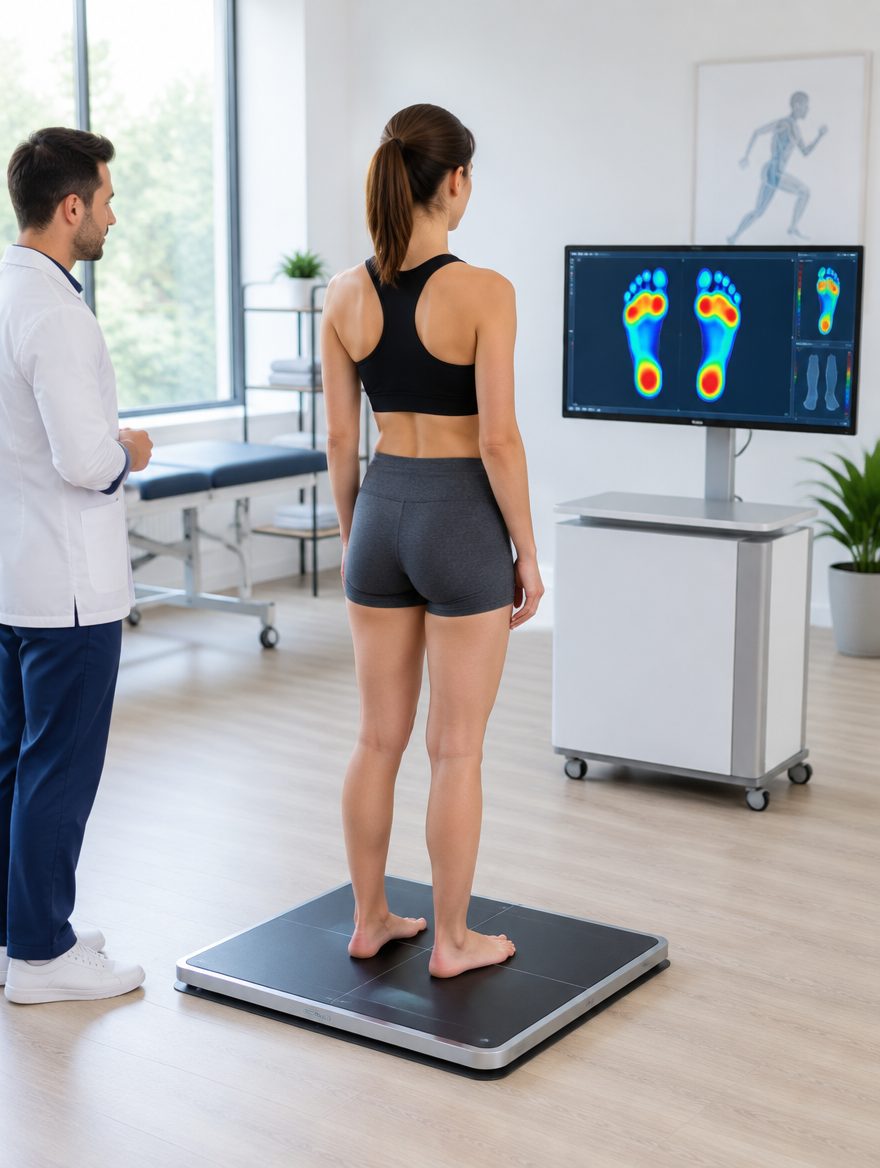
We measure before we treat. A sore calf tells you little about why it keeps straining; how you load your feet and how your hips and ankles move does. Your first visit is a measurement visit, and your pickleball injury treatment plan is built on what we find.
Visit one — we measure (and usually begin care)
- A real conversation. How often you play, how long you have played, your history — arthritis, osteoporosis, a joint replacement, old injuries — what hurts, and what you want to get back to.
- A hands-on structural exam and movement screen. Ankle dorsiflexion and calf strength, a single-leg balance and squat screen, hip rotation, shoulder range and rotator cuff strength, shoulder-blade control, and orthopedic tests for the lumbar discs, facets and SI joint. For elbow pain, resisted wrist extension and grip testing isolate the tendon.
- Surface EMG and thermal scanning. A painless MyoVision surface EMG scan shows where the muscles along the spine are guarding and compensating.
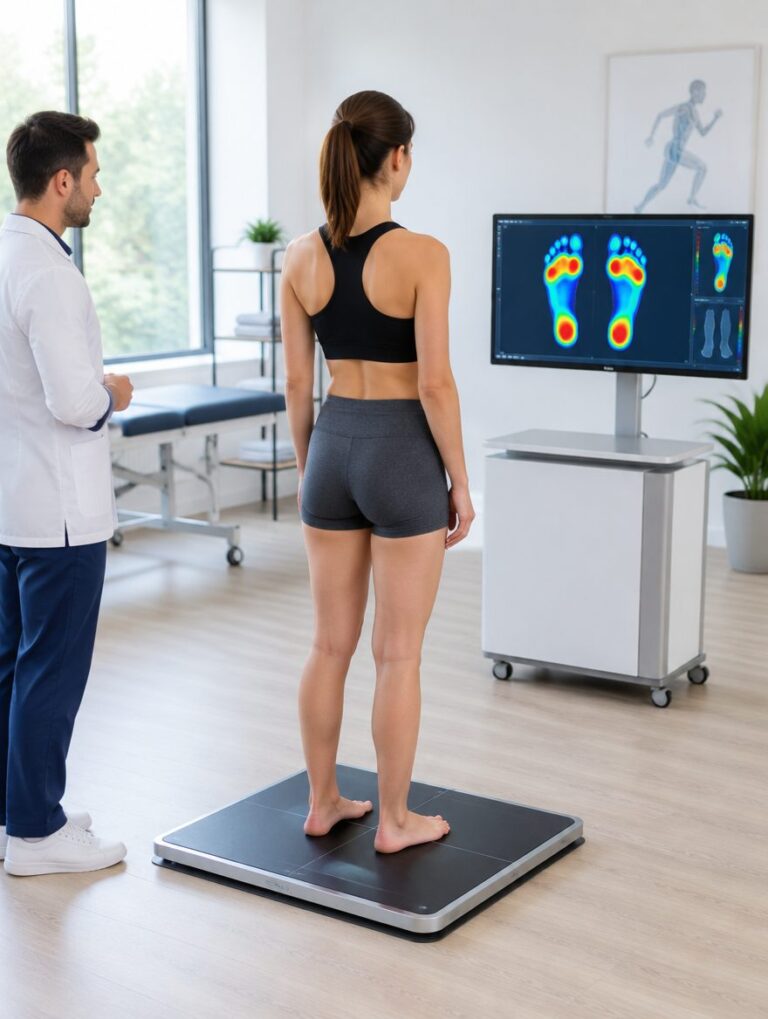
- GaitScan. A digital foot-pressure analysis with GaitScan shows how you load each foot — a collapsing arch or an old ankle sprain is often the reason the calf, knee or hip keeps flaring.
- Digital X-rays, when indicated. For persistent low back pain, radiating leg symptoms, a history of disc problems or significant arthritis we look at the actual architecture.
Visit two — your findings and your plan
We walk through the scans and the movement findings in plain English, map them to the phases of the 4R Method, and explain what we recommend, how often and for how long. Treatment begins at this visit. For a head start, take the 60-second spine assessment before you come in.
How does pickleball injury treatment work through the 4R Method?
Pickleball injury treatment at our clinic follows the 4R Method — Repair, Rebuild, Regenerate, Refine — because the order matters. Tissue that is only rested comes back weak and ready to re-injure; tissue that is loaded before it has calmed down flares again. So we do it in sequence.
R1 · Repair — calm the tissue (3–5 visits a week, 4–8 weeks)
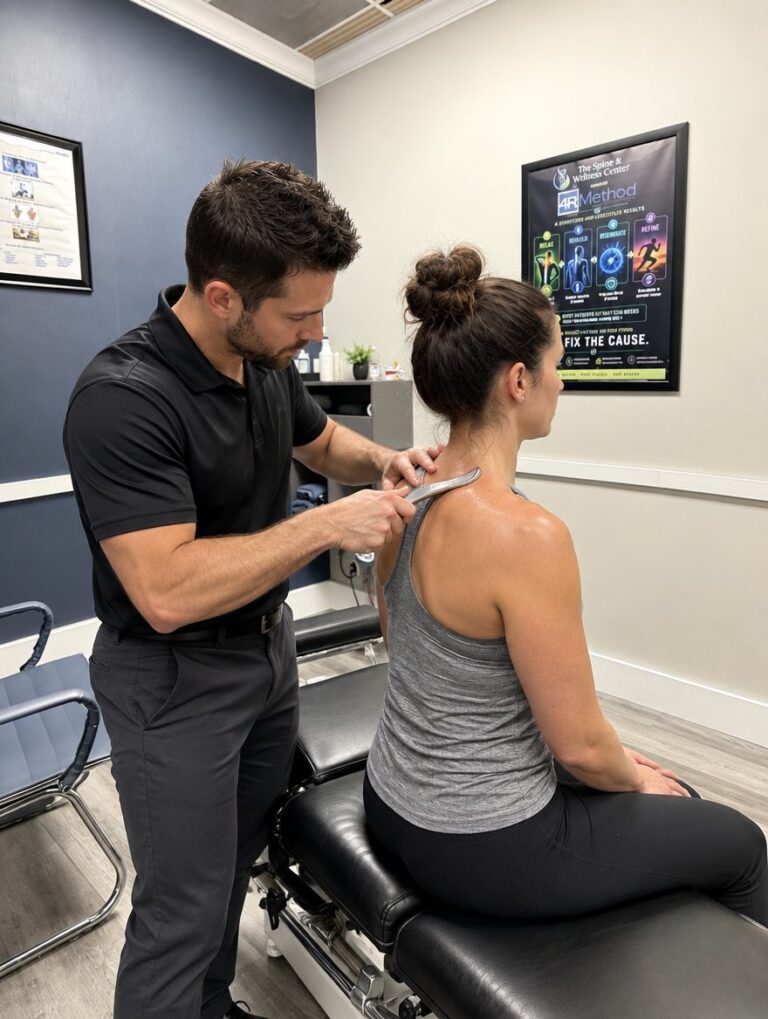
The Repair phase quiets whatever is irritated. For pickleball elbow that means the Graston Technique along the extensor tendon, cold laser to settle inflammation, and acoustic shockwave for stubborn cases. For calf and Achilles strains we use soft-tissue work, laser and early protected loading. For the shoulder, knee and low back it means precise chiropractic adjustments to the joints that have locked up, and non-surgical spinal decompression when a lumbar disc is involved. Most players notice a difference within two to three weeks.
R2 · Rebuild — restore mobility and strength (2–3 visits a week, 8–16 weeks)
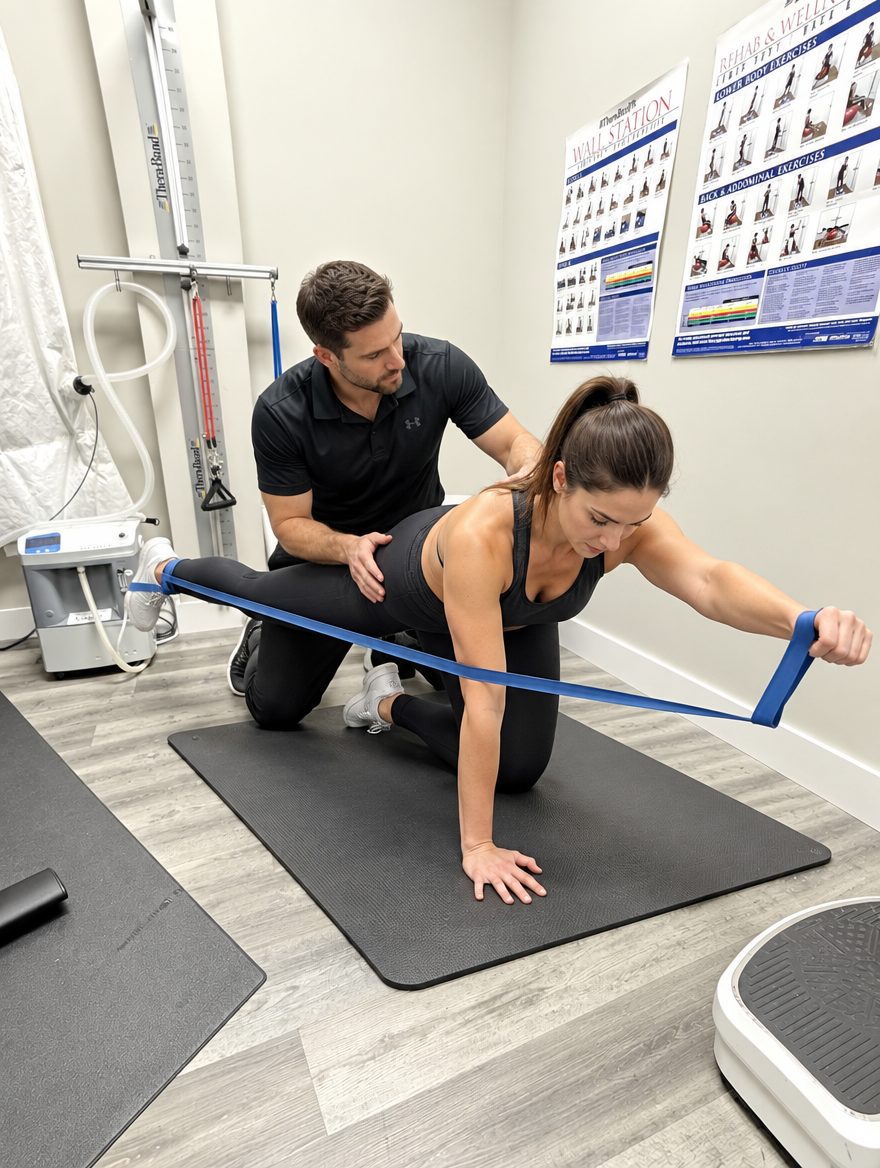
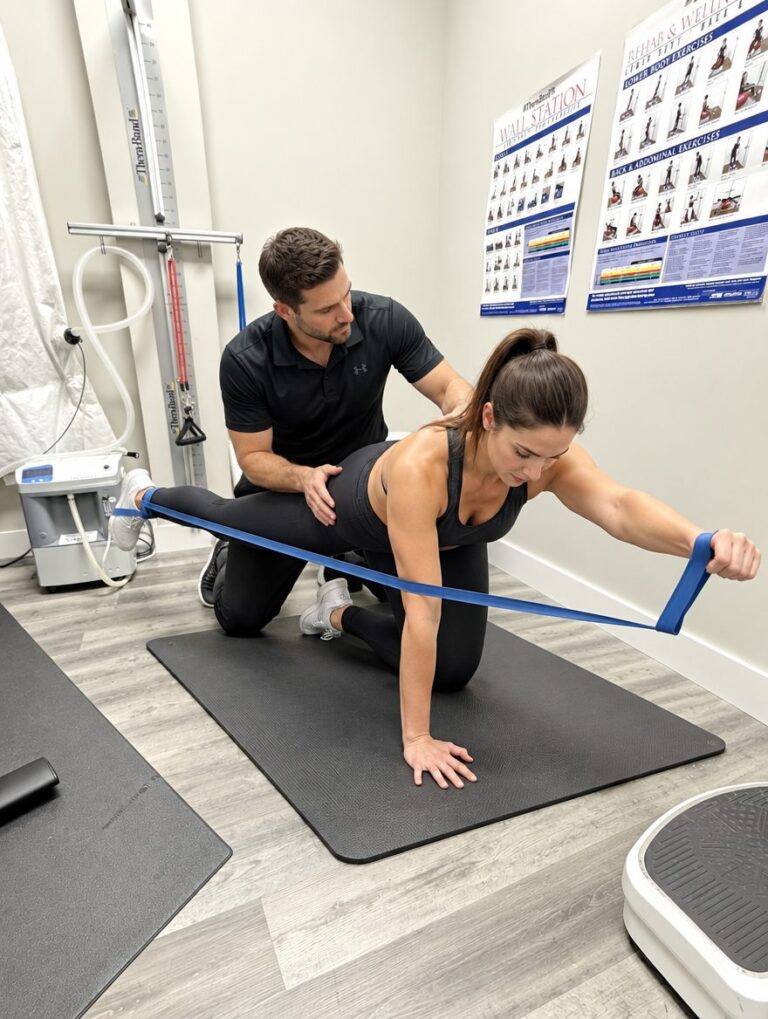
Once the tissue is quiet we correct what caused the injury. Physical therapy rebuilds calf and Achilles capacity with progressive loading so the push-off is safe again, single-leg strength and balance for the knee and ankle, shoulder-blade control and rotator cuff endurance for overheads, and hip and core strength so the low back stops absorbing every dink. For the elbow, a graded forearm loading program reloads the tendon. This is the phase that decides whether the injury returns.
R3 and R4 · Regenerate and Refine
The Regenerate phase (about twice a week for two or more months) supports tissue quality and recovery between sessions with red light, PEMF, massage therapy and cupping for the calf, forearm and shoulder. Refine is a brief structural tune-up every month or two — a quick visit that catches a tight calf or a grumbling elbow before it sidelines you for weeks.
Sports injury rehab
The staged progression we use for every injured player — calm, mobilize, stabilize, strengthen, return.
Learn moreTennis and golfer's elbow
Graston, cold laser and shockwave for pickleball elbow, plus a loading program that holds.
Learn moreKnee pain treatment
Patellar tendon, tracking and meniscus patterns from pivoting and lunging at the kitchen line.
Learn moreLower back pain relief
Decompression and adjustments for the disc and facet patterns that bending and rotation aggravate.
Learn moreWhen can you get back on the court?
You return to full play when you meet objective criteria, not when a date arrives. For most overuse injuries we keep you playing in a modified way — fewer games, no overheads, dinking and drilling instead of competitive play — rather than stopping you altogether. Full return is staged:
- Pain-free daily movement. Walking, stairs, gripping and sleeping without the calf, elbow, shoulder, knee or back speaking up.
- Symmetry on re-test. Ankle dorsiflexion, hip rotation and shoulder range within roughly 10 percent side to side; a surface EMG re-scan showing the guarding has settled.
- Strength benchmarks. 20–25 pain-free single-leg calf raises for calf and Achilles cases; a single-leg hop within 90 percent of the other side for the knee; pain-free resisted wrist extension and grip near the uninjured side for the elbow.
- Graded play progression. Dinking and drills, then half-court rallies, then full-court play without overheads, then overheads and competitive games — with 24 hours between steps.
- Volume before intensity. One session before back-to-back days, and back-to-back days before a tournament or league weekend.
If any step flares the injury, we back up one stage rather than push through. Good pickleball injury treatment returns you a week later and confident rather than a week early and fragile.
How do we prevent the next pickleball injury?
The best pickleball injury treatment looks forward. Once you are moving well, the goal is to keep the calf, elbow, shoulder, knee and back durable so you can play three or four days a week for years.
- Warm up before the first game. Five minutes of walking, calf raises, leg swings, shoulder circles and easy dinks. Cold calves are the ones that strain.
- Train the calf and the single leg. Daily calf raises and a couple of short balance and single-leg strength sessions a week change how your body handles push-offs and pivots.
- Check paddle and shoes. Grip size, paddle weight and court shoes with lateral support quietly drive elbow, wrist and ankle problems.
- Manage volume and recovery. Build up playing days gradually, hydrate in the Florida heat, and treat soreness that lasts more than 48 hours as information, not a challenge.
- Keep the hips and mid-back mobile so the low back and shoulder are not forced to make up the difference on overheads and low balls.
- Catch early aches. A tight calf after play or an elbow that aches the next morning is the time to come in — a Refine-phase tune-up is far shorter than a full Repair phase.
Active adults, seniors and younger players: what changes?
Pickleball injury treatment is scaled to age, history and stage. The sport’s fastest-growing group is the 50-and-over crowd, and that shapes how we care for most of our players.
Active adults and seniors. We tailor technique to your history — gentler approaches when there is osteoporosis, arthritis or a joint replacement, and closer attention to warm-up, recovery and playing frequency. Many players are on the court three to five days a week, and small adjustments to load and mechanics often make the difference between nagging pain and pain-free play. We also pay attention to balance and fall risk, because a stumble reaching for a lob is a common way wrists and shoulders get hurt.
Younger and competitive players. Players in their 20s to 40s, and the growing number of juniors picking up the sport in Coral Springs and Parkland, tend to arrive with the overuse profile of a racket athlete — elbow, shoulder and knee — and benefit from the same movement screen we use for high-school and college athletes.
When should a pickleball injury see a doctor first?
A small number of injuries are not conservative-care problems. If you felt a sudden pop in the calf or Achilles and cannot push off, a joint is severely swollen or looks deformed, you fell on an outstretched hand and the wrist is swollen and painful to move, you have numbness in the groin or loss of bladder or bowel control, or chest pain or shortness of breath during play, please see a doctor or urgent care today. We will be here for the recovery afterwards.
For everything else — the elbow that aches after every session, the calf that tightens on the first push-off, the shoulder that hurts on overheads, the low back that locks up after two hours of dinking — this is what we do every day for players from Coral Springs and Parkland, and same-day appointments are usually available. If your pain is mainly in the shoulder, start with our shoulder pain guide. We also treat tennis and padel players, who share many of the same patterns.
Serving pickleball players across North Broward
Our clinic at 5675 Coral Ridge Drive, Coral Springs, FL 33076 serves Coral Springs, Parkland, Coconut Creek, Margate, Boca Raton, Tamarac, Pompano Beach and Deerfield Beach. Same-day appointments are usually available — call (954) 341-2256 or book online. Most patients from Parkland and Coral Springs are here in under 15 minutes.
Medically reviewed by Dr. Jared Cohen, DC — Co-Founder & Clinical Director, The Spine and Wellness Center. Last reviewed October 2026.
Frequently asked questions
What are the most common pickleball injuries?
Pickleball elbow (lateral epicondylitis) and wrist sprains, calf strains and Achilles tendinopathy from push-offs, rotator cuff irritation from overheads, knee pain from pivoting and lunging, and low back pain from rotation and bending. In adults over 50 the calf and Achilles are the most common acute injury.
Do I need pickleball injury treatment or should I just rest?
Short rest can calm an acute flare, but rest alone rarely fixes the movement problem that caused the injury, so the pain often returns when you play again. Treating the tissue and the mechanics together — then rebuilding strength — is what lets you come back stronger rather than re-injured.
How is pickleball elbow treated without surgery or shots?
With a plan rather than a single tool: Graston Technique along the irritated tendon, cold laser or shockwave to support healing, joint and soft-tissue work up the arm, and a graded forearm loading program. We also review paddle grip size and your stroke so the strain that started it does not come right back.
How soon can I get back on the court?
It depends on the injury and how long it has been building. Mild strains often settle over three to four weeks of guided care; a calf or Achilles injury or a chronic tendon problem typically needs the full Repair and Rebuild phases, roughly 12–20 weeks to a confident full return. We progress you in stages and never promise a specific date.
Is pickleball injury treatment safe for older players with arthritis or a joint replacement?
Yes. We tailor every plan to the person, using gentler techniques where there is osteoporosis, arthritis or a joint replacement, and we choose the approach after reviewing your history and the injured area on visit one. Many of our players are in their 60s and 70s and on the court several days a week.
Do you treat pickleball players from Parkland and Coconut Creek?
Yes. Our clinic on Coral Ridge Drive in Coral Springs is minutes from Parkland, Coconut Creek, Margate, Tamarac and Boca Raton, and we see players from park, club and HOA courts across North Broward. Same-day appointments are usually available.
Same-day appointments
Let's build your plan.
Find out what's actually going on and get a clear path forward. Same-day appointments available.
- Same-day appointments are usually available
- Our team calls you back to confirm your visit
- Coral Springs, serving Parkland & North Broward since 2005
Prefer to talk now? Call or text (954) 341-2256