
Sports & Performance · 6 min read
Rotator cuff & shoulder pain: causes and care
Reaching overhead hurts, sleeping on that side is impossible, and getting dressed takes planning. Here is what is going on in the cuff and how most shoulders recover without an operation.

Quick answer
The rotator cuff is four muscles and tendons that hold the upper arm in its socket. Most shoulder pain comes from cuff tendinitis, impingement, bursitis or a partial tear — usually from repetitive overhead use, age-related wear or poor shoulder mechanics. Most cases improve with soft-tissue care, adjustments to the neck and upper back, and guided strengthening rather than surgery.
What is the rotator cuff?
The rotator cuff is a group of four muscles — supraspinatus, infraspinatus, teres minor and subscapularis — whose tendons wrap around the top of the upper arm bone and hold it snugly in the shallow shoulder socket. The cuff is what lets you lift, rotate and stabilize your arm through a remarkable range of motion. Because the shoulder trades stability for mobility, the cuff works hard every time you reach, and it is vulnerable to wear and injury.
Shoulder pain that makes it hard to reach overhead, sleep on one side or simply get dressed usually comes back to these tendons. In our Coral Springs clinic we see it in painters, swimmers, tennis and pickleball players, weekend golfers and plenty of people whose only sport is a laptop — and since 2005 most of them have recovered without an operation.

4 common rotator cuff injuries
Shoulder pain from the cuff usually falls into four overlapping categories. Knowing which you are dealing with guides the plan:
- Tendinitis (tendinopathy). Inflammation or degeneration of the cuff tendons from overuse — the most common pattern, especially after a burst of overhead activity.
- Impingement. The tendons and bursa get pinched between the arm bone and the bony roof of the shoulder when you raise the arm; the ‘painful arc’ between about 60 and 120 degrees.
- Bursitis. Irritation of the fluid-filled sac that cushions the tendons; often travels with impingement and makes the shoulder ache at rest.
- Partial or full-thickness tears. From a sudden injury — a fall on an outstretched arm, a hard lift — or gradual fraying over years. The American Academy of Orthopaedic Surgeons notes that many tears, especially partial ones, improve with non-surgical care.
Symptoms to watch for
- A dull ache deep in the shoulder that builds gradually rather than arriving all at once
- Pain when lifting or rotating the arm, especially overhead or behind the back (reaching for a seatbelt, a bra strap, a back pocket)
- Difficulty sleeping on the affected side; night pain that wakes you
- Weakness when reaching, lifting or carrying — a grocery bag suddenly feels heavy
- A catching, clicking or grinding sensation with certain movements
Get checked promptly if
You cannot lift the arm after a fall or injury, there is sudden severe pain or an obvious deformity — those can signal a significant tear or dislocation. Please see a doctor or urgent care today.
What causes rotator cuff pain?
Repetitive overhead activity is the leading cause — the tendons fray and inflame from doing the same motion thousands of times. Age plays a role: tendon tissue weakens with the years and the space the tendons pass through narrows. Acute injuries strain or tear the cuff suddenly.
The cause we find most often, though, is mechanics. Rounded shoulders and a forward head tilt the shoulder blade so the cuff tendons are pinched with every lift. A stiff upper back forces the shoulder to do the work the thoracic spine should share. A stiff neck changes how the nerves that drive the cuff fire. That is why we examine the neck and upper back on every shoulder, and why physical therapy and chiropractic work better together for this joint in particular. Elbow pain alongside it is common in racquet sports — see golfer’s and tennis elbow.
How we care for rotator cuff and shoulder pain
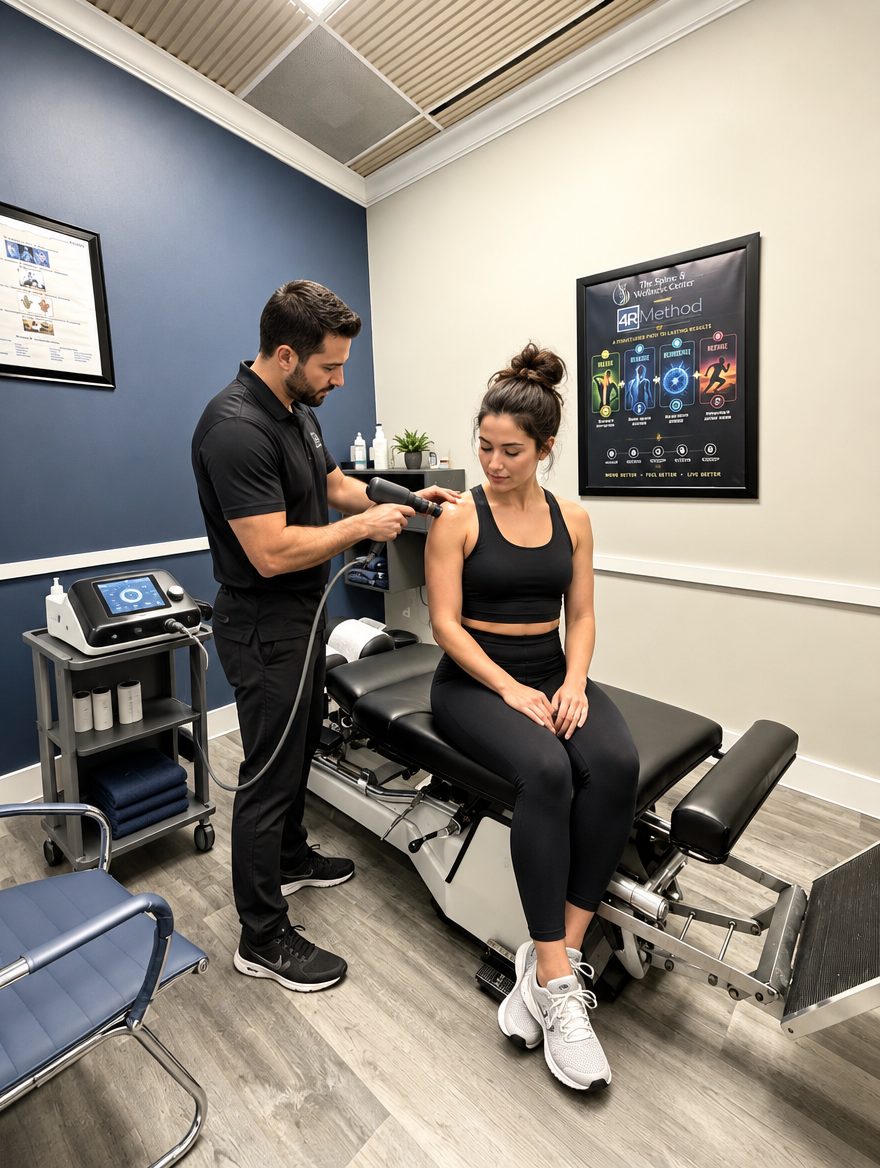
Most cuff injuries respond to a conservative plan, and surgery is reserved for the minority that do not improve — large full-thickness tears in particular. Visit one is measurement: a conversation about how it started, a hands-on exam of the cuff (strength tests for each of the four muscles, impingement tests, range of motion) plus the neck and upper back, surface EMG and thermal scanning, and digital X-rays when indicated. Visit two is your full report of findings and plan, and Most patients have already begun care on visit one; this is where the full plan takes over. Our rotator cuff treatment follows the 4R Method:
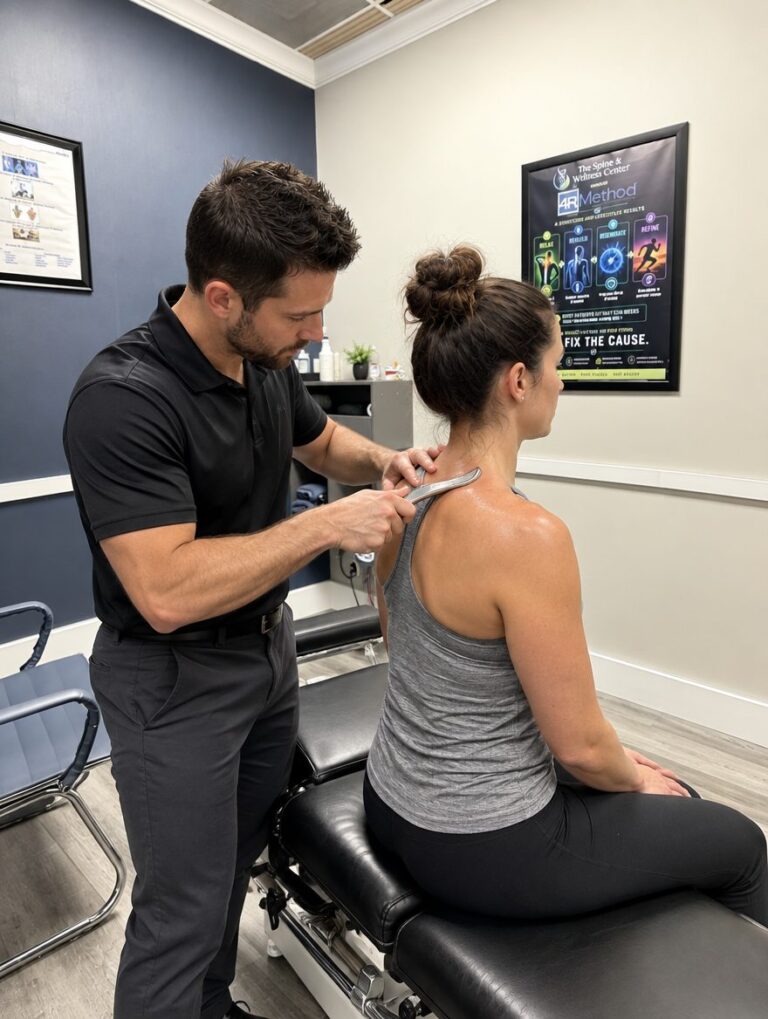
- Repair (3–5 visits a week, 4–8 weeks). Reduce the inflammation and restore pain-free motion: cold laser and therapeutic ultrasound for the irritated tendon, acoustic shockwave for chronic tendinopathy, Graston soft-tissue work for the thickened tissue, and chiropractic adjustments to the neck and upper back so the shoulder blade can sit where the cuff needs it.
- Rebuild (2–3 visits a week, 8–16 weeks). Guided physical therapy to strengthen the cuff and the scapular stabilizers — the phase that stops the injury from coming back.
- Regenerate and Refine. Red light and PEMF for tendon healing, then tune-ups before each season of whatever sport brought you in.
Our shoulder pain treatment in Coral Springs page covers the other sources — frozen shoulder, AC joint, labrum — and recovering from a sports injury the right way explains how we stage the return to play.
Exercises and self-care for the cuff
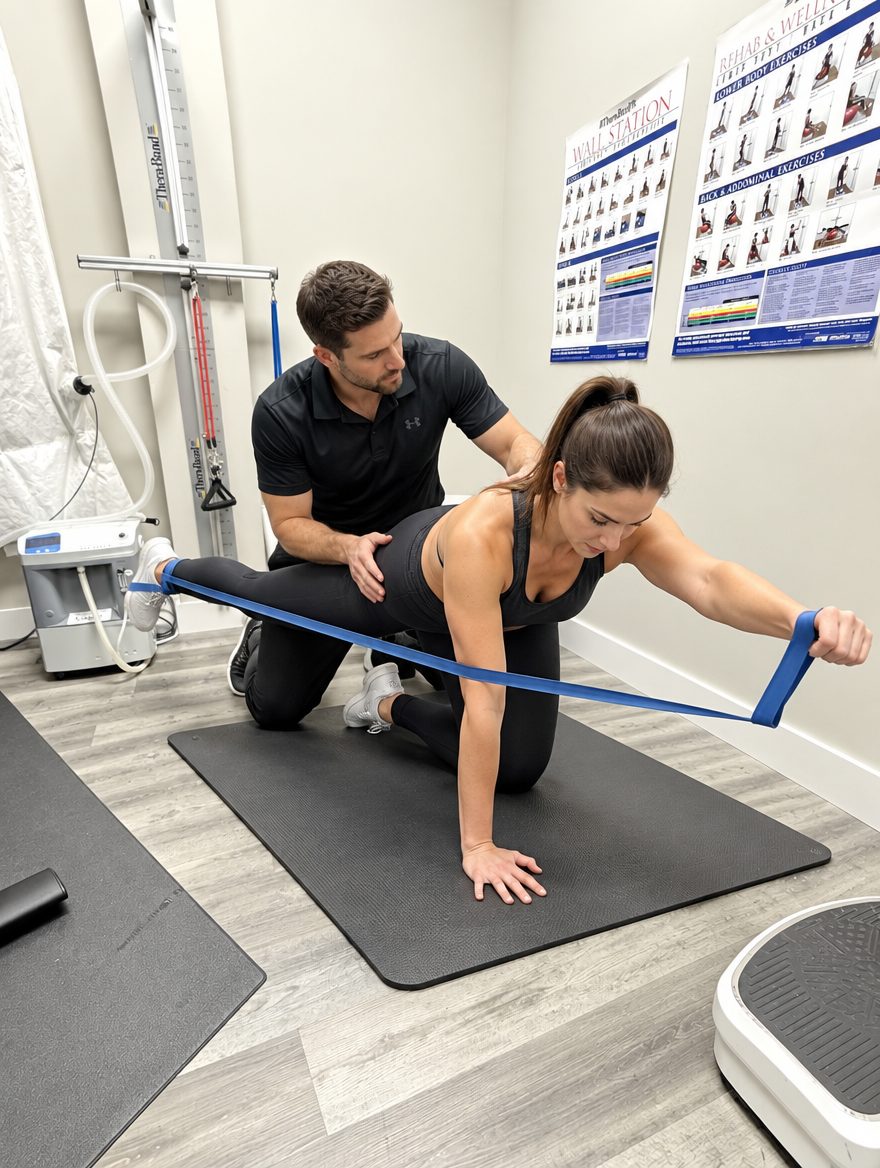
Once the sharp pain settles, gentle strengthening and mobility work are essential. Steady, guided exercise is far more effective than rest alone — the cuff heals by loading, not by hiding in a sling:
- Pendulum swings to keep the shoulder moving early on without loading the tendon
- Light resistance-band external rotations, elbow tucked at the side, 2 sets of 15
- Scapular squeezes and wall slides to improve shoulder-blade control
- A doorway chest stretch to undo the rounded-shoulder posture that pinches the cuff
- Avoid repetitive overhead activity until pain settles; ice after activity in the first weeks
Stop any exercise if pain radiates down the arm or steadily worsens, and see a doctor or urgent care today for sudden weakness or an inability to lift the arm. If shoulder pain has lasted more than a week, disrupts your sleep or comes with noticeable weakness, a spine assessment includes the shoulder, neck and upper-back exam that tells us which of the four injuries you are dealing with — and whether the neck is quietly driving it.
Serving shoulder pain patients across North Broward
Our clinic at 5675 Coral Ridge Drive, Coral Springs, FL 33076 serves Coral Springs, Parkland, Coconut Creek, Margate, Boca Raton, Tamarac, Pompano Beach and Deerfield Beach. Same-day appointments are usually available — call (954) 341-2256 or book online. Most patients from Parkland and Coral Springs are here in under 15 minutes.
Medically reviewed by Dr. Jared Cohen, DC — Co-Founder & Clinical Director, The Spine and Wellness Center. Last reviewed October 2026.
Frequently asked questions
How do I know if my shoulder pain is a rotator cuff injury?
Cuff injuries typically cause a deep ache, pain when lifting or rotating the arm overhead or behind the back, trouble sleeping on that side and weakness when reaching or carrying. A hands-on exam testing each of the four cuff muscles — plus the neck and upper back — confirms the source and severity.
Does a torn rotator cuff require surgery?
Not always. Many partial tears and most cases of tendinitis, bursitis and impingement improve with soft-tissue care, anti-inflammatory therapies and targeted strengthening. Surgery is generally reserved for large full-thickness tears, significant weakness, or shoulders that do not respond to a well-run conservative plan.
How long does a rotator cuff injury take to heal?
Mild strains and tendinitis often improve within a few weeks of consistent care; more significant injuries can take two to four months. The timeline depends on severity, how long the tendon has been irritated and how faithfully you follow the strengthening program in the Rebuild phase.
Why does my shoulder hurt more at night?
Lying down reduces blood flow to the already poorly supplied cuff tendons, and sleeping on the affected side compresses the inflamed tissue directly against the bone. Persistent night pain is one of the most reliable signs of a cuff problem and a common reason to seek care.

Same-day appointments
Reading about it is step one.
Step two is a measurement. Visit one we measure — and usually begin care; visit two you get your full findings and plan.
- Same-day appointments are usually available
- Our team calls you back to confirm your visit
- Coral Springs, serving Parkland & North Broward since 2005
Prefer to talk now? Call or text (954) 341-2256