

Conditions · Coral Springs & Parkland
Whiplash treatment in Coral Springs after a car accident
You felt fine at the scene. Two days later your neck is stiff, your head aches and your shoulders burn. That is whiplash — and the sooner it is measured and treated, the better the neck heals and the cleaner the documentation for your claim.
Quick answer
Whiplash treatment works best when it starts early. A rear-end collision whips the neck through a rapid backward-then-forward motion that strains the cervical ligaments, muscles, discs and facet joints. Symptoms often appear 24–72 hours later. Gentle adjustments, cervical decompression, cold laser, ultrasound and massage calm the injury, and rehab restores stability. Florida's PIP law generally requires initial treatment within 14 days.
What whiplash actually does to your neck
Effective whiplash treatment starts with understanding the injury. In a rear-end collision the seat pushes the torso forward while the head, which weighs 10–12 pounds, lags behind. The neck snaps into extension and then whips forward into flexion — all within about a quarter of a second, faster than any muscle can react. Even a low-speed parking-lot collision generates enough force to do this.
That motion strains the structures that hold the cervical spine together: the ligaments that limit joint motion, the facet joint capsules at the back of each segment, the muscles that are stretched before they can brace, and sometimes the discs and the nerve roots beside them. The medical name is cervical acceleration-deceleration injury; the pattern of symptoms it produces is called whiplash-associated disorder.
The upper neck — C1 to C3 — and the lower neck at C5–C6 take the most strain. That is why whiplash so often produces headaches at the base of the skull, pain into the shoulders and arms, and the loss of the normal cervical curve we see on X-ray weeks later.

Why whiplash symptoms show up 24–72 hours later
Most people feel little at the scene. Adrenaline masks pain, and the inflammation that follows a ligament and muscle strain takes a day or two to build. By the second or third morning, the neck is stiff, turning the head hurts and the headache has started. This delay is normal — and it is the main reason whiplash is under-treated.
Common whiplash symptoms, in the order they usually appear:
- Neck pain and stiffness — worse turning or looking up; often with a loss of range of motion.
- Headache — typically starting at the base of the skull and spreading forward.
- Shoulder, upper back and arm pain — the trapezius and shoulder blades absorb a lot of the force; tingling or numbness in the arm means a nerve root is irritated.
- Dizziness, fatigue and trouble concentrating — common in the first weeks and usually tied to the upper cervical joints and muscles.
- Jaw pain, ringing in the ears, sleep disruption and irritability — less common, but part of the recognized pattern.
Cleveland Clinic notes that whiplash symptoms often begin within 24 hours of the injury but can take several days to appear, and that most people recover within a few weeks with appropriate care — while some develop longer-lasting pain, particularly when the injury is not addressed early (Cleveland Clinic, Whiplash).
Why early care matters
Ligaments heal by laying down scar tissue along the lines of stress placed on them. With early whiplash treatment — motion restored and inflammation controlled — that tissue forms in a way that keeps the neck moving. Left to stiffen for weeks, it forms around a restricted joint — the pattern behind chronic post-whiplash neck pain and headaches.
Florida’s 14-day PIP rule: why the calendar matters for whiplash treatment
Timing matters clinically — and in Florida it matters for your insurance. Florida’s Personal Injury Protection (PIP) law generally requires that you receive initial medical treatment within 14 days of the accident for your PIP benefits to apply to the injury. Care from a chiropractic physician counts as initial treatment under the statute. Wait beyond that window and coverage for accident-related care may be denied, regardless of how real the injury is.
The statute is Florida Statute 627.736, and it is worth reading the key paragraph yourself (Florida Senate, s. 627.736, F.S.). Our role is to make sure the clinical side is handled correctly: a documented initial examination, objective findings, a diagnosis coded properly, and treatment notes that record progress at every visit. That documentation is what your PIP carrier — and, if needed, your attorney — relies on.
Practically, that means: if you were in a collision anywhere in Coral Springs, Parkland or North Broward, get examined within the first few days even if you feel ‘mostly fine.’ An exam that finds nothing is good news. An exam that finds a sprain you would otherwise have ignored protects both your neck and your claim. Read more on our car accident treatment page.
How we approach whiplash treatment at TSAWC
Our approach to whiplash treatment follows the body’s own healing sequence — the 4R Method: Repair, Rebuild, Regenerate, Refine. Whiplash is the condition where the order matters most. Aggressive manipulation of an acutely sprained neck is wrong; so is a soft collar and weeks of rest. The right plan calms the injury, keeps the joints moving gently, and then rebuilds the stability the ligaments lost.
R1 · Repair — calm the injury, keep it moving
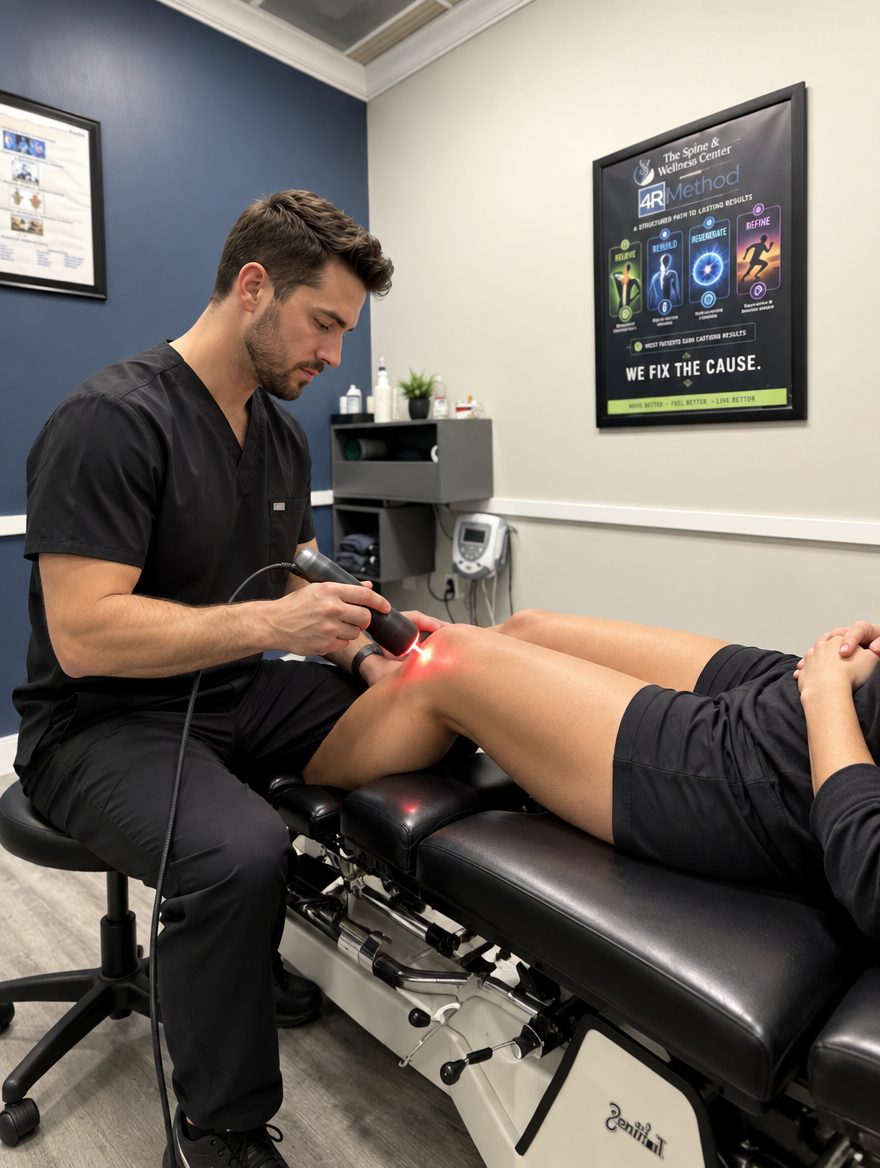
In the first weeks the goals are inflammation control and gentle motion. Cold laser and therapeutic ultrasound reduce inflammation in the strained ligaments and muscles; massage therapy eases the protective spasm; gentle, specific adjustments — low-force and instrument-assisted when the neck is acute — restore motion to the facet joints. If a disc or nerve root is involved, cervical decompression takes pressure off it. Typical commitment is 3–5 visits a week for 4–8 weeks.
R2 · Rebuild — restore stability and the curve
Once the acute phase settles, we rebuild what the injury took. Rehab retrains the deep neck flexors and scapular stabilizers that protect the ligaments; corrective care works to restore the cervical curve that whiplash so often flattens; and Graston Technique remodels the scar tissue forming in the strained muscles so it does not restrict motion. Rebuild usually runs 2–3 visits a week for 8–16 weeks.
R3 and R4 · Regenerate and Refine
The Regenerate phase (about 2 visits a week for two months or more) supports tissue healing with red light and PEMF, and addresses the sleep and stress disruption that follows an accident. Refine is the long game: a brief structural tune-up every month or two so the neck you rebuilt stays stable.
Chiropractic adjustments
Gentle, specific care that restores motion to the sprained facet joints without stressing the ligaments.
Learn moreCervical decompression
Computer-controlled traction that eases pressure on a disc or nerve root injured in the collision.
Learn moreCold laser therapy
Low-level laser that reduces inflammation in strained ligaments and muscles without medication.
Learn moreCar accident treatment
Our full auto-injury program — exam, documentation, treatment and coordination with your PIP claim.
Learn more6 proven steps for whiplash recovery after a car accident
Whether the collision was yesterday or last week, this is the whiplash treatment sequence that protects the neck and the claim:
- Get examined within the first few days — even if you feel mostly fine. Florida’s PIP law generally requires initial treatment within 14 days, and the exam establishes a baseline.
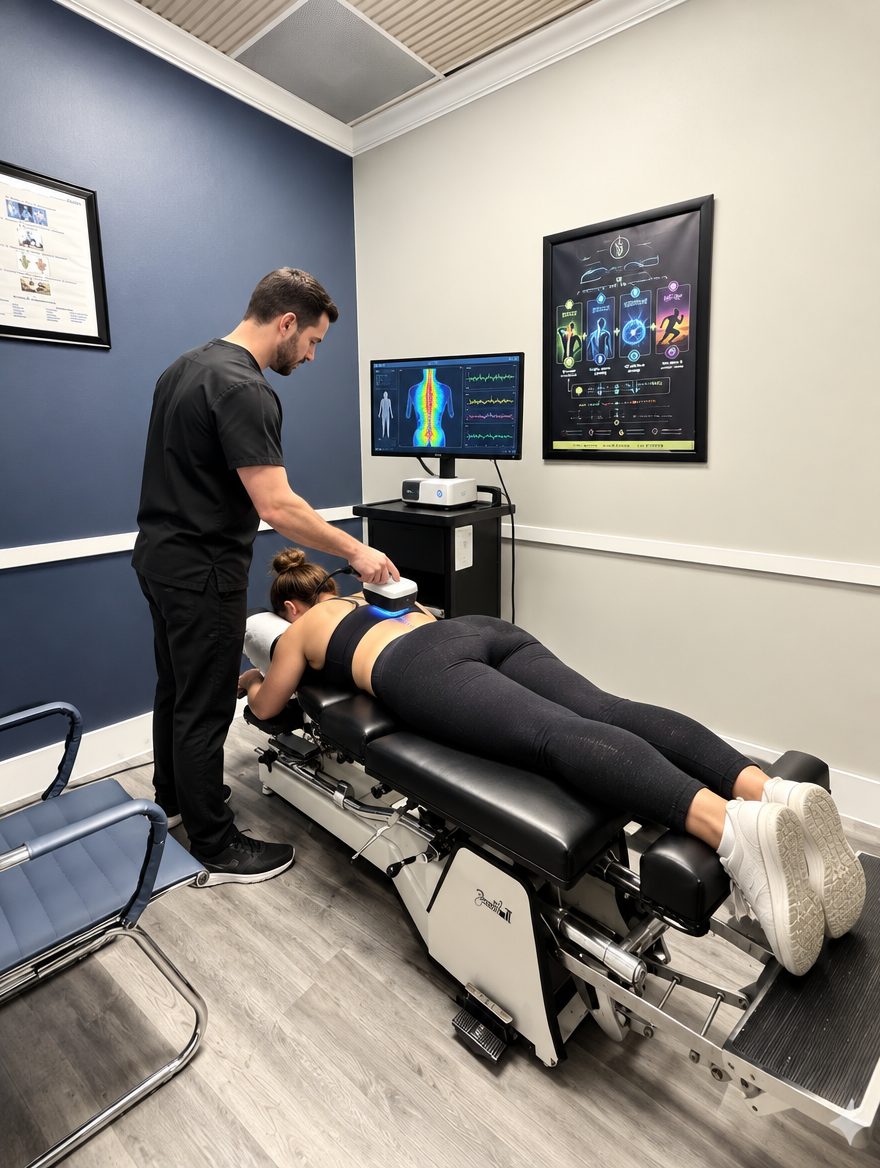
- Measure the injury objectively. Range of motion, orthopedic and neurological tests, surface EMG and thermal scanning, and digital X-rays when indicated. Objective findings are what document a real injury.
- Control the inflammation. Cold laser, therapeutic ultrasound, ice in the first 48 hours, and gentle soft-tissue work. No soft collar beyond a day or two — immobilization makes the stiffness worse.
- Restore motion gently. Low-force adjustments and pain-free range-of-motion exercises keep the facet joints moving while the ligaments heal.
- Rebuild stability. Deep neck flexor and scapular retraining, Graston for scar tissue, and curve-restoration work in the Rebuild phase.
- Document every visit. Progress notes, re-examinations and re-scans at regular intervals — the record your PIP carrier and attorney need.
What to expect at your first two visits
We measure before we treat, so your whiplash treatment plan — and your documentation — is built on your actual findings rather than a guess.
Visit one — we measure (and usually begin care)
- A real conversation. How the collision happened, where you were seated, headrest position, what you felt at the scene and since, and any prior neck problems — all of it recorded.
- A hands-on structural exam. Cervical range of motion measured, posture analysis, orthopedic tests for the facet joints, ligaments and discs, and a neurological screen (reflexes, strength, sensation) for arm symptoms.
- Surface scanning: sEMG + thermal. A painless scan along the spine. Surface EMG shows where the muscles beside each vertebra are guarding — acute whiplash typically shows marked activity through the cervical and upper thoracic segments; thermal scanning maps nerve irritation. Re-scanned at intervals to document progress.
- Digital X-rays, when indicated. We look at the cervical curve, alignment and any sign of instability, and review imaging from the ER or urgent care if you were seen there.
Visit two — your findings and your plan
Everything is explained in plain English with your scans and images in front of you, mapped to the four phases of the 4R Method: what we found, what we recommend, and how long it should take. Your full plan starts here — and in most cases care already began on visit one. For a head start, take the 60-second spine assessment and we will have your Spine Score and likely pattern before you walk in.
Whiplash care at home: what helps in the first two weeks
Between visits, the habits that support whiplash treatment in the first two weeks after a collision:
- Ice, then heat. Ice for 15 minutes a few times a day for the first 48 hours; moist heat for stiffness after that.
- Keep moving gently. Slow, pain-free neck rotation and shoulder rolls several times a day. Prolonged rest and soft collars stiffen the joints and slow healing.
- Set up your sleep. One pillow that keeps the neck level with the spine; avoid sleeping on your stomach.
- Limit screen time and driving posture. Forward-head posture loads the exact structures that were strained. Raise the screen and keep the headrest close to the back of your head when you drive.
- Write down your symptoms. A daily note of pain, stiffness, headaches and sleep supports your claim and helps us track the pattern.
If arm symptoms, dizziness or headaches are getting worse rather than better in the first week, do not wait — those patterns respond faster the earlier they are addressed.
When a neck injury needs urgent care instead
A small number of post-accident symptoms need same-day medical evaluation before any spine care: severe neck pain with an inability to move the head, numbness or weakness in the arms or legs, loss of bladder or bowel control, severe headache with confusion, vomiting or vision changes, loss of consciousness at the scene, or any sign of a head injury. If any of these apply, please see a doctor or urgent care today — we will be here for the recovery afterwards and can coordinate with the physicians who saw you.
For everything else — the stiff neck, the headache, the shoulder pain that started two days after the collision — this is what we do all day in Coral Springs and Parkland, and we are usually able to see you the same day you call. Ongoing neck pain from an older accident? Start with our neck pain guide.
Serving whiplash and auto injury patients across North Broward
Our clinic at 5675 Coral Ridge Drive, Coral Springs, FL 33076 serves Coral Springs, Parkland, Coconut Creek, Margate, Boca Raton, Tamarac, Pompano Beach and Deerfield Beach. Same-day appointments are usually available — call (954) 341-2256 or book online. Most patients from Parkland and Coral Springs are here in under 15 minutes.
Medically reviewed by Dr. Jared Cohen, DC — Co-Founder & Clinical Director, The Spine and Wellness Center. Last reviewed October 2026.
Frequently asked questions
How soon after a car accident should I start whiplash treatment?
Within the first few days, even if you feel mostly fine. Symptoms commonly appear 24–72 hours later, early care helps the ligaments heal with motion rather than stiffness, and Florida's PIP law generally requires initial treatment within 14 days of the accident for benefits to apply.
Can you get whiplash from a low-speed collision?
Yes. The neck is whipped faster than muscles can react even at parking-lot speeds, and vehicle damage is a poor predictor of neck injury. Seat position, headrest height and whether you were braced all matter more than how the bumper looks.
How long does whiplash take to heal?
Most people improve substantially within a few weeks to a few months with appropriate whiplash treatment. The Repair phase typically runs 4–8 weeks and the Rebuild phase 8–16 weeks, tapering as stability returns. Injuries that are left untreated for weeks before care begins tend to take longer.
Is it safe to adjust the neck after whiplash?
Yes, with the right technique and timing. In the acute phase we use low-force, instrument-assisted methods and focus on inflammation control; manual adjustments are introduced as the ligaments settle. Every whiplash treatment plan follows a full orthopedic, neurological and vascular screen, and X-rays when indicated.
Does whiplash treatment get covered by PIP insurance in Florida?
Generally yes, when initial treatment begins within 14 days of the accident and the injury is properly documented. Chiropractic care counts as initial treatment under Florida Statute 627.736. We document the exam, findings and progress at every visit and work with your PIP carrier and attorney as needed.
What if my neck X-rays at the ER were normal?
That is common and good news — it means no fracture. But X-rays do not show ligament, muscle or disc strain, which is what whiplash injures. A structural exam with range-of-motion measurement, surface EMG and, when indicated, curve analysis is how the soft-tissue injury is identified and documented.


Same-day appointments
Let's build your plan.
Find out what's actually going on and get a clear path forward. Same-day appointments available.
- Same-day appointments are usually available
- Our team calls you back to confirm your visit
- Coral Springs, serving Parkland & North Broward since 2005
Prefer to talk now? Call or text (954) 341-2256