
Headaches & Conditions · 6 min read
Chiropractic care for vertigo in Coral Springs and Parkland
When the room will not stop spinning, the cause may be in your inner ear or in your upper neck. Here is how we tell the difference and what drug-free care can do.


Quick answer
Vertigo is the sensation that you or the room is spinning. The most common cause is BPPV, displaced calcium crystals in the inner ear, which responds to canalith repositioning maneuvers such as the Epley, often within one to a few sessions. Dizziness driven by the upper neck responds to gentle cervical care and posture correction. Sudden vertigo with neurological signs needs a physician first.
What causes vertigo?
Vertigo is not ordinary dizziness. It is the specific sensation that you or the room is spinning or tilting, often with nausea and loss of balance, and it comes from a mismatch between what the inner ear, the eyes and the neck are telling the brain about where your head is in space. Episodes range from a few seconds when you roll over in bed to hours that make standing impossible.
The most common cause is benign paroxysmal positional vertigo, BPPV. Tiny calcium crystals in the inner ear drift out of the chamber where they belong and into one of the semicircular canals, where they send false motion signals whenever the head changes position. It is more common with age and after a head bump, and roughly half of cases have no identifiable trigger. Other causes we see at The Spine and Wellness Center in Coral Springs:
- Cervicogenic dizziness: faulty position signals from stiff, irritated upper neck joints, often after whiplash or years of forward-head posture
- Vestibular neuritis and labyrinthitis: inflammation of the balance nerve or inner ear, usually after a viral illness
- Meniere’s disease: fluid pressure changes in the inner ear, with ringing and hearing changes
- Whiplash and head trauma, a leading cause in people under 50; see Whiplash After a Car Accident
- Migraine, certain medications and, rarely, problems in the brainstem or cerebellum
The National Institute on Deafness and Other Communication Disorders has a clear overview of balance disorders. Our companion article Understanding Vertigo and BPPV goes deeper on the inner ear.
Symptoms of vertigo, and the ones that need a physician first
- Spinning or tilting dizziness, especially when rolling over, lying down or looking up
- Nausea, sweating and loss of balance during an episode
- Brief, intense spells lasting under a minute (typical of BPPV) or longer, steadier dizziness with neck stiffness (more typical of a neck cause)
- Ringing in the ears or hearing changes, which point toward the inner ear rather than the neck
- Headache at the base of the skull that travels with the dizziness
See a physician first
Sudden vertigo with a severe headache, double vision, slurred speech, numbness or weakness on one side, trouble walking, chest pain or fainting can signal a stroke or other emergency. Please see a doctor or urgent care today for any of those before anything else.
How we tell inner-ear vertigo from neck-driven dizziness
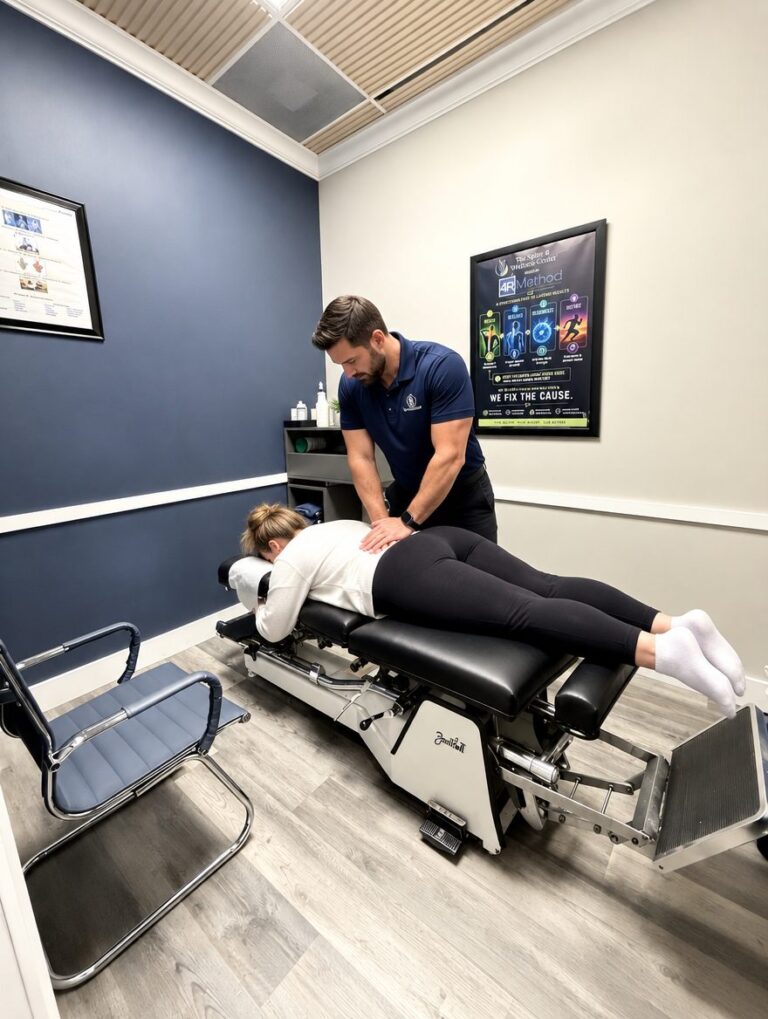
The distinction decides the treatment, so visit one is a careful measurement rather than a guess. We take a detailed history of when the spinning starts and how long it lasts, perform positional tests such as the Dix-Hallpike to see whether a head position triggers the characteristic eye movements of BPPV, examine the upper cervical joints and the muscles at the base of the skull, and use surface EMG and thermal scanning to see whether the neck is guarding. Digital X-rays are taken when indicated. Visit two is the report of findings and the plan.
BPPV declares itself with brief spells triggered by specific positions and a positive positional test. Cervicogenic dizziness tends to be a steadier unsteadiness that comes with neck pain, worsens with neck movement or long screen sessions, and often follows an accident. Many patients in Coral Springs and Parkland have a bit of both, which is why we treat both.

5 ways chiropractic care helps vertigo
- Canalith repositioning maneuvers. For BPPV, a sequence of guided head positions such as the Epley maneuver moves the displaced crystals out of the canal. Many patients feel relief after one to a few sessions.
- Gentle upper cervical care. Restoring motion to stiff or misaligned joints at the top of the neck cleans up the position signals they send; it is the core of our vertigo treatment for the neck-driven type.
- Soft-tissue release of the suboccipital muscles and upper traps, which carry much of the guarding after whiplash.
- Vestibular and balance retraining, simple gaze and balance exercises that teach the brain to recalibrate.
- Posture correction and neck pain treatment in the Rebuild phase so the neck stops feeding bad information.
Inside the 4R Method, BPPV is often a short Repair phase of a few visits. Cervicogenic dizziness follows the fuller sequence: Repair at 3–5 visits a week for 4–8 weeks, then Rebuild at 2–3 visits a week for 8–16 weeks. If headaches travel with the dizziness, headache treatment runs alongside; Natural Tension Headache Relief explains why the two so often arrive together.
What we do not do: we do not use forceful neck manipulation for vertigo, we do not treat Meniere’s or vestibular neuritis directly, and we coordinate with your physician or ENT when the inner ear needs medical care. For whiplash-related vertigo, whiplash treatment handles the injury and the dizziness together.
Living with vertigo between visits
- Move slowly through the positions that trigger spells: sit up in stages, and turn the whole body rather than just the head.
- Sleep slightly propped on two pillows during BPPV care, and avoid lying on the affected side for the first night after a maneuver.
- Do not drive during active episodes, and keep a hand on a rail on stairs.
- Stay hydrated and keep caffeine and alcohol modest; both can aggravate inner ear symptoms.
- Keep screens at eye level and take neck breaks every 30–60 minutes if the neck is part of your picture.
Vertigo that keeps returning, follows an accident, or comes with neck pain is a reason to measure rather than wait. A spine assessment at our Coral Springs clinic, minutes from Parkland and Coconut Creek, is where we sort out which kind of vertigo you have and what will help.
Serving vertigo and dizziness patients across North Broward
Our clinic at 5675 Coral Ridge Drive, Coral Springs, FL 33076 serves Coral Springs, Parkland, Coconut Creek, Margate, Boca Raton, Tamarac, Pompano Beach and Deerfield Beach. Same-day appointments are usually available — call (954) 341-2256 or book online. Most patients from Parkland and Coral Springs are here in under 15 minutes.
Medically reviewed by Dr. Jared Cohen, DC — Co-Founder & Clinical Director, The Spine and Wellness Center. Last reviewed October 2026.
Frequently asked questions
Can a chiropractor help with vertigo?
Yes, for the types that involve the inner ear crystals or the upper neck. BPPV is treated with canalith repositioning maneuvers such as the Epley, often with relief in one to a few sessions. Cervicogenic dizziness responds to gentle upper cervical care, soft-tissue release, balance retraining and posture correction. We refer inner ear diseases to your physician or ENT.
What is BPPV?
Benign paroxysmal positional vertigo is the most common cause of vertigo. Tiny calcium crystals in the inner ear drift into a semicircular canal and send false motion signals when the head changes position, producing brief, intense spinning when you roll over, lie down or look up. A positional test confirms it, and repositioning maneuvers treat it.
How do I know if my vertigo is from my neck?
Neck-driven dizziness is usually a steadier unsteadiness rather than brief spinning spells, comes with neck pain or stiffness, worsens with neck movement or long screen sessions, and often follows whiplash or a fall. A positional test that is negative for BPPV plus findings in the upper cervical joints points to the neck. Many people have both.
Is chiropractic care safe for dizziness?
Yes, when the cause has been evaluated first. We use positional tests to identify BPPV, examine the upper neck, and use gentle, specific techniques rather than forceful manipulation. Sudden vertigo with severe headache, double vision, slurred speech, weakness or trouble walking needs a physician first; please see a doctor or urgent care today for those.


Same-day appointments
Reading about it is step one.
Step two is a measurement. Visit one we measure — and usually begin care; visit two you get your full findings and plan.
- Same-day appointments are usually available
- Our team calls you back to confirm your visit
- Coral Springs, serving Parkland & North Broward since 2005
Prefer to talk now? Call or text (954) 341-2256