

Athletes · Coral Springs & Parkland
Athletic performance chiropractor in Coral Springs & Parkland
Sport-specific injury care and performance support for golfers, racket-sport players, ballplayers and student-athletes across South Florida. Recover faster, move better and stay in the game — drug-free.
Quick answer
An athletic performance chiropractor treats the injury and the movement pattern behind it. Our program combines chiropractic care, sports rehab, soft-tissue tools and a recovery stack inside the 4R Method, tuned to the demands of your sport — golf, tennis, pickleball, padel, baseball, football, soccer, volleyball and wrestling — and to your level, from high school to college.
What does an athletic performance chiropractor actually do?
An athletic performance chiropractor does two jobs that a general clinic usually separates. The first is injury care: settling the sprain, strain, tendon or back problem that is keeping you out. The second is performance: finding the restrictions and asymmetries that quietly cap your output — a hip that does not fully extend, a thoracic spine that will not rotate, a trunk that leaks force — and removing them so you can express the athleticism your training has already built.
The two are the same problem from different angles. Better mechanics mean less wasted stress on tissue, which is what keeps an athlete durable over a long South Florida season. That is why every athlete here, injured or not, gets the same structural evaluation and the same program — tuned to the demands of their sport and their level.
The program is led by Dr. Jared Cohen, DC, Clinical Director, and runs on the 4R Method: Repair, Rebuild, Regenerate, Refine. Where you enter the sequence depends on whether you arrive hurt, stiff, or simply wanting an edge.
In practice that means a golfer with a sore low back and a college sprinter with no complaints at all are evaluated the same way: joint by joint, movement by movement, with objective scans that can be repeated to prove the plan is working. The difference is only where the plan starts and how fast it moves.

Injury care by sport: choose your game
Every sport loads the body in its own way, so every sport gets its own page — the common injuries, the mechanics behind them and the plan back. Choose yours:
Golf
Fix the low back, hip and shoulder strain that wrecks the swing — and add rotation and distance.
Learn moreTennis
Relieve tennis elbow, shoulder and low back pain and keep your serve strong all season.
Learn morePickleball
Ease the knee, ankle, Achilles and shoulder strain of quick stops and overhead shots.
Learn morePadel
Recover from wrist, elbow and back strain and move sharper on the glass-walled court.
Learn moreBaseball
Protect the throwing shoulder, elbow and core through a long season of pitches and swings.
Learn moreFootball
Recover from contact injuries and build the neck, hip and core resilience the game demands.
Learn moreSoccer
Treat ankle, knee, hamstring, groin and hip injuries and keep your speed on the pitch.
Learn moreVolleyball
Relieve hitting-shoulder, jumper's knee, ankle and low back strain from jumping and hitting.
Learn moreWrestling
Recover from neck, shoulder, knee and low back strain and stay on the mat.
Learn moreHigh school athletes
Growth-plate-aware injury care, pre-season screens and load management for teen athletes.
Learn moreCollege athletes
Off-season rebuilds, in-season maintenance and a recovery stack coordinated with your athletic trainer.
Learn moreSports injury rehab
The rehab engine behind every sport page: criteria-based progressions from pain to full play.
Learn moreHow the 4R Method works for athletes
The 4R Method is the body’s own healing sequence, and for athletes it doubles as a season plan.
R1 · Repair — settle the injury
Calm the tissue and restore joint motion: chiropractic adjustments, cold laser, acoustic shockwave for stubborn tendons, and non-surgical spinal decompression when a disc is involved. Typically 3–5 visits a week for 2–4 weeks in an acute injury, 4–8 weeks for a chronic one.
R2 · Rebuild — fix the mechanics
The sports rehab and physical therapy phase: strength, mobility, landing and deceleration retraining, with Graston Technique, cupping and massage therapy clearing the fibrotic tissue a season leaves behind. Usually 2–3 visits a week for 8–16 weeks, tapering as the home program takes over.
R3 · Regenerate — the recovery stack
Red light therapy, PEMF, IHHT oxygen therapy and BrainTap, programmed around the training week — typically 2 visits a week for two or more months in the off-season, then folded into maintenance.
R4 · Refine — in-season maintenance
Brief tune-ups every month or two, a pre-season movement screen, and a short re-scan to confirm the gains are holding.
Why athletes choose an athletic performance chiropractor here
- Sport-specific care. We treat the exact demands of your sport — the golf swing, the overhead serve, the wrestler’s bridge — not a one-size-fits-all protocol.
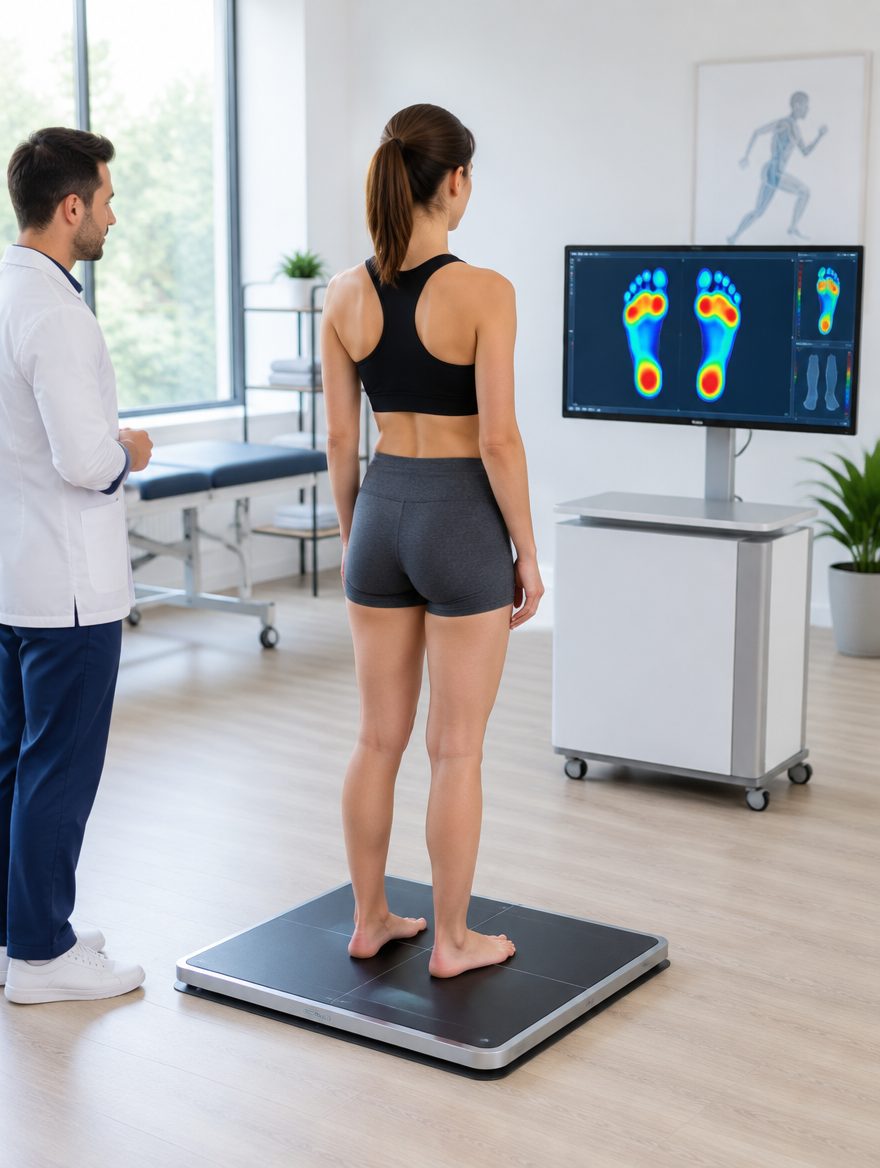
- We measure first. Hands-on structural exam, Myovision surface EMG and thermal scanning, GaitScan foot-pressure analysis and digital X-rays when indicated. Objective, re-scannable, and the basis for every plan.
- Drug-free recovery. Chiropractic, rehab and recovery therapies that heal without medication or unnecessary downtime.
- Performance, not just pain. Better mobility, power and resilience — so you play stronger, not just hurt less.
- Coordinated. With your athletic trainer, coach or physician when it helps, and prompt referral for imaging or an orthopedic opinion when the exam calls for it.
- Back in the game faster. Same-day appointments and a clear, staged return-to-play plan.
Injury care vs. performance work: which do you need?
Most athletes arrive somewhere on this spectrum. Here is how we match the entry point:
- Acute injury (rolled ankle, pulled hamstring, jammed shoulder): start in Repair. Rule out anything that needs imaging first; calm, restore motion, then rebuild.
- Nagging, recurring pain (the back that tightens every tournament, the elbow that flares each spring): start in Rebuild. The tissue is not the problem; the mechanics are. See lower back pain, shoulder pain and knee pain.
- Healthy but want an edge: start with the evaluation and the Regenerate stack; remove the restrictions you did not know were there.
- Student-athlete: start with a pre-season screen and a load map — see the high school and college programs.
Evidence supports the approach. Exercise-based and criteria-driven rehabilitation is the foundation of safe return to sport, and the American Academy of Orthopaedic Surgeons notes that most sports injuries are soft-tissue problems that respond to conservative care when it is complete rather than cut short (AAOS OrthoInfo, Sprains, Strains and Other Soft-Tissue Injuries).
Built for how South Florida plays
Coral Springs and Parkland are year-round sports towns. Golf and tennis never have an off-season here, pickleball and padel courts fill before sunrise, club soccer, volleyball and baseball run through the summer heat, and the local high schools field wrestling, football and track programs that train most of the year. A twelve-month calendar means the body never gets the natural rest a northern winter provides — so the maintenance side of the program matters more here than almost anywhere.
It also means the injuries cluster predictably. Spring brings throwing elbows and shoulders; late summer brings heat-fatigued hamstrings and ankle sprains from pre-season; winter brings wrestling necks and the low backs of golfers who finally have time to play five days a week. An athletic performance chiropractor who sees that cycle every year knows what is coming before it arrives, which is why we push pre-season screens six to eight weeks before each season starts.
- Adult recreational athletes: golf, tennis, pickleball and padel players who want to keep playing without the back, elbow or shoulder deciding for them.
- Youth and club athletes: growth-plate-aware care, load mapping across overlapping teams, and parents in every conversation.
- High school and college athletes: pre-season screens, in-season maintenance, recovery programming and coordination with the athletic trainer.
- Weekend warriors and masters athletes: the 5K runner, the cyclist on the Sawgrass loop, the adult-league player who is forty and still competitive.
What to expect at your first two visits
We measure before we treat, whatever your sport.
Visit one — we measure (and usually begin care)
- A real conversation. Sport, position, level, training week, competition calendar and injury history.
- A hands-on structural exam. Joint mechanics, soft tissue, strength and the sport-specific movements that matter — swing, serve, sprint, landing, bridge.
- Surface scanning: sEMG + thermal. A painless scan along the spine that shows where muscles are guarding and compensating.
- GaitScan and digital X-rays when indicated. Foot-pressure analysis for lower-body patterns; imaging when the architecture needs to be seen.
Visit two — findings and plan
What we found, what we recommend and how it fits your season, mapped to the four phases. Your full plan starts here — and in most cases care already began on visit one. The 60-second spine assessment gives us a head start before you arrive.
When a sports injury needs a doctor first
A suspected concussion, a joint that pops and swells rapidly, a limb you cannot bear weight on, sudden numbness or weakness, or any visible deformity should be evaluated by a doctor or urgent care today. Once assessed and cleared, the athletic performance chiropractor program picks up the stiffness, balance and reconditioning that follow, in coordination with your physician.
For everything else — the strains, the tendons, the backs and the restrictions that are costing you output — this is what we do all day in Coral Springs and Parkland, and same-day appointments are usually available.
Serving athletes of every sport and level across North Broward
Our clinic at 5675 Coral Ridge Drive, Coral Springs, FL 33076 serves Coral Springs, Parkland, Coconut Creek, Margate, Boca Raton, Tamarac, Pompano Beach and Deerfield Beach. Same-day appointments are usually available — call (954) 341-2256 or book online. Most patients from Parkland and Coral Springs are here in under 15 minutes.
Medically reviewed by Dr. Jared Cohen, DC — Co-Founder & Clinical Director, The Spine and Wellness Center. Last reviewed October 2026.
Frequently asked questions
What is an athletic performance chiropractor?
A chiropractor whose program is built around athletes: treating sports injuries with chiropractic care, soft-tissue tools and rehab, and also removing the restrictions and asymmetries that limit performance. Here that program runs on the 4R Method and includes a recovery stack of red light, PEMF, IHHT and BrainTap.
Do I need to be injured to come in?
No. Many athletes come in healthy for a structural evaluation, a pre-season screen or the recovery stack. Removing restrictions you did not know were there is often where the performance gains come from.
Which sports do you treat?
Golf, tennis, pickleball, padel, baseball, football, soccer, volleyball and wrestling have dedicated pages, and we see runners, swimmers, gymnasts, dancers, basketball players and lacrosse players as well. High school and college athletes each have their own program.
How quickly can I get back to play?
It depends on the injury and the sport. Acute sprains and strains often return in two to six weeks through a staged progression; tendon problems and chronic back pain take longer. We re-check objective criteria at each stage so the return is safe rather than rushed.
What is the difference between sports injury rehab and the athletic performance program?
Sports injury rehab is the Rebuild engine — the criteria-based strength and movement progressions that take an injury from pain control to full play. The athletic performance program wraps that engine in sport-specific evaluation, structural care, the Regenerate recovery stack and in-season maintenance, so it serves healthy athletes as well as injured ones.
Do you coordinate with coaches and athletic trainers?
Yes, with your permission. Sharing findings and the plan with your athletic trainer, coach or team physician keeps practice volume and return-to-play criteria consistent.
Do you see athletes from Parkland and Boca Raton?
Yes. Our Coral Springs clinic on Coral Ridge Drive is minutes from Parkland, Coconut Creek, Margate and Boca Raton, and we see athletes of every level from across North Broward. Same-day appointments are usually available.

Same-day appointments
Let's build your plan.
Find out what's actually going on and get a clear path forward. Same-day appointments available.
- Same-day appointments are usually available
- Our team calls you back to confirm your visit
- Coral Springs, serving Parkland & North Broward since 2005
Prefer to talk now? Call or text (954) 341-2256