
Conditions · Coral Springs & Parkland
Tennis elbow & golfer’s elbow treatment in Coral Springs
That burn on the outside — or inside — of the elbow is an overloaded tendon that never got the chance to heal. Shockwave, Graston, laser and a loading plan that actually rebuilds the tendon get you back to the court, the course and the keyboard.
Quick answer
Tennis elbow treatment at our Coral Springs clinic targets the overloaded forearm tendon — lateral epicondylalgia on the outside of the elbow, or medial (golfer's elbow) on the inside. Acoustic shockwave, Graston Technique and cold laser restart tendon healing; progressive loading and grip, wrist and shoulder mechanics rebuild it so the pain does not return. No injections, no surgery.
What is actually happening at the elbow
Effective tennis elbow treatment starts with what the tendon is doing. The muscles that extend your wrist and fingers all anchor to one small bony point on the outside of the elbow, the lateral epicondyle; the muscles that flex the wrist and grip anchor to the inside point, the medial epicondyle. Every grip, swing, keystroke and lift pulls on those anchors.
When the load is repeated faster than the tendon can adapt, the fibers develop micro-tears and the tissue becomes disorganized. Despite the ‘-itis’ names, chronic cases show very little inflammation on close study — the tendon is degenerating, not inflamed, which is why rest and anti-inflammatories so often fail and why the modern term is epicondylalgia. The American Academy of Orthopaedic Surgeons notes that most tennis elbow improves with non-surgical care (AAOS OrthoInfo).
You do not need to play a sport to get either. In Coral Springs and Parkland we see as many cases from keyboards, power tools, pickleball paddles, gym work and lifting toddlers as from tennis and golf. What they share is a tendon asked to do more than it has been trained for, usually with a wrist, grip or shoulder pattern that concentrates the load at the elbow.

Tennis elbow or golfer’s elbow? Lateral vs medial epicondylalgia
The side of the elbow and the movement that hurts tell them apart:
- Tennis elbow (lateral epicondylalgia): pain and tenderness on the outside of the elbow, worse gripping, lifting with the palm down, shaking hands, turning a doorknob or lifting a coffee cup; weak grip. Most common in the dominant arm between 30 and 55, and far more common than its golfing cousin.
- Golfer’s elbow (medial epicondylalgia): pain and tenderness on the inside of the elbow, worse gripping, flexing the wrist, carrying with the palm up, the golf downswing or a tennis serve; sometimes tingling into the ring and little fingers from the nearby ulnar nerve.
- Referred pain from the neck: outer elbow and forearm pain from an irritated C6–C7 nerve root that changes with head position and is not tender at the epicondyle itself — a look-alike we always screen for.
- Radial tunnel syndrome: an ache slightly below the lateral epicondyle, in the muscle, from the radial nerve — often mistaken for stubborn tennis elbow.
- Elbow joint or ligament problems: deep joint pain, swelling, locking or instability after a fall or throwing injury need a different plan.
Good to know
An elbow that has hurt for more than three months is almost never still ‘inflamed.’ It needs load — the right amount, applied progressively — more than it needs rest.
How we approach tennis elbow treatment at TSAWC
Our tennis elbow treatment follows the 4R Method — Repair, Rebuild, Regenerate, Refine — applied to a tendon that needs to be restarted, then retrained, then protected. Calming the pain alone is where most elbow plans stop, and why most elbows come back.
R1 · Repair — restart the stalled tendon
The Repair phase wakes a tendon that has stopped healing. Acoustic shockwave therapy delivers focused pulses into the tendon origin, stimulating blood flow and the body’s repair response; Graston Technique breaks up the disorganized, fibrotic tissue in the forearm extensors or flexors; cold laser therapy settles the acute irritation; and gentle mobilization frees the elbow, wrist and — when the exam finds it — the lower neck. Typical commitment is 3 visits a week for 4–8 weeks, with grip pain usually easing within two to three weeks.
R2 · Rebuild — load the tendon and fix the mechanics
Tendons rebuild under load, not rest. Physical therapy progresses the tendon through isometric holds, slow eccentric wrist work and then heavier strengthening, while we correct the grip size, wrist position and shoulder and posture habits that concentrated load at the elbow. Rebuild usually runs 2–3 visits a week for 8–16 weeks.
R3 and R4 · Regenerate and Refine
Regenerate supports tissue remodeling with PEMF and red light therapy at about 2 visits a week for two months or more. Refine is the return-to-sport phase: graded volume back to full sets, rounds and work weeks, with a brief tune-up every month or two during the season.
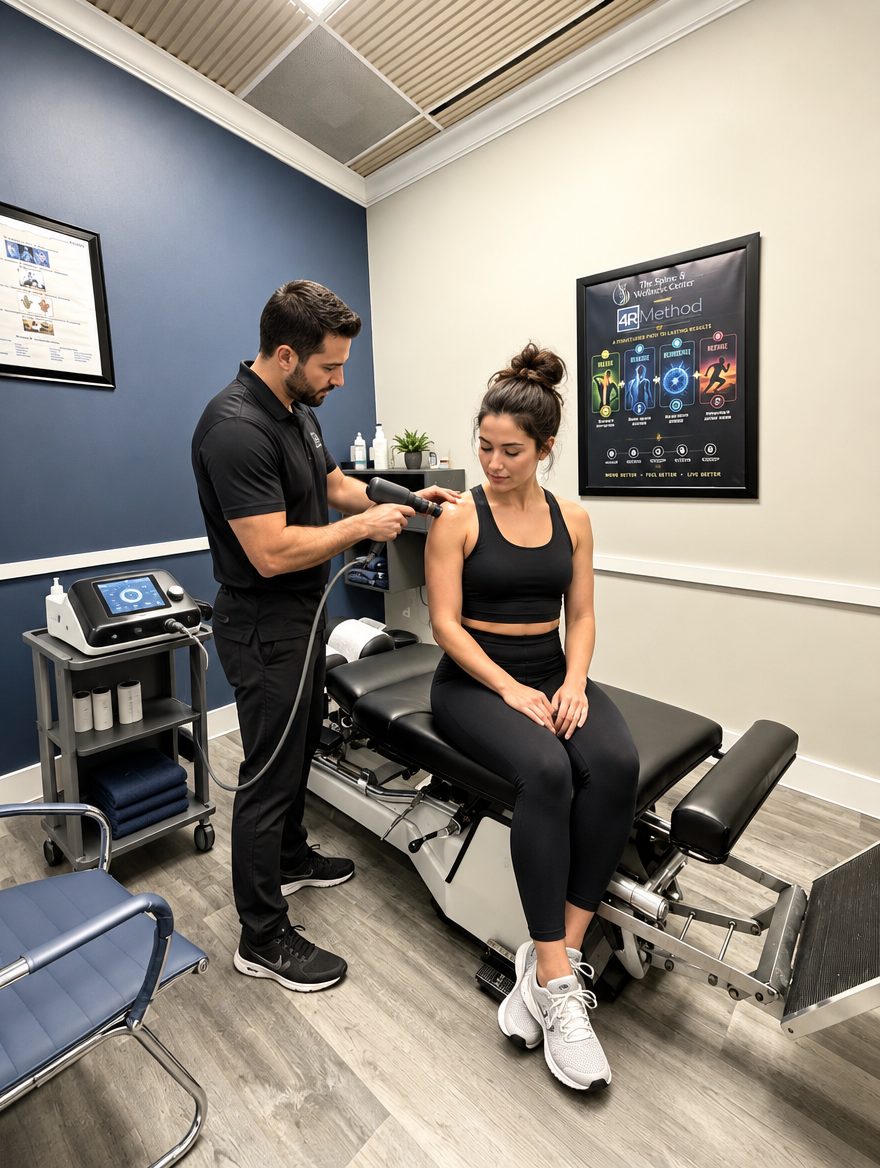
Acoustic shockwave therapy
Focused acoustic pulses that restart healing in degenerated tendon — the most effective single tool for chronic elbows.
Learn moreGraston Technique
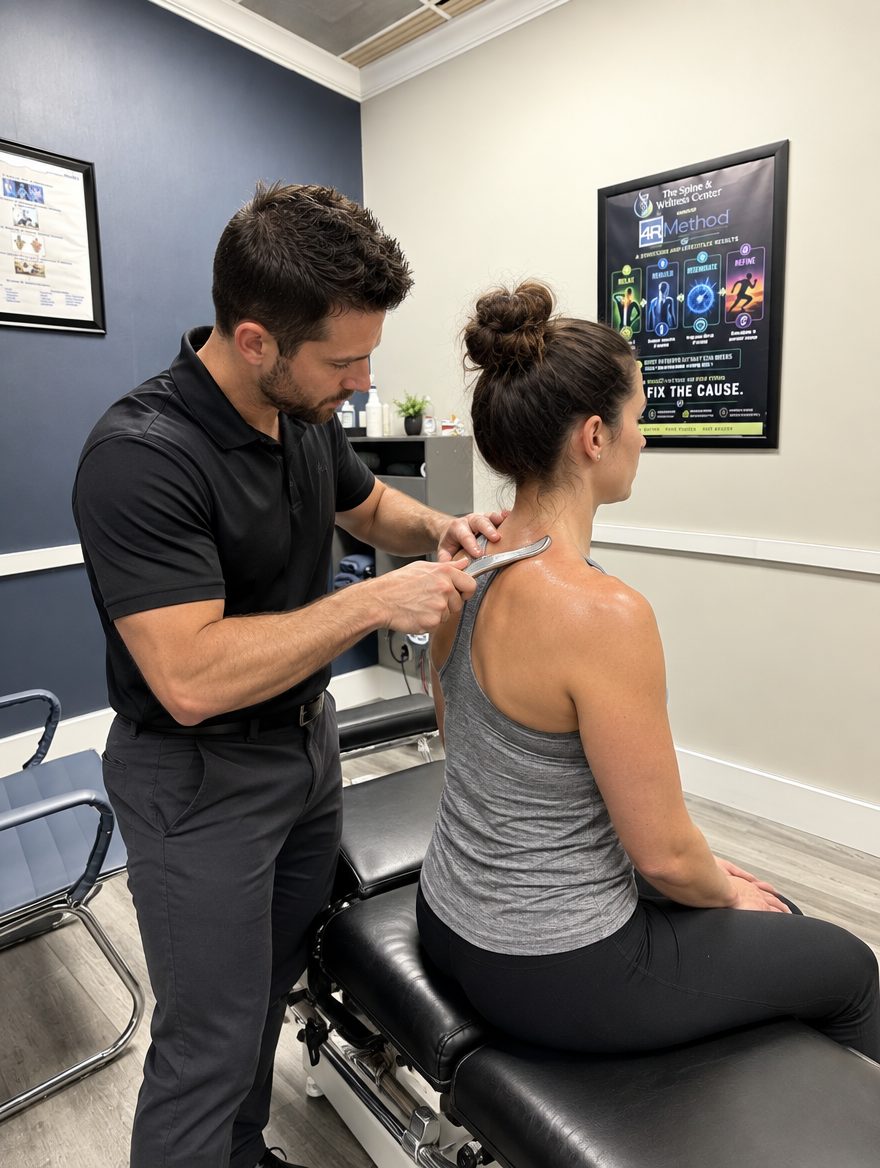
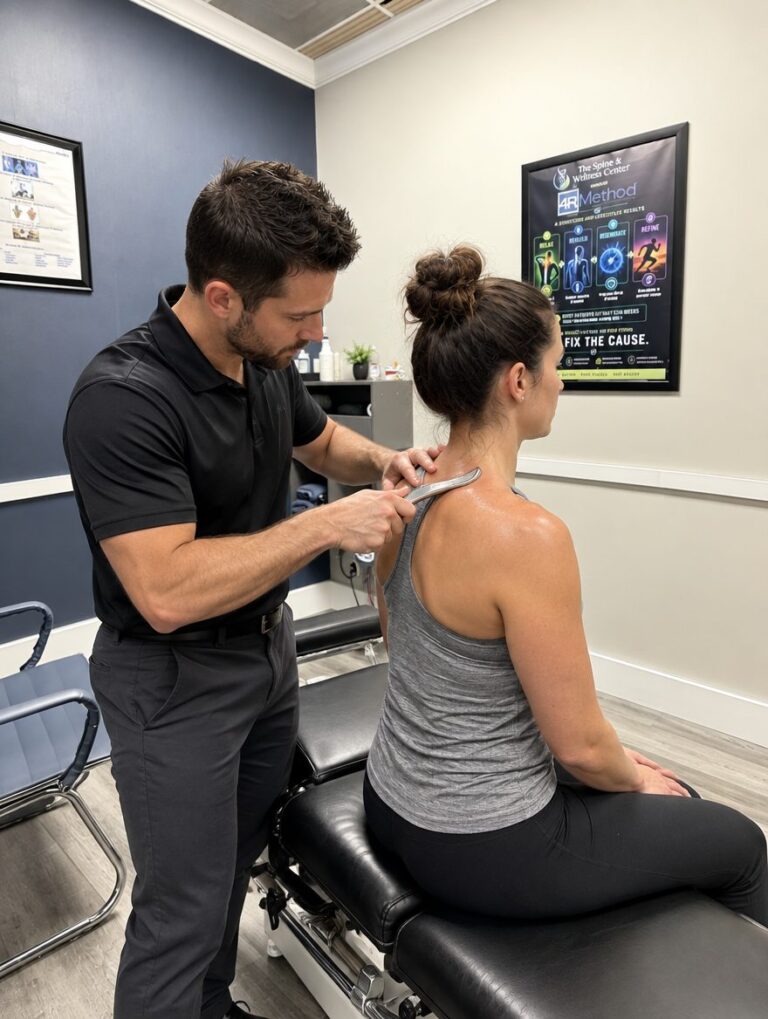
Instrument-assisted release of fibrotic forearm tissue and the tendon origin.
Learn moreCold laser therapy
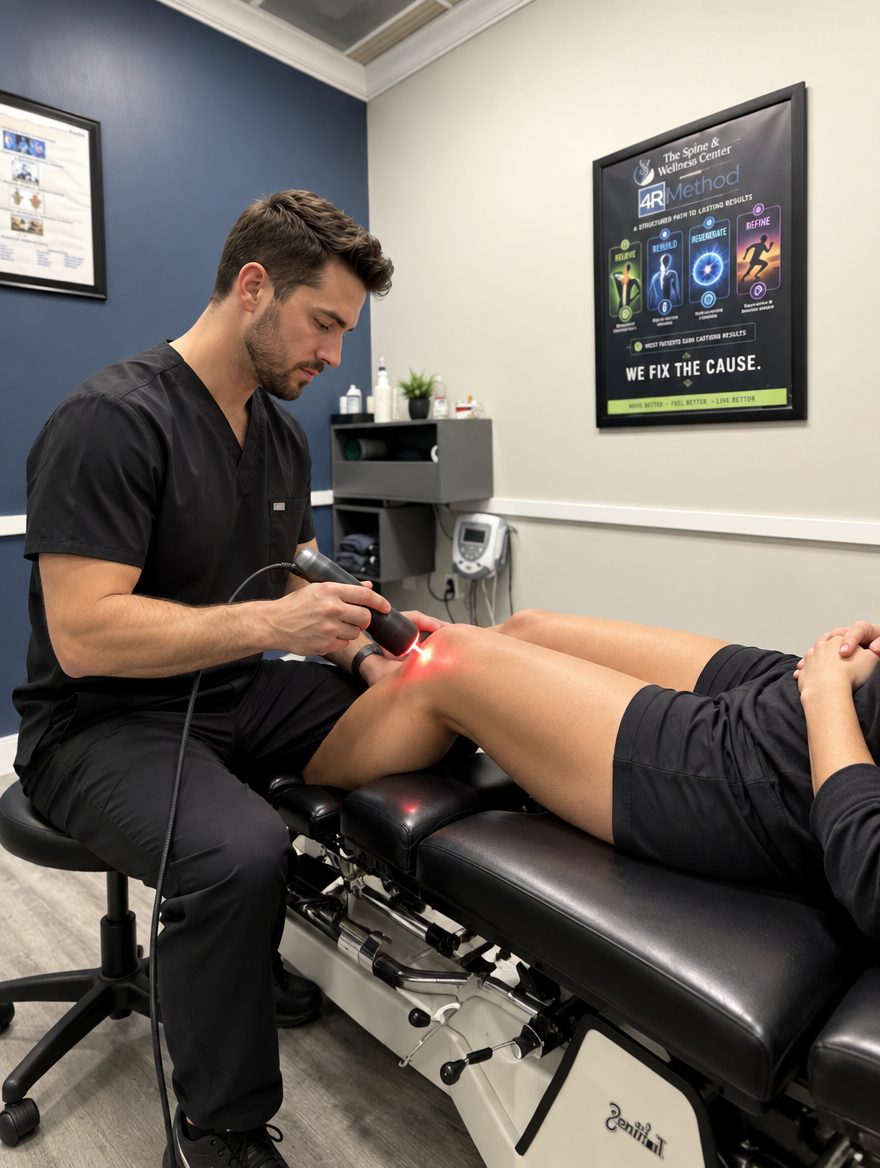
Low-level laser calms acute irritation at the epicondyle — painless, drug-free.
Learn morePhysical therapy
Progressive tendon loading and grip, wrist and shoulder mechanics that make the fix hold.
Learn more5 proven steps for tennis and golfer’s elbow (in order)
Tennis elbow treatment works as a sequence. This is the order that gets a tendon from painful to durable:
- Confirm the tendon — and the chain. Resisted wrist tests pinpoint lateral vs medial; the neck, shoulder and grip are screened for the upstream drivers.
- Restart healing. Shockwave and Graston on the tendon origin, cold laser for irritation. Usually weekly shockwave for 3–5 sessions inside the Repair phase.
- Manage load, don’t eliminate it. Shorter sessions, lighter racquet or club grip, a counterforce strap for the first weeks, and pain kept at a tolerable level during activity rather than avoided entirely.
- Load the tendon progressively. Isometrics for pain relief, slow heavy eccentrics for remodeling, then full strengthening and grip work. This is the step that makes it last.
- Return to sport with a plan. Graded volume, technique checks — grip size, string tension, swing path, keyboard height — and a tune-up schedule through the season.
What is not on the list as a first step: cortisone injections, which relieve pain for weeks but are associated with worse results at a year, or surgery. A tendon that has failed 6–12 months of proper conservative care, or an elbow with instability or locking, deserves an orthopedic opinion — and we will say so.
What to expect at your first two visits
We measure before we treat, so your plan targets the tendon that is hurting and the mechanics that overloaded it.
Visit one — we measure (and usually begin care)
- A real conversation. How it started, which movements hurt, what you grip and swing and how often, what you have tried, and what you want back.
- A hands-on structural exam. Palpation of both epicondyles, resisted wrist extension and flexion, grip strength on a dynamometer, elbow and wrist range of motion, shoulder blade and posture screening, and a cervical exam to rule the neck in or out.
- Surface scanning: sEMG + thermal. Surface EMG shows guarding along the cervical and upper thoracic spine; thermal scanning maps irritation from neck to hand. Painless and repeatable.
- Digital X-rays, when indicated. To rule out calcification, joint problems or cervical contributors. We review any ultrasound or MRI you already have.
Visit two — your findings and your plan
Your findings explained plainly: which tendon, how chronic, what is driving it, and a phase-by-phase plan with a realistic timeline — chronic tendons are told honestly that remodeling takes a few months. Treatment begins at this visit. If your neck is part of the picture, take the 60-second spine assessment first.
Tennis elbow treatment at home: load management that works
Between visits, how you use the arm decides whether the tendon rebuilds or re-tears:
- Keep pain in the tolerable zone. Mild discomfort during loading exercises that settles within 24 hours is fine; pain that is worse the next morning means the dose was too high.
- Check the grip. A racquet grip that is too small, a club held too tightly, a mouse gripped like a vise — all concentrate load at the elbow. Loosen and resize.
- Lift with the palm up early on. For tennis elbow, carrying with the palm facing up unloads the extensors; for golfer’s elbow, the reverse.
- Use the strap, not the brace. A counterforce strap just below the elbow spreads load during activity for the first weeks; a rigid wrist brace all day weakens the tendon you are trying to build.
- Do the eccentrics. The slow lowering exercises from your plan are the quiet workhorse of tendon repair — a few minutes, most days.
When elbow pain needs a doctor instead
Some elbow pain needs medical evaluation rather than tendon care: a deformed or swollen elbow after a fall, an inability to bend or straighten it, a hot, red joint with fever, numbness and weakness spreading through the hand, or a sudden pop with immediate weakness. If any of these apply, please see a doctor or urgent care today.
For the far more common picture — the outer or inner elbow that burns with every grip, the backhand you have stopped hitting, the mouse hand that aches by noon — this is daily work for us with tennis and golfer’s elbow patients across Coral Springs and Parkland. If your symptoms include hand numbness, read the carpal tunnel page; if the whole arm aches from a desk, the repetitive strain injury guide; if it started on the court, sports injury rehab.
Serving tennis and golfer's elbow patients across North Broward
Our clinic at 5675 Coral Ridge Drive, Coral Springs, FL 33076 serves Coral Springs, Parkland, Coconut Creek, Margate, Boca Raton, Tamarac, Pompano Beach and Deerfield Beach. Same-day appointments are usually available — call (954) 341-2256 or book online. Most patients from Parkland and Coral Springs are here in under 15 minutes.
Medically reviewed by Dr. Jared Cohen, DC — Co-Founder & Clinical Director, The Spine and Wellness Center. Last reviewed October 2026.
Frequently asked questions
What is the difference between tennis elbow and golfer's elbow?
Tennis elbow (lateral epicondylalgia) is pain at the outside of the elbow where the wrist extensor tendons attach; it hurts gripping and lifting palm-down. Golfer's elbow (medial epicondylalgia) is pain at the inside where the wrist flexors attach; it hurts gripping and lifting palm-up. Both are overuse tendon injuries and both respond to the same staged care.
Does shockwave therapy work for tennis elbow?
Acoustic shockwave is one of the most useful tools for chronic tennis elbow that has stopped responding to rest. Focused pulses into the tendon origin stimulate blood flow and the healing response in degenerated tissue. It is typically given weekly for several sessions and paired with soft-tissue work and progressive loading.
Why does my tennis elbow keep coming back after rest?
Rest calms the pain but does not rebuild the tendon or change the grip, wrist and shoulder mechanics that overloaded it, so the first week back on the court or keyboard re-injures it. Progressive loading — isometrics, then eccentrics, then strengthening — plus technique changes is what makes recovery hold.
Should I get a cortisone shot for tennis elbow?
Cortisone usually relieves tennis elbow pain for a few weeks, but studies associate injections with higher recurrence and worse outcomes at a year compared with a loading program. We recommend starting with conservative tendon care and reserving injections or surgery for cases that fail 6–12 months of proper treatment.
How long does tennis elbow treatment take?
Grip pain usually eases within two to three weeks of the Repair phase; tendon remodeling under progressive load takes a further two to three months, longer for elbows that have hurt for a year or more. We map a realistic timeline and return-to-sport plan after your evaluation.
Do you see tennis and golfer's elbow patients from Parkland and Boca Raton?
Yes. Our clinic on Coral Ridge Drive in Coral Springs is minutes from Parkland, Coconut Creek, Margate and Boca Raton, and same-day appointments are usually available.
Keep reading
From the blog
Same-day appointments
Let's build your plan.
Find out what's actually going on and get a clear path forward. Same-day appointments available.
- Same-day appointments are usually available
- Our team calls you back to confirm your visit
- Coral Springs, serving Parkland & North Broward since 2005
Prefer to talk now? Call or text (954) 341-2256