
Athletes · Coral Springs & Parkland
High school athlete performance care in Coral Springs & Parkland
Growing bodies are not small adult bodies. We help teen athletes recover from overuse injuries, move better and stay in the game — with drug-free, growth-plate-aware chiropractic, sports rehab and recovery care.
Quick answer
High school athlete performance care means treating a teenager as a still-growing athlete: screening for growth-plate and overuse problems first, managing the load of club plus school sports, and building movement quality with pre-season GaitScan and surface EMG screens. We settle the injury, correct the mechanics behind it and keep parents in every conversation.
Why high school athlete performance care is different from adult sports care
High school athlete performance is about far more than chasing a personal record. Between club teams, school sports and year-round training, today’s teenagers put their bodies under loads previous generations never faced — and they do it on a skeleton that is still growing. Their tissues are strong and adaptable, but they are also still developing, and that changes how injuries happen and how they should be managed.
The biggest difference is the growth plate: the area of developing cartilage near the ends of the long bones where growth happens. Because growth plates are softer than the surrounding bone and tendon, a young athlete’s weak link is often the bone–cartilage junction rather than the ligament. That is why teens develop conditions adults rarely do — Osgood-Schlatter disease (pain and swelling below the kneecap), Sever’s disease (heel pain) and Little League elbow and shoulder.
During a rapid growth spurt, bones can temporarily outpace the muscles and tendons around them, leaving the athlete tighter, less coordinated for a few weeks and more prone to strain. Our first job with any teen in Coral Springs or Parkland is to recognize when pain may involve a growth plate or a possible stress injury and, when it does, to recommend the right medical work-up before we treat.

Good to know
The National Institute of Arthritis and Musculoskeletal and Skin Diseases notes that growth-plate injuries need careful evaluation because they involve tissue that is still forming, and that most heal well when properly managed (NIAMS, Growth Plate Injuries).
Which overuse injuries do multi-sport teens get, and why?
Most teen athletes we see are not hurt from a single dramatic collision. They arrive with pain that crept in over weeks, because repetitive stress outpaced recovery. A few patterns are especially common among local high school athletes who play multiple sports or specialize year-round in one:
- Shin splints and lower-leg pain in runners and soccer players.
- Jumper’s knee and Osgood-Schlatter in basketball and volleyball players.
- Little League elbow and shoulder in baseball and softball throwers.
- Low back pain and stress reactions in gymnasts, dancers, wrestlers and football linemen.
- Heel pain (Sever’s) and Achilles tightness in cleated field sports.
- Recurring hip, hamstring or groin strains during growth spurts.
The common thread is training load without enough recovery, often made worse by early single-sport specialization and skipped warm-ups. A player on a club team, a school team and a travel side at the same time can log far more sessions than their body has adapted to. We look at the whole week — hours trained, true rest days, sleep and how the athlete moves — because calming the sore tissue without changing the load usually means the pain comes right back.
How we support high school athlete performance: the 4R Method for teens
Our high school athlete performance care follows the 4R Method: Repair, Rebuild, Regenerate, Refine — scaled to a growing body. The order matters: settle the injury, correct the movement fault or overload behind it, support recovery, then protect the gains across a long season.
R1 · Repair — settle the injury
Gentle, age-appropriate chiropractic adjustments restore motion in stiff hips, ankles and the mid-back; cold laser therapy supports recovery in irritated tendons and growth-plate regions; light soft-tissue work settles guarding. Usually 2–4 weeks at 3–5 visits a week for an acute problem, longer for one that has built all season.
R2 · Rebuild — fix the mechanics
The sports rehab phase: progressive strengthening, mobility drills, landing and deceleration retraining and warm-up coaching the athlete can run on their own. Graston Technique frees tight, restricted muscle and fascia. Typically 2–3 visits a week for 6–12 weeks, tapering as the home program takes over.
R3 and R4 · Regenerate and Refine
Regenerate supports recovery between practices — red light and PEMF are the tools we use most with teens. Refine is the maintenance rhythm: a brief tune-up every month or two in season, and a pre-season screen before the next one starts.
Sports injury rehab
Strength, mobility and movement retraining that hands the athlete tools they can use themselves.
Learn moreGaitScan analysis
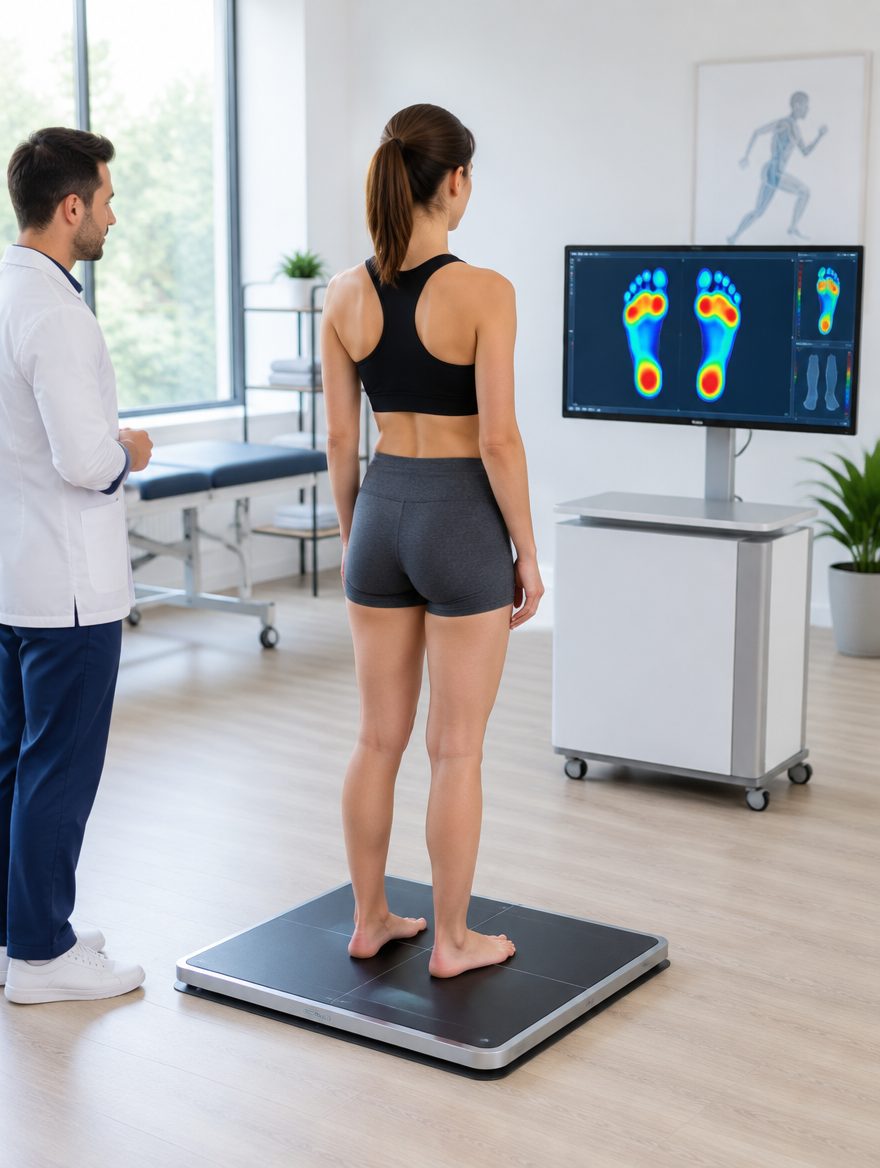
Pressure-plate analysis of how the feet load — the start of most shin, heel and knee problems.
Learn moreMyovision sEMG scan
A painless surface EMG scan that shows where muscles along the spine are guarding and compensating.
Learn moreChiropractic care
Gentle, growth-plate-aware adjustments to restore joint motion in hips, ankles and spine.
Learn more5 proven steps in our teen athlete program
The program for high school athlete performance runs the same five steps whether the athlete arrives injured or simply wants to stay durable:
- Pre-season screen. A GaitScan pressure-plate analysis of foot loading and a Myovision surface EMG scan of the spine, plus a movement screen — squat, single-leg balance, landing, hip and thoracic rotation. Done before the season, it shows the compensations that turn into injuries by week six.
- Load map. We write down every team, practice and private session on the calendar and look at the total against the athlete’s growth stage. Most overuse problems are solved here.
- Settle the current injury with the Repair-phase tools above, referring for imaging whenever a growth plate or stress injury is possible.
- Correct the movement fault in the Rebuild phase, and coach a 10–15 minute warm-up the athlete owns.
- Maintain through the season with brief tune-ups and recovery sessions, coordinating with the school athletic trainer when helpful.
Where our care fits alongside the sports physical
Every athlete should complete the pre-participation sports physical required by their school or league, performed by their pediatrician or a physician. That exam screens for cardiac and medical red flags and clears an athlete to play — it is essential, and our care does not replace it.
What a standard physical often does not have time to cover is movement quality: how well the hips, ankles and spine move, where the athlete compensates, and which overload patterns are building toward injury. That is where our evaluation adds value. We see student-athletes from the local high schools and club programs across Coral Springs and Parkland, and we are happy to coordinate with your child’s physician and athletic trainer whenever it helps.
Athletes heading to the next level move into our college athlete program; the full picture of what we offer by sport is on the athletic performance page.
What to expect at your teen’s first two visits
We measure before we treat, and parents are part of every conversation.
Visit one — we measure (and usually begin care)
- A real conversation. Sport, position, weekly training hours, growth spurts, sleep, and exactly how the pain behaves.
- A hands-on structural exam. The painful area and the joints above and below it, plus the movement screen: squat, single-leg balance, landing, hip and thoracic rotation.
- Surface scanning: sEMG + thermal. A painless scan along the spine showing where muscles are guarding and compensating, re-scannable to track progress.
- Digital X-rays when indicated. If anything suggests a growth-plate injury, a possible fracture or a stress reaction, we say so plainly and help you get the right referral and imaging first.
Visit two — findings and plan
Findings explained in language the athlete understands, with the parents in the room, mapped to the four phases of the 4R Method and the season calendar. Treatment begins at this visit. If the back is involved, the 60-second spine assessment gives us a head start.
Parents’ questions: load, growth spurts and when to see a doctor first
A few habits make high school athlete performance care work between visits:
- Count the sessions. A rough guide many sports-medicine groups use: no more hours of organized sport per week than the athlete’s age in years, and at least one full rest day.
- Respect the growth spurt. A few weeks of extra tightness and clumsiness after a spurt is normal; it is the wrong time to add volume.
- Warm up for real. 10–15 minutes of dynamic hip, hamstring and ankle work before every session.
- Sleep. Growing athletes repair tissue overnight; eight to ten hours is the target.
- Do not play through night pain or limping. Both are signals to be evaluated.
Some situations need medical care first: a suspected concussion, a joint that pops and swells rapidly, a limb the athlete cannot bear weight on, pain that wakes them at night, or any visible deformity — please see a doctor or urgent care today. Once assessed and cleared, we help with the reconditioning that follows, in coordination with the physician.
Serving high school and club athletes across North Broward
Our clinic at 5675 Coral Ridge Drive, Coral Springs, FL 33076 serves Coral Springs, Parkland, Coconut Creek, Margate, Boca Raton, Tamarac, Pompano Beach and Deerfield Beach. Same-day appointments are usually available — call (954) 341-2256 or book online. Most patients from Parkland and Coral Springs are here in under 15 minutes.
Medically reviewed by Dr. Jared Cohen, DC — Co-Founder & Clinical Director, The Spine and Wellness Center. Last reviewed October 2026.
Frequently asked questions
Is chiropractic care safe for a growing teenager?
Yes, when it is growth-plate aware. We use gentle, low-force techniques scaled to age and growth stage, screen for growth-plate and stress injuries before treating, and refer for imaging or a physician's opinion whenever the exam calls for it.
What is a pre-season screen and does my child need one?
A short evaluation before the season starts: a GaitScan of how the feet load, a surface EMG scan of the spine, and a movement screen of squat, balance, landing and rotation. It is most valuable for multi-sport athletes and anyone with a history of recurring injuries.
Does this replace the school sports physical?
No. The pre-participation physical from your pediatrician or physician screens for cardiac and medical red flags and is required to play. Our evaluation covers movement quality and overload patterns the physical does not have time for, and we coordinate with your child's physician.
How many sports is too many?
There is no single number, but a useful guide is no more hours of organized sport per week than the athlete's age, at least one rest day, and a few months each year away from any one sport. Overlapping club and school seasons during a growth spurt is where most overuse injuries start.
Will you talk to my child's athletic trainer or coach?
With your permission, yes. Coordinating with the school athletic trainer keeps return-to-play consistent and helps manage practice volume while an athlete rebuilds.
Do you see student-athletes from Parkland and Coconut Creek?
Yes. Our Coral Springs clinic on Coral Ridge Drive is minutes from Parkland, Coconut Creek, Margate and Boca Raton, and we see athletes from local high schools and club programs across North Broward. After-school and same-day appointments are usually available.


Same-day appointments
Let's build your plan.
Find out what's actually going on and get a clear path forward. Same-day appointments available.
- Same-day appointments are usually available
- Our team calls you back to confirm your visit
- Coral Springs, serving Parkland & North Broward since 2005
Prefer to talk now? Call or text (954) 341-2256