
Core care · Coral Springs & Parkland
Chiropractic care in Coral Springs & Parkland
Precise, measured adjustments that restore joint motion, calm irritated nerves and switch off muscle guarding — built into a plan that corrects the cause instead of chasing the symptom.
Quick answer
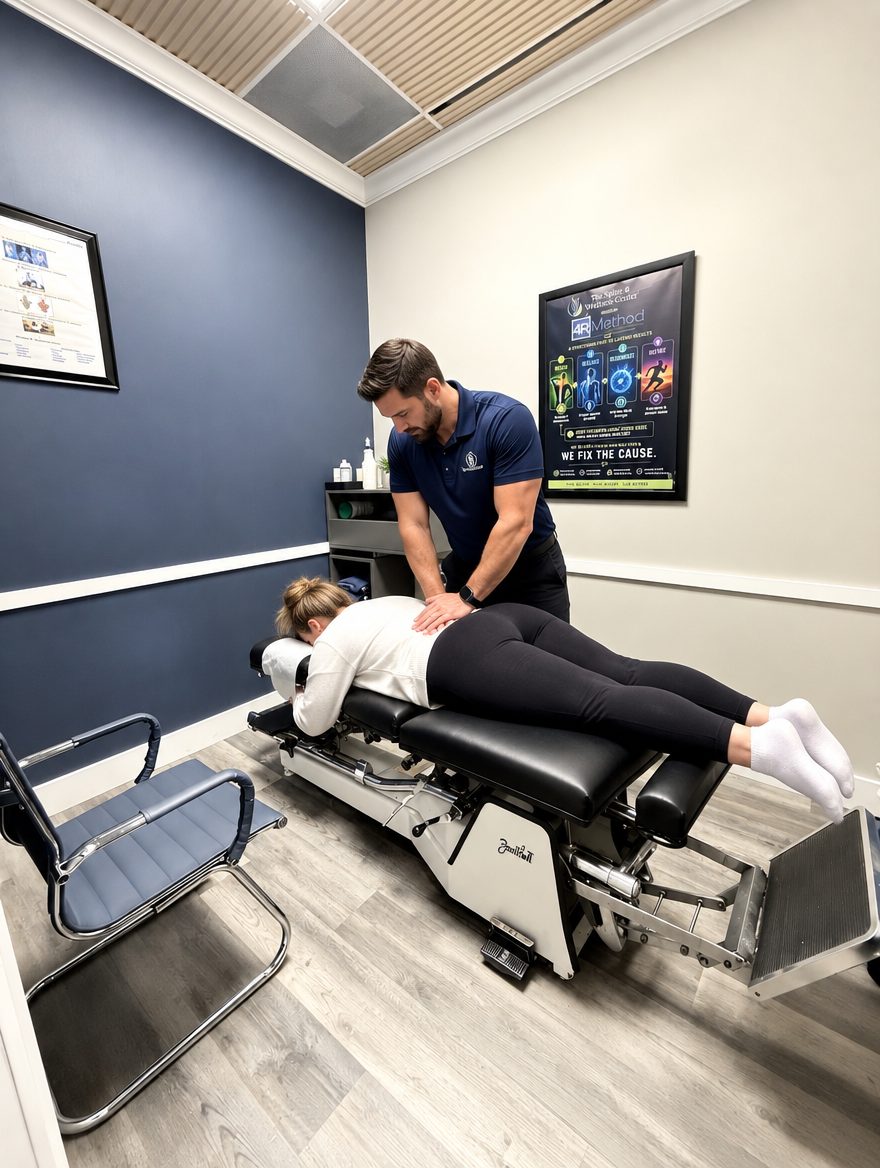
Chiropractic care restores normal motion to spinal joints that have locked up, which reduces irritation of the nerves beside them and lets the guarding muscles relax. At The Spine and Wellness Center it is measured first with a structural exam and surface scans, then delivered with the technique that fits your spine, inside every phase of the 4R Method.
What does a chiropractic adjustment actually do?
Chiropractic care restores motion to spinal joints that have stopped moving properly. Every vertebra meets the one below it at a disc in front and two small facet joints behind. When a facet joint locks — from a lift, a long drive on the Sawgrass, a night on a bad pillow, or years of sitting — three things happen in sequence.
- Joint motion is lost. The joint capsule tightens and the segment stops gliding. The levels above and below start moving too much to compensate, which is how one stiff joint becomes a sore region.
- The nerve becomes irritated. The nerve root exits the spine right beside that joint. Swelling and altered motion irritate it, producing local pain, referred pain into the hip, shoulder or head, and sometimes tingling.
- The muscles guard. The body splints the painful segment with spasm in the surrounding muscles. Guarding protects, but it also keeps the joint locked, which keeps the nerve irritated — a loop that does not break on its own.
An adjustment is a specific, quick, controlled movement applied to the locked joint to restore its glide. The ‘pop’ you may hear is gas releasing from the joint fluid — it is not bone moving on bone. Restoring motion reduces the mechanical irritation of the nerve, and within minutes the guarding muscles typically let go. That is why relief after a good adjustment feels like something unlocking.

Which chiropractic techniques do we use?
There is no single ‘right’ adjustment. The technique is matched to your spine, your age, your tolerance and the phase of care you are in. These are the four we rely on most in Coral Springs:
- Diversified technique. The classic hands-on adjustment — a precise, high-speed, low-force thrust to a specific joint. Effective, well studied, and the technique most patients picture when they think of chiropractic care.
- Drop-table technique. A section of the table drops a fraction of an inch as the adjustment is delivered, so the joint moves with far less force from the doctor’s hands. Ideal for the pelvis and sacroiliac joints, for larger patients, and for anyone who prefers a gentler feel.
- Instrument-assisted adjusting. A handheld, spring-loaded instrument delivers a very light, fast impulse to the joint. No twisting, no popping. We use it for the neck, for patients with osteoporosis or arthritis, for children and seniors, and for acute cases too painful for manual work.
- Corrective (mirror-image) adjusting. Rather than only freeing a locked joint, the adjustment is delivered in the opposite direction of your measured postural distortion — forward head posture, a lost neck curve, a tilted pelvis — to retrain the spine toward normal alignment over the Rebuild phase.
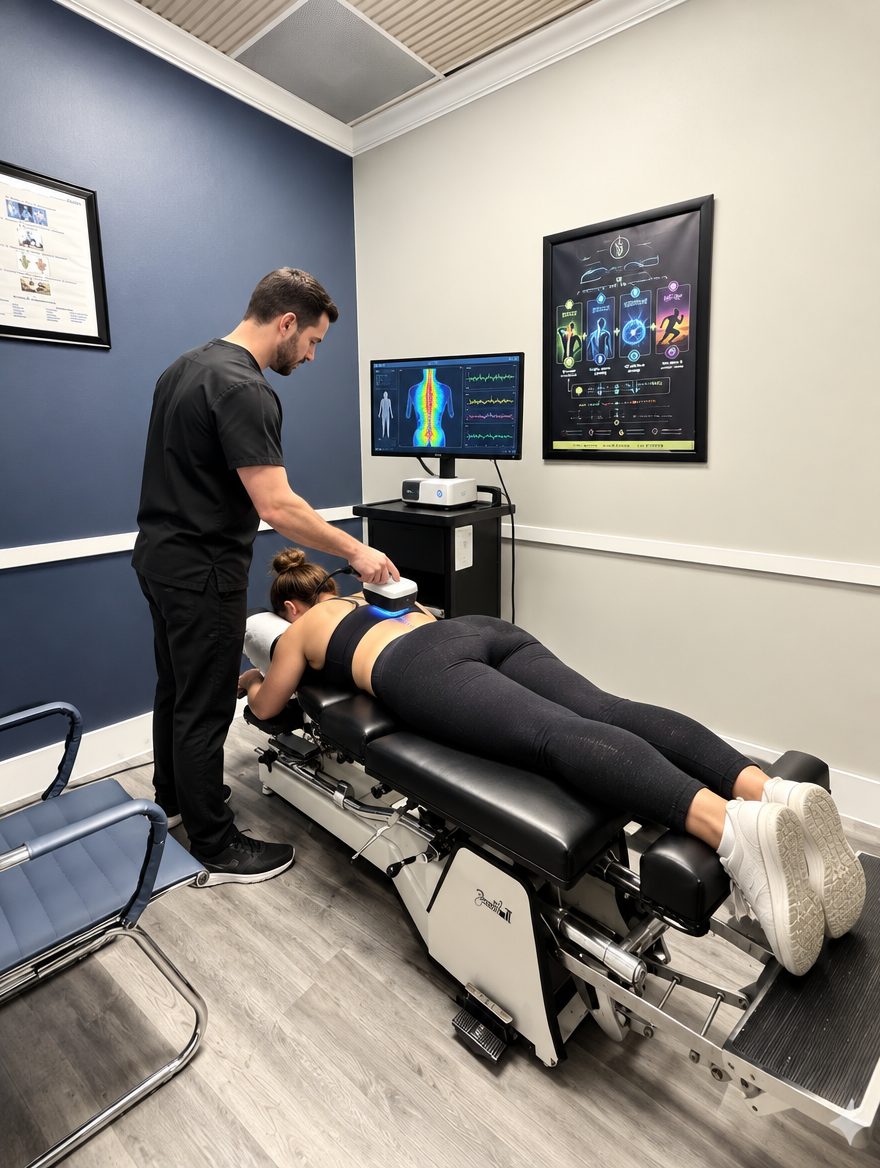
Adjustments are rarely delivered alone. Depending on your phase they are paired with spinal decompression, Graston Technique soft-tissue work, massage therapy, cold laser or PEMF, so the joint we free stays free.
What conditions does chiropractic care help?
Chiropractic care is most effective for pain that has a mechanical cause — a joint that is locked, a segment that is unstable, or a spine whose alignment overloads one structure. In our Coral Springs and Parkland practice the most common reasons people come in are:
- Lower back pain — facet joint irritation, the back that ‘goes out’, and the muscle strain that keeps recurring because the joint underneath was never freed.
- Neck pain and stiffness, including tech neck from desk and phone posture, and the headaches that start at the base of the skull.
- Hip and sacroiliac joint pain — one-sided low back and hip pain from a rotated pelvis.
- Mid-back and rib pain between the shoulder blades, common in drivers, desk workers and new parents.
- Disc problems and sciatica, where adjustments stabilize the segments around the disc while decompression takes the pressure off — see herniated discs.
- Sports and overuse injuries in golfers, tennis and pickleball players, runners and student athletes — see sports injury rehab.
Chiropractic care also has a place in prevention and performance: keeping a healthy spine moving well so it does not become a painful one. That is what the Refine phase of the 4R Method is for.
Good to know
The American College of Physicians’ clinical practice guideline recommends non-drug treatments, including spinal manipulation, as first-line options for acute and chronic low back pain (Qaseem et al., Annals of Internal Medicine, 2017).
What do the first two visits look like?
We do not adjust on a guess. The first visit is about measuring your spine so the adjustment on the second visit is the right one, delivered the right way.
Visit one — we measure (and usually begin care)
- A conversation about your pain, your history, what you have tried, and what you want back — sleeping through the night, a full round of golf, picking up your kids.
- A hands-on structural exam: posture, spinal and hip range of motion, palpation of each segment to find the locked joints, orthopedic tests, and neurological screening (reflexes, strength, sensation).
- Surface EMG and thermal scanning along the spine. The sEMG shows where your muscles are guarding; the thermal scan shows where nerves are irritated. Painless, objective and repeatable.
- Digital X-rays when indicated, to see curvature, alignment, disc spacing and wear — and to rule out anything an adjustment should not be applied to.
Visit two — your findings, your plan, and your first adjustment
Dr. Cohen reviews everything in plain English with your scans and images in front of you, explains which phase of the 4R Method you start in and what frequency makes sense, and Most patients have already begun care on visit one; this is where the full plan takes over. Many people feel a difference after that first adjustment; durable change takes the full plan. Curious where you stand? The 60-second spine assessment gives you a Spine Score before you walk in.
Is chiropractic care safe?
For the right patient, delivered after a proper exam, chiropractic adjustment is one of the safest treatments for spinal pain. The National Center for Complementary and Integrative Health summarizes the research as showing spinal manipulation is generally safe when performed by a trained, licensed practitioner, with side effects that are usually minor and short-lived — temporary soreness, stiffness or tiredness (NCCIH, Chiropractic: In Depth).
Safety is why we measure first. The exam and X-rays identify the situations where a manual adjustment is not appropriate — fracture, severe osteoporosis, spinal instability, tumor, infection, inflammatory arthritis in an active flare, or certain vascular conditions — and in many of those cases a gentler instrument or drop-table technique, decompression or rehab is used instead.
If you have sudden severe headache with neck pain, loss of bladder or bowel control, rapidly worsening weakness, or back pain with fever or unexplained weight loss, please see a doctor or urgent care today. For everything mechanical — the stiff, aching, locked-up spine — this is what we do all day.
How does chiropractic care fit into the 4R Method?
Adjustments appear in every phase of the 4R Method, but their purpose changes as you progress. That shift — from stabilization, to correction, to maintenance — is what separates a plan from a series of visits.
- R1 · Repair (3–5 visits/week, 4–8 weeks) — stabilization. Gentle, specific adjustments calm the irritated segment and break the guarding loop. For disc cases they are paired with spinal decompression; for joint cases with cold laser or ultrasound to reduce inflammation.
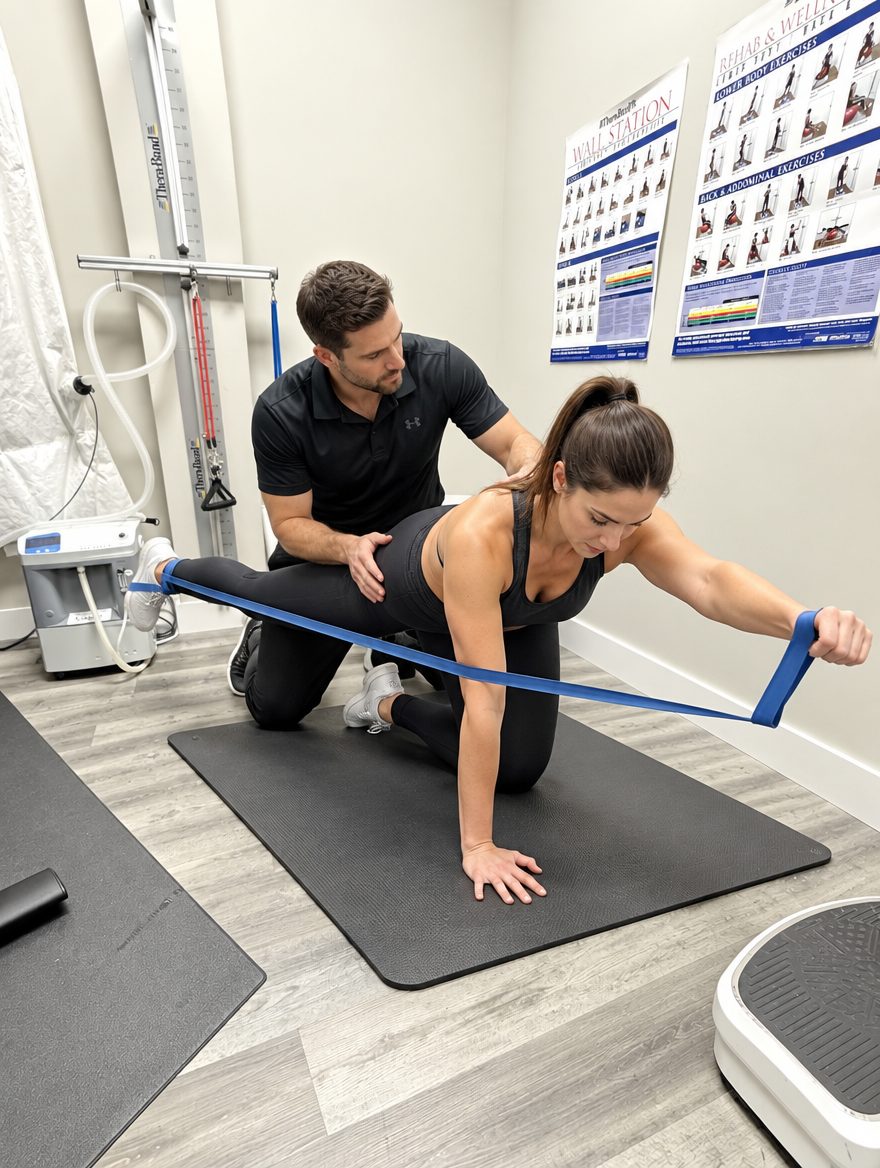
- R2 · Rebuild (2–3 visits/week, 8–16 weeks) — correction. Corrective, mirror-image adjustments retrain alignment while physical therapy rebuilds the deep core and hip stabilizers that hold the correction. This is the phase most clinics skip.
- R3 · Regenerate (2 visits/week, 2+ months) — resilience. Adjustments keep the corrected spine moving while red light, PEMF and recovery therapies elevate healing and energy.
- R4 · Refine (monthly) — tune-ups. A brief adjustment every month or two catches a locking joint before it becomes a painful one, and protects the gains you earned.
In our clinic, a Coral Springs desk worker with recurring low back pain, a Parkland high-school pitcher, and a retiree with a degenerative disc all receive chiropractic care — but at different frequencies, with different techniques, and for different reasons. The method is the same; the plan is yours.
Serving chiropractic patients across North Broward
Our clinic at 5675 Coral Ridge Drive, Coral Springs, FL 33076 serves Coral Springs, Parkland, Coconut Creek, Margate, Boca Raton, Tamarac, Pompano Beach and Deerfield Beach. Same-day appointments are usually available — call (954) 341-2256 or book online. Most patients from Parkland and Coral Springs are here in under 15 minutes.
Medically reviewed by Dr. Jared Cohen, DC — Co-Founder & Clinical Director, The Spine and Wellness Center. Last reviewed October 2026.
Frequently asked questions
Does a chiropractic adjustment hurt?
Usually not. Most adjustments feel like a quick stretch followed by relief, and the popping sound is gas releasing from the joint fluid, not bone. Acute or sensitive cases are adjusted with a drop-table or a light instrument instead of manual force. Mild soreness for a day afterward, like after exercise, is normal.
How often should I get adjusted?
It depends on your phase. In Repair, acute cases are typically seen 3–5 times a week for 4–8 weeks; Rebuild drops to 2–3 times a week; Regenerate to about twice a week; and Refine is a tune-up every month or two. Your frequency is set by your findings and re-scans, not by a template.
Will I have to keep coming forever?
No. The goal of the 4R Method is a spine that is corrected and stable, not one that depends on weekly visits. Most patients finish the structured plan and then choose a monthly or bi-monthly tune-up because it keeps them out of pain — the same way people keep seeing their dentist.
Is chiropractic care safe for seniors and children?
Yes, with the technique adjusted to the patient. Seniors with osteoporosis or arthritis are typically adjusted with instrument or drop-table methods that use very little force. Children receive extremely light, specific contacts. Your exam and X-rays, when indicated, determine what is appropriate before any adjustment is made.
Can a chiropractor help a herniated disc?
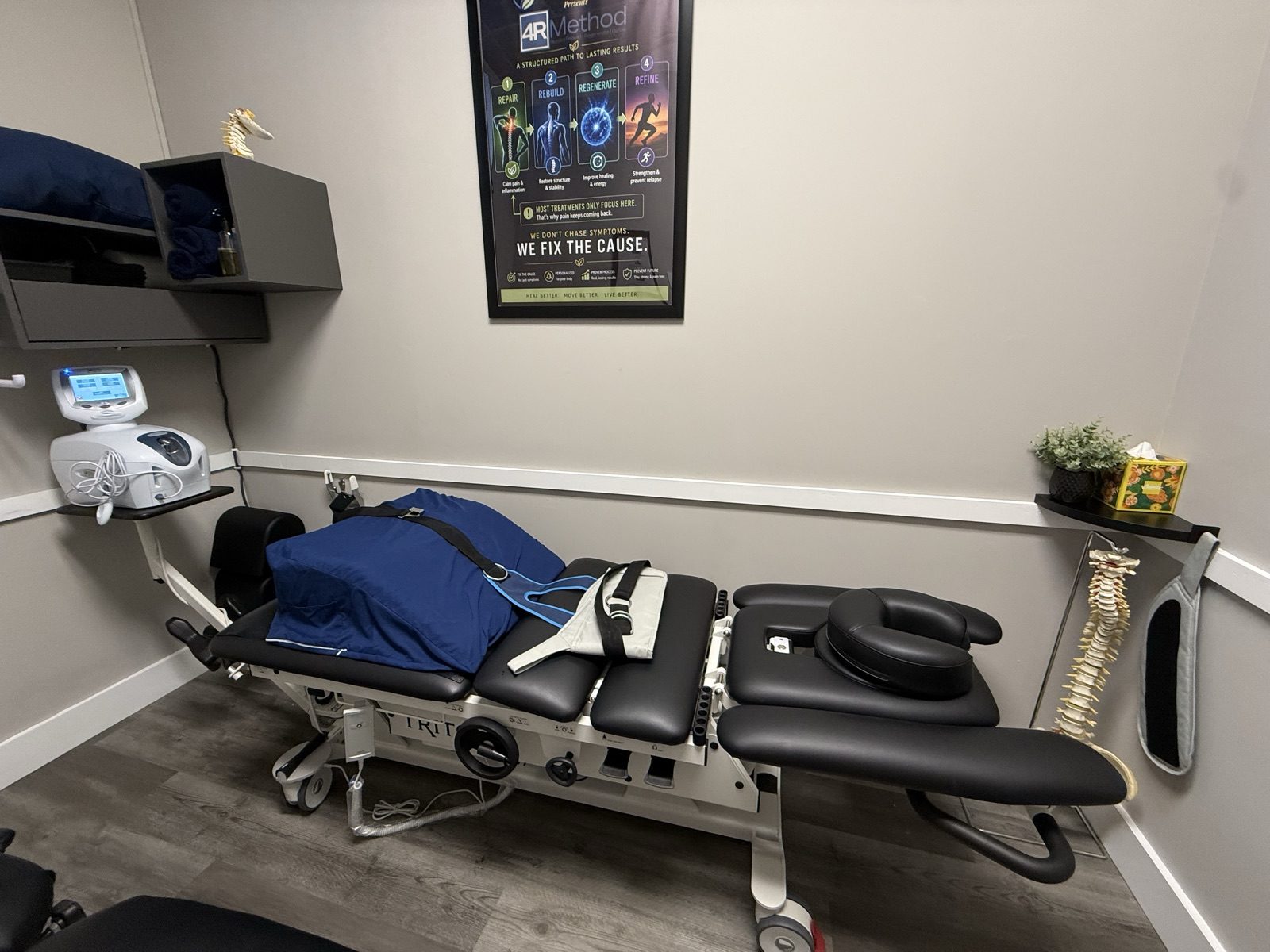
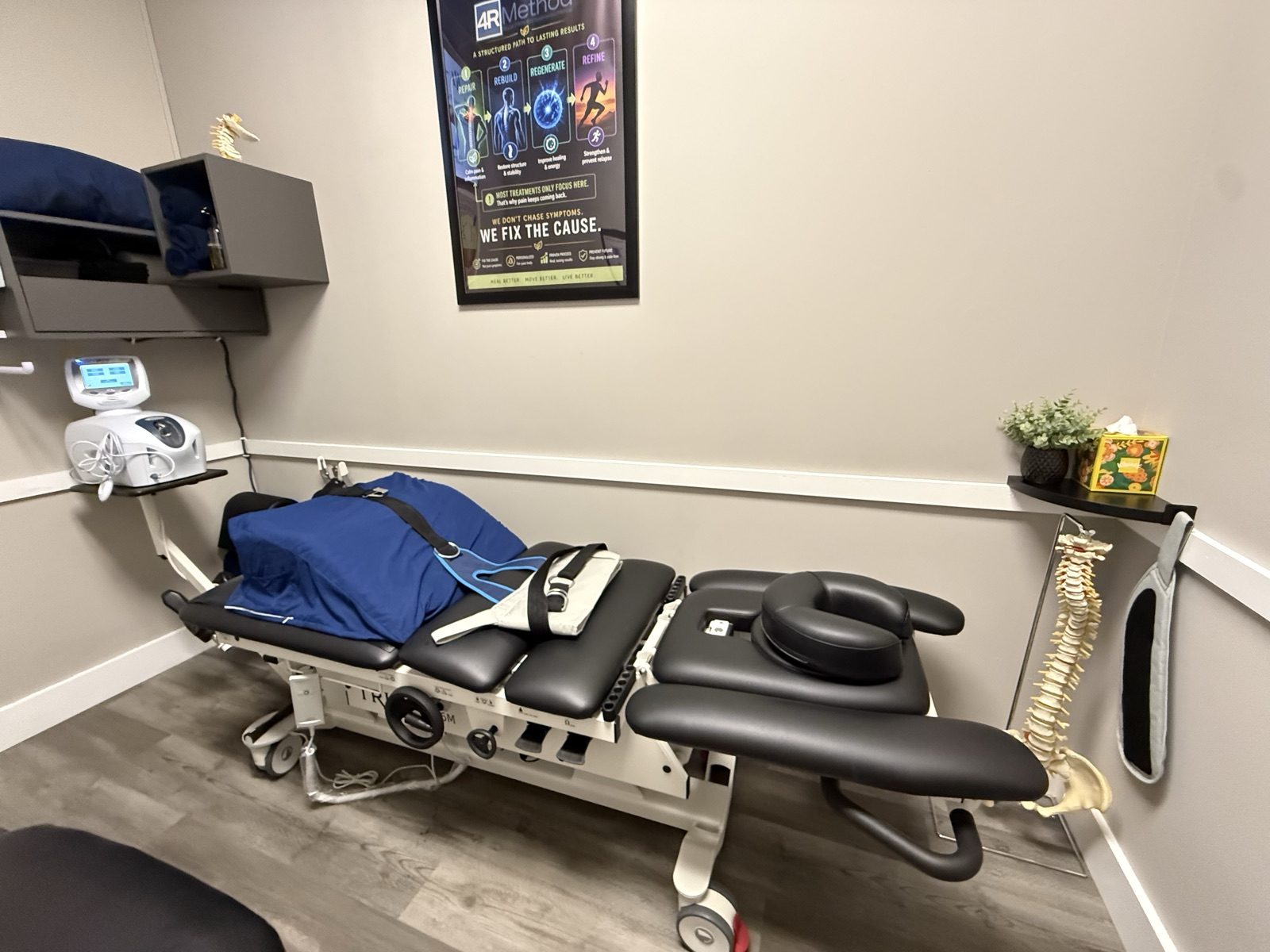
Yes, as part of a plan. Adjustments stabilize the segments around the disc and restore motion, while non-surgical spinal decompression on the Triton DTS takes the pressure off the nerve. Forceful manipulation directly at an acutely herniated level is avoided; the combination approach is what helps.
Do I need a referral or imaging before my first visit?
No referral is needed. The exam and surface scans on visit one tell us a great deal, and digital X-rays are taken when indicated. If you already have an MRI or X-rays, bring them and we will review them with you on visit two.


Same-day appointments
Let's fix the cause.
Measure first, then treat — a plan built on your actual structure.
- Same-day appointments are usually available
- Our team calls you back to confirm your visit
- Coral Springs, serving Parkland & North Broward since 2005
Prefer to talk now? Call or text (954) 341-2256