

Athletes & diagnostics · Coral Springs & Parkland
Sports injury rehab in Coral Springs & Parkland
Golf, tennis, pickleball, soccer, baseball, football — we rebuild the injured athlete, not just rest the injury. Measured assessment, staged rehab, objective return-to-play.
Quick answer
Sports injury rehab at The Spine and Wellness Center starts with measurement — a structural exam, surface EMG and GaitScan — then follows a staged progression: calm the injury, restore mobility, retrain stability, rebuild strength, return to sport. Athletes are cleared on objective criteria, not a calendar, inside the 4R Method. We treat youth, high-school, college and adult athletes.
What is sports injury rehab, and why is rest alone not enough?
Sports injury rehab is a structured program that takes an injured athlete from pain back to full performance — and fixes the mechanics that caused the injury so it does not happen again. Rest calms the symptom; it does nothing about the hip that does not rotate, the core that does not fire, or the foot that collapses with every stride.
That is why so many athletes in Coral Springs and Parkland come to us with the same injury for the third time. Sprains, strains and overuse injuries heal with time, but the weakness, stiffness and compensation they leave behind do not resolve on their own. The National Institute of Arthritis and Musculoskeletal and Skin Diseases notes that rehabilitation after a sports injury is aimed at restoring strength, flexibility and range of motion, and that returning too early is a common cause of re-injury (NIAMS, Sports Injuries).
Our program is built around that reality: measure what the injury changed, correct it in stages, and clear the athlete on objective criteria rather than a date.

Which sports injuries do we see most, by sport?
South Florida athletes play year-round, which means overuse injuries never get an off-season. These are the patterns we see most in our Coral Springs clinic:
- Golf — low back pain from the rotational load of the swing, lead-side hip and SI joint irritation, golfer’s elbow and lead-wrist strain. See golf injury treatment.
- Tennis — tennis elbow, rotator cuff and shoulder impingement from serving, low back pain from the open-stance forehand, and ankle sprains.
- Pickleball — the fastest-growing injury source we see: Achilles and calf strains, ankle sprains, falls onto the wrist and shoulder, and low back pain in players new to lateral movement. See pickleball injury treatment.
- Soccer — hamstring and groin strains, ankle sprains, knee injuries, and hip flexor tightness driving low back pain.
- Baseball and softball — throwing-shoulder and elbow overuse (especially in youth pitchers), oblique strains, and low back pain in hitters.
- Football — neck and upper back strain from contact, shoulder injuries, hamstring strains and lumbar stress from blocking and lifting.
Across every sport, two findings show up again and again: a stiff or unstable spine that forces the hips and shoulders to overwork, and a gait or foot pattern that loads one side of the body harder than the other. Those are where the rehab plan starts.
How do we assess an injured athlete?
Visit one is measurement. We do not guess at what an injury has changed; we test it, so the rehab plan addresses the actual deficit and so we have a baseline to clear you against later.
- Conversation and history. The injury, the sport, your position, your training load, previous injuries, and the date you are trying to get back for.
- Hands-on structural exam. Joint-by-joint range of motion, orthopedic tests on the injured tissue, movement screens (squat, lunge, single-leg balance, overhead reach), strength and neurological testing.
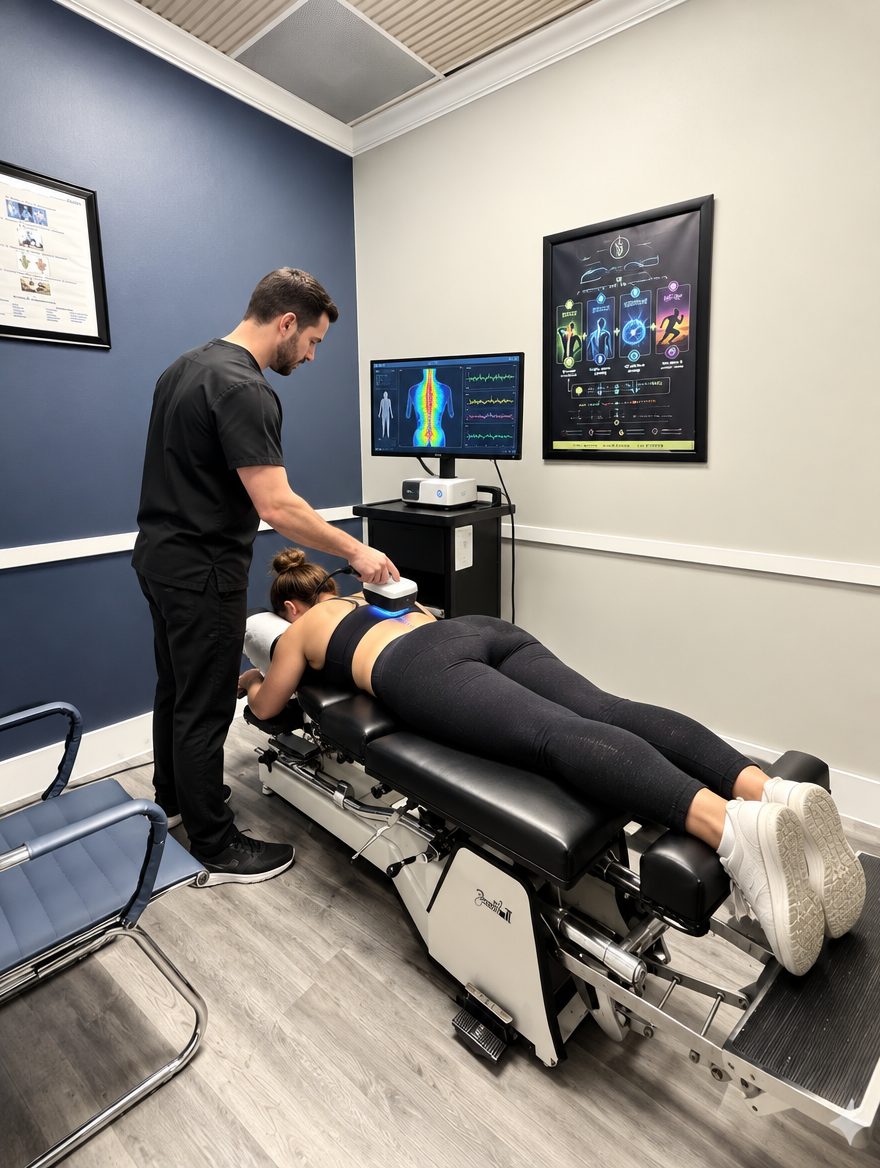
- Surface EMG (sEMG) and thermal scanning. A painless scan along the spine that shows where muscles are guarding or under-firing, and where nerves are irritated. It is the objective picture of how the injury has changed your spinal control.
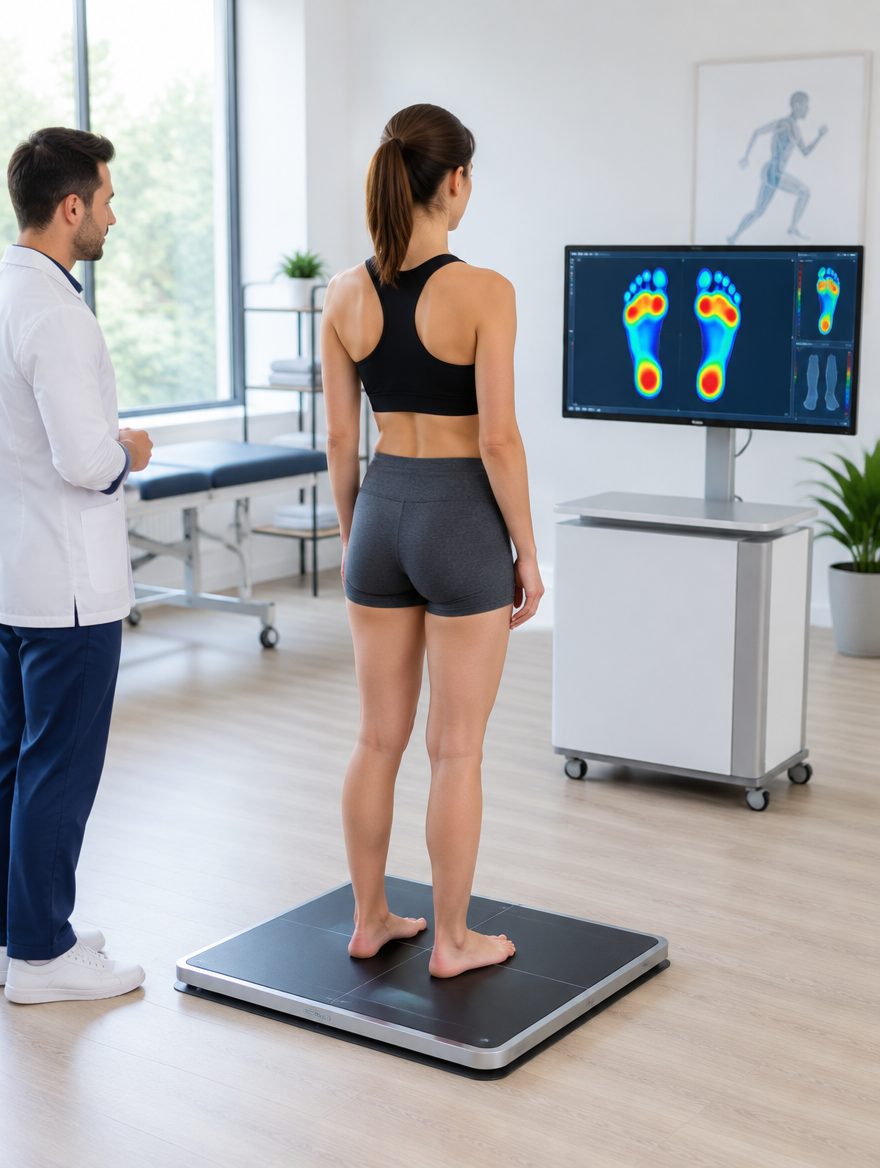
- GaitScan. A pressure-plate analysis of how your feet load as you stand and walk. Asymmetric loading, over-pronation and a collapsed arch show up as a map — and explain a lot of knee, hip and low back injuries.
- Digital X-rays when indicated, and a review of any MRI or imaging you already have.
Visit two is your report of findings: what the injury changed, what caused it, your staged plan inside the 4R Method, and Most patients have already begun care on visit one; this is where the full plan takes over. If you want a head start, the 60-second spine assessment gives us your Spine Score before you arrive.
What does the rehab progression look like?
Sports injury rehab follows the 4R Method — Repair, Rebuild, Regenerate, Refine — with each phase mapped to a stage of athletic recovery. You advance when you meet the stage’s criteria, not when a week passes.
- Calm the injury (Repair, 3–5 visits/week, 4–8 weeks). Reduce pain and inflammation and protect the healing tissue: cold laser, PEMF, gentle chiropractic adjustments to the segments that locked up, and spinal decompression when a disc is involved.
- Restore mobility (Repair → Rebuild). Regain full, pain-free range of motion in the injured joint and the joints around it — Graston Technique for scar tissue, massage therapy for guarding, guided mobility work.
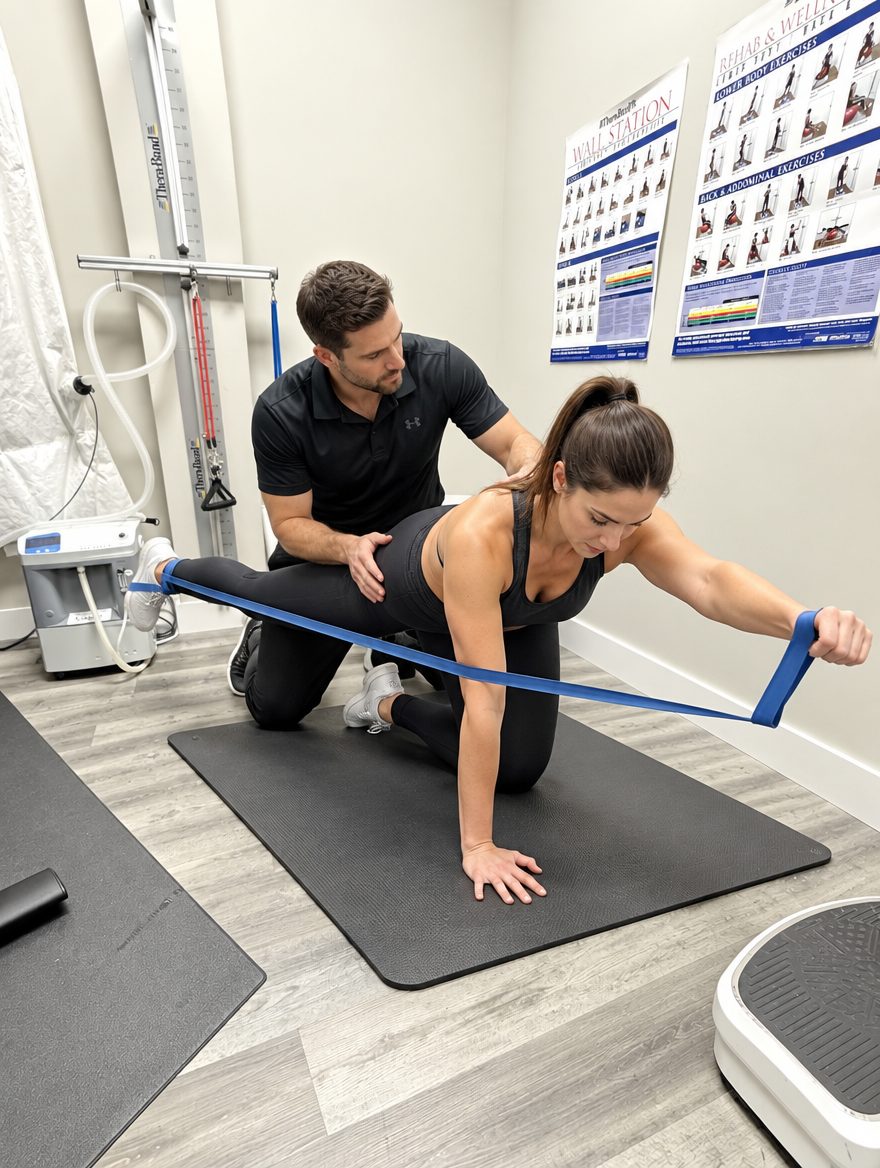
- Retrain stability (Rebuild, 2–3 visits/week, 8–16 weeks). Neuromuscular retraining of the deep core, hips and scapular stabilizers through physical therapy, so the spine and joints are controlled under load.
- Rebuild strength and power (Rebuild → Regenerate). Progressive loading, then speed, rotation and plyometrics, while red light and recovery protocols support adaptation.
- Return to sport (Regenerate, 2 visits/week, 2+ months). Sport-specific drills — the swing, the serve, the throw, the cut — at increasing intensity, with re-testing against your baseline.
- Stay there (Refine, monthly). Tune-ups and periodic re-scans through the season to catch the next problem before it becomes an injury.
A high-school soccer player with a hamstring strain and a 45-year-old Parkland golfer with low back pain move through the same six steps — at different speeds, with different exercises, toward different finish lines.
When is an athlete ready to return to play?
Return-to-play is a decision made on criteria, not on how long it has been. Being pain-free at rest is the entry requirement, not the finish line. Before we clear an athlete, we look for:
- Full, pain-free range of motion in the injured joint, equal to the uninjured side.
- Strength within roughly 90% of the uninjured side on the relevant tests, including single-leg and rotational strength.
- Clean movement screens — single-leg squat, hop tests, lunge and overhead patterns without compensation.
- A re-scan that matches the baseline: surface EMG shows symmetric muscle activity, and GaitScan shows balanced loading.
- Sport-specific tolerance — a full practice, a full bucket of balls, or a full set of serves without symptoms the next day.
- Confidence. An athlete who is still guarding mentally plays differently and gets hurt differently. We build intensity until the hesitation is gone.
Clearing an athlete early is the most common mistake in sports injury rehab, and the easiest to avoid when you have measured the baseline on day one.
Youth, high-school and college athletes
Growing athletes are not small adults. Growth plates, year-round single-sport specialization and pitch counts change what we look for and how fast we load. We coordinate with parents, coaches and athletic trainers, and we have dedicated programs for high-school athletes and college athletes who want to come back stronger than before the injury.
When should a sports injury see a doctor first?
Most sprains, strains and overuse injuries are exactly what we treat. A few signs mean medical evaluation comes first: a joint that is visibly deformed, a bone you heard or felt break, inability to bear weight at all, numbness or loss of circulation below the injury, a head injury with confusion or vomiting, or severe swelling that develops within minutes. In those cases, please see a doctor or urgent care today — we will be here for the rehab afterwards.
For everything else — the rolled ankle, the pulled hamstring, the shoulder that aches after every serve, the back that locks up on the tee box — we are usually able to see Coral Springs and Parkland athletes the same day they call.
Serving injured athletes across North Broward
Our clinic at 5675 Coral Ridge Drive, Coral Springs, FL 33076 serves Coral Springs, Parkland, Coconut Creek, Margate, Boca Raton, Tamarac, Pompano Beach and Deerfield Beach. Same-day appointments are usually available — call (954) 341-2256 or book online. Most patients from Parkland and Coral Springs are here in under 15 minutes.
Medically reviewed by Dr. Jared Cohen, DC — Co-Founder & Clinical Director, The Spine and Wellness Center. Last reviewed October 2026.
Frequently asked questions
How long does sports injury rehab take?
It depends on the tissue and the sport. A mild ankle sprain may clear in three to four weeks; a hamstring strain or a disc-related back injury often needs the full Repair and Rebuild phases, roughly 12–20 weeks to a confident return. We give you a realistic range at your report of findings and update it with each re-test.
Can I keep training while I rehab?
Usually, yes — modified. Most athletes keep conditioning, upper- or lower-body training away from the injury, and sport-specific skill work that does not load the injured tissue. Staying active speeds recovery; what changes is what you load and how hard. We coordinate with your coach or athletic trainer.
Do you treat youth and high-school athletes?
Yes. Youth, high-school and college athletes are a large part of our practice. Growth plates, specialization and pitch counts change how we assess and load, and techniques are adapted to age. We work with parents and coaches, and we have dedicated performance programs for high-school and college athletes.
What is the difference between sports injury rehab and physical therapy?
Physical therapy is one of the tools inside sports injury rehab. Rehab here also includes the structural side — adjustments, decompression when a disc is involved, Graston and cold laser — plus the assessment tools (sEMG, GaitScan) and the sport-specific return-to-play stage that a general PT program usually does not.
Will I need imaging before starting?
Not always. The exam, movement screens and surface scans on visit one usually tell us what is injured and how badly. Digital X-rays are taken when indicated, and if we suspect a fracture or a significant tear we refer for imaging before Most patients have already begun care on visit one; this is where the full plan takes over. If you already have an MRI, bring it.
Can rehab help prevent the same injury from coming back?
That is its main purpose. Most repeat injuries come from mechanics that were never corrected — a stiff hip, a weak core, uneven foot loading. Measuring and correcting those in the Rebuild phase, and checking them during Refine-phase tune-ups through the season, is what keeps the injury from recurring.

Same-day appointments
Let's fix the cause.
Measure first, then treat — a plan built on your actual structure.
- Same-day appointments are usually available
- Our team calls you back to confirm your visit
- Coral Springs, serving Parkland & North Broward since 2005
Prefer to talk now? Call or text (954) 341-2256