

Conditions · Coral Springs & Parkland
Car accident chiropractor in Coral Springs & Parkland
Whiplash, disc injuries and SI joint sprains often do not hurt until days after the collision. Here is what to do in the first 72 hours, what Florida's 14-day rule means, and how we treat the injury — and document it.
Quick answer
A car accident chiropractor evaluates and treats the soft tissue, disc and joint injuries that collisions cause — most often whiplash, cervical and lumbar disc injuries and sacroiliac sprains. At The Spine and Wellness Center we measure the injury on visit one, document it for your claim, and treat it non-surgically through the 4R Method. Florida's PIP law generally requires initial medical treatment within 14 days of the accident.
What should you do in the first 72 hours after a car accident?
Seeing a car accident chiropractor within the first few days matters for two reasons: injuries from a collision are easiest to treat before the body builds scar tissue and guarding around them, and Florida’s insurance rules put a clock on your care. Adrenaline masks pain for 24–72 hours, so ‘I felt fine at the scene’ is the most common sentence we hear in our Coral Springs clinic from people who are very much not fine a week later.
- Get checked for emergencies first. Loss of consciousness, confusion, severe headache, vomiting, chest pain, numbness in both arms or legs, or any inability to move normally — please see a doctor or urgent care today before anything else.
- Document the scene. Photos of the vehicles and the road, the other driver’s information, the police report number, and the names of any witnesses.
- Write down your symptoms daily. Neck stiffness, headache, back pain, tingling, sleep problems, dizziness. Symptoms that appear on day two or three are typical of whiplash and are still accident-related.
- Notify your auto insurer. Florida is a no-fault state; your own Personal Injury Protection (PIP) coverage is usually the first payer for medical care regardless of who caused the crash.
- Book an evaluation. Florida’s PIP law generally requires initial medical treatment within 14 days of the accident to preserve benefits, and an early exam creates the baseline every later record is measured against.

Florida’s 14-day PIP rule: what it means for your treatment
Florida’s Personal Injury Protection statute generally requires that a person injured in a motor vehicle accident receive initial medical services within 14 days of the accident for PIP benefits to apply. Treatment can be provided by, or under the referral of, a licensed physician, chiropractic physician, dentist or hospital, among others. Chiropractic physicians are specifically included, which is why a car accident chiropractor is an appropriate first stop for the spinal and soft tissue injuries collisions cause.
Two further points are worth knowing. PIP typically covers a percentage of reasonable medical expenses up to the policy limit, and the amount available can depend on whether an ’emergency medical condition’ is documented by a qualifying provider. We are careful to describe these rules generally, because the details depend on your policy and your situation; your insurer or attorney can confirm how they apply to you.
Keep it simple
Day 14 is a deadline, not a target. The sooner a car accident chiropractor measures the injury, the better the clinical outcome and the cleaner the record. If you were in a crash this week in Coral Springs, Parkland or Coconut Creek, we are usually able to see you the same day you call.
Common car accident injuries we treat (and the ones we refer out)
Even a low-speed rear-end collision transfers enough force to the body to sprain ligaments, strain muscles and injure discs. These are the patterns a car accident chiropractor sees most, roughly in order of frequency:
- Whiplash (cervical acceleration-deceleration injury). The head snaps backward then forward, straining the neck’s ligaments, muscles and facet joints. Neck pain, stiffness, headaches at the base of the skull, shoulder pain and sometimes dizziness, usually peaking 24–72 hours after the crash. See our whiplash treatment page for the full program.
- Cervical and lumbar disc injuries. The compressive and shearing forces of a collision can bulge or herniate a disc. Arm or leg pain, tingling or weakness after a crash points to a nerve root and is a decompression case. See herniated disc treatment.
- Sacroiliac (SI) joint sprain. Bracing a foot on the brake pedal drives force up one leg into the pelvis, straining the SI joint. One-sided low back and hip pain that flares standing from a chair or climbing stairs. See our hip and SI joint guide.
- Mid-back and rib joint sprains from the seat belt and seat back — sharp pain between the shoulder blades, worse with deep breaths or twisting.
- Shoulder, wrist and knee injuries from bracing on the wheel or striking the dash.
Some symptoms are not ours to treat first. Headache with confusion, memory problems, nausea, light sensitivity or unusual fatigue after a crash can indicate a concussion; chest pain, shortness of breath, abdominal pain, or numbness in both arms or legs can indicate injuries that need imaging and medical management. In those cases we refer you to the appropriate physician or urgent care right away and coordinate the spinal care afterwards.
How a car accident chiropractor evaluates the injury (visit 1)
Accident injuries are measured, not guessed, because the baseline exam is both the foundation of your treatment plan and the first page of your medical record. Your first visit at our Coral Springs clinic includes:
- A detailed history of the collision. Direction of impact, speed, head position, seat belt use, headrest position, airbag deployment, and the timeline of every symptom since. These details correlate with specific injury patterns.
- A hands-on structural exam. Cervical, thoracic and lumbar range of motion measured in degrees, orthopedic tests for ligament, disc and joint injury, and neurological screening of the arms and legs (reflexes, strength, sensation).
- Surface EMG and thermal scanning. A painless scan that objectively shows where the muscles along the spine are guarding and where nerve irritation is present. Because it is repeatable, it documents both the injury and the recovery.
- Digital X-rays when indicated. To rule out fracture and instability and to assess alignment — a loss of the normal cervical curve is common after whiplash. We review any ER imaging you already have.
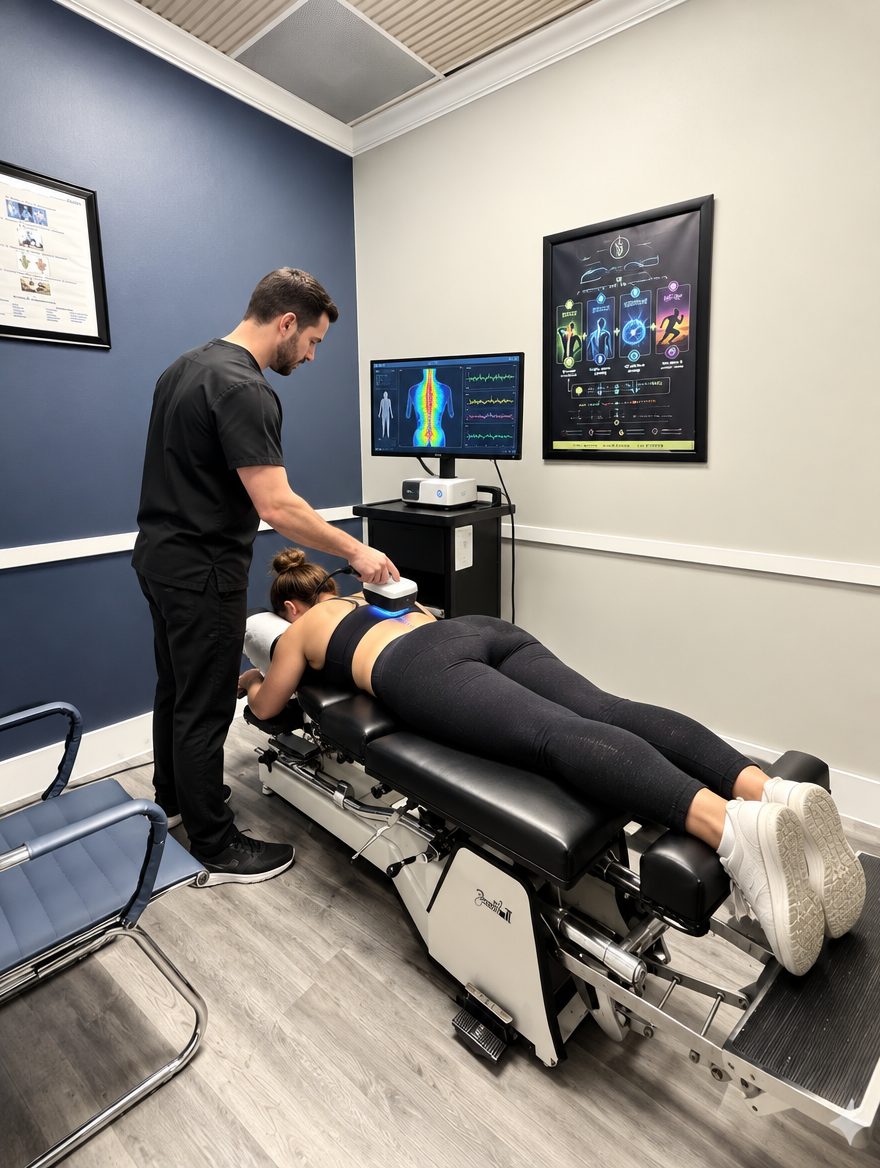
Visit two is your report of findings: the exam results, scans and images explained in plain English and mapped to a treatment plan with a specific frequency and duration. Treatment begins that day.
The documentation we provide for your claim
We handle your PIP claim for you. We bill your auto insurer directly and our front desk takes care of the PIP claim paperwork, so you can focus on getting better instead of chasing forms.
Accurate records protect your recovery and your claim, and a car accident chiropractor who measures carefully produces records that hold up. Dr. Jared Cohen and the team provide:
- An initial examination report with the mechanism of injury, objective findings (range of motion in degrees, orthopedic and neurological results, sEMG and thermal findings, imaging) and the clinical diagnosis.
- A written treatment plan with the recommended frequency, duration and goals, updated at each re-evaluation.
- Daily treatment notes documenting what was done and how you responded.
- Re-evaluation reports at regular intervals, including repeat sEMG and thermal scans that show measurable progress.
- Itemized billing suitable for PIP submission, and direct communication with your attorney’s office if you have one.
We do not inflate findings and we do not prolong care that is no longer needed — honest, objective records are what serve patients best, and they are what insurers and attorneys trust.
How we treat car accident injuries: the 4R Method
Car accident treatment at The Spine and Wellness Center follows the 4R Method — Repair, Rebuild, Regenerate, Refine — because collision injuries heal in a sequence. A car accident chiropractor who skips steps leaves people with the chronic neck or back pain that follows so many crashes.
R1 · Repair — calm the injury (3–5 visits a week, 4–8 weeks)
Early care focuses on inflammation and guarding: cold laser and therapeutic ultrasound over sprained ligaments and facet joints, gentle massage and soft tissue work for spasm, low-force adjustments to restore motion to locked segments once acute inflammation settles, and spinal decompression for disc injuries with arm or leg symptoms.
R2 · Rebuild — restore strength and alignment (2–3 visits a week, 8–16 weeks)
Whiplash commonly flattens the cervical curve and switches off the deep neck flexors; lumbar injuries do the same to the core. Physical therapy, corrective chiropractic and Graston Technique for the scar tissue that forms after ligament sprains rebuild the structure so the injury does not become a chronic problem.
R3 · Regenerate and R4 · Refine
Regenerate supports tissue quality with red light and PEMF; Refine is a brief monthly tune-up for patients who want to protect the recovery. Most uncomplicated whiplash cases are discharged from active care well before this point.
Whiplash treatment
The full program for cervical acceleration-deceleration injuries, from the first 72 hours to discharge.
Learn moreSpinal decompression
For disc injuries with arm or leg symptoms — gentle traction that takes pressure off the nerve.
Learn moreGraston Technique
Breaks up the scar tissue that forms after ligament sprains so the neck and back move freely again.
Learn morePhysical therapy
Rebuilds the deep neck flexors and core that whiplash and lumbar injuries switch off.
Learn moreWhat to expect from recovery after a collision
Most whiplash and soft tissue injuries improve substantially within six to twelve weeks of structured care with a car accident chiropractor, and the best predictor of a good outcome is starting early and staying active. The National Institute of Neurological Disorders and Stroke notes that most people with whiplash recover within a few months, while a minority develop persistent symptoms — the group early, active care aims to keep small (NINDS, Whiplash Information Page).
Between visits: keep the neck and back moving gently rather than bracing in a collar, apply ice during the first 48 hours and heat for stiffness after that, keep screens at eye level, and avoid heavy lifting until cleared. Tell us immediately about new numbness, weakness, dizziness or headaches. If you would like a head start before your first visit, take the 60-second spine assessment.
Serving car accident injury patients across North Broward
Our clinic at 5675 Coral Ridge Drive, Coral Springs, FL 33076 serves Coral Springs, Parkland, Coconut Creek, Margate, Boca Raton, Tamarac, Pompano Beach and Deerfield Beach. Same-day appointments are usually available — call (954) 341-2256 or book online. Most patients from Parkland and Coral Springs are here in under 15 minutes.
Medically reviewed by Dr. Jared Cohen, DC — Co-Founder & Clinical Director, The Spine and Wellness Center. Last reviewed October 2026.
Frequently asked questions
Should I see a car accident chiropractor even if I feel fine?
Yes, if the collision had any real force. Adrenaline masks pain for 24–72 hours and whiplash symptoms commonly peak on day two or three. An early evaluation catches injuries before scar tissue and guarding set in, and it creates the baseline record that Florida's PIP rules and any later claim depend on.
What is Florida's 14-day rule?
Florida's PIP law generally requires that initial medical treatment be received within 14 days of the accident for PIP benefits to apply. Treatment from a licensed chiropractic physician counts. The specifics depend on your policy and situation, so confirm with your insurer or attorney — but do not let the deadline approach before being evaluated.
Does PIP cover chiropractic care after a car accident?
Chiropractic physicians are among the providers Florida's PIP statute recognizes for initial and follow-up care. Coverage is typically a percentage of reasonable medical expenses up to your policy limit, and the amount available can depend on how the injury is documented. We provide itemized billing and records suitable for PIP submission.
Do I need a lawyer to see you?
No. Many patients come to a car accident chiropractor directly after a crash, and PIP is your own coverage regardless of fault. If you do have an attorney, we communicate directly with their office and provide the examination reports, treatment notes and re-evaluations they need. We do not require representation to begin care.
How long does treatment take after a car accident?
Most uncomplicated whiplash and soft tissue injuries improve substantially within six to twelve weeks. The Repair phase typically runs 4–8 weeks at 3–5 visits a week, followed by a Rebuild phase to restore strength and alignment. Disc injuries with nerve symptoms and multi-region injuries take longer. Re-evaluations every few weeks track measurable progress.
What if I was already seen at the ER?
That is a good start — the ER rules out fractures and emergencies, but it does not usually treat the soft tissue, joint and disc injuries that cause lasting pain. Bring your ER records and imaging to your first visit; we build on them rather than repeating them, and your ER visit counts toward the 14-day window.

Same-day appointments
Let's build your plan.
Find out what's actually going on and get a clear path forward. Same-day appointments available.
- Same-day appointments are usually available
- Our team calls you back to confirm your visit
- Coral Springs, serving Parkland & North Broward since 2005
Prefer to talk now? Call or text (954) 341-2256