

Athletes · Coral Springs & Parkland
Soccer injury treatment in Coral Springs & Parkland
Rolled ankles, tweaked knees, pulled hamstrings and tight groins — soccer is a cut-and-sprint sport played on hard South Florida fields. We treat the injury, find why it happened and rebuild the movement so it holds.
Quick answer
Effective soccer injury treatment calms the injured tissue first, then corrects the mechanics that produced it. For ankle sprains, knee pain, hamstring and groin strains and low back pain we combine chiropractic care, soft-tissue work, cold laser and progressive sports rehab inside the 4R Method, then clear players back to the pitch in stages.
Why soccer injuries happen the way they do
Good soccer injury treatment starts with understanding how the game loads the body. Soccer is a start-stop sport: a 90-minute match is hundreds of accelerations, decelerations, cuts, jumps and long kicks, most of them on one leg at a time. That is why the ankle, the knee, the hamstrings, the adductors (groin) and the hip flexors take the brunt of the damage — and why the low back gets dragged into it when the core tires.
In Coral Springs and Parkland most of the players we see are young. Club, school and travel teams often overlap, so a 14-year-old can play more minutes in a tournament weekend than their tissues have adapted to. On a growing body, bone, growth plates and tendons mature at different rates, which changes where the weak link sits. A teenager’s heel or kneecap tendon can be the structure that complains before a ligament ever does.
Our job has three parts: treat the injury, find the mechanical reason it happened, and rebuild strength and movement quality so the same weak link does not go again a month later.

Ankle, knee, hamstring, groin or hip? How to tell what is hurt
The mechanism and the location tell you a lot before any imaging does. These are the five patterns that account for most youth and club soccer injuries:
- Ankle sprain. A planted foot rolls inward on a cut or tackle, over-stretching the outer ankle ligaments. The most common soccer injury — and the one most likely to become a chronically unstable ankle if balance is never retrained.
- Knee pain and ACL-region injuries. Patellar tendon pain below the kneecap, IT band tightness and overuse ache are what we treat; any pop, locking, giving way or rapid swelling is referred for imaging and an orthopedic opinion first. Young female players carry a higher ACL risk, so we screen landing mechanics.
- Hamstring strain. A sudden grab at the back of the thigh mid-sprint, from a tight pull to a tear. Hamstrings re-injure when a player returns before strength and hip control are back.
- Groin (adductor) and hip flexor strain. Pain in the inner thigh or front of the hip after long kicks, lunges and side-to-side cuts. Often sits on top of a hip that does not rotate well.
- Low back pain. Repeated kicking, twisting and a fatigued core leave a nagging ache across the lumbar spine. In a growing athlete, persistent back pain deserves a careful look, not a shrug.
Growth-plate overuse sits alongside these: Sever’s disease (heel pain) and Osgood-Schlatter (pain below the kneecap) appear during growth spurts and heavy schedules, and respond to load management and targeted rehab rather than pushing through.
Good to know
The American Academy of Orthopaedic Surgeons notes that incompletely rehabilitated ankle sprains are a leading cause of recurrent sprains and chronic ankle instability (AAOS OrthoInfo, Sprained Ankle). Balance and strength retraining is the part that matters most — and the part most often skipped.
How we approach soccer injury treatment at TSAWC
Our soccer injury treatment follows the 4R Method: Repair, Rebuild, Regenerate, Refine. The sequence matters. Calming the pain and sending a player straight back to full training is how a two-week injury becomes a season-long one. So we settle the tissue first, then correct the mechanics, then protect the gains.
R1 · Repair — calm the tissue and restore motion
In the Repair phase we reduce swelling and get the joint moving again: gentle, age-appropriate chiropractic adjustments to the ankle, hip, pelvis and spine where motion is lost, cold laser therapy to support early tissue healing, and light soft-tissue work. For acute injuries the Repair phase is typically 3–5 visits a week for 2–4 weeks; for chronic or recurring problems it can run 4–8 weeks.
R2 · Rebuild — fix the reason it happened
Rebuild is where the sports rehab lives: single-leg strength and balance, hip mobility and rotation, hamstring strength through full length, core control for the trunk during sprints and shots, and retraining how the player decelerates and changes direction. Graston Technique breaks down the scar tissue and adhesions a strain leaves behind. Typical commitment is 2–3 visits a week for 6–12 weeks, tapering as the home program takes over.
R3 and R4 · Regenerate and Refine
Regenerate supports recovery between hard sessions with red light and PEMF. Refine is the long game: a brief tune-up and movement check every month or two across the season, plus a pre-season screen so small compensations are caught early.
Sports injury rehab
Progressive strength, balance and agility work that turns 'the pain is gone' into 'ready to compete'.
Learn moreChiropractic care
Restore motion in the ankle, hip, pelvis and lumbar spine so the whole chain moves well.
Learn moreGraston Technique
Instrument-assisted soft-tissue work for the scar tissue left by hamstring and groin strains.
Learn moreCold laser therapy
Low-level laser that calms inflammation and supports healing in sprained ligaments and irritated tendons.
Learn more6 proven treatments for soccer injuries (and when each one fits)
No single tool covers soccer injury treatment on its own. These are the six we reach for most, matched to the pattern they work best on:
- Chiropractic adjustments. Best for a stiff ankle after a sprain, a hip that will not rotate, a rotated pelvis and the locked lumbar joints behind low back pain. Gentle techniques scaled to the athlete’s age.
- Sports rehab and physical therapy. Best for every injury on this page. Strength, balance and movement retraining are what prevent the re-injury. See our physical therapy page.
- Graston Technique. Best for hamstring, groin and calf strains that have left fibrous, tight tissue and for IT band restriction.
- Cold laser therapy. Best in the first days and weeks after an ankle sprain or tendon flare — drug-free inflammation control.
- Acoustic shockwave therapy. Best for stubborn tendon problems — patellar tendon, Achilles, chronic hamstring tendinopathy — in older teens and adults. See shockwave therapy.
- GaitScan and movement analysis. Best for players with recurring ankle, shin or knee problems. A GaitScan pressure-plate analysis shows how the foot loads, and informs cleat, orthotic and strength decisions.
When disc pressure is part of the picture in an older teen, non-surgical spinal decompression may be added; massage therapy supports recovery during heavy tournament stretches.
Getting back on the pitch: agility, mobility and return-to-play
Pain-free is not the same as ready. The best soccer injury treatment makes the next injury less likely, so once the acute phase settles we shift toward performance: ankle and hip mobility for clean cuts, single-leg strength and balance for plant and landing, core control during sprints and shots, and retraining deceleration and change of direction.
Return-to-play is staged: straight-line running, then cutting, then non-contact drills, then full practice, checking pain, swelling, range of motion and single-leg hop symmetry before each step. For hamstring and ACL-region injuries, quality of movement drives risk, so we watch how the athlete lands and decelerates, not just how much they can lift.
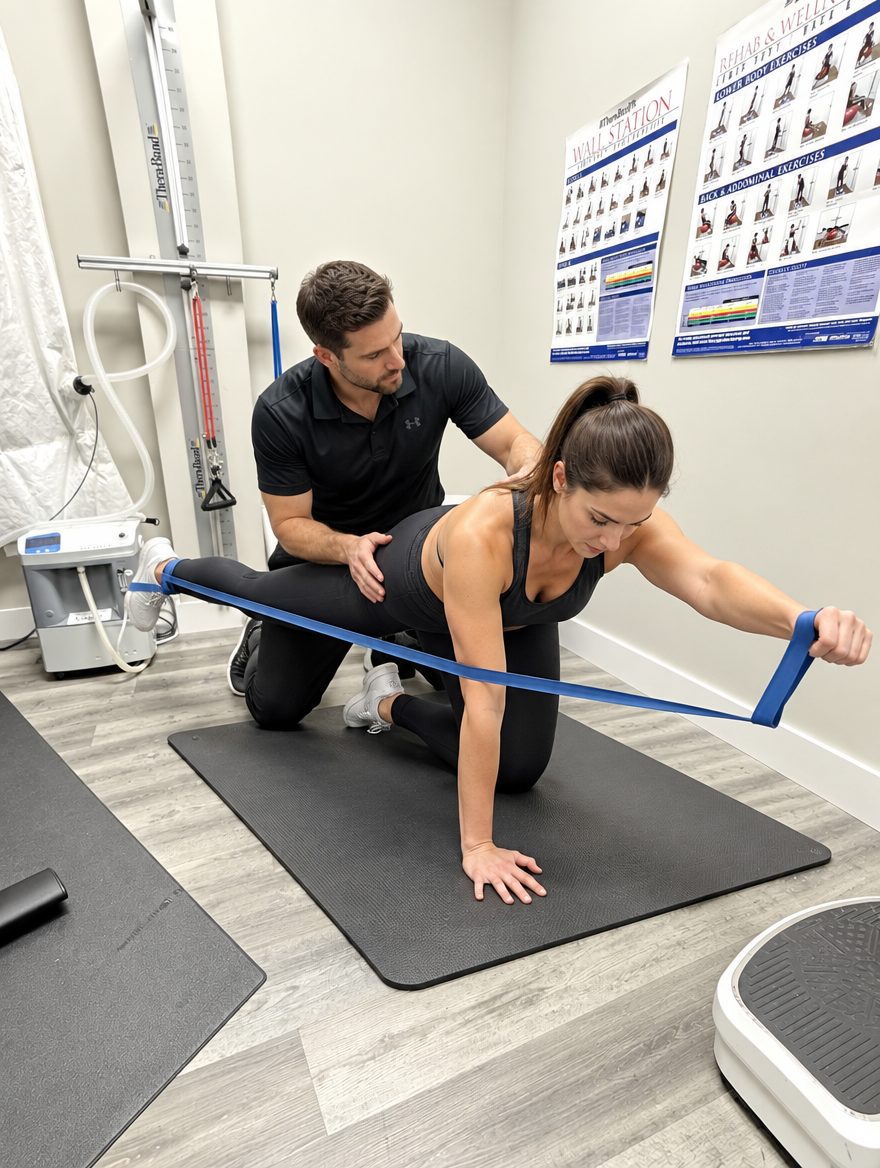
Many Coral Springs and Parkland club families also use us for pre-season screens and in-season maintenance, which is where our high school athlete program picks up. You can read about the full program on our athletic performance page.
What to expect at your player’s first two visits
We measure before we treat, because a plan built on a guess is how injuries recur.
Visit one — we measure (and usually begin care)
- A real conversation. How it happened, which teams and how many sessions a week, recent growth spurts, and when the next game is.
- A hands-on structural exam. The injured area plus the joints above and below it: ankle and hip range of motion, ligament and hamstring tests, single-leg balance, a look at how the athlete squats, lands and cuts, and a neurological screen when the back is involved.
- Surface scanning: sEMG + thermal. A painless scan along the spine that shows where the paraspinal muscles are guarding and compensating — useful whenever low back pain or a pelvic imbalance is part of the picture.
- Digital X-rays when indicated. Particularly if a growth plate, a possible stress injury or a fracture needs to be ruled out. We refer for MRI and an orthopedic opinion when the exam calls for it.
Visit two — findings and plan
We explain what we found in plain language — to the player and the parents — mapped to the four phases of the 4R Method with realistic timelines against the season calendar. Treatment begins at this visit. If the back is involved, the 60-second spine assessment gives us a head start before you arrive.
Home care for soccer injuries, and when to see a doctor first
Between visits, a few things speed soccer injury treatment along or stall it:
- Ice and elevate a fresh sprain for the first 48 hours, then move it gently within comfort — a stiff ankle heals slower than a mobile one.
- Do not stretch a fresh hamstring or groin strain aggressively. Early forced stretching re-tears healing fibers. Your plan will add length at the right stage.
- Respect the schedule. Playing for three teams at once during a growth spurt is the most common cause of the overuse injuries we see in Coral Springs and Parkland. Build in true rest days.
- Warm up properly. A 10–15 minute dynamic warm-up with hip, hamstring and ankle work measurably lowers injury rates in youth soccer.
- Sleep. Growing athletes repair tissue overnight.
Some situations need medical care before anything else. A suspected concussion — confusion, a worsening headache, vomiting, loss of consciousness or neck pain after a collision or heading — should be evaluated by a physician or urgent care today and the player kept out of play; the CDC HEADS UP program is an excellent guide for parents and coaches. The same applies to a knee that pops and swells rapidly, an ankle that cannot bear weight, or any visible deformity. Once cleared, we help with the stiffness, balance and reconditioning that follow.
Serving youth and club soccer players across North Broward
Our clinic at 5675 Coral Ridge Drive, Coral Springs, FL 33076 serves Coral Springs, Parkland, Coconut Creek, Margate, Boca Raton, Tamarac, Pompano Beach and Deerfield Beach. Same-day appointments are usually available — call (954) 341-2256 or book online. Most patients from Parkland and Coral Springs are here in under 15 minutes.
Medically reviewed by Dr. Jared Cohen, DC — Co-Founder & Clinical Director, The Spine and Wellness Center. Last reviewed October 2026.
Frequently asked questions
How long does a soccer ankle sprain take to heal?
A mild sprain usually settles in one to three weeks; a moderate sprain often takes four to six weeks; severe sprains longer. The bigger question is whether balance and strength are retrained, because that is what decides whether the ankle stays stable. We stage the return from straight-line running to cutting to full practice.
Can a chiropractor help with a pulled hamstring?
Yes, as part of a complete soccer injury treatment plan. We restore hip and pelvic motion, use Graston and soft-tissue work on the healing fibers once the acute phase has passed, and rebuild hamstring strength through full length so the strain does not recur. Early, aggressive stretching is what we avoid.
Is soccer injury treatment safe for a 12-year-old?
Yes. Techniques are scaled to a growing body — gentle, low-force adjustments, soft-tissue work and rehab appropriate to the athlete's age and growth stage. We screen for growth-plate involvement first and refer for imaging or a physician's opinion whenever a stress injury or fracture is possible.
My child keeps getting the same injury. Why?
Recurring injuries almost always mean a mechanical cause that was never corrected — an unstable ankle, a hip that does not rotate, weak single-leg control, or a schedule that never allows recovery. The Rebuild phase of our plan targets that cause rather than only calming the symptom.
Do you treat concussions?
No. A suspected concussion must be evaluated by a physician or urgent care first, and the player kept out of play until medically cleared. Once cleared, we help with the neck stiffness, balance and reconditioning that often linger, coordinating with the treating physician.
Do you see club and travel soccer players from Parkland?
Yes. Our Coral Springs clinic on Coral Ridge Drive is minutes from Parkland, Coconut Creek, Margate and Boca Raton, and we see club, travel, middle school and high school players from across North Broward. Same-day appointments are usually available during the season.
Same-day appointments
Let's build your plan.
Find out what's actually going on and get a clear path forward. Same-day appointments available.
- Same-day appointments are usually available
- Our team calls you back to confirm your visit
- Coral Springs, serving Parkland & North Broward since 2005
Prefer to talk now? Call or text (954) 341-2256