

Athletes · Coral Springs & Parkland
Volleyball injury treatment in Coral Springs & Parkland
Aching hitting shoulders, jumper's knee, ankle rolls at the net and a low back that hurts on every arch — we treat the injury and fix the swing and landing mechanics behind it, drug-free.
Quick answer
Effective volleyball injury treatment settles the irritated tissue, restores shoulder, hip and ankle motion, then retrains the jump and the swing so the problem stops recurring. For rotator cuff pain, jumper's knee, ankle sprains and low back strain we combine chiropractic care, Graston, cold laser or shockwave and progressive sports rehab inside the 4R Method.
Why volleyball is so hard on the shoulder, knee, ankle and low back
Good volleyball injury treatment starts with the mechanics of the sport. A single match is dozens of overhead swings, explosive jumps and hard landings, quick lateral cuts and repeated dives to the floor. Stack a club season on top of a school season — the normal pattern for players in Coral Springs and Parkland — and that volume adds up on growth plates, tendons and stabilizing muscles that are still maturing.
The overhead swing is the signature stress. Every serve and spike loads the rotator cuff and the muscles that control the shoulder blade; when those tire or lose their timing, the shoulder starts to ache at the top of the swing. Below the waist, the patellar tendon absorbs the force of every take-off and landing, and the ankle lives on a crowded net line where a landing on a teammate’s foot is one play away.
Our job is to calm the injured tissue, restore normal joint motion and strength, and retrain the jump and the swing so the same problem does not keep coming back.

Is it the shoulder, the knee, the ankle or the back? Common volleyball injuries
Most of what we see in club and high school volleyball players falls into a handful of recognizable patterns. Each has a clear mechanism on the court and a conservative path back:
- Hitting shoulder and rotator cuff pain. A deep ache at the top of the swing, pain reaching overhead or lying on that side, sometimes a ‘dead arm’ after serving. Usually rotator cuff tendinopathy and shoulder-blade (scapular) control that has lost its timing — see our shoulder pain page.
- Jumper’s knee (patellar tendinopathy). Tenderness just below the kneecap that warms up during play and aches afterward. Thousands of jumps without enough strength and recovery irritate the patellar tendon. Osgood-Schlatter is the growth-plate version in younger teens — see knee pain treatment.
- Ankle sprain. Landing on another player’s foot at the net rolls the ankle and over-stretches the outer ligaments. Acute, usually dramatic, and prone to recurrence when rehab is cut short.
- Low back strain. Repeated arching and trunk rotation while hitting load the lumbar facet joints and the muscles beside them. A back that hurts on every arch or after long tournament days — see lower back pain relief.
- Finger, wrist and neck complaints. Jammed fingers from blocking and setting, wrist strain from diving, and neck and upper-back tightness from constant overhead posture and tracking the ball.
Good to know
Acute ankle sprains are among the most prevalent musculoskeletal injuries, and most involve the lateral ligament complex — the exact structure a net-side landing over-stretches (StatPearls, Acute Ankle Sprain, NCBI Bookshelf). Recurrence and chronic instability follow when balance and strength retraining is skipped. That is why our ankle plan always ends with single-leg work, not just rest.
How we approach volleyball injury treatment at TSAWC
Our volleyball injury treatment follows the 4R Method: Repair, Rebuild, Regenerate, Refine. Calming the pain and sending a hitter straight back to full practice volume is how a two-week shoulder problem becomes a season-long one. We settle the tissue first, correct the mechanics second, and protect the gains third.
R1 · Repair — calm the tissue and restore motion
The Repair phase reduces inflammation and restores joint motion. Gentle, age-appropriate chiropractic adjustments to the shoulder girdle, thoracic spine, hips and ankles where motion is lost, cold laser therapy for irritated tendons and fresh sprains, and acoustic shockwave therapy for stubborn patellar or rotator cuff tendinopathy in older athletes. Typical commitment is 3–5 visits a week for 2–4 weeks in an acute injury, up to 4–8 weeks when the problem has been building all season.
R2 · Rebuild — fix the swing and the landing
Rebuild is the sports rehab phase: rotator cuff and scapular stabilizer strength, thoracic mobility so the hitter can reach a high contact point without borrowing range from the low back, quad and hip strength for quiet landings, and single-leg balance for the ankle. Graston Technique clears the adhesions in the cuff and patellar tendon. Usually 2–3 visits a week for 6–12 weeks, tapering as the home program takes over.
R3 and R4 · Regenerate and Refine
Regenerate supports recovery between sessions with red light and PEMF. Refine is maintenance: a brief tune-up and movement check every month or two across a long club season, plus a pre-season screen.
Sports injury rehab
Jump-landing, cuff and scapular strength that keeps a cleared player cleared.
Learn moreAcoustic shockwave therapy
Targets stubborn jumper's knee and rotator cuff tendinopathy that has stopped responding to rest.
Learn moreGraston Technique
Instrument-assisted soft-tissue work for the cuff, patellar tendon and tight hip flexors.
Learn moreChiropractic care
Restore shoulder, mid-back, hip and ankle motion so the swing and the jump stop overloading one link.
Learn more6 proven treatments for volleyball injuries (and when each one fits)
No single tool covers volleyball injury treatment on its own. These are the six we use most, matched to what they work best on:
- Chiropractic adjustments. Best for a stiff thoracic spine that limits the swing, a locked-up low back after tournament weekends, and a stiff ankle after a sprain.
- Sports rehab and physical therapy. Best for every injury on this page; strength and landing retraining are what prevent recurrence. See physical therapy.
- Acoustic shockwave therapy. Best for chronic patellar and rotator cuff tendinopathy in older teens and adults.
- Cold laser therapy. Best in the first days and weeks after a sprain or a tendon flare — drug-free inflammation control.
- Graston Technique and cupping. Best for tight, fibrotic tissue in the cuff, forearm, hip flexors and calves; cupping helps during heavy tournament stretches.
- Myovision sEMG and movement analysis. Best for recurring shoulder and back pain: a surface EMG scan shows which muscles are guarding and compensating along the spine.
Jump mechanics and shoulder mobility: the performance side
Treating pain is half of volleyball injury treatment. The players who stay healthy are the ones who move well, and that is where our rehab focuses once the acute injury settles.
On the lower body we look at how the athlete loads and lands the jump: whether the knees track over the toes, whether the hips absorb force, and whether landings are quiet and controlled or stiff and knee-dominant. Cleaning up landing mechanics reduces the repetitive strain that feeds jumper’s knee and protects the ankle and the ACL.
On the upper body we assess shoulder mobility and the strength of the rotator cuff and shoulder-blade stabilizers. A hitter needs a mobile shoulder to reach a high contact point and a stable one to decelerate the arm safely after contact. When mobility is limited or the stabilizers are weak, the swing borrows range from the wrong places and the shoulder, neck or low back pays for it.
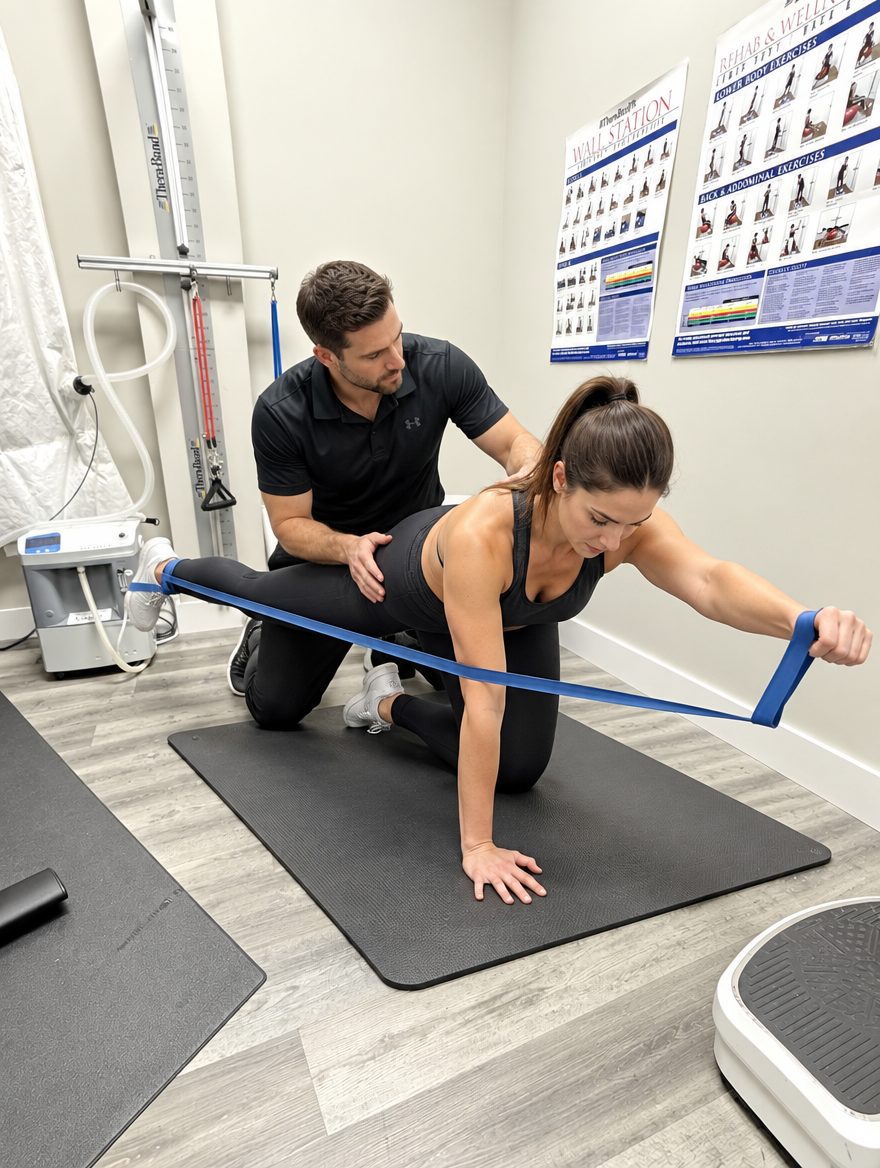
Return-to-play is staged — swings at reduced volume before full hitting, box landings before live jumping — and we coordinate with parents and, when appropriate, coaches. This is also where our high school athlete program and the wider athletic performance program pick up for in-season maintenance.
What to expect at the first two visits
We measure before we treat, because a plan built on a guess is how injuries recur.
Visit one — we measure (and usually begin care)
- A real conversation. Position, club and school schedules, weekly training hours, recent growth spurts, how the pain behaves, and the next tournament date.
- A hands-on structural exam. The injured area plus the joints above and below it: shoulder and thoracic range of motion, rotator cuff and scapular strength tests, patellar tendon loading, single-leg balance, and a look at how the athlete squats, jumps and lands.
- Surface scanning: sEMG + thermal. A painless scan along the spine that shows where the paraspinal muscles are guarding — useful whenever low back or neck pain is part of the picture.
- Digital X-rays when indicated. Particularly to rule out a growth-plate problem, a stress reaction or a fracture. We refer for MRI and an orthopedic opinion when the exam calls for it.
Visit two — findings and plan
Findings explained in plain language to the athlete and the parents, mapped to the four phases of the 4R Method with timelines against the season. Treatment begins at this visit. If the back is involved, the 60-second spine assessment gives us a head start.
Home care for volleyball injuries, and when to see a doctor first
A few things between visits speed volleyball injury treatment along or stall it:
- Ice and elevate a fresh ankle sprain for the first 48 hours, then move it gently within comfort.
- Manage jump volume. Jumper’s knee responds to fewer total jumps per week far more than to any brace. Count them during a flare.
- Warm the shoulder up properly. Band work for the cuff and scapula before serving, not just arm swings.
- Build in rest days. Club plus school plus private lessons during a growth spurt is the most common cause of the overuse injuries we see in Coral Springs and Parkland.
- Sleep. Growing athletes repair tendon tissue overnight.
Some situations need medical care first. A knee that pops and swells rapidly, an ankle the player cannot bear weight on, a finger that is visibly deformed, or a head impact with confusion, worsening headache or vomiting should be seen by a doctor or urgent care today. Once assessed and cleared, we help with the stiffness, balance and reconditioning that follow, in coordination with the physician.
Serving club and high school volleyball players across North Broward
Our clinic at 5675 Coral Ridge Drive, Coral Springs, FL 33076 serves Coral Springs, Parkland, Coconut Creek, Margate, Boca Raton, Tamarac, Pompano Beach and Deerfield Beach. Same-day appointments are usually available — call (954) 341-2256 or book online. Most patients from Parkland and Coral Springs are here in under 15 minutes.
Medically reviewed by Dr. Jared Cohen, DC — Co-Founder & Clinical Director, The Spine and Wellness Center. Last reviewed October 2026.
Frequently asked questions
What are the most common volleyball injuries in youth and high school players?
Hitting-shoulder and rotator cuff pain from the overhead swing, jumper's knee from repeated take-offs and landings, ankle sprains from net-side landings, and low back strain from arching and rotating while hitting. Finger and wrist injuries from blocking and diving are common but usually minor.
Can a chiropractor help with volleyball shoulder pain?
Yes, as part of a complete volleyball injury treatment plan. We restore shoulder, shoulder-blade and mid-back motion, settle the irritated cuff with laser, shockwave or Graston, and rebuild cuff and scapular strength so the swing stops overloading the joint.
How long does jumper's knee take to get better?
With volleyball injury treatment that includes load management and strengthening, mild patellar tendinopathy often settles in four to six weeks; cases that have built over a season can take two to three months. Tendons adapt slowly, so progressive loading matters more than rest alone.
Should my daughter keep playing through shoulder pain?
Pain that warms up and returns after play is a signal the tissue is not keeping up with the load. A short reduction in hitting volume plus a plan usually prevents a longer absence later. Sharp pain, weakness or a dead-arm feeling should be evaluated before more play.
Is this safe for a 13-year-old?
Yes. Techniques are scaled to a growing body — gentle adjustments, soft-tissue work and rehab appropriate to age and growth stage — and we screen for growth-plate involvement first, referring for imaging or a physician's opinion whenever a stress injury is possible.
Do you see club volleyball players from Parkland and Boca Raton?
Yes. Our Coral Springs clinic on Coral Ridge Drive is minutes from Parkland, Coconut Creek, Margate and Boca Raton, and we see club and high school players from across North Broward. Same-day appointments are usually available during the season.
Same-day appointments
Let's build your plan.
Find out what's actually going on and get a clear path forward. Same-day appointments available.
- Same-day appointments are usually available
- Our team calls you back to confirm your visit
- Coral Springs, serving Parkland & North Broward since 2005
Prefer to talk now? Call or text (954) 341-2256