
Treatment · Coral Springs & Parkland
Spinal Decompression in Plantation, FL
Computer-controlled disc decompression for herniated discs, sciatica and pinched nerves — The Spine and Wellness Center, about 25 minutes from Plantation up University Drive or the Sawgrass Expressway, with same-day appointments most days.
Quick answer
Spinal decompression near Plantation is available at The Spine and Wellness Center, 5675 Coral Ridge Drive, Coral Springs — about 25 minutes from Plantation. Your first visit is a measurement visit: hands-on exam, surface EMG and thermal scans, and X-rays when indicated. Decompression on the Triton DTS table is set at visit two (initial care often starts on visit one), after your report of findings confirms a disc or nerve pattern.
Why Plantation patients choose us for spinal decompression
The Spine and Wellness Center has cared for Plantation families since 2005. Here is why they keep choosing us for spinal decompression in Plantation rather than a clinic down the street.
- Close enough to be routine. The clinic is about 25 minutes from Plantation up University Drive or the Sawgrass Expressway. Free parking is at the door, and we schedule follow-ups around your commute so the drive stays a non-issue.
- Hours built for working people. Open until 7:00 pm three evenings a week (Monday, Tuesday, Thursday), plus Wednesday afternoons and Friday mornings.
- Care that fits Plantation life. We regularly treat Plantation professionals who commute on I-595 and the Turnpike, golfers from Plantation Preserve and Jacaranda, and cyclists and runners from Central Park. That experience shapes everything from the exam to the home-care plan.
What is spinal decompression and how does the Triton DTS table work?
Searching for spinal decompression in Plantation usually starts with a word nobody wants to hear: herniation. A disc has bulged, an MRI or an exam says a nerve is involved, and the options on the table seem to be medication, an injection or surgery. Non-surgical decompression on the Triton DTS table is the fourth option — and at our Coral Springs clinic, about 25 minutes from Plantation, it is usually the first one we reach for.
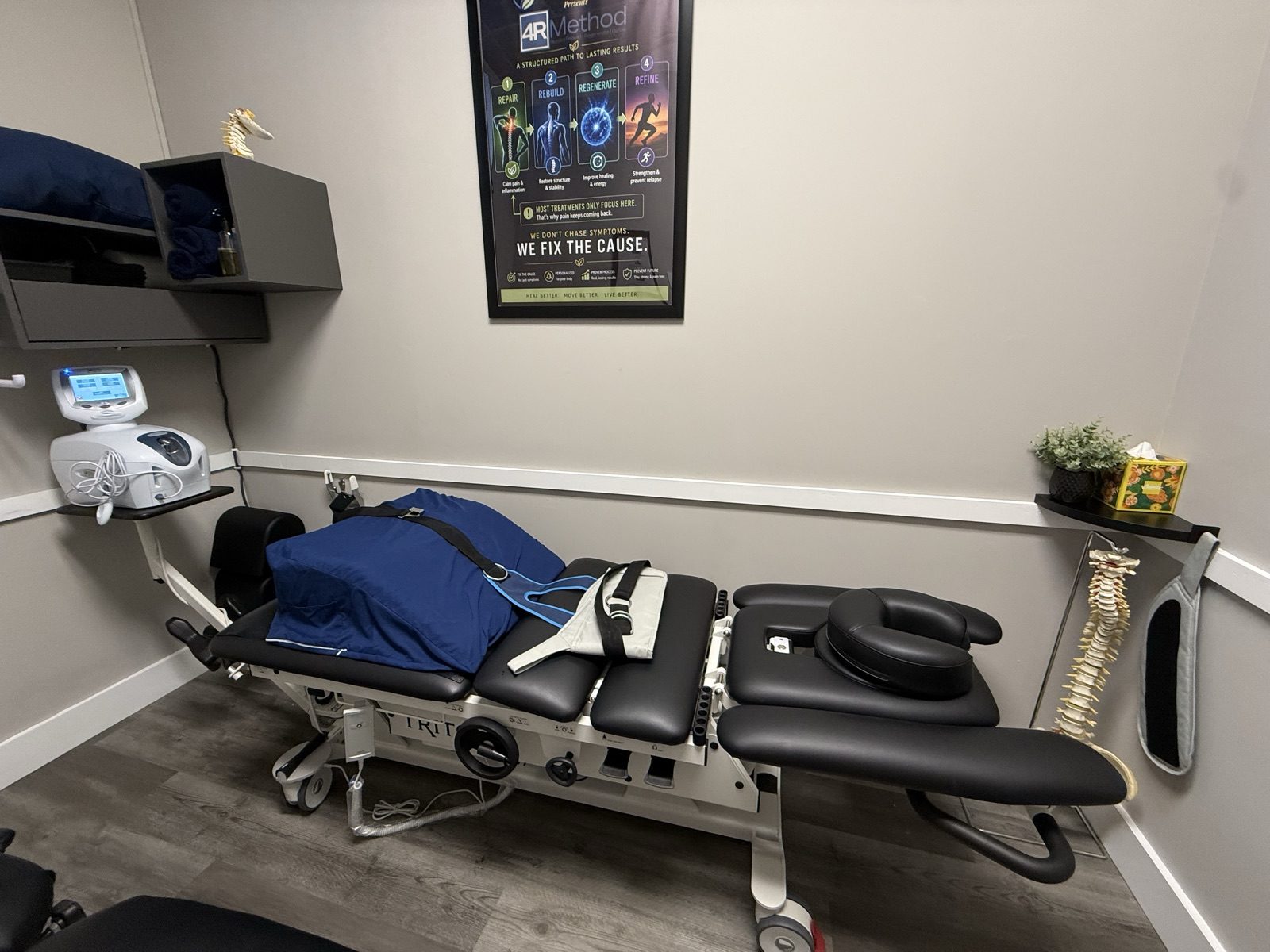
The principle is simple. Pressure inside an injured disc pushes the bulge outward against the nerve. Decompression reverses that pressure for a few minutes at a time: the table draws the vertebrae apart in controlled cycles, which is intended to pull the bulge inward and let fluid and nutrients back into the disc. Repeated over a program of sessions, the nerve gets room and the disc gets a chance to heal.
What makes the Triton DTS different from traction is the computer. It senses when the muscles along your spine start to guard and softens the pull before they tighten — so you stay relaxed and the force reaches the disc instead of the muscles. Read our main spinal decompression therapy page for the research; keep reading here for how it works for Plantation residents.

Who is spinal decompression in Plantation for — and is it the same as traction?
Not every back needs a decompression table, and we say so on visit one. The exam sorts Plantation patients into two groups: those whose pain is coming from a disc or a compressed nerve, and those whose pain is joint, muscle or sacroiliac — which responds better to adjustments, rehab and soft-tissue work. Decompression is for the first group.
- Disc herniation or bulge with pain that worsens sitting, bending or coughing — our herniated disc guide explains the pattern.
- Sciatica running from the buttock down one leg — see sciatica treatment.
- Neck disc with arm symptoms — tingling, numbness or weakness into the shoulder, arm or hand.
- Degenerative discs that have lost height, leaving the facet joints behind them overloaded.
- Pain that outlasted other care — medication, injections or stretching that helped for a while and then did not.
And the traction question: decompression and traction both pull on the spine, but traction pulls constantly and the muscles brace; the Triton DTS pulls in smooth, computer-monitored cycles that keep the muscles relaxed and direct the separation to one disc level. Same family, very different tool.
What does a 20-minute decompression session feel like?
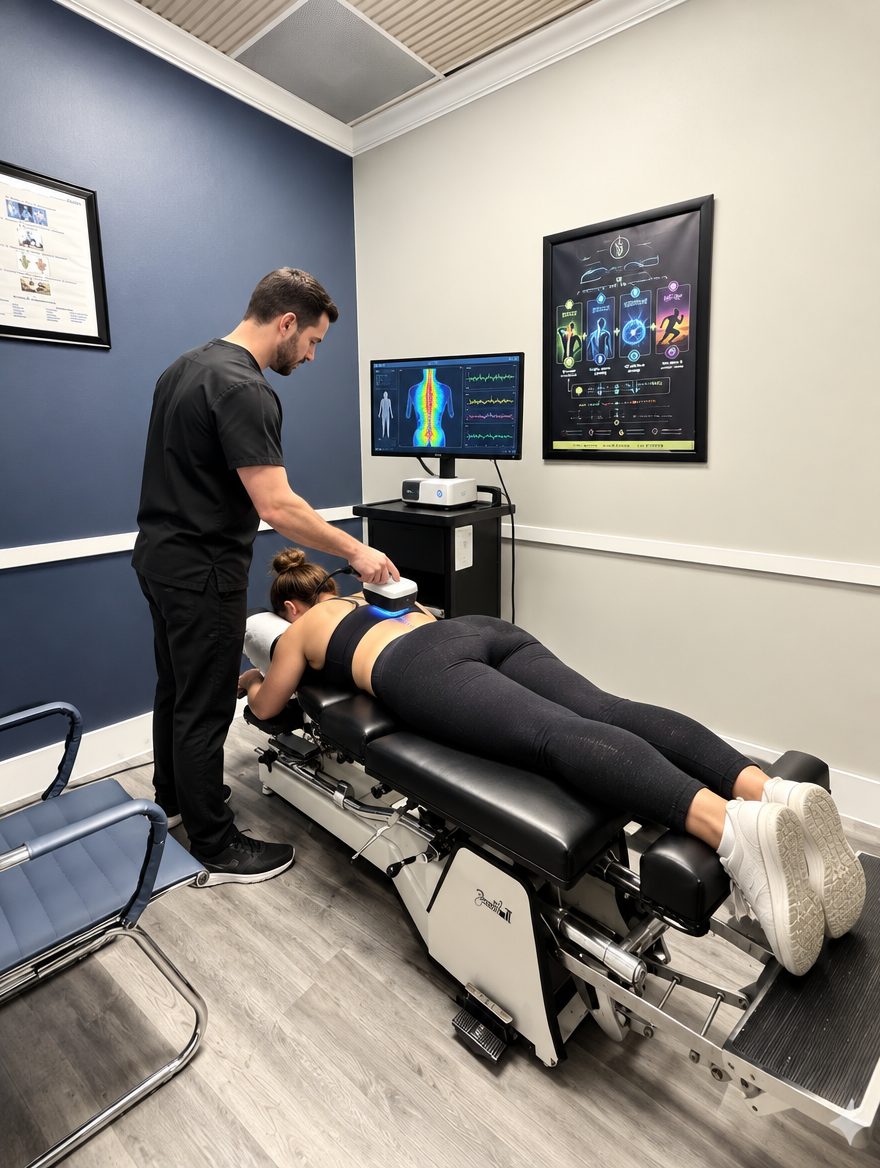
A session on the Triton DTS takes about 20 minutes, and most Plantation patients find it relaxing enough to close their eyes. Here is the sequence:
- Harnessing. You lie on the table — face up for the lower back, with a padded cervical cradle for the neck. A pelvic harness and a chest harness hold you so the pull reaches the spine, not the legs.
- Programming. Dr. Cohen sets the angle of pull, the target force and the cycle pattern for your disc level. Force builds over the first sessions rather than starting at full strength.
- Cycles. The table pulls smoothly, holds for about a minute, then eases back for a rest period. This repeats for roughly 20 minutes while you breathe and relax.
- Support therapy. Most sessions are paired with a specific chiropractic adjustment, cold laser or PEMF in the same visit to calm inflammation.
Afterward, some people feel lighter immediately; others notice a mild, pleasant soreness like the day after a good stretch. We ask you to avoid heavy lifting and long sitting for the rest of the day — which, for Plantation patients, usually means timing the drive home before the commute. That is what spinal decompression in Plantation looks like, session by session.
Where does decompression sit in the 4R Method?
Every plan at The Spine and Wellness Center follows the 4R Method — Repair, Rebuild, Regenerate, Refine — and decompression belongs to the first phase. Its job is to take pressure off the nerve and calm the inflammation, so the rest of the plan has a stable spine to work with.
Repair — a structured decompression program
A typical disc program runs 3–5 visits a week for 4–8 weeks. Decompression anchors each visit, paired with adjustments, cold laser or PEMF. Most Plantation patients notice meaningful change in the first two to three weeks, and we re-scan with surface EMG and thermal imaging to confirm the nerve is quieting objectively, not just by feel.
Rebuild — decompression tapers, stabilization takes over
As symptoms settle, decompression steps back and Rebuild takes over: corrective chiropractic protocols, physical therapy to retrain the deep core and hip stabilizers, and Graston work for the fibrotic tissue around the old injury. This phase runs 2–3 visits a week for 8–16 weeks and is the reason the relief holds when you go back to golf at Plantation Preserve and Jacaranda.
Regenerate and Refine
Regenerate supports healing with red light and PEMF at about two visits a week for two or more months. Refine is a brief tune-up every month or two — and for patients with degenerative discs, a short decompression session can be part of it to stay ahead of flare-ups.
What does the evidence say, who should not have it, and what happens at your first two visits?
Honest expectations first. The strongest published signal for decompression concerns disc height: a cohort study in BMC Musculoskeletal Disorders reported restored disc height on imaging after a decompression program, associated with reduced discogenic low back pain (Apfel et al., 2010). Larger trials are still needed, and we tell every Plantation patient that. What the wider evidence firmly supports is trying conservative care before surgery — NINDS reports that most low back pain improves without an operation (NINDS, Back Pain).
- We do not decompress during pregnancy, with spinal fracture or significant osteoporosis, tumor or infection, unstable spondylolisthesis, hardware at the treated level, an abdominal aortic aneurysm, or severe neuropathy.
- We often can after a healed microdiscectomy or other surgery without hardware — records and imaging are reviewed first.
- See a doctor or urgent care today if you have loss of bladder or bowel control, groin numbness, rapidly worsening weakness, or back pain with fever.
Then the two-visit start. Visit one measures: conversation, structural exam, nerve-tension and neurological tests, surface EMG and thermal scanning, X-rays when indicated. Visit two is your report of findings with the scans in front of you, your decompression program mapped to the 4R phases, and the first session on the table. Spinal decompression in Plantation begins with that order of operations. A head start: the 60-second spine assessment.
Getting to our Coral Springs clinic from Plantation
From Westfield Broward at Broward Boulevard and University Drive, take University Drive north about 12 miles to Wiles Road, turn west to Coral Ridge Drive and then north. Or take the Sawgrass Expressway north from Sunrise Boulevard to the Coral Ridge Drive exit and head south.
Park free in the lot outside the clinic. If you need to be seen quickly, call (954) 341-2256 — we hold same-day slots most days, and we will tell you exactly when to leave Plantation to arrive on time.
| Monday | 9:00 am – 7:00 pm |
|---|---|
| Tuesday | 9:00 am – 7:00 pm |
| Wednesday | 3:00 pm – 7:00 pm |
| Thursday | 9:00 am – 7:00 pm |
| Friday | 9:00 am – 12:00 pm |
| Saturday – Sunday | Closed |
The Spine and Wellness Center
5675 Coral Ridge Drive, Coral Springs, FL 33076
Phone: (954) 341-2256
Get directions from Plantation on Google Maps
What patients say
We do not have a published review from a Plantation patient yet, so here is one from a Coral Springs patient — the same clinic and the same team you would see:
“Some of the warmest and most caring staff in the business. Dr. Cohen, without a doubt, is passionate about his craft and the community he serves.”
Related care for Plantation residents
Start with the full guide to spinal decompression, then explore the other care we provide for Plantation patients.
Spinal decompression therapy — the full guide
How the Triton DTS works, who it helps, what the research says and where it sits in the 4R Method.
Learn moreChiropractic care for Plantation
Your Plantation hub: everything we treat, directions, hours and what to expect on your first visit.
Learn moreIHHT oxygen therapy in Plantation
IHHT oxygen therapy for Plantation patients, from our Coral Springs clinic.
Learn moreRed light therapy in Plantation
Red light therapy for Plantation patients, from our Coral Springs clinic.
Learn moreAll service areas
Every community we serve from Coral Springs, with drive times and the care available for each.
Learn moreServing spinal decompression patients from Plantation across North Broward
Our clinic at 5675 Coral Ridge Drive, Coral Springs, FL 33076 serves Coral Springs, Parkland, Coconut Creek, Margate, Boca Raton, Tamarac, Pompano Beach and Deerfield Beach. Same-day appointments are usually available — call (954) 341-2256 or book online. Most patients from Parkland and Coral Springs are here in under 15 minutes.
Medically reviewed by Dr. Jared Cohen, DC — Co-Founder & Clinical Director, The Spine and Wellness Center. Last reviewed October 2026.
Frequently asked questions
Can decompression help a herniated disc without surgery?
Often, yes. Decompression is designed to lower the pressure inside a herniated or bulging disc so the material can move away from the nerve and the disc can rehydrate. Most low back pain, including many disc herniations, improves with conservative care; surgery is generally reserved for progressive neurological loss or pain that does not respond to other treatment.
Is spinal decompression the same as an inversion table?
No. An inversion table hangs your whole body by the ankles with a constant, uncontrolled pull that the muscles resist. The Triton DTS targets one disc level, uses harnesses so the force reaches the spine, and cycles the pull up and down under computer control so the paraspinal muscles stay relaxed and the separation happens at the disc.
Does decompression work for neck disc problems too?
Yes. Cervical decompression uses a padded cradle rather than a pelvic harness, with the angle and force programmed for the C5–C7 levels that most often pinch a nerve into the shoulder, arm or hand. The session is shorter and gentler than lumbar decompression and is paired with a specific adjustment and cold laser for the inflamed tissue.
Do you offer same-day appointments for Plantation patients?
Usually, yes. Same-day appointments are often available at our Coral Springs clinic, about 25 minutes from Plantation, so spinal decompression in Plantation can start the week you call. Your first visit is a measurement visit — exam, surface EMG and thermal scans, X-rays when indicated — and your plan and treatment begin on visit two, typically within a few days.
Is there parking at the clinic?
Yes. Free parking is right outside the door at 5675 Coral Ridge Drive — no garage, no meters, no validation. Most Plantation patients find it simpler than parking near the coast or at a medical tower, and you walk straight into reception.
Which Plantation neighborhoods do you serve?
All of them. We regularly see patients from Plantation Central Park, Volunteer Park, Plantation Acres, Jacaranda and Westfield Broward and across the 33313, 33317, 33322, 33323, 33324 and 33325 ZIP codes. Wherever you are in Plantation, the drive is about 25 minutes up University Drive or the Sawgrass Expressway, and we schedule follow-ups around your commute.
Same-day appointments
Let's fix the cause.
Measure first, then treat — a plan built on your actual structure.
- Same-day appointments are usually available
- Our team calls you back to confirm your visit
- Coral Springs, serving Parkland & North Broward since 2005
Prefer to talk now? Call or text (954) 341-2256