

Conditions · Coral Springs & Parkland
Sciatica treatment in Coral Springs (non-surgical)
Pain that shoots from the low back down one leg is a nerve under pressure. We find what is pinching the sciatic nerve root, take the pressure off with decompression and precise adjustments, then stabilize the spine so it stays off.
Quick answer
Effective sciatica treatment relieves pressure on the sciatic nerve root rather than numbing the leg. Most sciatica comes from a herniated or bulging lumbar disc at L4–L5 or L5–S1, sometimes from stenosis or a tight piriformis. We use non-surgical spinal decompression, specific adjustments and core rehab inside the 4R Method, and most patients notice the leg pain easing within the first few weeks.
What is sciatica, and why does a back problem hurt in your leg?
Sciatica treatment starts with one fact: the pain in your leg is a messenger, not the problem. The sciatic nerve is the largest nerve in the body. It forms from nerve roots at L4, L5 and S1 in the lower spine, runs through the buttock and down the back of each leg to the foot. Pressure anywhere along its roots sends pain the whole length of the line.
That is why a disc in your lower back can leave your calf burning or your foot numb. In our Coral Springs clinic the most common culprit is a herniated or bulging lumbar disc pressing on a nerve root, followed by spinal stenosis narrowing the nerve’s exit, a rotated pelvis loading one side of the spine, and a tight piriformis muscle gripping the nerve in the buttock.
Painkillers may quiet the signal for a few hours, but they never touch what is squeezing the nerve. Sciatica treatment at The Spine and Wellness Center does the opposite: we locate exactly where the nerve is compressed and take that pressure off, so the pain has a reason to stay gone.
Is it really sciatica? How to tell the patterns apart
Not every leg pain is sciatica, and not every sciatica comes from a disc. The pattern tells us a lot before any scan does:
- Disc-driven sciatica: sharp, electric or burning pain from the low back or buttock down the back of one leg, often below the knee; worse sitting, bending forward, coughing or sneezing. Numbness, tingling or weakness in the foot usually means the nerve root is involved.
- Stenosis-driven sciatica: legs that cramp, tire or go heavy after walking a short distance, easing when you sit or lean on a shopping cart. More common after 60.
- Piriformis syndrome: deep buttock pain with tingling down the leg that flares with prolonged sitting or climbing stairs, but with little or no back pain.
- Hip or SI joint pain: one-sided pain over the dimple above the buttock or in the groin that rarely travels below the knee — see our hip and SI joint guide.
Leg symptoms that follow one nerve’s territory — the outside of the shin and big toe (L5), or the calf and outer foot (S1) — point to a specific nerve root, which is what the exam on your first visit is designed to isolate.
Good to know
Sciatica is a symptom, not a diagnosis. Finding which structure is pressing on the sciatic nerve roots is the whole game — and it is the step most sciatica treatment skips.
How we approach sciatica treatment with the 4R Method
Our sciatica treatment follows the body’s healing sequence — the 4R Method: Repair, Rebuild, Regenerate, Refine. Relief without correction is temporary by design, and correction on an inflamed, guarded spine does not hold. So we do them in order.
R1 · Repair — take the pressure off the nerve
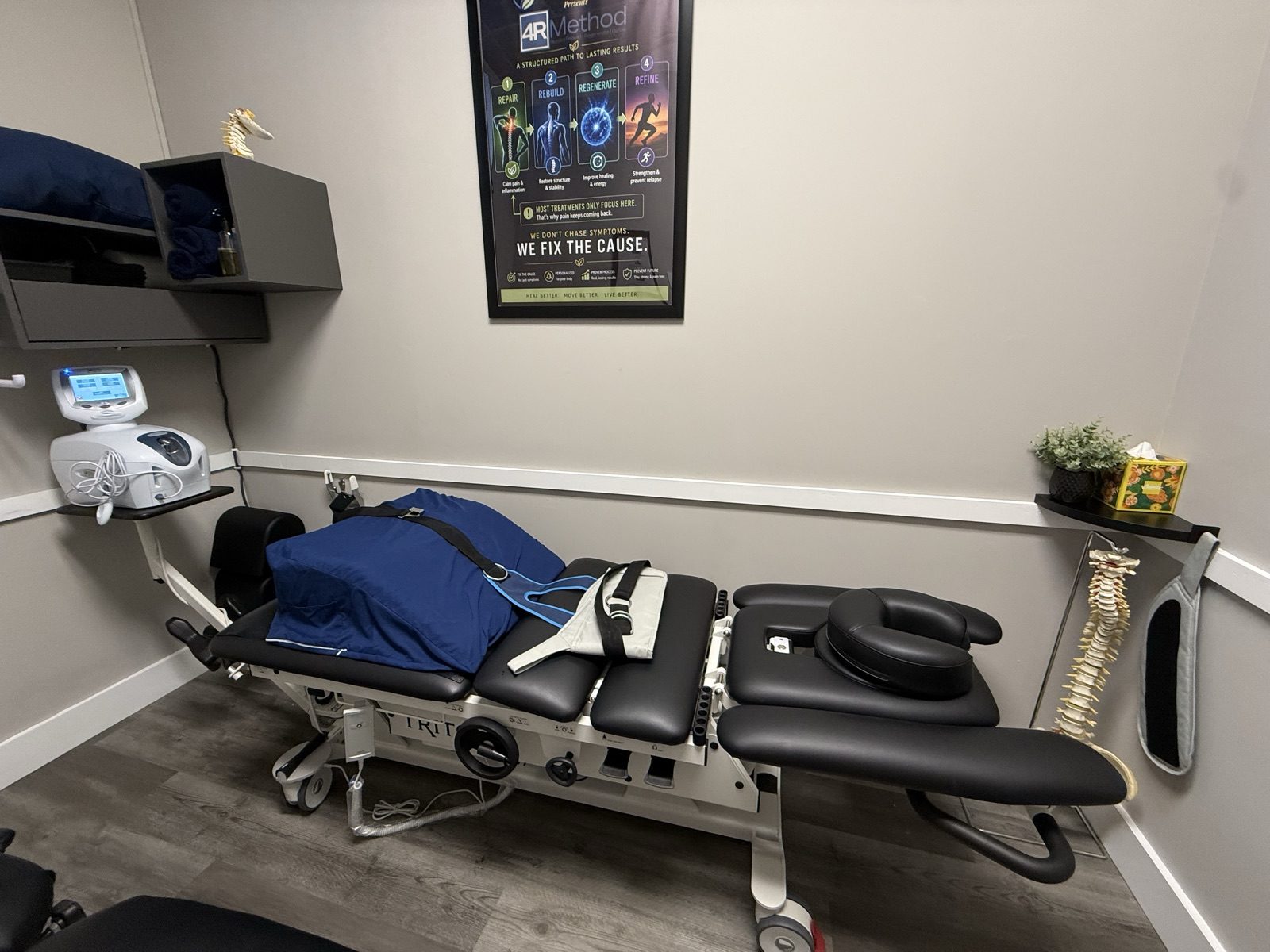
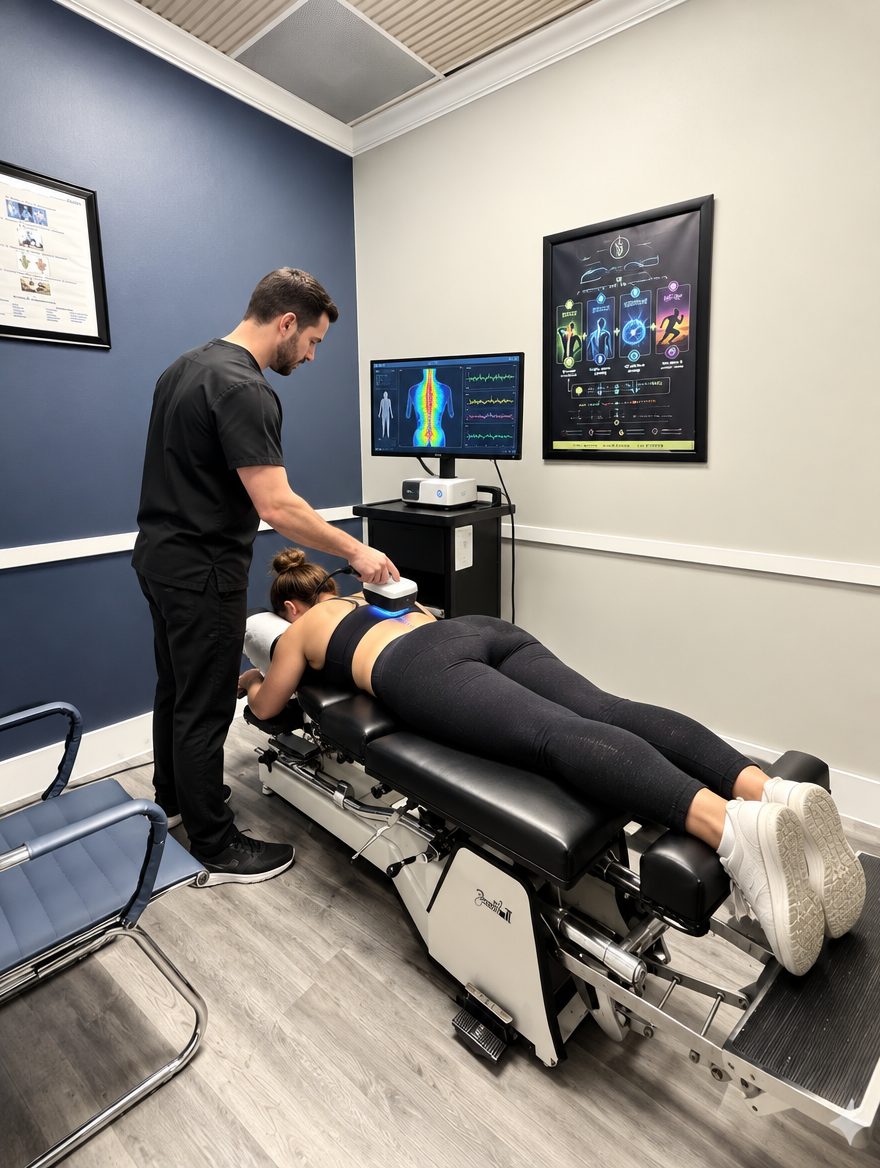
The Repair phase interrupts the pain at its source. For disc-driven sciatica that means non-surgical spinal decompression on the Triton DTS table, which gently opens the disc space so the herniated material can retract from the nerve, paired with precise lumbar and pelvic adjustments and cold laser to calm inflammation around the irritated root. Typical commitment is 3–5 visits a week for 4–8 weeks; most patients notice the leg pain easing in the first two to three weeks.
R2 · Rebuild — correct what let the nerve get pinched
Once the nerve is quiet, we correct the architecture that produced the problem: corrective care to restore the lumbar curve, physical therapy to retrain the deep core and hip stabilizers, and Graston soft-tissue work on the piriformis and hip rotators. Usually 2–3 visits a week for 8–16 weeks. This is the phase that turns relief into a spine that no longer pinches the nerve.
R3 and R4 · Regenerate and Refine
Regenerate layers in PEMF, red light and recovery protocols at about 2 visits a week to support disc and nerve healing at the cellular level. Refine is a brief structural tune-up every month or two so the gains you earned stay earned.
Non-surgical spinal decompression
Computer-controlled cycles that open the disc space and pull pressure off the sciatic nerve root.
Learn moreChiropractic adjustments
Restore motion to the lumbar segments and pelvis so one side of the spine stops carrying the load.
Learn moreCold laser therapy
Painless low-level laser that calms inflammation around the irritated nerve root.
Learn morePhysical therapy & core rehab
Rebuild the stabilizers and hip mobility that keep the nerve clear for the long run.
Learn more6 non-surgical sciatica treatment options (and when each fits)
No two cases of sciatica are identical, so no two plans should be either. These are the six tools we reach for most, matched to the pattern they fit:
- Non-surgical spinal decompression. Best for herniated and bulging discs. Each cycle on the Triton DTS table lowers pressure inside the disc so the bulge draws inward and the disc rehydrates. About 20 minutes on the table.
- Chiropractic adjustments. Best for a rotated pelvis, locked facet joints and SI joint patterns that load one nerve root. Specific, controlled, and matched to your comfort — from firmer hands-on adjustments to low-force methods.
- Physical therapy and core stabilization. Best for recurring sciatica. The deep core and glutes protect the disc when you sit, lift and play.
- Graston Technique and soft-tissue work. Best for piriformis involvement and the fibrotic tissue that forms around a long-irritated nerve.
- Cold laser therapy. Best for acute flare-ups — reduces inflammation around the nerve without heat or medication.
- PEMF and red light. Best as support between visits; both encourage circulation and tissue repair in the Regenerate phase.
What is not on the list: long-term pain medication, repeated injections, and surgery as a first step. According to the National Institute of Neurological Disorders and Stroke, most sciatica improves with conservative care, and surgery is usually considered only when leg weakness progresses or pain does not respond to other treatment (NINDS, Sciatica).
What to expect at your first two visits
We measure before we treat, so your sciatica treatment plan is built on your actual structure rather than a guess.
Visit one — we measure (and usually begin care)
- A real conversation. Where the pain travels, what makes it worse, what you have tried, and what you want to get back to.
- A hands-on structural exam. Lumbar and hip range of motion, straight-leg-raise and nerve-tension tests, piriformis and SI joint tests, and neurological testing of reflexes, strength and sensation to see which root is involved.
- Surface EMG and thermal scanning. A painless scan along the spine that shows where the muscles are guarding and where nerve irritation is changing skin temperature — objective, and re-scannable to track progress.
- Digital X-rays when indicated. Disc spacing, alignment and wear; we also review any MRI you already have.
Visit two — your findings and your plan
We walk you through what we found with your scans in front of you, mapped to the four phases of the 4R Method, with a realistic timeline. Your full plan starts here — and in most cases care already began on visit one. If you want a head start, take the 60-second spine assessment and we will have your likely pattern before you walk in.
Sciatica relief at home: what helps and what makes it worse
What you do between visits matters as much as what happens on the table. These are the habits that take strain off the sciatic nerve:
- Break up sitting. Sitting loads the lumbar discs more than standing. Stand or walk for two minutes every 30–45 minutes, especially on long commutes.
- Walk, gently and often. Short walks beat bed rest; prolonged rest stiffens the joints and switches off the stabilizers.
- Hinge, don’t bend. Lift with the load close and the hips doing the work; rounding the low back under load is how discs get hurt.
- Sleep neutral. On your side with a pillow between the knees, or on your back with a pillow under the knees.
- Skip aggressive hamstring stretching early on. Forcing a stretch on an irritated nerve root can make sciatica worse. Your plan includes the right movements at the right stage.
Ice for the first 48 hours of a flare, heat for stiffness after that. And if the pain is radiating below the knee, do not wait weeks to see if it settles — nerve symptoms respond faster the sooner the pressure comes off.
When sciatica needs a doctor instead of a chiropractor
A small number of symptoms are not chiropractic problems and need same-day medical evaluation: loss of bladder or bowel control, numbness in the groin or inner thighs, rapidly worsening leg weakness or foot drop, back pain with fever or unexplained weight loss, or pain after a serious fall or accident. If any of these apply, please see a doctor or urgent care today.
For everything else — the burning down the leg, the foot that tingles, the disc you were told might need surgery — non-surgical sciatica treatment is what we do all day in Coral Springs and Parkland. If the pain is centered in the low back rather than the leg, start with our lower back pain guide; if it feels more like a trapped nerve in the neck or arm, see pinched nerve treatment.
Serving sciatica patients across North Broward
Our clinic at 5675 Coral Ridge Drive, Coral Springs, FL 33076 serves Coral Springs, Parkland, Coconut Creek, Margate, Boca Raton, Tamarac, Pompano Beach and Deerfield Beach. Same-day appointments are usually available — call (954) 341-2256 or book online. Most patients from Parkland and Coral Springs are here in under 15 minutes.
Medically reviewed by Dr. Jared Cohen, DC — Co-Founder & Clinical Director, The Spine and Wellness Center. Last reviewed October 2026.
Frequently asked questions
What does sciatica feel like?
Sciatica is usually a sharp, electric or burning pain that starts in the lower back or buttock and shoots down one leg, often below the knee. It frequently comes with numbness, tingling or weakness in the leg or foot, and it tends to get worse when you sit, bend forward, cough or sneeze.
Can sciatica be treated without surgery?
In most cases, yes. Sciatica is usually caused by pressure on a nerve root from a disc, so we use non-surgical spinal decompression, specific adjustments and rehab to take that pressure off and let the nerve heal. Surgery is generally reserved for progressive weakness or pain that fails conservative care.
How long does sciatica treatment take to work?
Many patients notice the leg pain easing within the first few visits as nerve pressure drops, with meaningful relief in two to three weeks of a Repair-phase plan. The full timeline depends on the cause and how long the nerve has been compressed, which we map out at your second visit.
Is spinal decompression safe for sciatica?
Non-surgical decompression uses gentle, computer-controlled cycles and is well tolerated by most patients. Pregnancy, fractures, spinal instability, tumors and recent spinal surgery with hardware are the main exclusions, and your exam and imaging on visit one tell us whether it is right for you.
Should I stretch or rest with sciatica?
Gentle movement beats bed rest, but aggressive hamstring or forward-bend stretching can irritate a compressed nerve root. Short frequent walks, breaking up sitting and sleeping in a neutral position help; we add specific nerve-friendly movements once we know which structure is involved.
Do you see sciatica patients from Parkland and Boca Raton?
Yes. Our clinic on Coral Ridge Drive in Coral Springs is a short drive from Parkland, Coconut Creek, Margate, Tamarac, Boca Raton and Deerfield Beach, and same-day appointments are usually available for new sciatica patients.

Same-day appointments
Let's build your plan.
Find out what's actually going on and get a clear path forward. Same-day appointments available.
- Same-day appointments are usually available
- Our team calls you back to confirm your visit
- Coral Springs, serving Parkland & North Broward since 2005
Prefer to talk now? Call or text (954) 341-2256