
Conditions · Coral Springs & Parkland
Pinched nerve treatment in Coral Springs
Burning, tingling or numbness that travels down an arm or leg means a nerve is under pressure somewhere upstream. We find exactly where, take the load off it, and fix what let it get trapped in the first place.
Quick answer
Pinched nerve treatment works by relieving the structure compressing the nerve — usually a herniated disc, bone spur or narrowed opening in the neck or lower back. We locate the compressed nerve with a neurological exam and surface scanning, then use non-surgical spinal decompression, specific adjustments, cold laser and rehab inside the 4R Method. Most patients feel the arm or leg symptoms easing within the first few weeks.
What is a pinched nerve, and where is it actually pinched?
Pinched nerve treatment begins with a map. A pinched nerve — what doctors call nerve compression or radiculopathy — happens when surrounding tissue crowds a nerve and will not let it move freely. The nerve responds the only way it can: sharp or burning pain, numbness, tingling, or weakness that travels down the arm or leg it serves.
The most common places a nerve gets trapped are where it leaves the spine. In the neck, a herniated disc or bone spur at C5–C7 pinches a root that runs into the shoulder, arm and fingers. In the lower back, a disc at L4–L5 or L5–S1 pinches a root that runs down the leg — the pattern most people know as sciatica. Nerves can also be compressed further down the line, at the wrist, elbow or buttock.
Painkillers may mute the signal for a while, but they do nothing about the pressure causing it. Our pinched nerve treatment in Coral Springs takes the opposite approach: locate the compressed nerve, take the load off it, and correct what allowed it to become trapped — naturally and without surgery.

Neck or lower back? Cervical vs lumbar radiculopathy
The symptoms follow the path of the compressed nerve, so where you feel them tells us which region is involved:
- Cervical radiculopathy (neck): pain from the neck into the shoulder blade and down the arm; tingling in the thumb and index finger (C6), the middle finger (C7) or the ring and little fingers (C8). Often worse looking up or turning the head toward the painful side, and sometimes eased by resting the hand on top of the head.
- Lumbar radiculopathy (low back): pain from the buttock down the back or side of one leg, often below the knee; numbness on the shin and big toe (L5) or the calf and outer foot (S1). Worse sitting, bending forward, coughing or sneezing.
- Weakness is the tiebreaker. A grip that drops things, a foot that slaps when you walk, or a leg that buckles means the nerve root is losing function and needs prompt attention.
Cervical and lumbar patterns respond to the same principles — decompress, stabilize, rebuild — but the exact techniques, the position on the decompression table and the rehab are different, which is why the first visit is a measurement visit.
Carpal tunnel or a pinched nerve in the neck? How to tell
Numb, tingling fingers are one of the most misread symptoms we see. Carpal tunnel syndrome and a C6–C7 nerve root compression can feel almost identical in the hand, but they are treated completely differently:
- Carpal tunnel affects the thumb, index, middle and half of the ring finger (the median nerve’s territory), is worse at night and with gripping or typing, and does not involve neck or shoulder-blade pain. Shaking the hand often relieves it.
- A cervical pinched nerve usually comes with neck pain or stiffness, pain between the shoulder blades, and symptoms that change with head position. Numbness in the little finger points to C8 or the ulnar nerve at the elbow rather than the carpal tunnel.
- Double crush is common: a mildly compressed root in the neck makes the same nerve more vulnerable at the wrist, so both have to be addressed.
The neurological exam on visit one — reflexes, strength, sensation and nerve-tension tests — separates these patterns. If the wrist is the primary site, we treat it as carpal tunnel; if the neck is, the plan targets the cervical spine. Often it is both.
Good to know
Nerve symptoms that keep moving — one day the thumb, the next the shoulder blade — almost always point upstream to the spine, not to the hand.
How we approach pinched nerve treatment with the 4R Method
Our pinched nerve treatment follows the 4R Method: Repair, Rebuild, Regenerate, Refine. The order matters, because relief without correction is temporary by design.
R1 · Repair — decompress the nerve
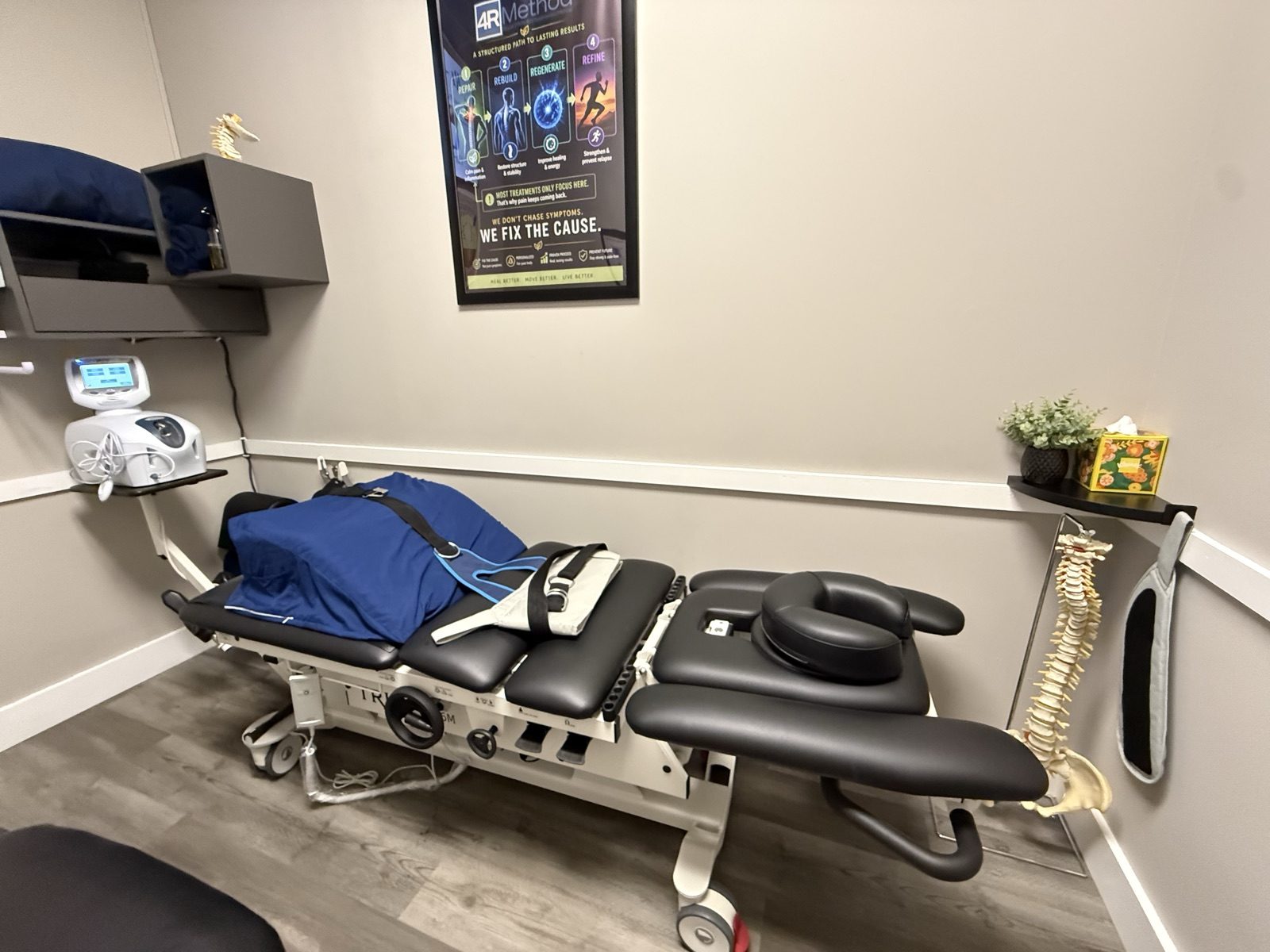
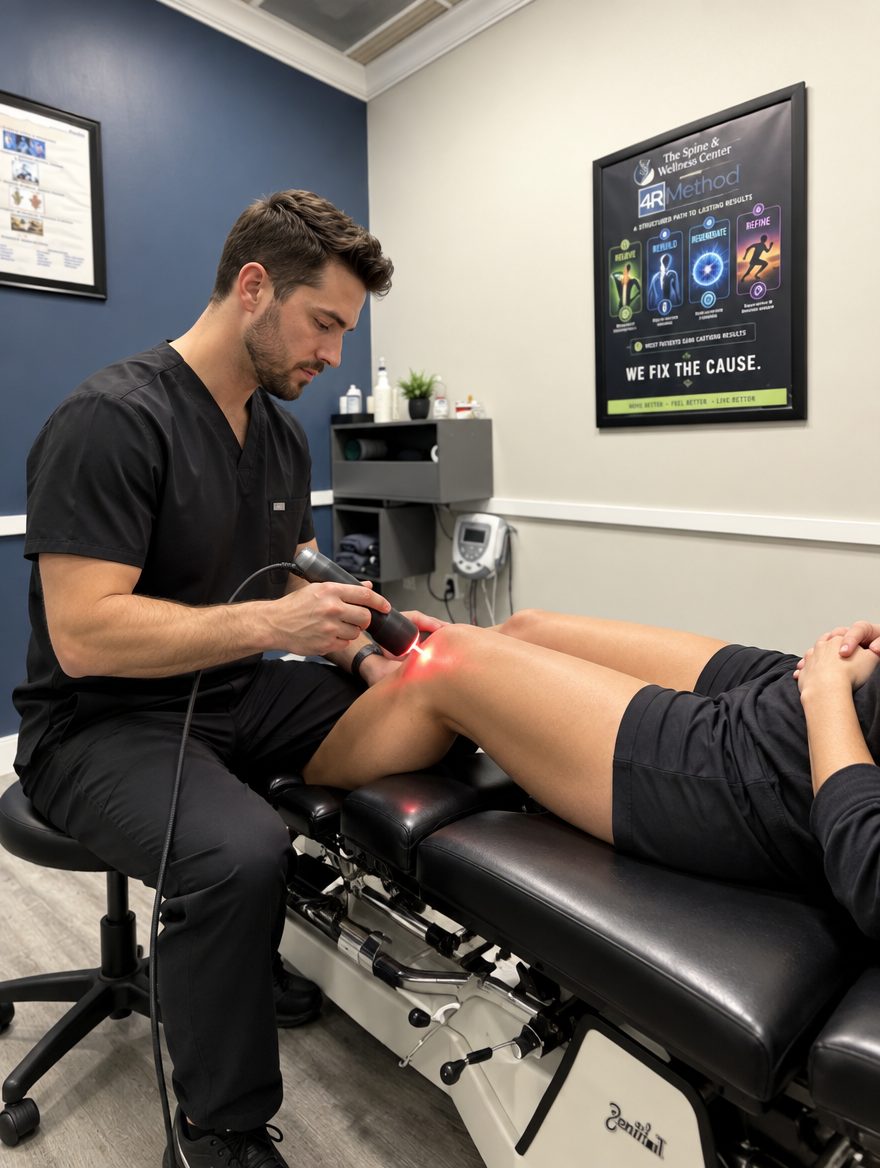
For disc- and spur-related compression, non-surgical spinal decompression on the Triton DTS table gently opens the space the nerve runs through — cervical or lumbar — so a bulge can retract and the opening can clear. We pair it with precise adjustments at the involved segment and cold laser to calm the inflamed root. Typically 3–5 visits a week for 4–8 weeks.
R2 · Rebuild — stop it from getting trapped again
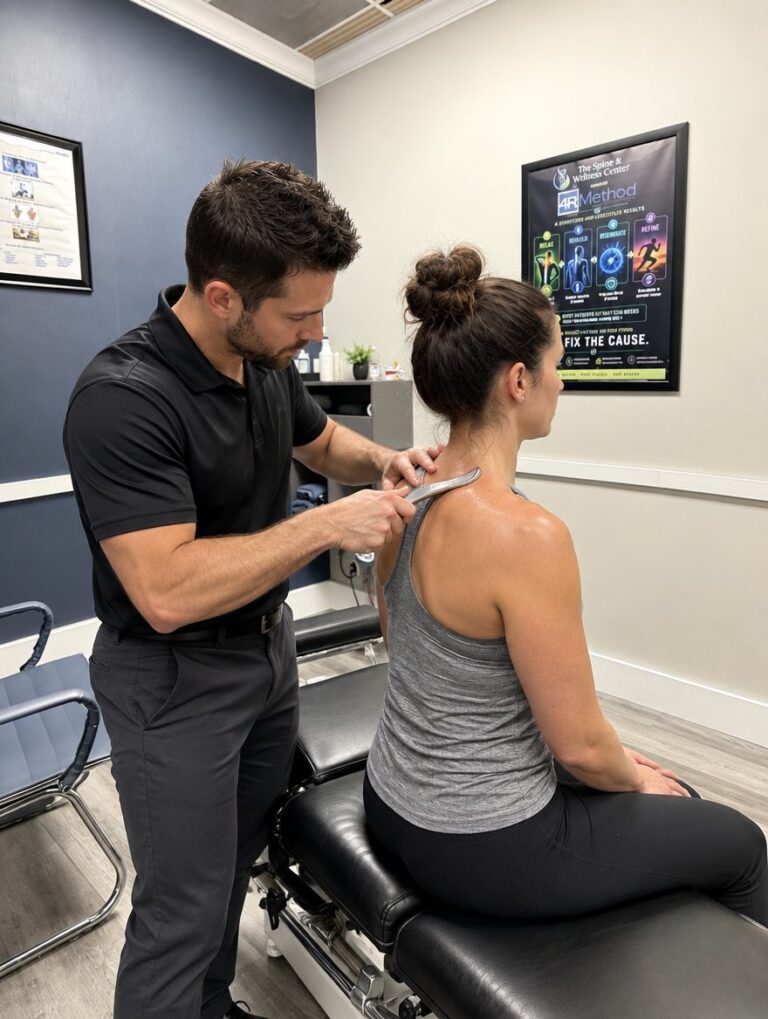
With the nerve quiet, we correct posture and curve, retrain the deep neck flexors or deep core with physical therapy, and release the scalenes, pectorals, piriformis or forearm tissue that squeeze the nerve further down the line with Graston Technique. Usually 2–3 visits a week for 8–16 weeks.
R3 and R4 · Regenerate and Refine
Nerves heal slowly — roughly a millimeter a day — so the Regenerate phase supports them with PEMF and red light at about 2 visits a week, and Refine keeps the spine clear with a tune-up every month or two.
Non-surgical spinal decompression
Opens the disc space in the neck or low back so the nerve root has room again.
Learn moreChiropractic adjustments
Restore motion to the segment that is crowding the nerve and calm the guarding around it.
Learn moreCold laser therapy
Painless low-level laser for the inflamed nerve root and the tissue around it.
Learn morePhysical therapy
Postural and stabilizer retraining so the opening the nerve uses stays open.
Learn moreWhat to expect at your first two visits
Because the whole plan depends on where the nerve is compressed, we measure first.
Visit one — we measure (and usually begin care)
- A real conversation. Where the symptoms travel, which fingers or toes are affected, what positions change them, and what you have tried.
- A hands-on structural and neurological exam. Range of motion, nerve-tension tests for the arm and leg, Spurling’s and straight-leg-raise tests, wrist and elbow tests, and reflexes, strength and sensation mapped by nerve root.
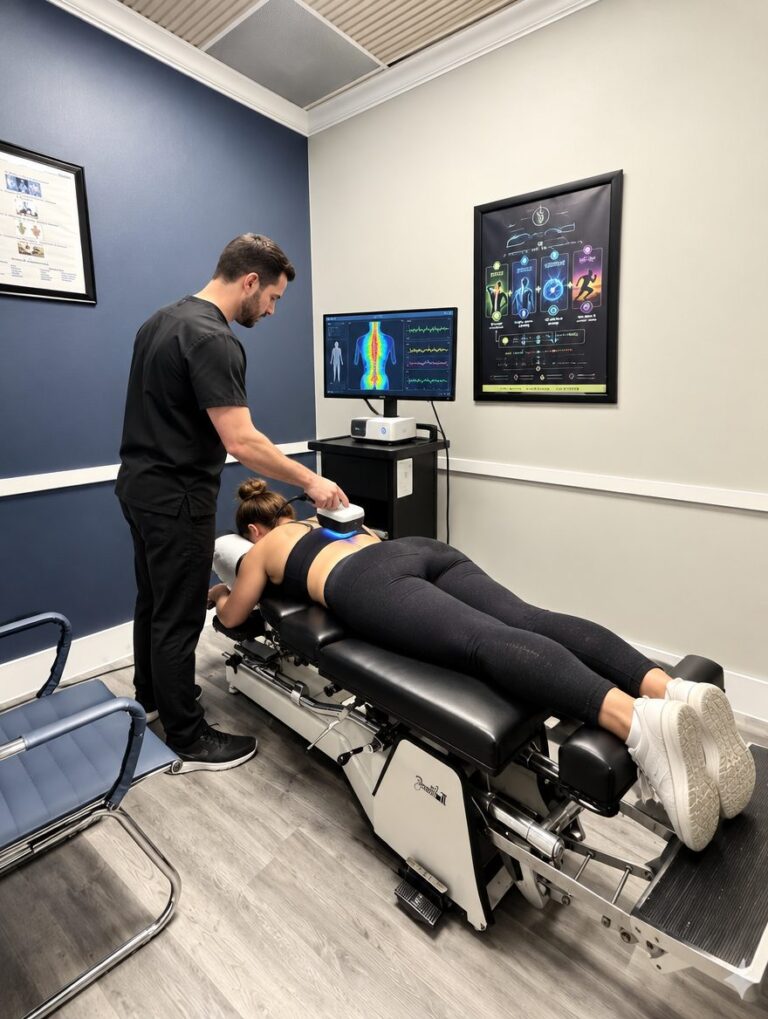
- Surface EMG and thermal scanning. A painless scan showing where the paraspinal muscles are guarding and where nerve irritation is changing skin temperature.
- Digital X-rays when indicated. Disc spacing, spurs, curve and alignment; we also review any MRI or nerve-conduction study you already have.
Visit two — your findings and your plan
We show you which nerve is compressed and where, how the four phases of the 4R Method apply to you, and a realistic timeline. Your full plan starts here — and in most cases care already began on visit one. The 60-second spine assessment gives us a head start if you take it before you come in.
Pinched nerve relief at home between visits
- Change the position that provokes it. For the neck, raise the monitor to eye level and stop looking down at the phone; for the low back, break up sitting every 30–45 minutes.
- Avoid aggressive stretching of the painful limb. Pulling on an irritated nerve makes it angrier. Gentle nerve-glide movements, which we teach you, are different.
- Sleep with the nerve slack. A single supportive pillow for the neck; a pillow between the knees for the low back.
- Ice the spine, not the limb. The inflammation is at the root, so cold on the neck or low back for 15 minutes helps more than icing the hand or foot.
- Keep moving. Short walks keep the nerve gliding and the discs nourished.
According to the National Institute of Neurological Disorders and Stroke, most pinched nerves improve with conservative care such as rest from the aggravating activity, physical therapy and anti-inflammatory measures, with surgery reserved for cases that do not respond (NINDS, Pinched Nerve). Our job is to be the care that works first.
When a pinched nerve needs a doctor today
Please see a doctor or urgent care today if you have rapidly worsening weakness, a foot or wrist that drops, loss of bladder or bowel control, numbness in the groin, symptoms in both arms and both legs at once, or nerve symptoms after a significant fall or car accident. These can signal spinal cord involvement rather than a single root.
For the far more common pattern — one arm or one leg, burning or tingling, worse in certain positions — pinched nerve treatment without drugs or surgery is what we do all day in Coral Springs and Parkland. Related reading: neck pain treatment, bulging disc treatment and spinal stenosis treatment.
Serving pinched nerve patients across North Broward
Our clinic at 5675 Coral Ridge Drive, Coral Springs, FL 33076 serves Coral Springs, Parkland, Coconut Creek, Margate, Boca Raton, Tamarac, Pompano Beach and Deerfield Beach. Same-day appointments are usually available — call (954) 341-2256 or book online. Most patients from Parkland and Coral Springs are here in under 15 minutes.
Medically reviewed by Dr. Jared Cohen, DC — Co-Founder & Clinical Director, The Spine and Wellness Center. Last reviewed October 2026.
Frequently asked questions
What does a pinched nerve feel like?
A pinched nerve typically causes sharp, burning or electric pain that radiates down one arm or leg, with numbness, tingling or a pins-and-needles feeling along the nerve's path. Some people notice weakness or a heavy limb. The symptoms follow the territory of the compressed nerve, which is how we identify it.
Can a pinched nerve heal without surgery?
Usually, yes. Most nerve compression comes from a disc, spur or narrowed opening that responds to decompression, adjustments and rehab. Surgery is generally reserved for progressive weakness or symptoms that do not improve with conservative care over several weeks to months.
How long does pinched nerve treatment take?
Many patients feel the radiating pain easing within the first few visits as pressure comes off the root, with meaningful relief in two to three weeks. Numbness resolves more slowly than pain because nerves regenerate gradually, so the full timeline depends on how long the nerve was compressed.
Is my hand numbness carpal tunnel or my neck?
Carpal tunnel affects the thumb through the ring finger, is worse at night and with gripping, and has no neck pain. A cervical pinched nerve usually comes with neck or shoulder-blade pain and changes with head position. The exam on your first visit tests both, because the two often coexist.
Does spinal decompression work for a pinched nerve in the neck?
Yes. The Triton DTS table has a cervical setting that gently opens the space between the neck vertebrae so a bulging disc or narrowed opening stops pressing on the root. Sessions last about 20 minutes and most patients find them relaxing.
Do you treat pinched nerve patients from Parkland and Coconut Creek?
Yes. Our clinic on Coral Ridge Drive in Coral Springs is minutes from Parkland, Coconut Creek, Margate and Tamarac, and same-day appointments are usually available for new nerve-pain patients.
Same-day appointments
Let's build your plan.
Find out what's actually going on and get a clear path forward. Same-day appointments available.
- Same-day appointments are usually available
- Our team calls you back to confirm your visit
- Coral Springs, serving Parkland & North Broward since 2005
Prefer to talk now? Call or text (954) 341-2256