
Conditions · Coral Springs & Parkland
Spinal stenosis treatment in Coral Springs (non-surgical)
When the spinal canal narrows, walking and standing become a daily negotiation. We find exactly where your nerves are being crowded, create space with decompression and flexion-based care, and tell you honestly what conservative treatment can and cannot do.
Quick answer
Spinal stenosis treatment without surgery focuses on creating space for crowded nerves and keeping it open. Stenosis is a narrowing of the spinal canal or nerve openings from arthritis, thickened ligaments and worn discs. We use non-surgical spinal decompression, gentle adjustments and flexion-based rehab inside the 4R Method. Many patients walk and stand longer within weeks; surgery is considered when weakness progresses or conservative care fails.
What is spinal stenosis, and why does walking make it worse?
Spinal stenosis treatment starts with the anatomy of space. Your spinal cord and nerve roots run through a bony canal and exit through small openings between the vertebrae. Spinal stenosis is a gradual narrowing of that canal or those openings. As the space tightens it crowds the nerves, and the result is deep back or neck pain, numbness, tingling, and legs that cramp, tire or go heavy after a short walk.
The narrowing is usually built from several sources at once: age-related arthritis and bone spurs on the facet joints, thickened or stiffened ligaments inside the canal, bulging or herniated discs pushing inward, degenerative disc disease collapsing the openings, or a vertebra that has slipped forward (spondylolisthesis). Some people are simply born with a narrower canal.
Walking and standing upright extend the spine, which narrows the canal further — which is why the legs fade after a block and recover when you sit down or lean on a shopping cart. Many people are told their only options are pain medication or surgery. Our spinal stenosis treatment in Coral Springs sees it differently: by identifying exactly where and why your nerves are being squeezed, we can often relieve that pressure and help you move comfortably again.
Is it stenosis, a disc, or your circulation? Telling the patterns apart
- Lumbar stenosis (neurogenic claudication): heaviness, cramping or numbness in both legs that builds with walking or standing and eases within minutes of sitting or bending forward. Walking uphill or pushing a cart is easier than walking on flat ground. Most common after 60.
- Disc-driven sciatica: sharp pain down one leg that is worse sitting and bending forward — the opposite of stenosis. See sciatica treatment.
- Vascular claudication: calf cramping with walking that eases when you simply stop, without needing to sit or bend. This is a circulation problem and needs a physician.
- Cervical stenosis: neck pain with clumsy hands, difficulty with buttons, or an unsteady, wide-based walk. This can involve the spinal cord itself and needs prompt medical evaluation.
- Hip arthritis: groin pain with walking that does not change with bending forward — see our hip pain guide.
The flexion test
If leaning forward on a cart lets you walk twice as far, your stenosis is mechanical and flexion-based care has something to offer. That single observation shapes your whole plan.
Why flexion-based care relieves spinal stenosis
Bending slightly forward (flexion) opens the spinal canal and the nerve openings by up to a third; arching backward (extension) closes them. That simple mechanical fact is the foundation of non-surgical spinal stenosis treatment:
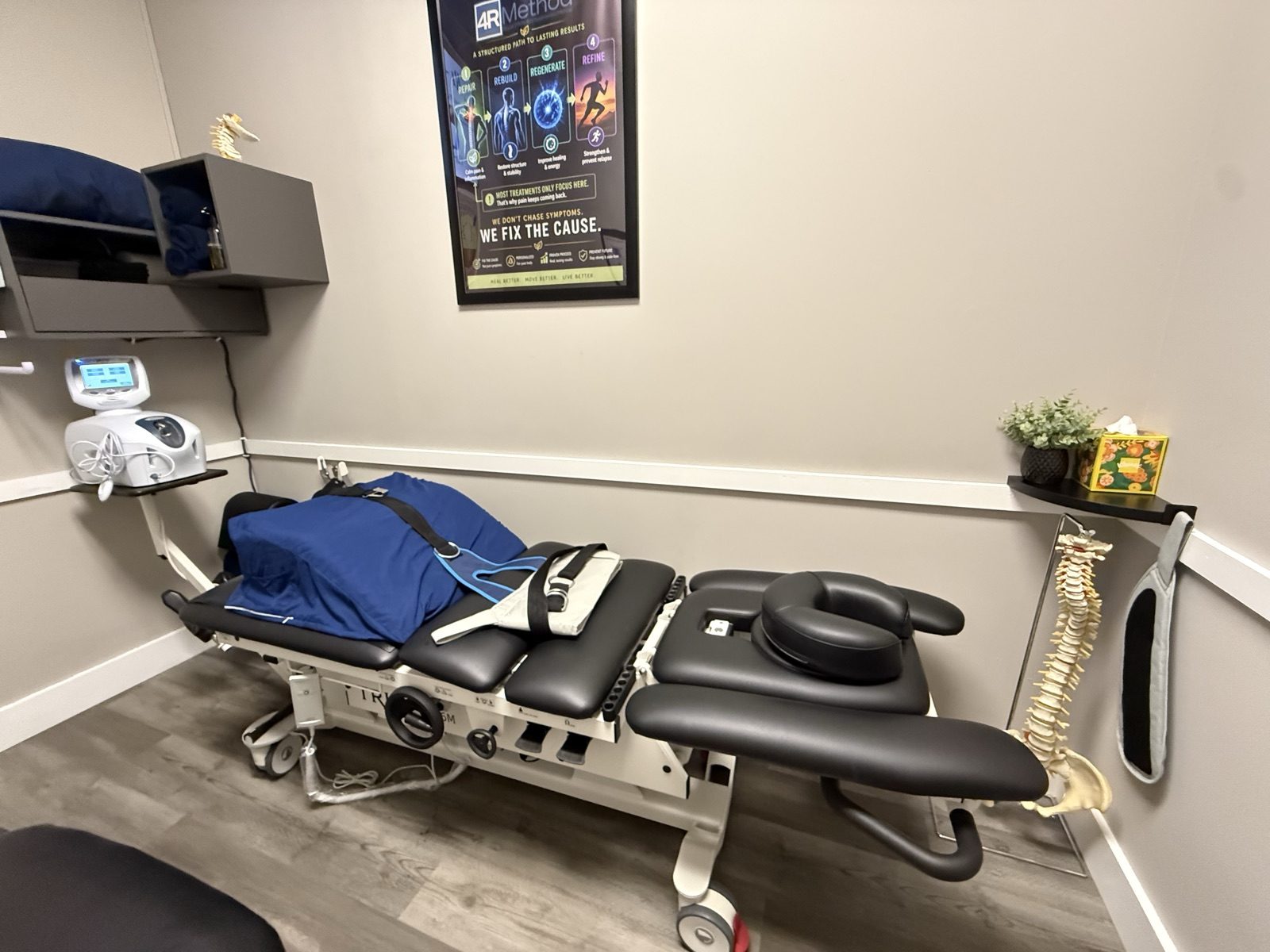
- Decompression creates space directly. The Triton DTS table applies gentle, computer-controlled cycles of pull and release with the lumbar spine in slight flexion, separating the vertebrae and lowering pressure on the crowded nerves. About 20 minutes per session.
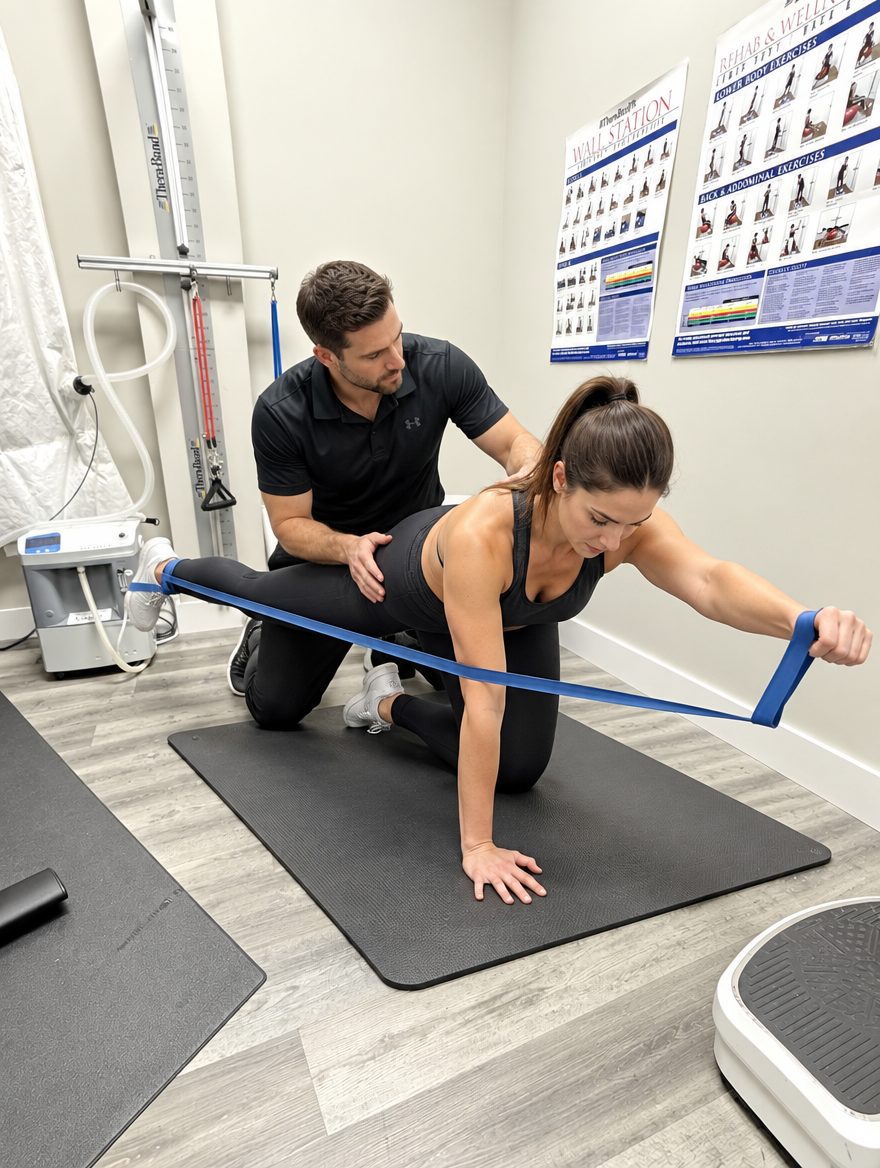
- Flexion-based rehab keeps it open. Posterior pelvic tilts, knee-to-chest and seated flexion movements, plus deep core and glute strengthening, teach the spine to hold a slightly flexed, decompressed posture while walking.
- Gentle adjustments restore motion. Low-force, specific adjustments to the hips, pelvis and the segments above and below the stenosis reduce the extension load on the narrowed level.
- Inflammation is managed without drugs. Cold laser and PEMF calm the irritated roots and the arthritic joints around them.
According to the National Institute of Arthritis and Musculoskeletal and Skin Diseases, most people with spinal stenosis are first treated with non-surgical measures — exercise, physical therapy and activity modification — and surgery is considered when symptoms are severe, progressive or unresponsive (NIAMS, Spinal Stenosis).
How we approach spinal stenosis treatment with the 4R Method
Our spinal stenosis treatment runs on the 4R Method — Repair, Rebuild, Regenerate, Refine — with the emphasis on building a spine that walks farther, not just one that hurts less today.
R1 · Repair — create space, calm the nerves
Non-surgical spinal decompression with a flexion bias, gentle adjustments to the pelvis and neighboring segments, and cold laser for the inflamed roots. Typically 3–5 visits a week for 4–8 weeks; many patients notice they can stand and walk longer within the first few weeks.
R2 · Rebuild — a stronger, better-positioned spine
Physical therapy built around flexion-based stabilization, hip mobility and walking tolerance, with Graston for the stiff hip flexors that pull the lumbar spine into extension. Usually 2–3 visits a week for 8–16 weeks. We track walking distance as an outcome, not just pain.
R3 and R4 · Regenerate and Refine
PEMF, red light and recovery protocols at about 2 visits a week support the arthritic joints and nerves, and a brief tune-up every month or two keeps the canal as open as your anatomy allows.
Non-surgical spinal decompression
Gentle, flexion-biased traction cycles that open a narrowed canal and ease nerve pressure.
Learn morePhysical therapy
Flexion-based stabilization and walking-tolerance training that keep the space you gained.
Learn moreChiropractic adjustments
Low-force, specific adjustments to the pelvis and neighboring segments — never forced extension.
Learn moreCold laser therapy
Painless laser for the inflamed nerve roots and arthritic facet joints.
Learn moreWhen is spinal stenosis surgery indicated?
We are honest about this on visit two, because stenosis is one condition where surgery has a clear place. The American Academy of Orthopaedic Surgeons describes surgery — typically a laminectomy to remove bone and ligament crowding the canal, sometimes with fusion — as an option when non-surgical care has not relieved symptoms over months, or when there is progressive weakness or loss of bladder or bowel function (AAOS OrthoInfo, Lumbar Spinal Stenosis).
- Conservative care first for the majority: pain and walking limits without progressive neurological loss.
- Surgical referral when leg weakness is worsening, when walking tolerance keeps falling despite a full Repair phase, or when bladder or bowel function changes. We will tell you plainly, and help coordinate the referral.
- After surgery, the Rebuild and Refine phases still matter — the segments above and below a decompression or fusion take more load.
What to expect at your first two visits
Visit one — we measure (and usually begin care)
- A real conversation. How far you can walk before the legs fade, what relieves it, any hand clumsiness or balance changes, and any imaging you already have.
- A hands-on structural exam. A walking test, flexion and extension tolerance, hip screening, nerve-tension tests, and neurological testing of reflexes, strength, sensation and balance.
- Surface EMG and thermal scanning. A painless scan showing where the muscles are guarding and where nerve irritation is present — our objective baseline.
- Digital X-rays when indicated. Disc height, spurs, alignment and any slippage; we review your MRI against what the exam found.
Visit two — your findings and your plan
We explain which levels are narrowed, what conservative care can realistically achieve for your case, and a 4R timeline. Your full plan starts here — and in most cases care already began on visit one. The 60-second spine assessment gives us a head start.
Living with spinal stenosis: habits that help you walk farther
- Walk in intervals. Walk until the legs start to fade, sit or bend forward for a minute, then go again. Tolerance builds week by week.
- Cycle instead of treadmill. A stationary bike keeps the spine in slight flexion and is usually comfortable for stenosis.
- Sleep slightly curled. On your side with knees drawn up, or on your back with pillows under the knees.
- Avoid prolonged standing and arching. Overhead reaching, standing at a counter for long periods and sleeping flat on the stomach all extend the spine.
- Keep the hips mobile and the core strong. Tight hip flexors pull the lumbar spine into extension; a stronger core holds it neutral.
Please see a doctor or urgent care today if you develop loss of bladder or bowel control, numbness in the groin, rapidly worsening leg weakness, or new hand clumsiness and unsteadiness. For everything else, non-surgical spinal stenosis treatment is our daily work in Coral Springs and Parkland.
Serving spinal stenosis patients across North Broward
Our clinic at 5675 Coral Ridge Drive, Coral Springs, FL 33076 serves Coral Springs, Parkland, Coconut Creek, Margate, Boca Raton, Tamarac, Pompano Beach and Deerfield Beach. Same-day appointments are usually available — call (954) 341-2256 or book online. Most patients from Parkland and Coral Springs are here in under 15 minutes.
Medically reviewed by Dr. Jared Cohen, DC — Co-Founder & Clinical Director, The Spine and Wellness Center. Last reviewed October 2026.
Frequently asked questions
What is spinal stenosis and what causes it?
Spinal stenosis is a narrowing of the spinal canal or the openings where nerves exit. It is most often caused by age-related arthritis, bone spurs, thickened ligaments, bulging or herniated discs, or a slipped vertebra crowding the nerves. We identify the specific source before building a care plan.
Can spinal stenosis be treated without surgery?
Often, yes. Non-surgical decompression, flexion-based rehab and gentle adjustments can reduce pressure on crowded nerves and improve how far you can walk. Results vary by case, and we are honest about what conservative care can and cannot do for your spine.
Why does my leg pain ease when I sit or lean on a cart?
Bending forward opens the spinal canal and nerve openings; standing upright and arching closes them. That is why stenosis symptoms build with walking and ease with sitting or leaning forward, and it is the reason flexion-based care works.
When is surgery necessary for spinal stenosis?
Surgery is generally considered when non-surgical care has not relieved symptoms over several months, when leg weakness is progressing, or when bladder or bowel function changes. If your exam shows those signs, we tell you plainly and help coordinate the referral.
Is spinal decompression safe with spinal stenosis?
For most stenosis patients, yes — the Triton DTS table uses gentle, computer-controlled cycles with a flexion bias that most find relaxing. Unstable spondylolisthesis, fractures, tumors and recent spinal hardware are the main exclusions, which your exam and imaging on visit one rule in or out.
Do you treat spinal stenosis patients from Parkland and Boca Raton?
Yes. Our clinic on Coral Ridge Drive in Coral Springs is minutes from Parkland, Coconut Creek and Margate and an easy drive from Boca Raton, Deerfield Beach and Pompano Beach, with same-day appointments usually available.
Keep reading
From the blog
Same-day appointments
Let's build your plan.
Find out what's actually going on and get a clear path forward. Same-day appointments available.
- Same-day appointments are usually available
- Our team calls you back to confirm your visit
- Coral Springs, serving Parkland & North Broward since 2005
Prefer to talk now? Call or text (954) 341-2256