
Conditions · Coral Springs & Parkland
Bulging disc treatment in Coral Springs
A disc that has pushed past its normal boundary can stay quiet for years or press on a nerve tomorrow. We find which disc is bulging and why, lower the pressure inside it, and rebuild the support around it — without surgery.
Quick answer
Bulging disc treatment aims to lower the pressure inside the disc so the bulge draws back from the nerve, then correct the loading that caused it. We use non-surgical spinal decompression on the Triton DTS table, specific adjustments, cold laser and core rehab inside the 4R Method. A bulge is less advanced than a herniation, and most respond well to conservative care.
What is a bulging disc, and why does it hurt?
Bulging disc treatment makes more sense once you know what a disc is. Between each pair of vertebrae sits a cushion with a tough, layered outer wall (the annulus) and a soft gel center (the nucleus). The disc absorbs shock, spaces the bones so nerves can exit cleanly, and lets the spine bend.
When the outer wall weakens — from years of sitting, repeated bending and lifting, a car accident, or simple wear — the disc can flatten and push outward past its normal boundary. That is a bulging disc. Often it stays quiet. But when the bulge presses on a nearby nerve root, it triggers pain, numbness, tingling or weakness in the arm (neck discs) or leg (lower back discs).
Too often the answer is a prescription that masks the symptom while the disc keeps losing height. Our bulging disc treatment in Coral Springs takes the opposite path: we find exactly which disc is involved, lower the pressure inside it, and correct the mechanics that overloaded it.

Bulging disc vs herniated disc: what is the difference?
The two terms get used interchangeably, but they describe different stages of the same process:
- Bulging disc: the outer wall stays intact but sags outward, usually around a broad portion of the disc’s circumference. Think of a tire with low pressure. It is common with age — many people over 40 have one on an MRI without symptoms.
- Herniated disc: the inner gel pushes through a tear in the outer wall, usually at one focused spot. Because the nucleus material is chemically irritating to nerves, herniations tend to produce sharper, more intense nerve pain — see our herniated disc guide.
- Both can pinch a nerve. Whether a disc causes symptoms depends on where it presses, not just on which label it carries. A broad bulge in an already narrow canal can hurt more than a small herniation in a roomy one.
The practical point: a bulge is the earlier, more reversible stage. Treating a bulging disc well often prevents it from becoming a herniation. According to the American Academy of Orthopaedic Surgeons, most disc problems improve with non-surgical care, and surgery is considered only when symptoms persist or weakness progresses (AAOS OrthoInfo).
Good to know
An MRI finding of a bulge is not a sentence. What matters is whether the bulge matches your symptoms — which is why we examine you before we read the report.
How to tell where your bulging disc is
The pattern of symptoms usually points to the region before any imaging does:
- Lumbar bulge (L4–L5, L5–S1): low back ache that is worse sitting, bending forward, coughing or sneezing; pain into the buttock or down one leg (sciatica); numbness on the shin, big toe or outer foot.
- Cervical bulge (C5–C7): neck stiffness, pain between the shoulder blades, and tingling into the arm or fingers — a pinched nerve pattern.
- Thoracic bulge: less common; a band-like ache around the ribs or mid-back.
- Quiet bulge: dull, central back ache with no limb symptoms — the disc is irritated but not yet pressing on a nerve, and the best time to treat it.
Leg or arm symptoms matter most. Numbness, tingling or weakness means a nerve root is involved, and nerve pain responds best to decompression rather than to more stretching.
How we approach bulging disc treatment with the 4R Method
Our bulging disc treatment follows the 4R Method — Repair, Rebuild, Regenerate, Refine — because lowering disc pressure without fixing the loading is temporary by design.
R1 · Repair — lower the pressure inside the disc
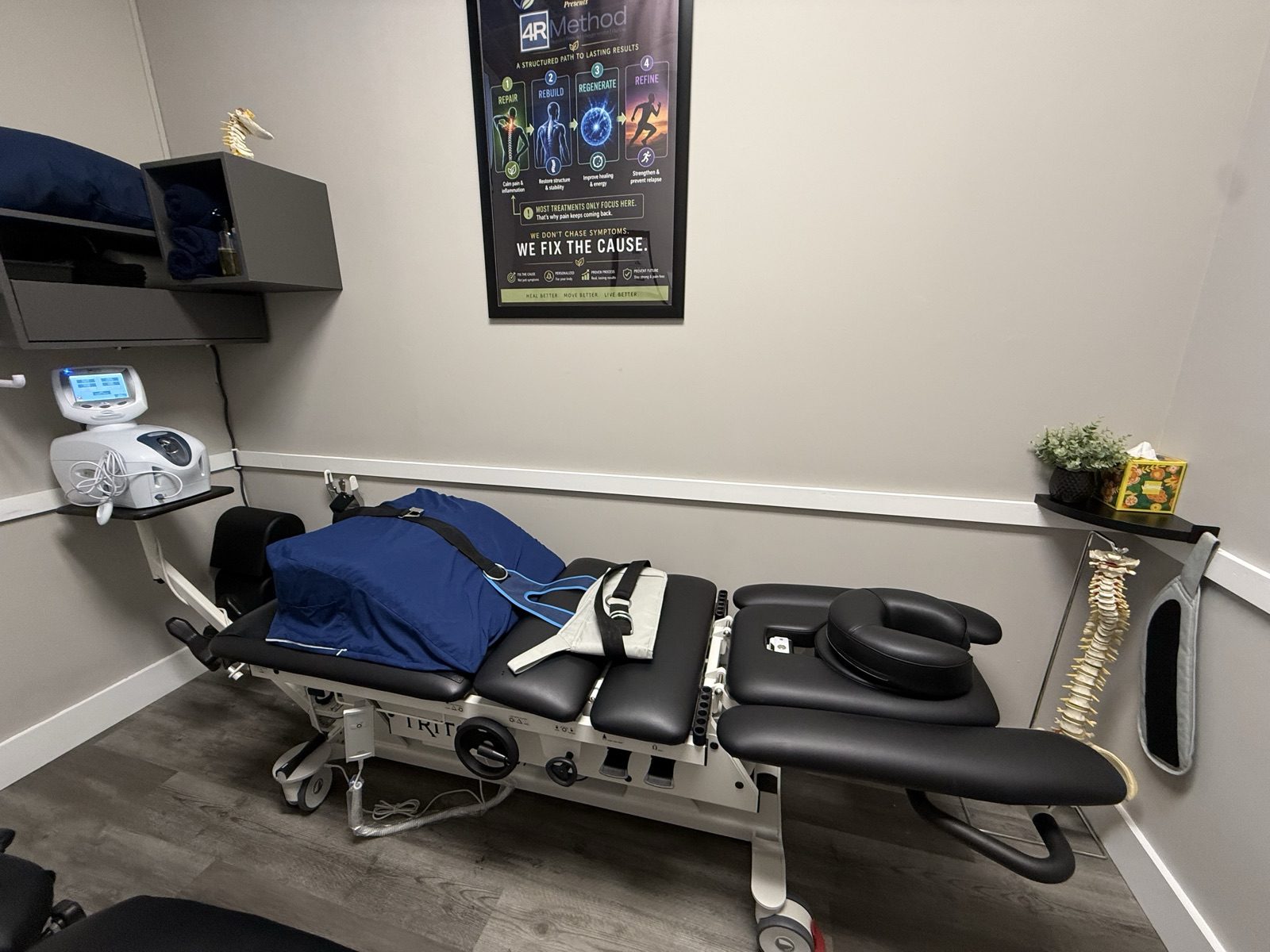
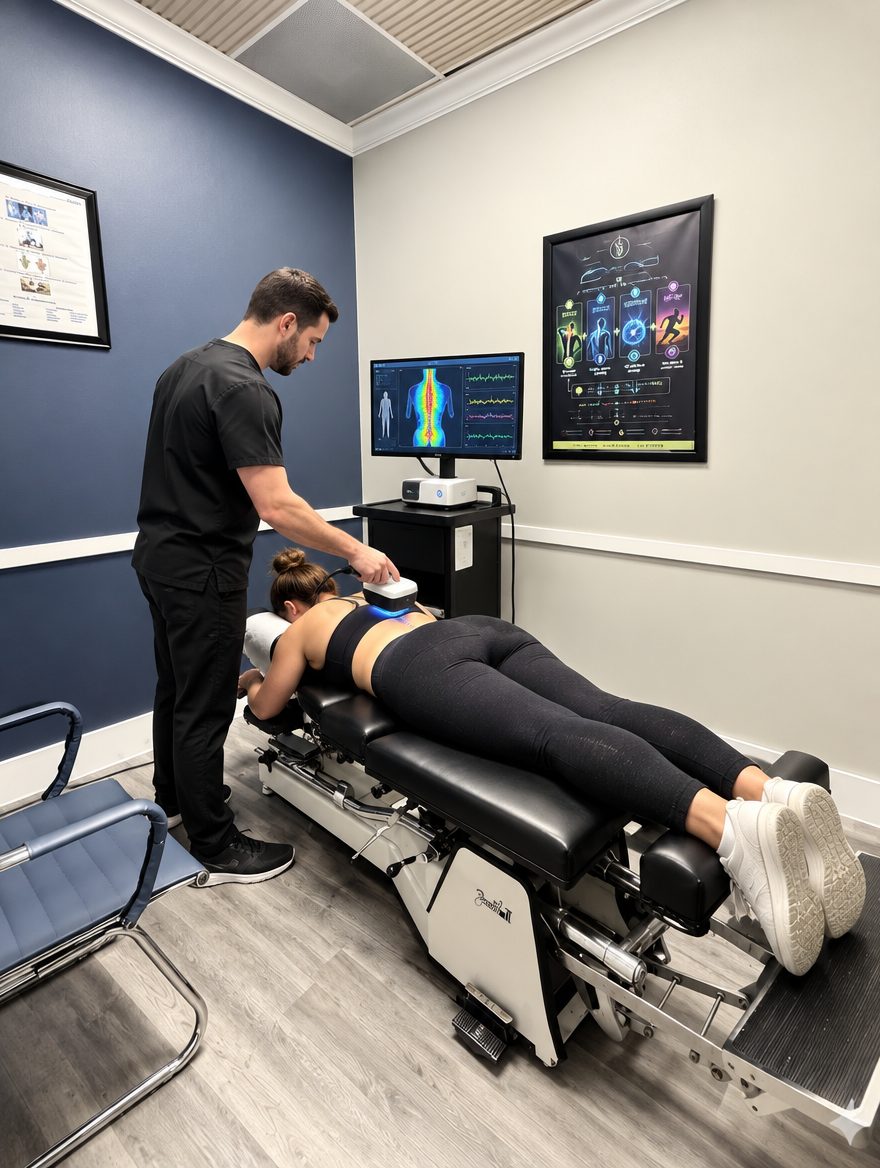
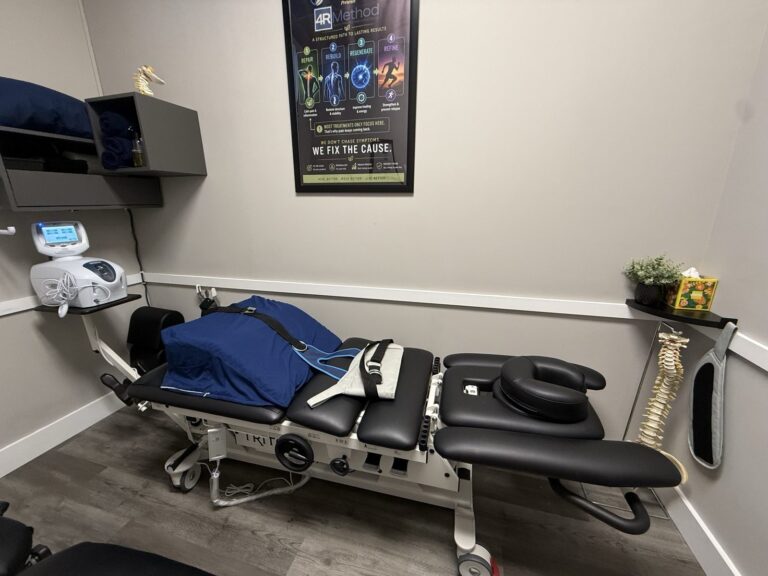
Non-surgical spinal decompression on the Triton DTS table cycles gentle pulling and relaxing forces that create negative pressure inside the disc, drawing the bulge inward and pulling in fluid and nutrients. About 20 minutes on the table, paired with precise adjustments at the involved segment and cold laser for inflammation. Typically 3–5 visits a week for 4–8 weeks.
R2 · Rebuild — fix what overloaded the disc
Corrective care to restore the spinal curve, physical therapy for the deep core and hip stabilizers, and Graston for the guarded soft tissue around the segment. Usually 2–3 visits a week for 8–16 weeks. This is the phase that stops the bulge coming back.
R3 and R4 · Regenerate and Refine
Discs have a poor blood supply and heal slowly, so the Regenerate phase supports them with PEMF and red light at about 2 visits a week. Refine is a brief tune-up every month or two to protect the disc height you regained.
Non-surgical spinal decompression
The core of bulging disc care: negative pressure that draws the bulge back and rehydrates the disc.
Learn moreChiropractic adjustments
Restore motion to the segments above and below so the bulging disc stops taking all the load.
Learn morePEMF therapy
Supports circulation and disc healing between decompression sessions.
Learn moreCore & hip rehab
Rebuild the stabilizers that protect the disc when you sit, lift and play.
Learn moreWhat to expect at your first two visits
Visit one — we measure (and usually begin care)
- A real conversation. How the pain behaves with sitting, bending and coughing, whether it travels into a limb, and what you have already tried.
- A hands-on structural exam. Range of motion, orthopedic tests that load and unload the disc, nerve-tension tests, and neurological testing of reflexes, strength and sensation.
- Surface EMG and thermal scanning. A painless scan showing where the muscles are guarding the disc and where nerve irritation is present — re-scannable to track progress.
- Digital X-rays when indicated. Disc height, alignment and wear; we review any MRI you already have against what we found.
Visit two — your findings and your plan
Everything explained with your scans in front of you, mapped to the four phases of the 4R Method, with a realistic timeline. Your full plan starts here — and in most cases care already began on visit one. The 60-second spine assessment gives us a head start on your likely pattern.
Bulging disc care at home: what helps and what makes it worse
- Break up sitting. Sitting raises pressure inside a lumbar disc more than standing or walking. Stand for two minutes every 30–45 minutes.
- Hinge, don’t bend. Keep loads close and move at the hips; rounding the back under load is how bulges become herniations.
- Walk daily. Gentle, rhythmic loading pumps fluid in and out of the disc and keeps it nourished.
- Sleep neutral. Side-lying with a pillow between the knees, or on the back with a pillow under the knees; one supportive pillow for the neck.
- Skip deep forward-bend stretches early on. Flexion pushes the nucleus backward toward the nerve. Your plan includes the right movements at the right stage.
Ice for the first 48 hours of a flare, heat for stiffness afterward. If pain starts traveling down the leg or arm, do not wait to see if it settles — nerve symptoms respond faster the sooner the pressure comes off.
When a bulging disc needs a doctor instead
Please see a doctor or urgent care today if you have loss of bladder or bowel control, numbness in the groin or inner thighs, rapidly worsening weakness in a limb, back pain with fever or unexplained weight loss, or pain following a serious fall or accident.
For the common bulging disc — the ache that is worse sitting, the tingling into the leg or arm, the disc you were told to live with — non-surgical bulging disc treatment is our daily work in Coral Springs and Parkland. If your disc has already progressed, read our guide to herniated discs; if several discs are wearing at once, see degenerative disc disease treatment.
Serving bulging disc patients across North Broward
Our clinic at 5675 Coral Ridge Drive, Coral Springs, FL 33076 serves Coral Springs, Parkland, Coconut Creek, Margate, Boca Raton, Tamarac, Pompano Beach and Deerfield Beach. Same-day appointments are usually available — call (954) 341-2256 or book online. Most patients from Parkland and Coral Springs are here in under 15 minutes.
Medically reviewed by Dr. Jared Cohen, DC — Co-Founder & Clinical Director, The Spine and Wellness Center. Last reviewed October 2026.
Frequently asked questions
What is the difference between a bulging disc and a herniated disc?
A bulging disc sags outward with its outer wall intact, usually around a broad portion of the disc. A herniated disc has a tear in the wall that lets the inner gel push through at one spot. Both can press on nerves; a bulge is the earlier, more reversible stage.
Can a bulging disc heal without surgery?
Most do. Lowering pressure inside the disc with non-surgical spinal decompression lets the bulge draw back and the disc rehydrate, while adjustments and core rehab correct the loading that caused it. Surgery is generally reserved for progressive weakness or pain that fails conservative care.
How does spinal decompression help a bulging disc?
The Triton DTS table applies computer-controlled cycles of gentle pull and release that create negative pressure inside the disc. That draws the bulge inward, away from the nerve, and pulls fluid and nutrients into the disc. Sessions take about 20 minutes and most patients find them relaxing.
How long does bulging disc treatment take?
Many patients feel meaningful relief within the first two to three weeks of a Repair-phase plan as pressure on the disc and nerve eases. A full program runs through the Rebuild phase so the result holds; your timeline is set at your second visit based on your exam and imaging.
Should I stretch a bulging disc?
Carefully. Deep forward bends can push the disc material backward toward the nerve. Walking, breaking up sitting and hip-hinging are safe for nearly everyone; specific extension-based or nerve-glide movements are added once we know which disc is involved and which direction it is bulging.
Do you treat bulging disc patients from Parkland and Boca Raton?
Yes. Our clinic on Coral Ridge Drive in Coral Springs is minutes from Parkland, Coconut Creek, Margate, Boca Raton and Deerfield Beach, and same-day appointments are usually available for new disc patients.
Same-day appointments
Let's build your plan.
Find out what's actually going on and get a clear path forward. Same-day appointments available.
- Same-day appointments are usually available
- Our team calls you back to confirm your visit
- Coral Springs, serving Parkland & North Broward since 2005
Prefer to talk now? Call or text (954) 341-2256