
Discs & Nerves · 6 min read
Sciatica relief without surgery in Coral Springs & Parkland
Sharp, shooting pain down one leg is a symptom, not a diagnosis. Find what is pressing on the nerve, take the pressure off, and the leg quiets down — no operation required for most people.

Quick answer
Lasting sciatica relief without surgery means finding what is pressing on the sciatic nerve roots — usually a disc at L4–L5 or L5–S1 — and taking that pressure off. Non-surgical spinal decompression, precise adjustments, soft-tissue work and rehab resolve most cases over several weeks. Surgery is reserved for progressive weakness or pain that does not respond.
What is sciatica, exactly?
Sciatica relief starts with understanding that sciatica is not a diagnosis on its own. It is a set of symptoms caused by irritation or compression of the sciatic nerve — the longest nerve in the body, formed by nerve roots that leave the lower spine, run through the buttock and travel down the back of each leg. Press on it anywhere along that path and pain, tingling or numbness can show up anywhere below.
True sciatica almost always affects one side. The hallmark is pain that radiates from the low back or buttock into the thigh, calf or foot — often described as electric, burning or a deep ache that will not let you get comfortable. Since 2005 our Coral Springs clinic has helped thousands of people in Coral Springs and Parkland get through it without an operation.

Symptoms that call for sciatica relief — and warning signs
- Sharp, burning or electric pain radiating from the low back into one leg
- Pins-and-needles, tingling or numbness in the leg or foot
- Weakness in the leg, or difficulty lifting the front of the foot
- Pain that worsens with prolonged sitting, coughing or sneezing
- Symptoms that clearly change with position — better standing and walking, worse slumped in a chair
See a doctor today if
Leg weakness is getting worse quickly, you have numbness in the groin or inner thighs, or you notice any change in bladder or bowel control. Those are rare, but they are urgent — please see a doctor or urgent care today.
What causes sciatica?
Identifying the source is the whole game, because real sciatica relief depends on treating the right structure. According to the Mayo Clinic, a herniated disc is the most common cause, but several structures can produce the same radiating pain:
- Herniated or bulging disc pressing on a nerve root at L4–L5 or L5–S1 — by far the most frequent pattern (see our herniated disc guide)
- Piriformis syndrome, where a deep buttock muscle clamps the nerve — common in runners, cyclists and people who sit on a wallet
- Spinal stenosis, a narrowing of the canal or nerve openings that crowds the nerve, usually after 50
- Degenerative changes and bone spurs that shrink the space a nerve root passes through
- Contributing factors: pregnancy, long daily sitting, a rounded-back lifting habit, extra body weight
Visit one at our clinic is measurement: a conversation about how the pain behaves, a hands-on exam that tests the nerve directly (straight-leg raise, slump test, piriformis and SI provocation), surface EMG and thermal scanning, and digital X-rays when indicated. Visit two is your full report of findings and plan, and Most patients have already begun care on visit one; this is where the full plan takes over.
The 6-step plan for sciatica relief without surgery
Our sciatica treatment follows the 4R Method — Repair, Rebuild, Regenerate, Refine. Sciatica lives mostly in the first two phases. In the order they usually enter the plan:
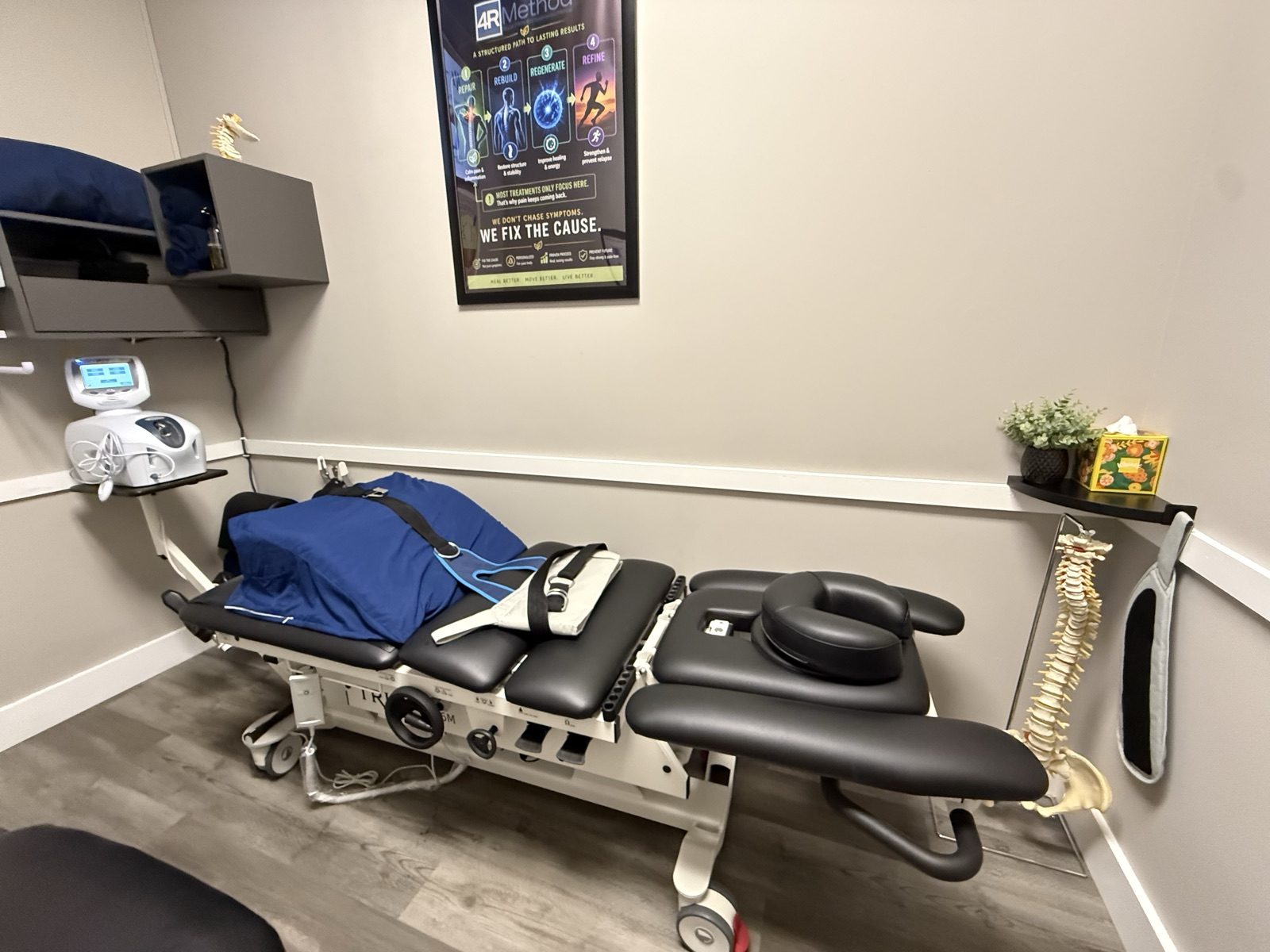
- Decompress the nerve. For disc-related sciatica, non-surgical spinal decompression on the Triton DTS table is the cornerstone: about 20 minutes of gentle, cyclical traction that lowers pressure inside the disc so it can draw back from the nerve root.
- Restore motion with precise adjustments. Locked lumbar and SI joints make the irritated level absorb every movement; freeing them spreads the load again.
- Calm the inflammation. Cold laser and therapeutic ultrasound settle the chemically irritated nerve root in the first weeks.
- Release the soft tissue. Graston and targeted muscle work for the piriformis and hip rotators — essential when the muscle, not the disc, is the squeeze.
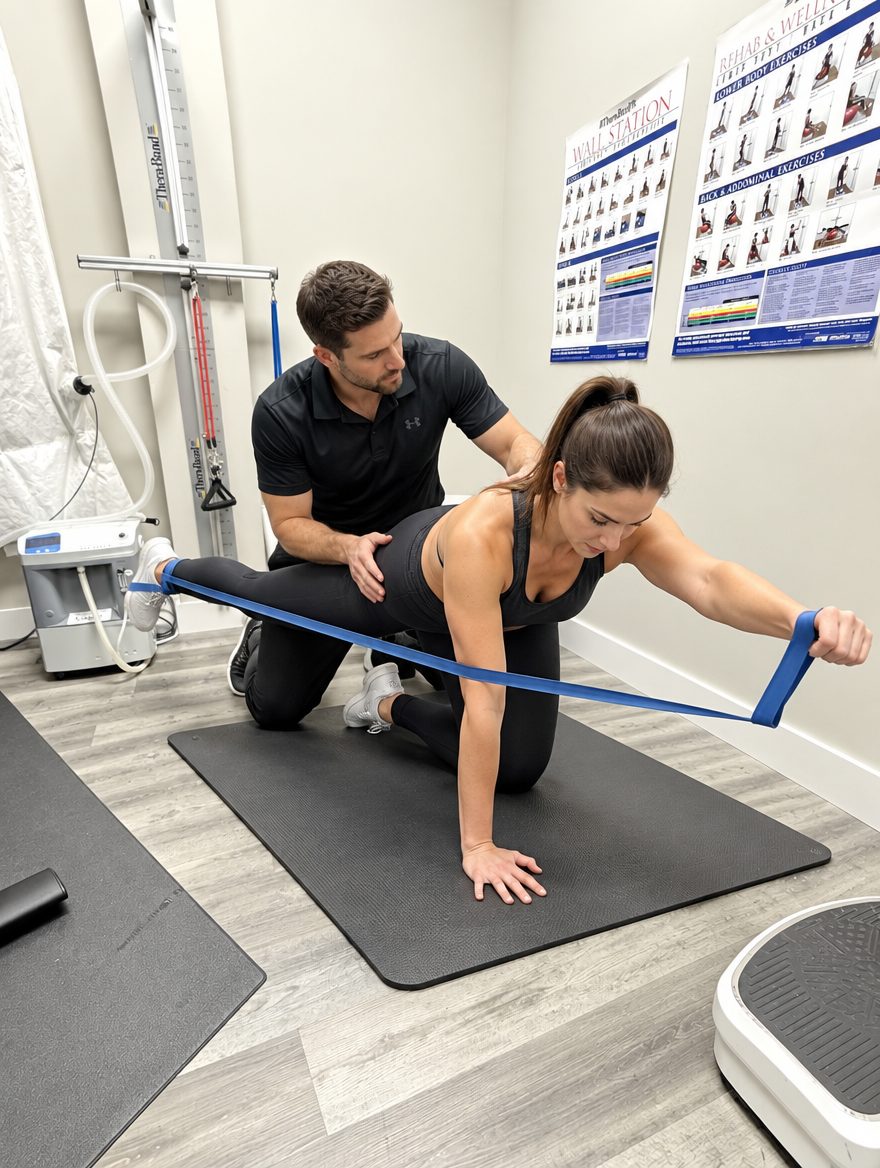
- Rebuild the stabilizers. Physical therapy for the deep core and hips so the disc is protected when you sit, lift and play — the phase most clinics skip.
- Protect the gains. Monthly tune-ups and the home habits below keep the nerve quiet for the long term.
Repair typically runs 3–5 visits a week for 4–8 weeks, and most patients feel meaningful change in the first two to three weeks. Rebuild tapers to 2–3 visits a week for 8–16 weeks. When the squeeze is at a nerve root rather than the disc itself, our pinched nerve treatment page explains how the plan shifts.
Self-care that supports sciatica relief at home
Professional care addresses the cause; a few habits ease the day-to-day and speed recovery:
- Avoid long sitting — stand and walk for a minute every 30 to 45 minutes
- Ice the low back during sharp flare-ups; gentle heat for muscle tightness
- Keep walking. Light, regular walking beats bed rest for nearly everyone
- Try the gentle hip and hamstring work in 7 sciatica stretches you can do at home — and stop any stretch that sends pain down the leg
- Mind your posture when sitting, lifting and sleeping; a pillow between the knees helps side-sleepers
When to see us in Coral Springs
If leg pain lasts more than a week, keeps returning or interferes with sleep and work, it is time to find out what is pressing on the nerve — that is where sciatica relief actually starts. The sooner an irritated nerve root is decompressed, the faster it tends to settle. A spine assessment is the measurement visit described above. And if you are still unsure whether your back is the source, what’s really causing your lower back pain walks through the other candidates.
Serving sciatica patients across North Broward
Our clinic at 5675 Coral Ridge Drive, Coral Springs, FL 33076 serves Coral Springs, Parkland, Coconut Creek, Margate, Boca Raton, Tamarac, Pompano Beach and Deerfield Beach. Same-day appointments are usually available — call (954) 341-2256 or book online. Most patients from Parkland and Coral Springs are here in under 15 minutes.
Medically reviewed by Dr. Jared Cohen, DC — Co-Founder & Clinical Director, The Spine and Wellness Center. Last reviewed October 2026.
Frequently asked questions
Can sciatica be treated without surgery?
Yes. Most cases respond to non-surgical care — decompression for disc-related compression, adjustments to restore motion, soft-tissue work for the piriformis and rehab to stabilize the spine. Surgery is generally considered only for progressive weakness or pain that has not responded to a well-run conservative plan.
How long does sciatica take to go away?
Mild, muscle-driven sciatica may ease within a few weeks. Disc-related cases usually improve meaningfully in the first two to three weeks of a Repair-phase plan and continue over two to three months as the disc heals. Your timeline depends on the cause, how long the nerve has been irritated and how consistently you follow the plan.
Is walking good for sciatica?
Usually, yes. Gentle walking keeps the spine mobile, pumps fluid through the discs and discourages the stiffness that bed rest creates. Avoid long sitting and stop any activity that sharply increases leg pain. If walking itself brings on leg heaviness that eases when you sit, tell us — that pattern points to stenosis rather than a disc.
Does spinal decompression help sciatica?
For disc-driven sciatica it is often the cornerstone. Cyclical traction on the Triton DTS table lowers pressure inside the disc so the bulge can draw back from the nerve root and the disc can pull in fluid and nutrients. We pair it with adjustments, anti-inflammatory therapies and rehab so the relief holds.

Same-day appointments
Reading about it is step one.
Step two is a measurement. Visit one we measure — and usually begin care; visit two you get your full findings and plan.
- Same-day appointments are usually available
- Our team calls you back to confirm your visit
- Coral Springs, serving Parkland & North Broward since 2005
Prefer to talk now? Call or text (954) 341-2256