
Service Areas · Coral Springs & Parkland
Pinched Nerve Treatment in Sunrise, FL
We find which nerve is compressed and take the pressure off, without drugs or surgery — The Spine and Wellness Center, about 20 minutes from Sunrise straight up the Sawgrass Expressway, with same-day appointments usually available.
Quick answer
The closest clinic for measured, non-surgical pinched nerve treatment near Sunrise is The Spine and Wellness Center at 5675 Coral Ridge Drive, Coral Springs, about 20 minutes from Sunrise. The first visit is a nerve-focused exam with surface EMG, thermal scanning and X-rays when indicated; the second is your report of findings, where treatment — typically decompression on the Triton DTS table — begins.
Why Sunrise patients choose us for pinched nerve treatment
The Spine and Wellness Center has cared for Sunrise families since 2005. Here is why they keep choosing us for pinched nerve treatment in Sunrise rather than a clinic down the street.
- Close enough to be routine. The clinic is about 20 minutes from Sunrise straight up the Sawgrass Expressway. Free parking is at the door, and we schedule follow-ups around your commute so the drive stays a non-issue.
- Hours built for working people. Open until 7:00 pm three evenings a week (Monday, Tuesday, Thursday), plus Wednesday afternoons and Friday mornings.
- Care that fits Sunrise life. We regularly treat Sunrise families, hockey fans and arena staff from Amerant Bank Arena, retail and hospitality workers on their feet all day at Sawgrass Mills, and cyclists from Markham Park. That experience shapes everything from the exam to the home-care plan.
What does a pinched nerve actually mean?
If you are looking for pinched nerve treatment in Sunrise, you have probably already noticed the odd thing about this injury: the pain is not where the problem is. A compressed nerve root in the neck hurts in the arm; one in the lower back hurts in the leg. The spine is the source, the limb is the messenger.
Four ways a nerve gets compressed
- Disc bulge or herniation — the most common cause. Disc material presses on the nerve root as it exits the spine.
- Foraminal stenosis — the opening the nerve passes through narrows, usually from disc thinning and wear.
- Bone spurs — osteoarthritic growth that crowds the nerve, often alongside stenosis.
- Soft-tissue entrapment — the nerve is squeezed further along its path, as in carpal tunnel syndrome at the wrist or piriformis syndrome in the hip.
Each cause responds to a different treatment, so the label ‘pinched nerve’ on its own is not enough to plan care. Since 2005, our clinic on Coral Ridge Drive — about 20 minutes from Sunrise — has built every nerve plan on measurement first, under the clinical direction of Dr. Jared Cohen, DC. Start with our herniated disc guide if you have been told a disc is involved.

Is it your neck, your lower back, or somewhere else? How to tell
The pattern of your symptoms usually points to the level before any image does. Here is how the three most common pinched-nerve patterns show up in Sunrise patients:
- Neck (cervical radiculopathy, usually C5–C7): pain from the neck into the shoulder blade and down the arm; tingling in the thumb and index finger (C6), middle finger (C7) or ring and little fingers (C8); worse turning the head or looking up. Often paired with a loss of the normal neck curve.
- Lower back (lumbar radiculopathy, usually L4–S1): pain from the buttock down the back or side of the leg, often below the knee — the pattern called sciatica. Numbness on the top of the foot or the outer calf; worse sitting, bending or coughing.
- Peripheral entrapment: carpal tunnel syndrome produces numb thumb, index and middle fingers that wake you at night; piriformis syndrome produces buttock pain and leg tingling that mimics sciatica but tests normal at the spine.
Weakness is the symptom that matters most. Trouble gripping, a foot that slaps when you walk, or an arm that tires quickly means the nerve’s motor fibers are affected, and that changes how urgently we take the pressure off. According to the Mayo Clinic, most people recover from a pinched nerve with conservative care, while progressive weakness or symptoms that fail to settle are reasons to seek further evaluation (Mayo Clinic, Pinched nerve).
How pinched nerve treatment in Sunrise works: take the pressure off, then correct the cause
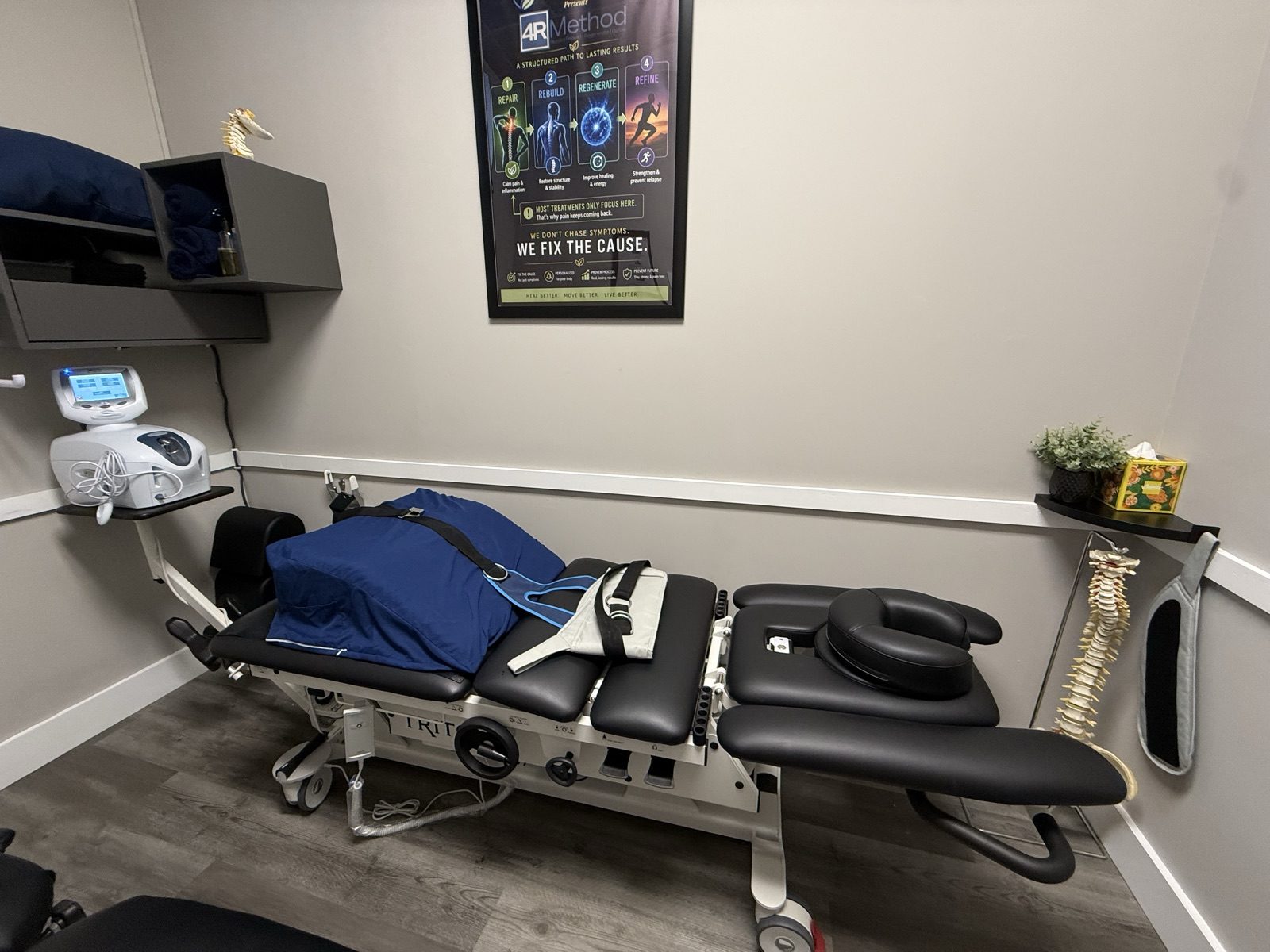
You cannot stretch a nerve out from under a disc, and medication only quiets the signal. A compressed nerve needs space. That principle shapes every phase of the 4R Method we use — Repair, Rebuild, Regenerate, Refine.
Repair — decompress the nerve
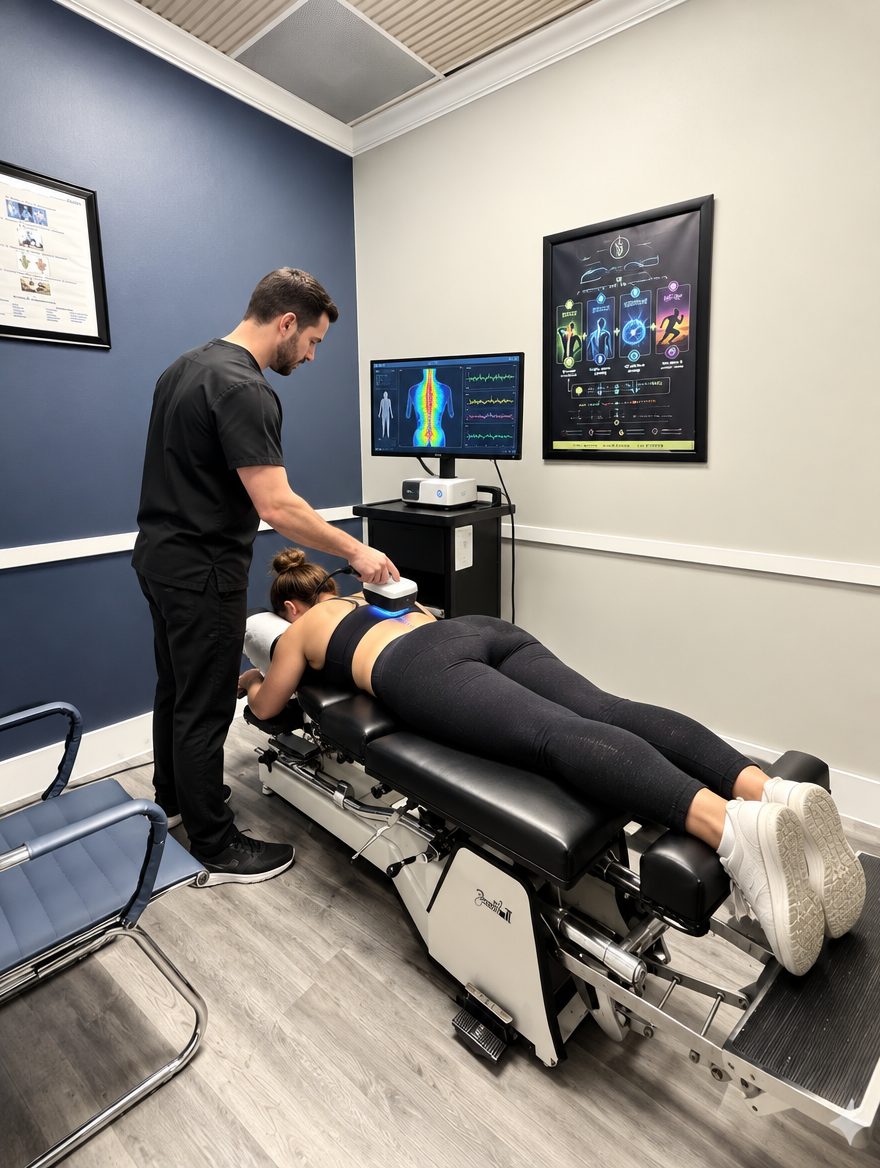
For disc and stenosis patterns, non-surgical spinal decompression on the Triton DTS table is the centerpiece: about 20 minutes of computer-controlled traction cycles that lower pressure inside the disc so herniated material can retract from the nerve. We pair it with precise adjustments at the involved level and cold laser or ultrasound for inflammation. Typically 3–5 visits a week for 4–8 weeks; nerve symptoms often begin to recede within the first two to three weeks.
Rebuild — fix the architecture
A nerve gets pinched because of posture, lost spinal curve, a rotated pelvis or weak stabilizers. Rebuild corrects those with corrective care, physical therapy and soft-tissue work, 2–3 visits a week for 8–16 weeks, so the opening the nerve passes through stays open.
Regenerate and Refine
Regenerate supports nerve and tissue recovery with red light, PEMF and IHHT, usually twice a week for two or more months. Refine is a brief monthly tune-up so the space you won stays won.
What happens at your first two visits?
A pinched nerve is a measurement problem before it is a treatment problem. Your first visit finds the level; your second visit explains the plan and begins care.
Visit one — we measure (and usually begin care)
- A real conversation. Where the pain travels, what makes it worse, how long it has been there, and what you need to get back to.
- A neurological screen. Reflexes, muscle strength and skin sensation along each nerve’s territory, plus nerve-tension tests for the arm and leg.
- A hands-on structural exam. Posture, neck and lumbar range of motion, and orthopedic tests that isolate the level of compression.
- Surface EMG and thermal scanning. Painless scans along the spine that show where muscles are guarding and where temperature changes point to nerve irritation.
- Digital X-rays, when indicated. Disc spacing, foraminal narrowing, curvature and spurs. We review any MRI you already have.
Visit two — findings and plan
We walk you through your scans and images, name the nerve and the structure compressing it, and lay out the 4R plan: phase, frequency, duration. Treatment begins at this visit. For a head start, take the 60-second spine assessment before you leave Sunrise.
What helps a pinched nerve at home — and when to see a doctor instead
What you do in the hours you are not with us either protects the nerve or re-irritates it. For most Sunrise patients, these are the habits that matter:
- Change position before it hurts. Nerve symptoms build with sustained posture. Set a timer: every 30 minutes, stand, move, reset.
- Keep the screen at eye level. Hours of looking down loads the cervical discs and narrows the openings the neck nerves pass through.
- Skip the aggressive stretch. Yanking on an irritated nerve is one of the most common ways people make sciatica or arm tingling worse. Nerve glides, done correctly and at the right stage, are different — we will show you.
- Walk daily. Ten minutes, two or three times a day, keeps the spine moving and the discs nourished.
- Ice, then heat. Ice for the first two days of a flare, heat for stiffness after that.
Some symptoms mean the nerve is not a chiropractic problem today: weakness that is getting worse quickly, numbness in the saddle area, new bladder or bowel changes, or nerve pain after a significant fall or crash. In those cases please see a doctor or urgent care today. Otherwise you are in the right place — our guides to lower back pain relief and carpal tunnel treatment are good next reads.
Getting to our Coral Springs clinic from Sunrise
From Sawgrass Mills or Amerant Bank Arena, take the Sawgrass Expressway north and follow it as it curves east along the top of Coral Springs; exit at Coral Ridge Drive and head south. The clinic is on Coral Ridge Drive just south of the expressway, about 15 miles from the mall.
There is free parking at the door and no building to navigate — you walk straight into reception. For a same-day appointment, call (954) 341-2256 before you leave Sunrise, or book online.
| Monday | 9:00 am – 7:00 pm |
|---|---|
| Tuesday | 9:00 am – 7:00 pm |
| Wednesday | 3:00 pm – 7:00 pm |
| Thursday | 9:00 am – 7:00 pm |
| Friday | 9:00 am – 12:00 pm |
| Saturday – Sunday | Closed |
The Spine and Wellness Center
5675 Coral Ridge Drive, Coral Springs, FL 33076
Phone: (954) 341-2256
Get directions from Sunrise on Google Maps
What patients say
We do not have a published review from a Sunrise patient yet, so here is one from a Coral Springs patient — the same clinic and the same team you would see:
“Some of the warmest and most caring staff in the business. Dr. Cohen, without a doubt, is passionate about his craft and the community he serves.”
Related care for Sunrise residents
Start with the full guide to pinched nerve treatment, then explore the other care we provide for Sunrise patients.
Herniated discs — the full guide
The most common reason a spinal nerve gets pinched, and how decompression gives the disc room to retract.
Learn moreNeck pain relief — the full guide
When the pinched nerve is in the neck: arm pain, hand tingling and the cervical disc behind it.
Learn moreChiropractic care for Sunrise
Your Sunrise hub: everything we treat, directions, hours and what to expect on your first visit.
Learn moreHerniated disc treatment in Sunrise
Herniated disc treatment for Sunrise patients, from our Coral Springs clinic.
Learn moreNeck pain treatment in Sunrise
Neck pain treatment for Sunrise patients, from our Coral Springs clinic.
Learn moreAll service areas
Every community we serve from Coral Springs, with drive times and the care available for each.
Learn moreServing pinched nerve patients from Sunrise across North Broward
Our clinic at 5675 Coral Ridge Drive, Coral Springs, FL 33076 serves Coral Springs, Parkland, Coconut Creek, Margate, Boca Raton, Tamarac, Pompano Beach and Deerfield Beach. Same-day appointments are usually available — call (954) 341-2256 or book online. Most patients from Parkland and Coral Springs are here in under 15 minutes.
Medically reviewed by Dr. Jared Cohen, DC — Co-Founder & Clinical Director, The Spine and Wellness Center. Last reviewed October 2026.
Frequently asked questions
How long does a pinched nerve take to get better?
Many patients notice tingling and radiating pain begin to recede within the first two to three weeks of the Repair phase. Full recovery depends on finishing the Rebuild phase, which corrects the posture, curve or pelvic imbalance that narrowed the nerve's opening. We re-scan along the way so progress is measured rather than guessed.
Is a pinched nerve the same as sciatica?
Sciatica is a pinched nerve in the lower back — usually at L4, L5 or S1 — that sends pain, tingling or numbness down the leg. 'Pinched nerve' is the broader term and also covers compressed nerves in the neck, which produce arm and hand symptoms, and peripheral entrapments such as carpal tunnel syndrome.
Should I stretch a pinched nerve?
Carefully, and usually not at first. Forcing a stretch on an irritated nerve root often increases tingling and pain. The nerve needs space, not tension, which is why decompression comes before stretching in our plans. Nerve-gliding movements, taught at the right stage, are different and do help.
Do you offer same-day appointments for Sunrise patients?
Usually, yes. Same-day appointments are often available at our Coral Springs clinic, about 20 minutes from Sunrise, so pinched nerve treatment in Sunrise can start the week you call. Your first visit is a measurement visit — exam, surface EMG and thermal scans, X-rays when indicated — and your plan and treatment begin on visit two, typically within a few days.
How far is the clinic from Sawgrass Mills?
From Sawgrass Mills, plan on about 20 minutes to 5675 Coral Ridge Drive, Coral Springs, FL 33076 — straight up the Sawgrass Expressway. The clinic is on Coral Ridge Drive just south of the Sawgrass Expressway, with free parking at the door.
Is there parking at the clinic?
Yes. Free parking is right outside the door at 5675 Coral Ridge Drive — no garage, no meters, no validation. Most Sunrise patients find it simpler than parking near the coast or at a medical tower, and you walk straight into reception.
Same-day appointments
Let's build your plan.
Find out what's actually going on and get a clear path forward. Same-day appointments available.
- Same-day appointments are usually available
- Our team calls you back to confirm your visit
- Coral Springs, serving Parkland & North Broward since 2005
Prefer to talk now? Call or text (954) 341-2256