
Treatment · Coral Springs & Parkland
Spinal Decompression in Fort Lauderdale, FL
The Spine and Wellness Center, Coral Springs: Triton DTS spinal decompression about 30 to 35 minutes from Fort Lauderdale via I-595 or I-95 to the Sawgrass Expressway or Florida's Turnpike. Measured first, treated second, same-day appointments usually available.
Quick answer
The closest clinic offering Triton DTS spinal decompression to Fort Lauderdale is The Spine and Wellness Center at 5675 Coral Ridge Drive, Coral Springs, about 30 to 35 minutes from Fort Lauderdale. The first visit is an exam with surface EMG, thermal scanning and X-rays when indicated; the second is your report of findings, where decompression — about 20 relaxed minutes per session — begins.
Why Fort Lauderdale patients choose us for spinal decompression
The Spine and Wellness Center has cared for Fort Lauderdale families since 2005. Here is why they keep choosing us for spinal decompression in Fort Lauderdale rather than a clinic down the street.
- Close enough to be routine. The clinic is about 30 to 35 minutes from Fort Lauderdale via I-595 or I-95 to the Sawgrass Expressway or Florida’s Turnpike. Free parking is at the door, and we schedule follow-ups around your commute so the drive stays a non-issue.
- Hours built for working people. Open until 7:00 pm three evenings a week (Monday, Tuesday, Thursday), plus Wednesday afternoons and Friday mornings.
- Care that fits Fort Lauderdale life. We regularly treat Fort Lauderdale desk commuters from downtown and Las Olas, boaters and beach regulars, families from Victoria Park and Coral Ridge, and anyone recovering from an I-95 collision. That experience shapes everything from the exam to the home-care plan.
What is spinal decompression and how does the Triton DTS table work?
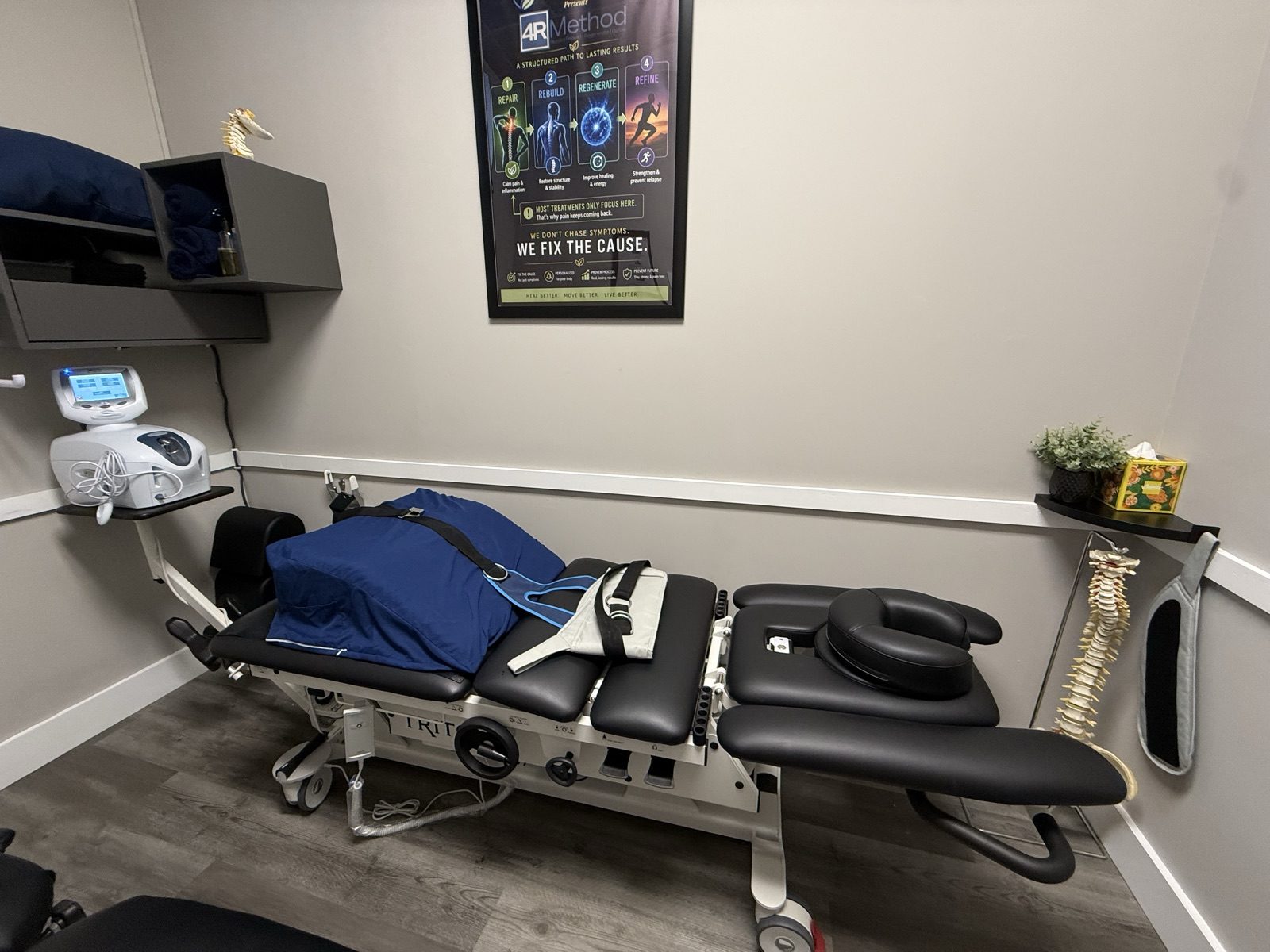
If you are weighing spinal decompression in Fort Lauderdale against an injection or a surgical consult, start with what the treatment actually does. On the Triton DTS table at our Coral Springs clinic, a computer applies a precisely controlled pull along the spine, holds it, then releases — in repeating cycles targeted to the disc that is causing trouble. The aim is to reduce the pressure inside that disc so a bulge can move away from the nerve.
That matters because disc pain is really nerve pain. A herniated or bulging disc at L4–L5 or L5–S1 presses on the root that runs down the leg; in the neck, a C5–C7 disc presses on the root that runs into the shoulder and arm. Pills quiet the signal for a few hours. Decompression works on the cause of the signal.
Patients from Las Olas Boulevard and Victoria Park often tell us they expected a clinic version of hanging from a bar. It is nothing like that. The table does the work, the computer keeps the force smooth, and most people describe the sessions as relaxing. For the engineering details and the research behind it, read our main spinal decompression therapy guide.

Who is spinal decompression in Fort Lauderdale for — and is it the same as traction?
Not every back needs a decompression table, and we say so on visit one. The exam sorts Fort Lauderdale patients into two groups: those whose pain is coming from a disc or a compressed nerve, and those whose pain is joint, muscle or sacroiliac — which responds better to adjustments, rehab and soft-tissue work. Decompression is for the first group.
- Disc herniation or bulge with pain that worsens sitting, bending or coughing — our herniated disc guide explains the pattern.
- Sciatica running from the buttock down one leg — see sciatica treatment.
- Neck disc with arm symptoms — tingling, numbness or weakness into the shoulder, arm or hand.
- Degenerative discs that have lost height, leaving the facet joints behind them overloaded.
- Pain that outlasted other care — medication, injections or stretching that helped for a while and then did not.
And the traction question: decompression and traction both pull on the spine, but traction pulls constantly and the muscles brace; the Triton DTS pulls in smooth, computer-monitored cycles that keep the muscles relaxed and direct the separation to one disc level. Same family, very different tool.
What does a 20-minute decompression session feel like?
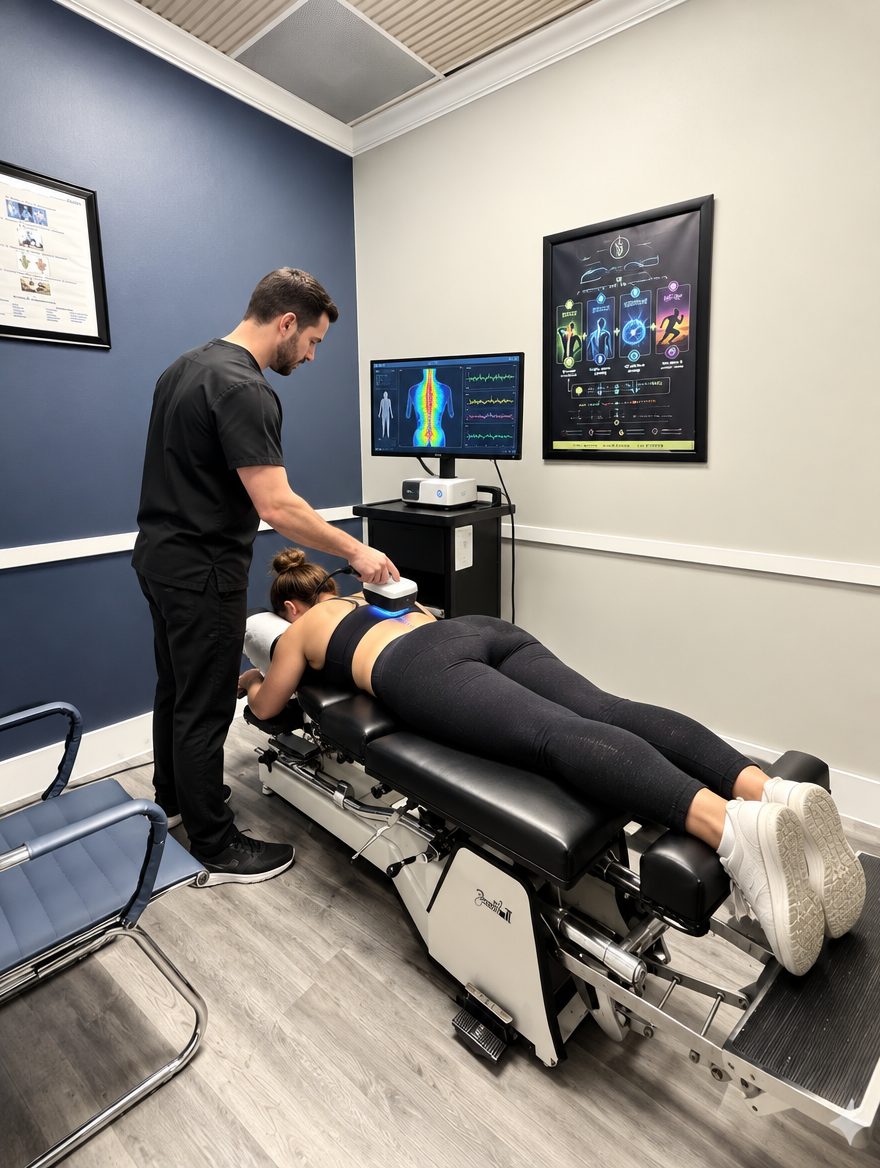
A session on the Triton DTS takes about 20 minutes, and most Fort Lauderdale patients find it relaxing enough to close their eyes. Here is the sequence:
- Harnessing. You lie on the table — face up for the lower back, with a padded cervical cradle for the neck. A pelvic harness and a chest harness hold you so the pull reaches the spine, not the legs.
- Programming. Dr. Cohen sets the angle of pull, the target force and the cycle pattern for your disc level. Force builds over the first sessions rather than starting at full strength.
- Cycles. The table pulls smoothly, holds for about a minute, then eases back for a rest period. This repeats for roughly 20 minutes while you breathe and relax.
- Support therapy. Most sessions are paired with a specific chiropractic adjustment, cold laser or PEMF in the same visit to calm inflammation.
Afterward, some people feel lighter immediately; others notice a mild, pleasant soreness like the day after a good stretch. We ask you to avoid heavy lifting and long sitting for the rest of the day — which, for Fort Lauderdale patients, usually means timing the drive home before the commute. That is what spinal decompression in Fort Lauderdale looks like, session by session.
Where does decompression sit in the 4R Method?
Decompression is a Repair-phase tool. That single sentence explains most of what makes our approach different from a clinic that sells decompression as a package: the table is the start of the plan, not the whole plan. The 4R Method — Repair, Rebuild, Regenerate, Refine — gives each phase a job, a frequency and a duration.
- Repair (3–5 visits a week, 4–8 weeks). Decompression at most visits to take pressure off the nerve, paired with a specific adjustment and cold laser or PEMF for inflammation. Re-scans at set points confirm the nerve is quieting.
- Rebuild (2–3 visits a week, 8–16 weeks). Decompression tapers. Corrective care and physical therapy retrain the deep core and hips so the disc is protected when you sit, lift and play.
- Regenerate (about 2 visits a week, 2+ months). Red light and PEMF support tissue recovery and energy.
- Refine (monthly). A short structural tune-up; patients with degenerative discs sometimes keep a brief decompression session in the routine.
For Fort Lauderdale residents, the practical consequence is a predictable schedule: a busy first month or two, then fewer visits as the structure takes over the job the table was doing.
What does the evidence say, who should not have it, and what happens at your first two visits?
The evidence base for decompression is encouraging and still developing, and we say so plainly. A retrospective cohort in BMC Musculoskeletal Disorders found that patients completing a non-surgical spinal decompression program showed restored disc height on imaging, associated with less discogenic low back pain (Apfel et al., 2010). The broader literature supports conservative-first care: the National Institute of Neurological Disorders and Stroke notes that most low back pain improves without surgery (NINDS, Back Pain).
Who should not have decompression
We screen for pregnancy, spinal fracture or significant osteoporosis, spinal tumor or infection, unstable spondylolisthesis, recent spinal surgery with hardware at the treated level, abdominal aortic aneurysm or a hernia a harness could aggravate, and severe neuropathy. Previous surgery without hardware, such as a microdiscectomy, is often fine once healed. If you have loss of bladder or bowel control, numbness in the groin, rapidly worsening weakness, or back pain with fever, please see a doctor or urgent care today before booking.
Visit one — we measure (and usually begin care); visit two — your full plan
Visit one for Fort Lauderdale patients is an evaluation, not a session on the table: a real conversation, a hands-on structural exam with nerve-tension and neurological tests, surface EMG and thermal scanning, and digital X-rays when indicated (we also review any MRI you bring). Visit two is your report of findings, where Dr. Jared Cohen, DC maps your decompression program to the 4R phases and Most patients have already begun care on visit one; this is where the full plan takes over. That is how spinal decompression in Fort Lauderdale starts — with data. Take the 60-second spine assessment before you drive in.
Getting to our Coral Springs clinic from Fort Lauderdale
From Las Olas Boulevard, take I-595 west to the Sawgrass Expressway, follow it north and east along Coral Springs, exit at Coral Ridge Drive and head south. Or take Florida’s Turnpike north to the Sawgrass Expressway west and exit at Coral Ridge Drive. The clinic is just south of the expressway.
Free parking is right at the door — no garage, no meters. Same-day appointments are usually available: call (954) 341-2256 or book online, and we will find a slot that fits your Fort Lauderdale schedule.
| Monday | 9:00 am – 7:00 pm |
|---|---|
| Tuesday | 9:00 am – 7:00 pm |
| Wednesday | 3:00 pm – 7:00 pm |
| Thursday | 9:00 am – 7:00 pm |
| Friday | 9:00 am – 12:00 pm |
| Saturday – Sunday | Closed |
The Spine and Wellness Center
5675 Coral Ridge Drive, Coral Springs, FL 33076
Phone: (954) 341-2256
Get directions from Fort Lauderdale on Google Maps
What patients say
We do not have a published review from a Fort Lauderdale patient yet, so here is one from a Coral Springs patient — the same clinic and the same team you would see:
“Some of the warmest and most caring staff in the business. Dr. Cohen, without a doubt, is passionate about his craft and the community he serves.”
Related care for Fort Lauderdale residents
Start with the full guide to spinal decompression, then explore the other care we provide for Fort Lauderdale patients.
Spinal decompression therapy — the full guide
How the Triton DTS works, who it helps, what the research says and where it sits in the 4R Method.
Learn moreChiropractic care for Fort Lauderdale
Your Fort Lauderdale hub: everything we treat, directions, hours and what to expect on your first visit.
Learn moreCold laser therapy in Fort Lauderdale
Cold laser therapy for Fort Lauderdale patients, from our Coral Springs clinic.
Learn moreIHHT oxygen therapy in Fort Lauderdale
IHHT oxygen therapy for Fort Lauderdale patients, from our Coral Springs clinic.
Learn moreAll service areas
Every community we serve from Coral Springs, with drive times and the care available for each.
Learn moreServing spinal decompression patients from Fort Lauderdale across North Broward
Our clinic at 5675 Coral Ridge Drive, Coral Springs, FL 33076 serves Coral Springs, Parkland, Coconut Creek, Margate, Boca Raton, Tamarac, Pompano Beach and Deerfield Beach. Same-day appointments are usually available — call (954) 341-2256 or book online. Most patients from Parkland and Coral Springs are here in under 15 minutes.
Medically reviewed by Dr. Jared Cohen, DC — Co-Founder & Clinical Director, The Spine and Wellness Center. Last reviewed October 2026.
Frequently asked questions
Is spinal decompression the same as an inversion table?
No. An inversion table hangs your whole body by the ankles with a constant, uncontrolled pull that the muscles resist. The Triton DTS targets one disc level, uses harnesses so the force reaches the spine, and cycles the pull up and down under computer control so the paraspinal muscles stay relaxed and the separation happens at the disc.
Does decompression work for neck disc problems too?
Yes. Cervical decompression uses a padded cradle rather than a pelvic harness, with the angle and force programmed for the C5–C7 levels that most often pinch a nerve into the shoulder, arm or hand. The session is shorter and gentler than lumbar decompression and is paired with a specific adjustment and cold laser for the inflamed tissue.
Do I need an MRI before starting decompression?
Not necessarily. Bring any imaging you already have and we will review it, but your first visit includes a hands-on exam with nerve-tension and neurological testing, surface EMG and thermal scanning, and digital X-rays when indicated. If the picture is unclear or there are red flags, we will refer you for an MRI before prescribing decompression.
Do you offer same-day appointments for Fort Lauderdale patients?
Usually, yes. Same-day appointments are often available at our Coral Springs clinic, about 30 to 35 minutes from Fort Lauderdale, so spinal decompression in Fort Lauderdale can start the week you call. Your first visit is a measurement visit — exam, surface EMG and thermal scans, X-rays when indicated — and your plan and treatment begin on visit two, typically within a few days.
How far is the clinic from Las Olas Boulevard?
From Las Olas Boulevard, plan on about 30 to 35 minutes to 5675 Coral Ridge Drive, Coral Springs, FL 33076 — via I-595 or I-95 to the Sawgrass Expressway or Florida's Turnpike. The clinic is on Coral Ridge Drive just south of the Sawgrass Expressway, with free parking at the door.
Is there parking at the clinic?
Yes. Free parking is right outside the door at 5675 Coral Ridge Drive — no garage, no meters, no validation. Most Fort Lauderdale patients find it simpler than parking near the coast or at a medical tower, and you walk straight into reception.
Same-day appointments
Let's fix the cause.
Measure first, then treat — a plan built on your actual structure.
- Same-day appointments are usually available
- Our team calls you back to confirm your visit
- Coral Springs, serving Parkland & North Broward since 2005
Prefer to talk now? Call or text (954) 341-2256