
Treatment · Coral Springs & Parkland
Spinal Decompression in Pembroke Pines, FL
The Spine and Wellness Center, Coral Springs: Triton DTS spinal decompression about 35 to 40 minutes from Pembroke Pines via I-75 or Florida's Turnpike to the Sawgrass Expressway. Measured first, treated second, same-day appointments usually available.
Quick answer
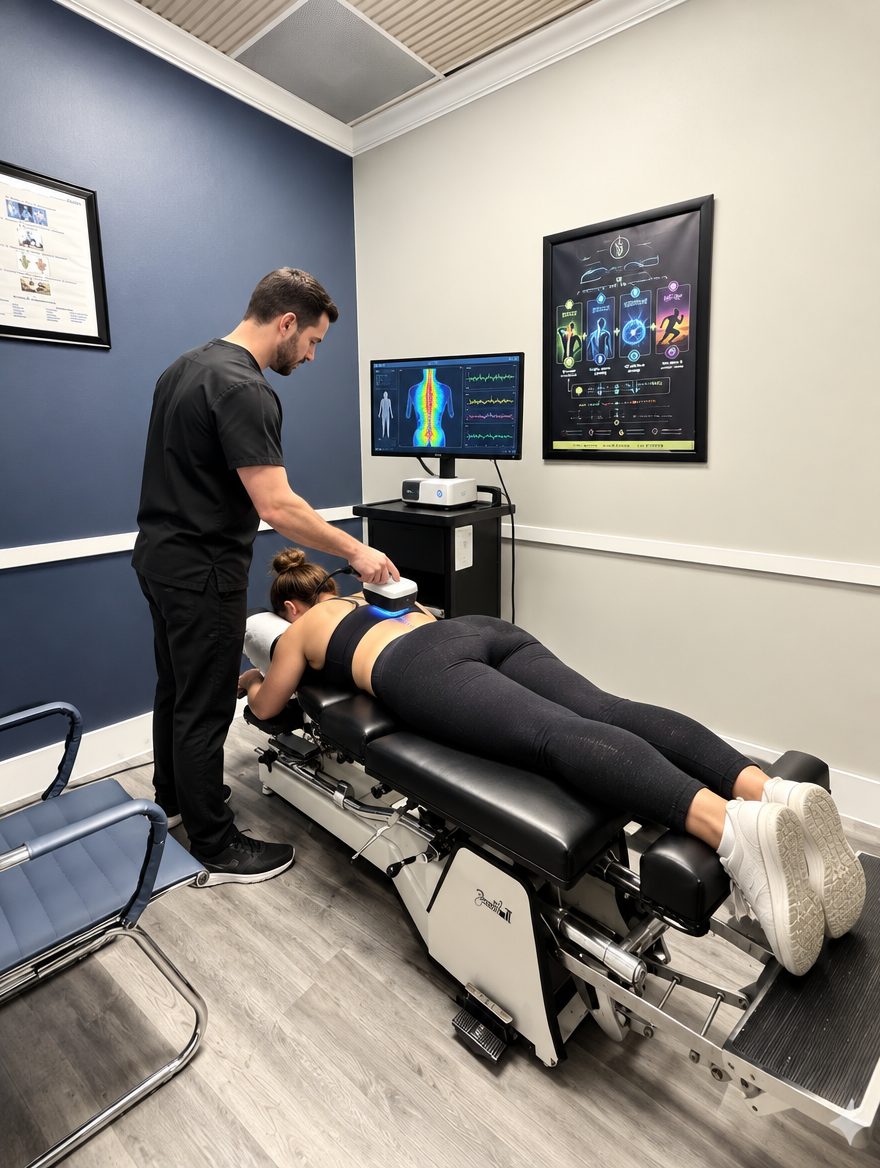
Spinal decompression near Pembroke Pines is available at The Spine and Wellness Center, 5675 Coral Ridge Drive, Coral Springs — about 35 to 40 minutes from Pembroke Pines. Your first visit is a measurement visit: hands-on exam, surface EMG and thermal scans, and X-rays when indicated. Decompression on the Triton DTS table is set at visit two (initial care often starts on visit one), after your report of findings confirms a disc or nerve pattern.
Why Pembroke Pines patients choose us for spinal decompression
When someone from Pembroke Pines calls about spinal decompression in Pembroke Pines, three things usually settle the decision to come to Coral Springs instead of somewhere closer.
- The drive is easier than it sounds. It is about 35 to 40 minutes via I-75 or Florida’s Turnpike to the Sawgrass Expressway, and parking is free, right outside the door. We see patients from C.B. Smith Park, Pembroke Lakes Mall and Chapel Trail every week.
- Evening and early slots. Monday, Tuesday and Thursday run until 7:00 pm; Wednesday afternoons and Friday mornings round out the week. Most Pembroke Pines patients can fit visits around work and school runs.
- We understand who lives in Pembroke Pines. Our typical Pembroke Pines patients are Pembroke Pines families and youth athletes from Silver Lakes and Chapel Trail, tennis players and runners from C.B. Smith Park, and I-75 commuters — and the plan reflects those loads, not a template.
What is spinal decompression and how does the Triton DTS table work?
Searching for spinal decompression in Pembroke Pines usually starts with a word nobody wants to hear: herniation. A disc has bulged, an MRI or an exam says a nerve is involved, and the options on the table seem to be medication, an injection or surgery. Non-surgical decompression on the Triton DTS table is the fourth option — and at our Coral Springs clinic, about 35 to 40 minutes from Pembroke Pines, it is usually the first one we reach for.
The principle is simple. Pressure inside an injured disc pushes the bulge outward against the nerve. Decompression reverses that pressure for a few minutes at a time: the table draws the vertebrae apart in controlled cycles, which is intended to pull the bulge inward and let fluid and nutrients back into the disc. Repeated over a program of sessions, the nerve gets room and the disc gets a chance to heal.
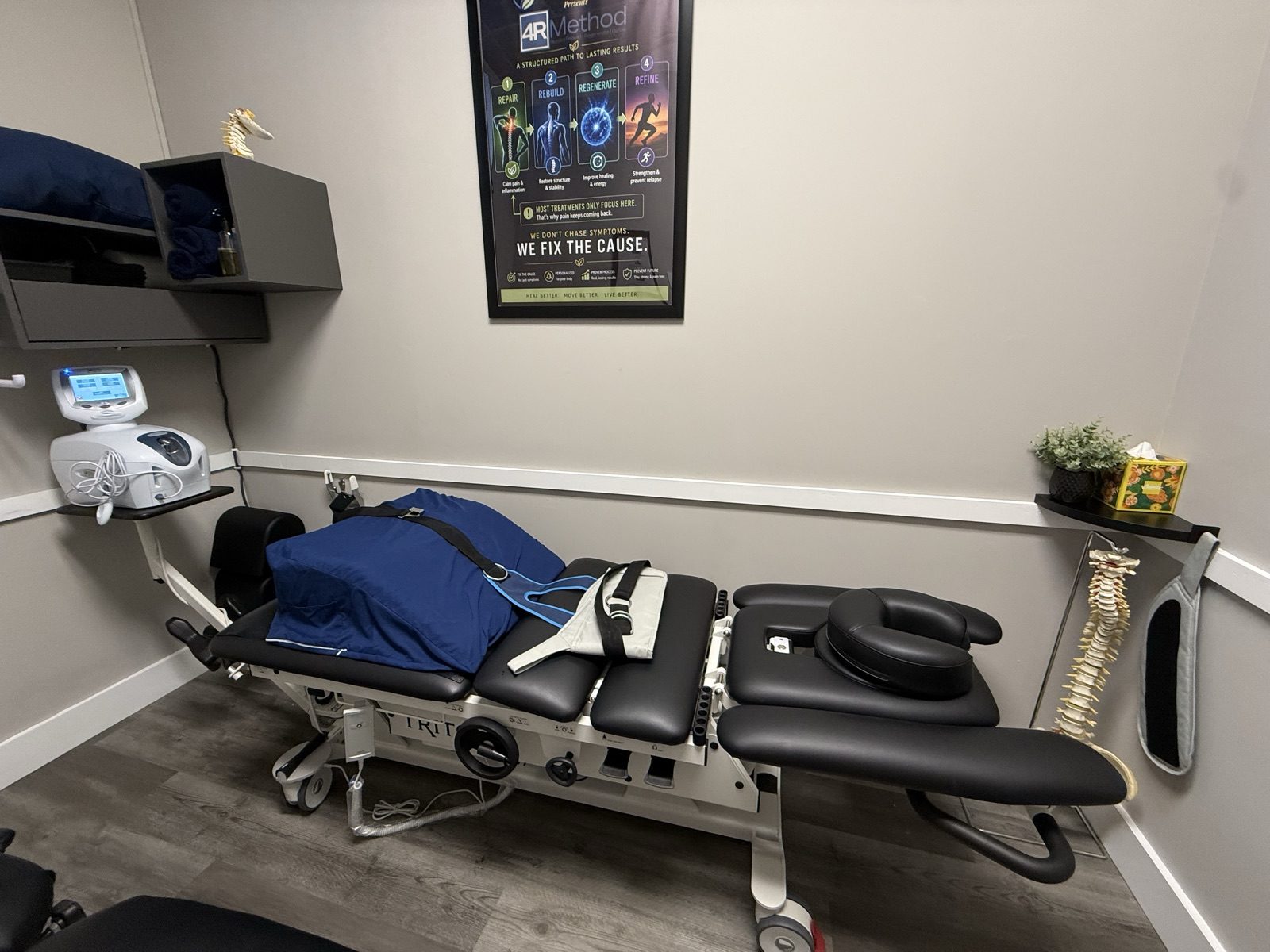
What makes the Triton DTS different from traction is the computer. It senses when the muscles along your spine start to guard and softens the pull before they tighten — so you stay relaxed and the force reaches the disc instead of the muscles. Read our main spinal decompression therapy page for the research; keep reading here for how it works for Pembroke Pines residents.

Who is spinal decompression in Pembroke Pines for — and is it the same as traction?
The strongest signal that decompression is the right tool is a symptom that travels. Leg pain, foot tingling, arm numbness, a weak grip — these mean a nerve is being compressed, and nerve compression responds to taking pressure off far better than to more stretching or stronger medication.
Among Pembroke Pines patients, the typical candidates are a herniated or bulging lumbar disc (see our herniated disc page), sciatica from L4–L5 or L5–S1, a cervical disc pinching a nerve into the arm, degenerative disc disease from decades of desk and windshield time, and the frustrating group who already tried injections and are looking for something that addresses the disc itself.
People often ask whether this is just traction with a nicer name. It is not. Traction pulls steadily; the paraspinal muscles sense that and tighten, so much of the force never reaches the disc. The Triton DTS ramps force up and down in programmed cycles and adjusts to your resistance, keeping the muscles quiet and the separation at the disc. That difference is why patients from C.B. Smith Park describe sessions as relaxing rather than uncomfortable.
What does a 20-minute decompression session feel like?
A session on the Triton DTS takes about 20 minutes, and most Pembroke Pines patients find it relaxing enough to close their eyes. Here is the sequence:
- Harnessing. You lie on the table — face up for the lower back, with a padded cervical cradle for the neck. A pelvic harness and a chest harness hold you so the pull reaches the spine, not the legs.
- Programming. Dr. Cohen sets the angle of pull, the target force and the cycle pattern for your disc level. Force builds over the first sessions rather than starting at full strength.
- Cycles. The table pulls smoothly, holds for about a minute, then eases back for a rest period. This repeats for roughly 20 minutes while you breathe and relax.
- Support therapy. Most sessions are paired with a specific chiropractic adjustment, cold laser or PEMF in the same visit to calm inflammation.
Afterward, some people feel lighter immediately; others notice a mild, pleasant soreness like the day after a good stretch. We ask you to avoid heavy lifting and long sitting for the rest of the day — which, for Pembroke Pines patients, usually means timing the drive home before the commute. That is what spinal decompression in Pembroke Pines looks like, session by session.
Where does decompression sit in the 4R Method?
Patients from Pembroke Pines sometimes arrive having been quoted a fixed number of decompression sessions somewhere else. We do it differently. The 4R Method — Repair, Rebuild, Regenerate, Refine — places decompression in Repair, and the number of sessions follows the re-scans, not a package.
Phase 1 · Repair
Three to five visits a week for four to eight weeks, with the Triton DTS at the center of each visit and a specific adjustment, cold laser or PEMF alongside it. The goal is measurable: surface EMG and thermal re-scans that show the nerve irritation settling, matched by less leg or arm pain in your day.
Phase 2 · Rebuild
Two to three visits a week for eight to sixteen weeks. Decompression tapers as physical therapy, corrective chiropractic protocols and Graston soft-tissue work rebuild the core, hips and curves that let the disc get hurt in the first place. This is the phase that keeps youth sports in Silver Lakes and Chapel Trail from undoing the Repair work.
Phases 3 and 4 · Regenerate and Refine
Red light and PEMF about twice a week for two or more months, then a monthly tune-up. Some degenerative-disc patients keep an occasional decompression session in Refine as insurance against flare-ups.
What does the evidence say, who should not have it, and what happens at your first two visits?
The evidence base for decompression is encouraging and still developing, and we say so plainly. A retrospective cohort in BMC Musculoskeletal Disorders found that patients completing a non-surgical spinal decompression program showed restored disc height on imaging, associated with less discogenic low back pain (Apfel et al., 2010). The broader literature supports conservative-first care: the National Institute of Neurological Disorders and Stroke notes that most low back pain improves without surgery (NINDS, Back Pain).
Who should not have decompression
We screen for pregnancy, spinal fracture or significant osteoporosis, spinal tumor or infection, unstable spondylolisthesis, recent spinal surgery with hardware at the treated level, abdominal aortic aneurysm or a hernia a harness could aggravate, and severe neuropathy. Previous surgery without hardware, such as a microdiscectomy, is often fine once healed. If you have loss of bladder or bowel control, numbness in the groin, rapidly worsening weakness, or back pain with fever, please see a doctor or urgent care today before booking.
Visit one — we measure (and usually begin care); visit two — your full plan
Visit one for Pembroke Pines patients is an evaluation, not a session on the table: a real conversation, a hands-on structural exam with nerve-tension and neurological tests, surface EMG and thermal scanning, and digital X-rays when indicated (we also review any MRI you bring). Visit two is your report of findings, where Dr. Jared Cohen, DC maps your decompression program to the 4R phases and Most patients have already begun care on visit one; this is where the full plan takes over. That is how spinal decompression in Pembroke Pines starts — with data. Take the 60-second spine assessment before you drive in.
Getting to our Coral Springs clinic from Pembroke Pines
From C.B. Smith Park at Flamingo Road and Pines Boulevard, take Pines Boulevard west to I-75 north, continue to the Sawgrass Expressway, follow it north and east along Coral Springs, exit at Coral Ridge Drive and head south.
Free parking is right at the door — no garage, no meters. Same-day appointments are usually available: call (954) 341-2256 or book online, and we will find a slot that fits your Pembroke Pines schedule.
| Monday | 9:00 am – 7:00 pm |
|---|---|
| Tuesday | 9:00 am – 7:00 pm |
| Wednesday | 3:00 pm – 7:00 pm |
| Thursday | 9:00 am – 7:00 pm |
| Friday | 9:00 am – 12:00 pm |
| Saturday – Sunday | Closed |
The Spine and Wellness Center
5675 Coral Ridge Drive, Coral Springs, FL 33076
Phone: (954) 341-2256
Get directions from Pembroke Pines on Google Maps
What patients say
We do not have a published review from a Pembroke Pines patient yet, so here is one from a Coral Springs patient — the same clinic and the same team you would see:
“I was dealing with ongoing elbow and shoulder pain affecting my daily routine and workouts. The treatment plan felt personalized — over the months I’ve noticed steady progress: less pain, better mobility, feeling stronger.”
Related care for Pembroke Pines residents
Start with the full guide to spinal decompression, then explore the other care we provide for Pembroke Pines patients.
Spinal decompression therapy — the full guide
How the Triton DTS works, who it helps, what the research says and where it sits in the 4R Method.
Learn moreChiropractic care for Pembroke Pines
Your Pembroke Pines hub: everything we treat, directions, hours and what to expect on your first visit.
Learn moreRed light therapy in Pembroke Pines
Red light therapy for Pembroke Pines patients, from our Coral Springs clinic.
Learn moreCold laser therapy in Pembroke Pines
Cold laser therapy for Pembroke Pines patients, from our Coral Springs clinic.
Learn moreAll service areas
Every community we serve from Coral Springs, with drive times and the care available for each.
Learn moreServing spinal decompression patients from Pembroke Pines across North Broward
Our clinic at 5675 Coral Ridge Drive, Coral Springs, FL 33076 serves Coral Springs, Parkland, Coconut Creek, Margate, Boca Raton, Tamarac, Pompano Beach and Deerfield Beach. Same-day appointments are usually available — call (954) 341-2256 or book online. Most patients from Parkland and Coral Springs are here in under 15 minutes.
Medically reviewed by Dr. Jared Cohen, DC — Co-Founder & Clinical Director, The Spine and Wellness Center. Last reviewed October 2026.
Frequently asked questions
Do I need an MRI before starting decompression?
Not necessarily. Bring any imaging you already have and we will review it, but your first visit includes a hands-on exam with nerve-tension and neurological testing, surface EMG and thermal scanning, and digital X-rays when indicated. If the picture is unclear or there are red flags, we will refer you for an MRI before prescribing decompression.
What should I do after a decompression session?
Keep it easy for the rest of the day: avoid heavy lifting, prolonged sitting and aggressive stretching so the disc keeps the space it gained. Short walks are fine and encouraged. Drink water, use ice over the area if it feels sore, and follow the home-care guidance in your plan. Report any new numbness, tingling or weakness promptly.
Does spinal decompression hurt?
No. Most patients describe a slow, gentle lengthening along the spine and find the session relaxing — many close their eyes or read. The computer adjusts the force to your muscle resistance so there is no jerking or bracing. Mild, pleasant soreness the next day is common early on and settles as the program continues.
Do you offer same-day appointments for Pembroke Pines patients?
Usually, yes. Same-day appointments are often available at our Coral Springs clinic, about 35 to 40 minutes from Pembroke Pines, so spinal decompression in Pembroke Pines can start the week you call. Your first visit is a measurement visit — exam, surface EMG and thermal scans, X-rays when indicated — and your plan and treatment begin on visit two, typically within a few days.
Do you take patients from Pembroke Pines?
Yes. We have treated Pembroke Pines patients since 2005, including families from C.B. Smith Park, Pembroke Lakes Mall and Chapel Trail. Our clinic at 5675 Coral Ridge Drive in Coral Springs is about 35 to 40 minutes from Pembroke Pines via I-75 or Florida's Turnpike to the Sawgrass Expressway, and the 33024, 33025, 33026, 33027, 33028 and 33029 ZIP codes are all inside our normal service area.
How far is the clinic from C.B. Smith Park?
From C.B. Smith Park, plan on about 35 to 40 minutes to 5675 Coral Ridge Drive, Coral Springs, FL 33076 — via I-75 or Florida's Turnpike to the Sawgrass Expressway. The clinic is on Coral Ridge Drive just south of the Sawgrass Expressway, with free parking at the door.
Same-day appointments
Let's fix the cause.
Measure first, then treat — a plan built on your actual structure.
- Same-day appointments are usually available
- Our team calls you back to confirm your visit
- Coral Springs, serving Parkland & North Broward since 2005
Prefer to talk now? Call or text (954) 341-2256