
Core care · Coral Springs & Parkland
Spinal traction therapy in Coral Springs
A gentle, steady stretch of the spine for stiff, irritated necks and backs — often the first step before decompression, and sometimes all a mild case needs.
Quick answer
Spinal traction therapy applies a gentle, sustained pull along the spine to open the space between vertebrae, ease pressure on irritated joints and nerves, and relax guarding muscles. It is simpler and lighter than computer-controlled decompression, which makes it the right starting point for very irritated or sensitive spines inside the Repair phase of the 4R Method.
What is spinal traction therapy?
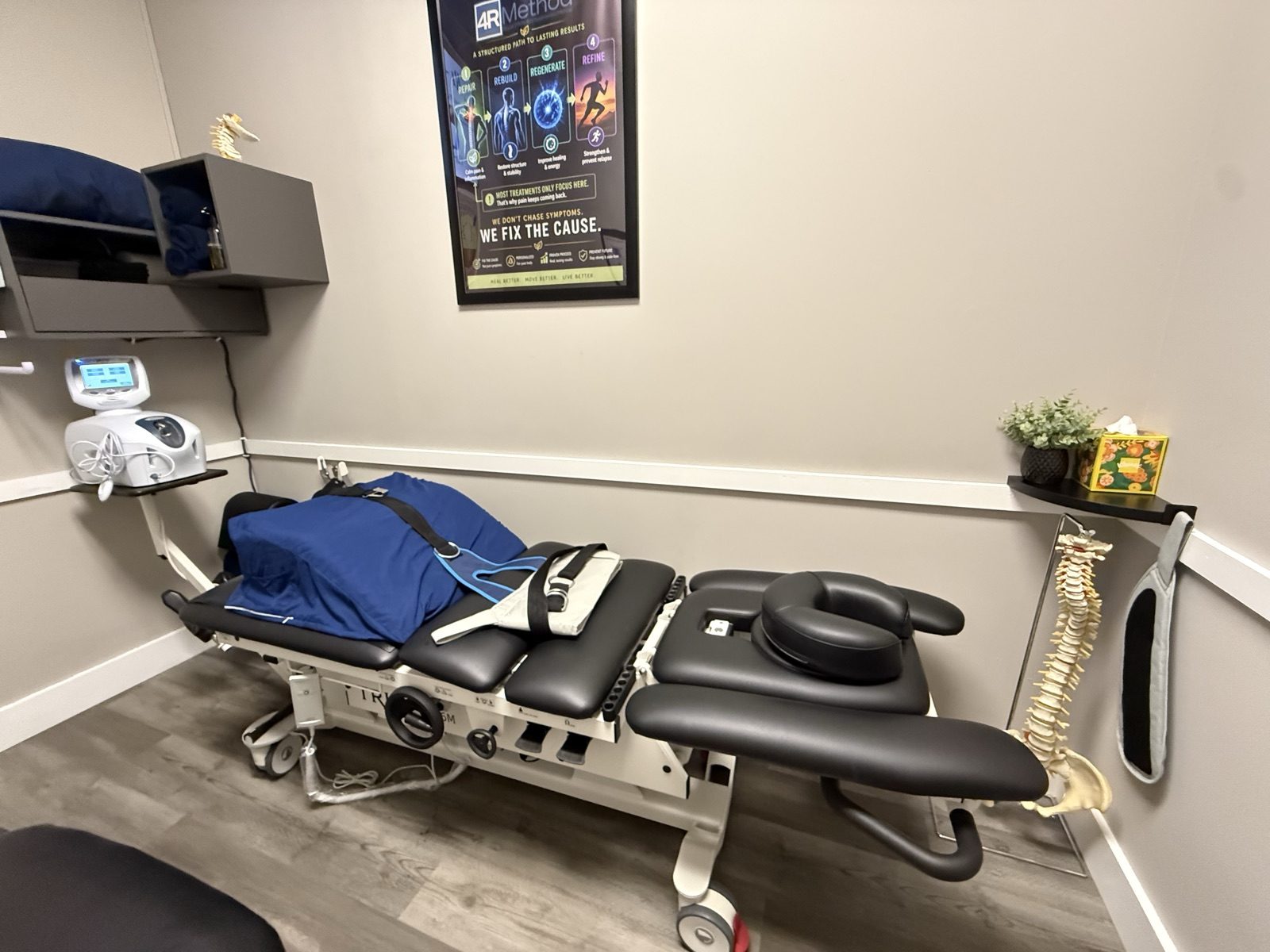
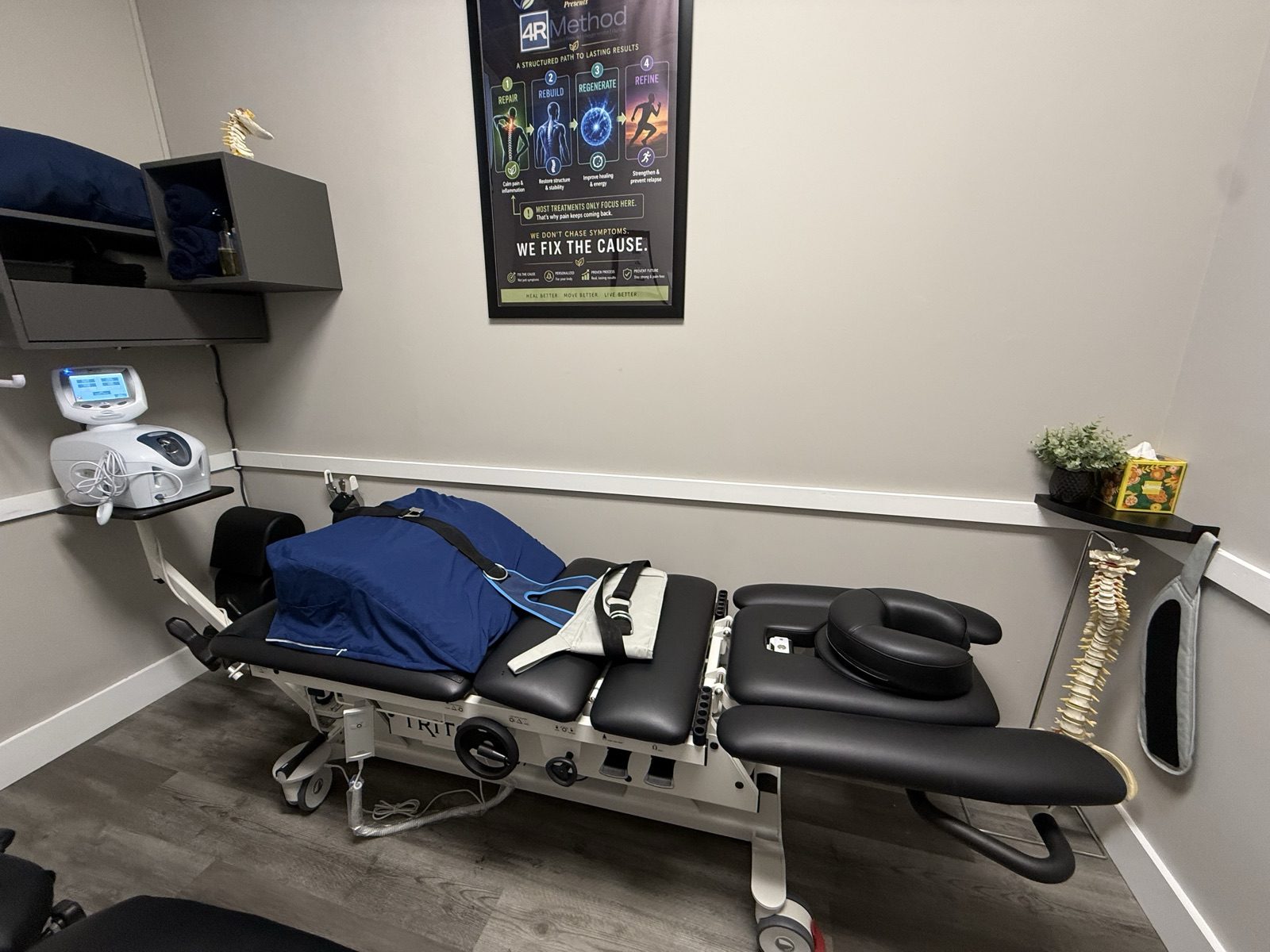
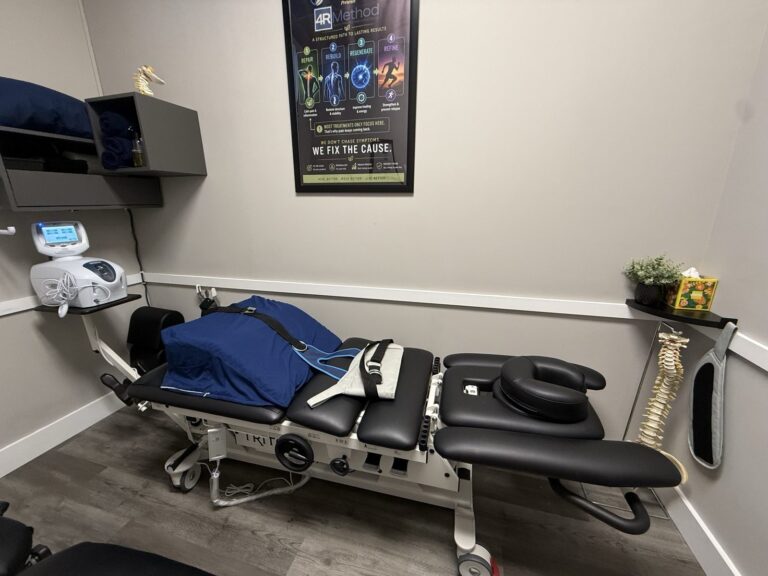
Spinal traction therapy is a gentle, sustained pull applied along the length of the spine to separate the vertebrae slightly and take pressure off the structures between them. At our Coral Springs clinic it is delivered mechanically — on the Triton DTS table in its traction mode, or with a cervical traction unit for the neck — with the force measured and controlled rather than estimated by hand.
The idea is simple. Every disc, facet joint and nerve root in your spine is loaded by gravity and by muscle tension all day. Traction briefly reverses that load. The joint spaces open, the nerve openings widen, blood flow to the disc improves, and the muscles that have been guarding the segment sense the stretch and begin to let go.
Traction has been used for spinal pain for over a century, from simple pulleys to modern motorized tables. What has changed is precision: today the angle, force and duration are set to your spine and your tolerance, and increased only as the spine proves it can handle more.

How is traction different from spinal decompression?
They are related but not the same, and we use them for different patients at different stages. The short version: traction is a steady pull; non-surgical spinal decompression is a computer-controlled cycle of pull and release designed to lower the pressure inside a disc.
- Force pattern. Traction applies a mostly constant or intermittent pull at a set force. Decompression ramps the force up and down in smooth, logarithmic cycles that keep the paraspinal muscles from bracing, which allows a deeper separation at the target level.
- Goal. Traction aims to open joint and nerve spaces and relax guarding. Decompression aims to create negative pressure inside a specific disc so a bulge can retract and the disc can rehydrate.
- Targeting. Traction stretches a region of the spine. Decompression is angled to a specific disc level — L4–L5, L5–S1, C5–C6.
- Intensity. Traction uses lighter forces and shorter holds, which is why it tolerates an acutely irritated spine better.
- Best for. Traction: stiffness, facet irritation, mild nerve irritation, degenerative discs, and sensitive spines. Decompression: true disc herniation with sciatica or arm symptoms.
In our clinic many disc patients begin with a few sessions of traction and graduate to decompression once the spine tolerates the pull. Others never need the step up — for a stiff, achy neck, traction may be all that is required.
Who starts with spinal traction therapy?
Traction is the right first tool when the spine is too irritated, too sensitive or too unsettled for a full decompression program — or when the problem is stiffness and joint irritation rather than a disc herniation. Typical starting cases in Coral Springs and Parkland:
- Neck pain with stiffness from desk and phone posture, with or without mild tingling into the shoulder.
- Acute lower back pain with heavy guarding, where a gentle stretch is tolerated and stronger forces are not yet.
- Facet joint irritation — the sharp, ‘can’t stand up straight’ pain that eases when the joints are gently opened.
- Degenerative disc disease in patients who want to maintain joint space and mobility without aggressive treatment.
- Mild disc bulges as a lead-in to decompression, or for patients who are anxious about a new treatment and want to start gently.
- Seniors and sensitive spines for whom a light, steady pull is more comfortable than a manual adjustment.
Traction is almost never the whole plan. It is paired with chiropractic adjustments, cold laser or massage therapy in the Repair phase, and gives way to rehab in Rebuild.
Honest about the evidence
A Cochrane review found that traction used alone, or added to physiotherapy, made little or no difference for low back pain compared with placebo or other treatments (Wegner et al., Cochrane Database of Systematic Reviews, 2013). That is exactly why we never use it in isolation — traction is a gentle on-ramp inside a structured plan, not a standalone fix.
What does a traction session feel like?
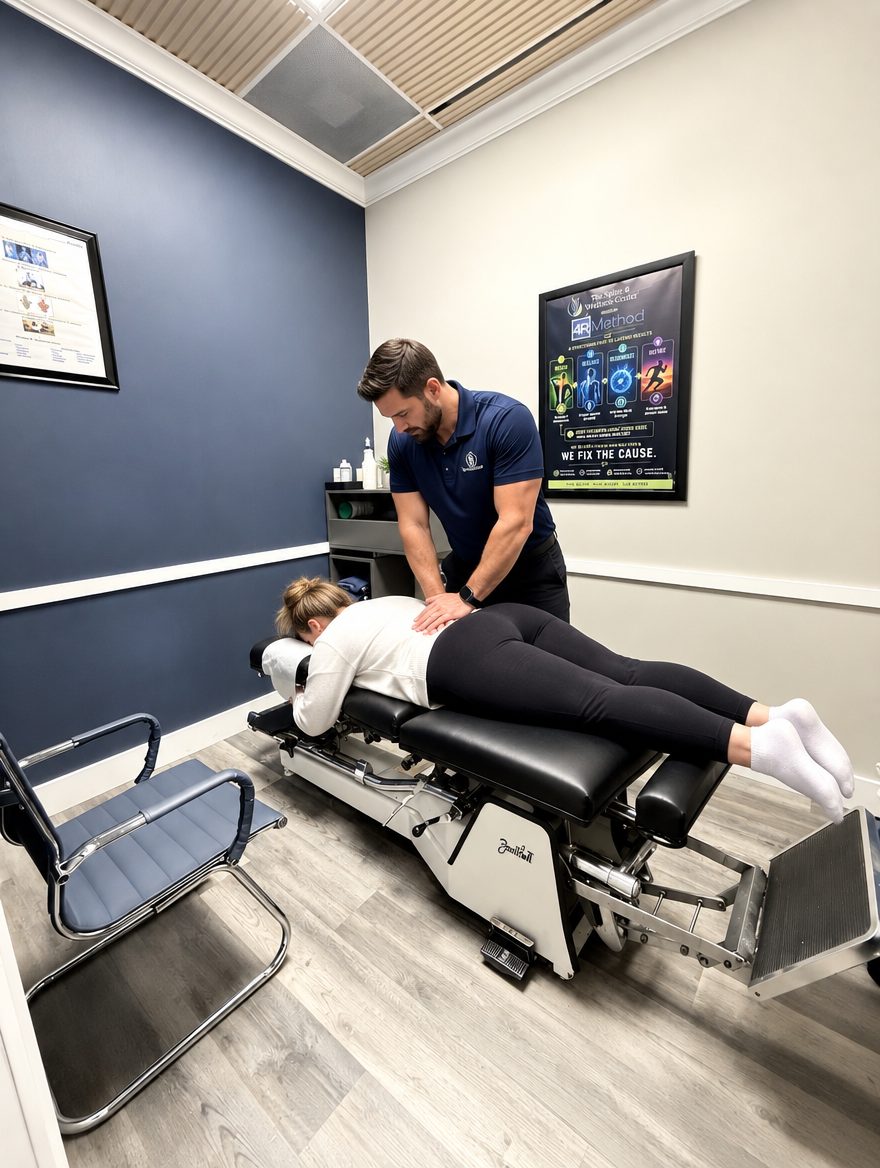
A traction session takes 10–15 minutes and feels like a slow, pleasant stretch. Most patients relax into it; some fall asleep. Here is how it goes:
- Positioning. For the lower back you lie on the Triton table with a pelvic harness and a chest harness. For the neck, a padded cradle supports the base of the skull — no chin strap, no hanging.
- Settings. The pull is set low on your first session — often a fraction of your body weight for the lumbar spine and a few pounds for the neck — and increased gradually across the program as your spine tolerates it.
- The pull. The table applies the force smoothly and holds it, either steadily or in gentle intermittent intervals. You feel lengthening through the spine and, often, the guarding muscles letting go within a few minutes.
- Release and support. The force eases off slowly. A session is usually followed by an adjustment, cold laser or PEMF, and we ask you to avoid heavy lifting for the rest of the day.
You should never feel sharp pain. If you do, the session stops and the settings are revisited — the force is always adjustable in real time.
Where does traction fit in the 4R Method?
Spinal traction therapy lives in the Repair phase of the 4R Method, where the goal is calming pain and inflammation before correction begins.
R1 · Repair (3–5 visits/week, 4–8 weeks)
Traction opens the irritated segment and relaxes guarding so adjustments can restore motion. For disc patients, traction typically runs for the first one to two weeks and then transitions into a decompression program once the paraspinals stop bracing against the pull. We re-scan with surface EMG to see that change objectively.
R2 through R4 · Rebuild, Regenerate, Refine
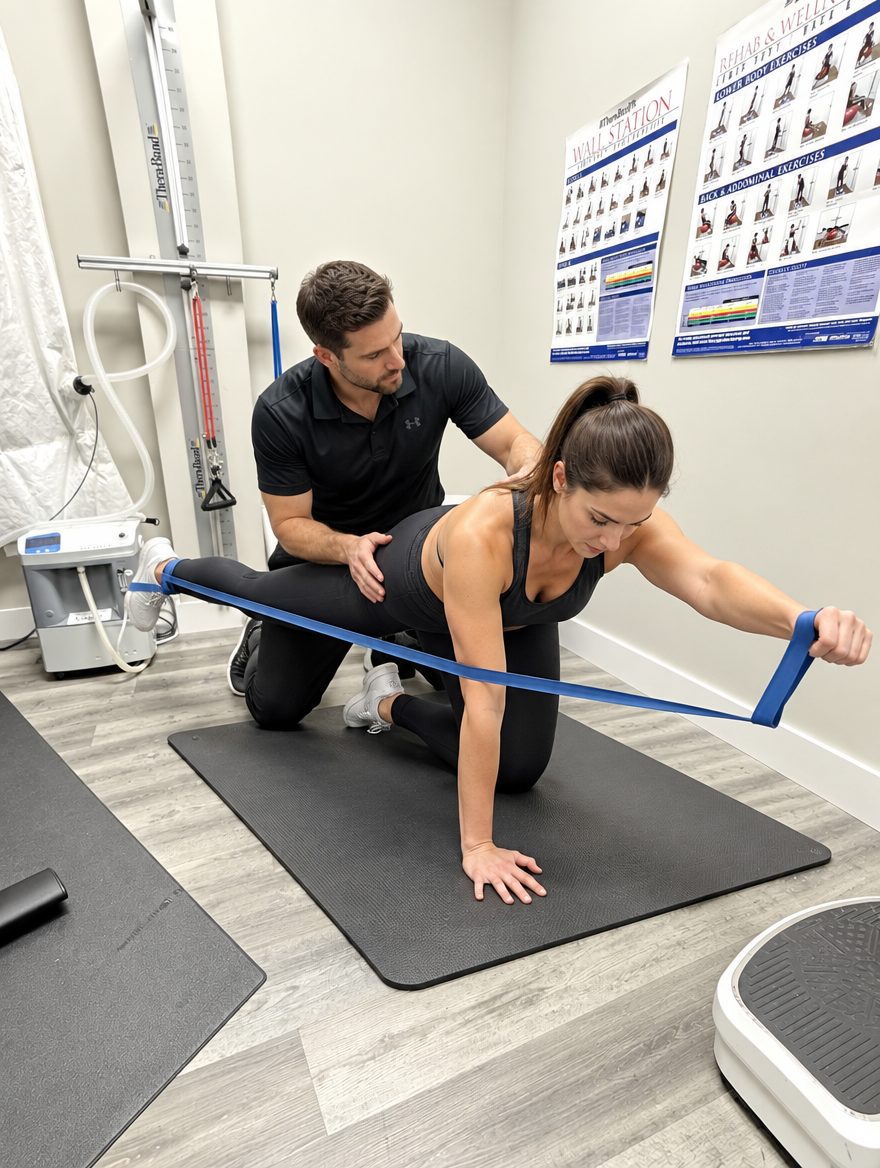
As the pain settles, traction tapers out and physical therapy takes over to stabilize what was opened. Some patients with degenerative discs keep a short cervical or lumbar traction session as part of their monthly Refine-phase tune-up to maintain joint space and mobility.
Is spinal traction safe, and what to expect at your first two visits
Traction is gentle and well tolerated, but it is only prescribed after an exam. Pregnancy, spinal fracture or significant osteoporosis, spinal instability, tumor or infection, recent spinal surgery with hardware, severe rheumatoid arthritis of the neck, and certain vascular conditions are reasons to use a different approach. If you have loss of bladder or bowel control, rapidly worsening weakness, or back pain with fever, please see a doctor or urgent care today.
Visit one — we measure (and usually begin care)
A conversation about your symptoms and goals; a hands-on structural exam with range of motion, orthopedic and neurological tests; surface EMG and thermal scanning to map guarding and nerve irritation; and digital X-rays when indicated, to confirm the spine is appropriate for traction.
Visit two — report of findings, and the full plan is set
Dr. Cohen explains the findings, whether traction, decompression or adjustments alone fit your pattern, and where you start in the 4R Method. Most patients have already begun care on visit one; this is where the full plan takes over. If you want a head start, the 60-second spine assessment gives us your Spine Score and likely pattern before you arrive.
Serving spinal traction patients across North Broward
Our clinic at 5675 Coral Ridge Drive, Coral Springs, FL 33076 serves Coral Springs, Parkland, Coconut Creek, Margate, Boca Raton, Tamarac, Pompano Beach and Deerfield Beach. Same-day appointments are usually available — call (954) 341-2256 or book online. Most patients from Parkland and Coral Springs are here in under 15 minutes.
Medically reviewed by Dr. Jared Cohen, DC — Co-Founder & Clinical Director, The Spine and Wellness Center. Last reviewed October 2026.
Frequently asked questions
Is spinal traction the same as decompression?
No. Traction is a steady, lighter pull that opens joint and nerve spaces and relaxes guarding. Decompression is a computer-controlled cycle of pull and release on the Triton DTS designed to lower pressure inside a specific disc. Many patients start with traction and move to decompression once the spine tolerates it.
Does spinal traction therapy hurt?
It should not. Sessions feel like a slow, pleasant stretch, and the force starts low and increases only as your spine tolerates it. You should never feel sharp pain; if you do, the session stops and the settings are revisited. Mild stretch-like soreness afterward is normal.
How many traction sessions will I need?
For most patients, traction runs during the first one to two weeks of the Repair phase and then either tapers out or transitions into decompression. Stiff-neck and degenerative-disc patients may keep a short session as part of monthly Refine-phase tune-ups. The number depends on how you respond, which we re-scan to confirm.
Can I do traction at home with a device?
Home cervical traction devices can help maintain gains for some patients, and we will tell you if one fits your case. They are not a substitute for a measured, supervised program — the forces are unmeasured and the angle is rarely right for the segment that needs it.
Is traction good for a pinched nerve in the neck?
Often, yes, for mild to moderate cases. Cervical traction widens the openings the nerve roots pass through and relaxes the muscles compressing them. For a confirmed disc herniation with arm weakness, decompression is usually the stronger tool, and the exam on your first visit tells us which fits.
Who should not have spinal traction?
People who are pregnant, have a spinal fracture or significant osteoporosis, spinal instability, a tumor or infection, hardware from recent spinal surgery at the treated level, or severe rheumatoid arthritis of the neck. Your exam and X-rays, when indicated, screen for all of these before Most patients have already begun care on visit one; this is where the full plan takes over.

Same-day appointments
Let's fix the cause.
Measure first, then treat — a plan built on your actual structure.
- Same-day appointments are usually available
- Our team calls you back to confirm your visit
- Coral Springs, serving Parkland & North Broward since 2005
Prefer to talk now? Call or text (954) 341-2256