Advanced therapies · Coral Springs & Parkland
Acoustic shockwave therapy in Coral Springs
High-energy acoustic pulses that wake up a tendon or fascia that stopped healing. For plantar fasciitis, Achilles and patellar tendinopathy, tennis elbow and stubborn trigger points — without injections or surgery.
Quick answer
Acoustic shockwave therapy (extracorporeal shockwave therapy, ESWT) delivers focused acoustic pulses into a painful tendon, fascia or muscle. The pulses stimulate new blood vessel growth, collagen production and the breakdown of calcific deposits, restarting healing in chronic injuries. Sessions take about 5–10 minutes, and most courses run three to six sessions a week apart.
What is acoustic shockwave therapy and how does it work?
Acoustic shockwave therapy is a non-invasive treatment that sends high-energy acoustic pulses through the skin into a painful tendon, ligament, fascia or muscle. In the medical literature it is called extracorporeal shockwave therapy (ESWT); ‘extracorporeal’ simply means the energy is generated outside the body. The same technology, at higher energy, has been used for decades to break up kidney stones.
In musculoskeletal care the goal is different: not to destroy tissue but to provoke a healing response in tissue that has gone quiet. A chronic tendon problem is usually not inflamed any more. It is degenerated — disorganized collagen, poor blood supply, and nerve endings that keep signaling pain. The pulses jolt that tissue back into an active repair state.
Three things the pulses do
- Neovascularization: the mechanical stress stimulates growth of new small blood vessels in the tendon, bringing oxygen and nutrients to tissue that was starved of them.
- Collagen synthesis: the cells that build tendon (tenocytes) are activated to lay down fresh, organized collagen in place of the degenerated tissue.
- Calcific deposit breakdown: in calcific tendinopathy of the shoulder and some heel spurs, repeated pulses fragment the calcium deposits so the body can resorb them.
There is also a direct effect on pain. The pulses over-stimulate the local nerve endings and change how pain signals are transmitted, which is why many people feel relief within the first one or two sessions, before the tissue itself has remodeled.

What conditions does shockwave therapy treat?
Shockwave therapy is best suited to chronic tendon and fascia problems that have lasted more than three months and have not responded to rest, stretching or hands-on care. The six conditions we treat with it most often in Coral Springs and Parkland are:
- Plantar fasciitis — stubborn heel and arch pain, especially the first steps in the morning. The American Academy of Orthopaedic Surgeons lists ESWT among the non-surgical options for plantar fasciitis that has not improved with conservative care (AAOS OrthoInfo).
- Achilles tendinopathy — thickened, painful tendon above the heel in runners and weekend athletes.
- Patellar tendinopathy (‘jumper’s knee’) — pain just below the kneecap in pickleball, basketball and volleyball players.
- Tennis elbow and golfer’s elbow — lateral and medial epicondylitis from racquet sports, golf and repetitive gripping.
- Calcific shoulder tendinopathy — rotator cuff pain with calcium deposits visible on X-ray.
- Myofascial trigger points — the tight, tender knots in the upper trapezius, glutes and calves that refer pain elsewhere and keep neck pain or lower back pain going.
It is also used for greater trochanteric pain syndrome (outer hip pain), shin splints and hamstring tendinopathy, and it has become a regular part of our sports injury rehab programs for athletes who need a tendon to recover on a timeline.
Good to know
The pulses treat the tendon or fascia itself. If the pain is coming from a joint that is not moving or a nerve that is being pinched, we address that with chiropractic care or spinal decompression first, so the tendon stops being overloaded.
What does a shockwave therapy session feel like?
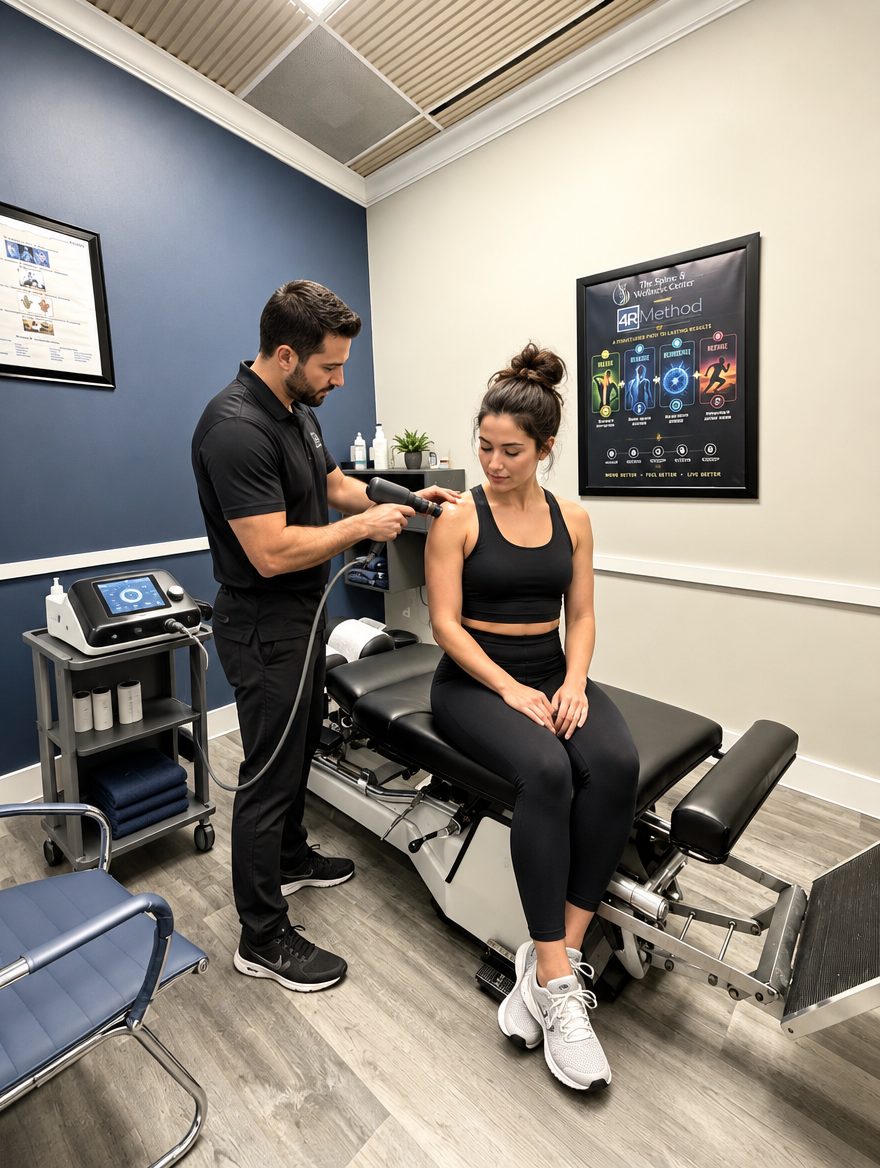
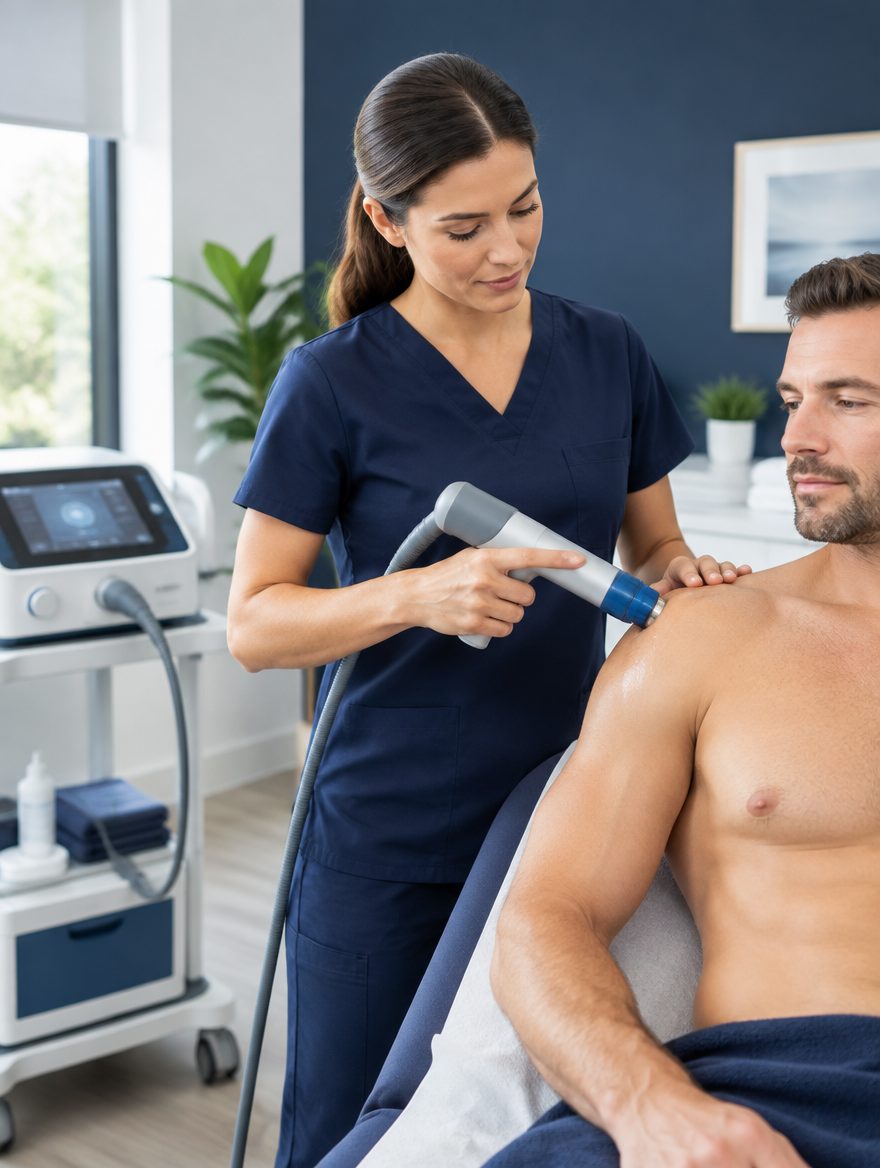
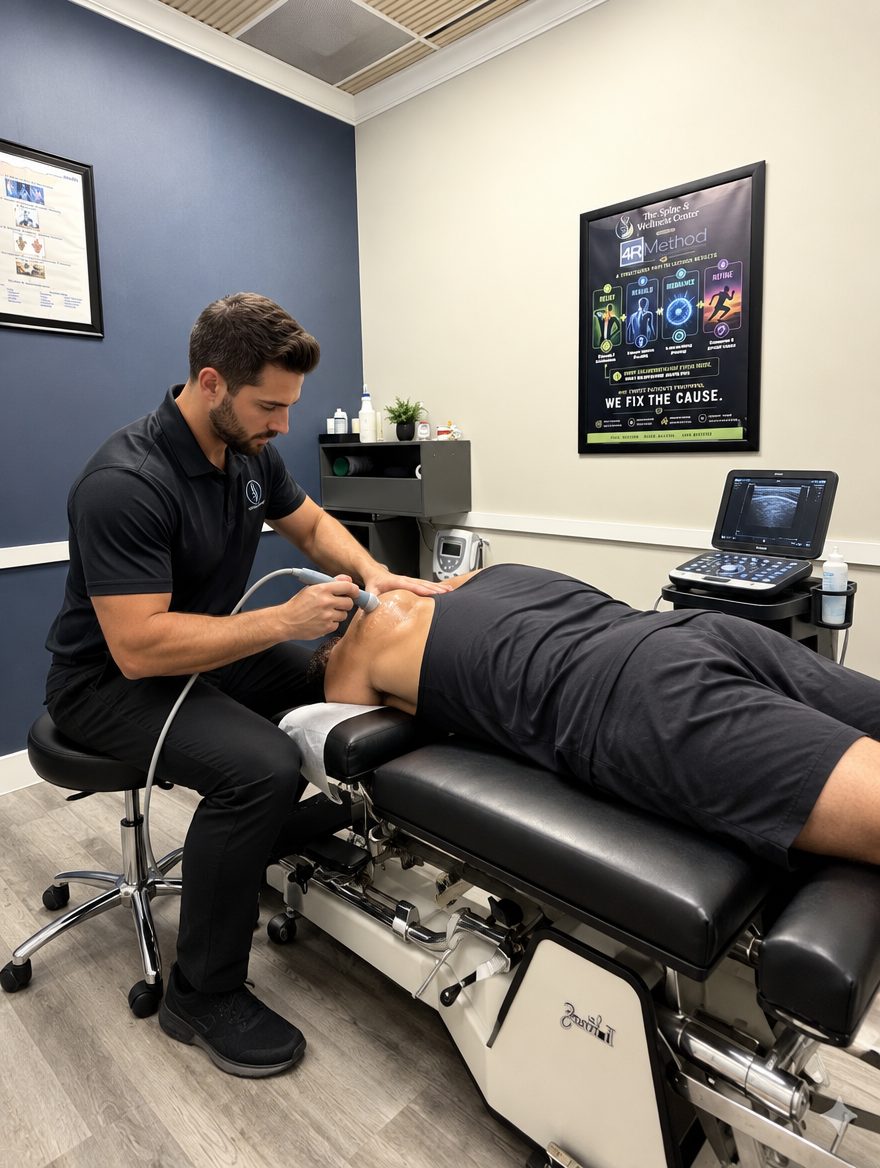
A shockwave therapy session is one of the quickest treatments we offer: the actual application takes about 5 to 10 minutes, and the whole visit, including the other care in your plan, usually runs 30 to 45 minutes.
- Locate the spot. The provider palpates to find the most tender point of the tendon or fascia and marks it.
- Apply gel. Ultrasound gel helps the acoustic energy pass into the tissue.
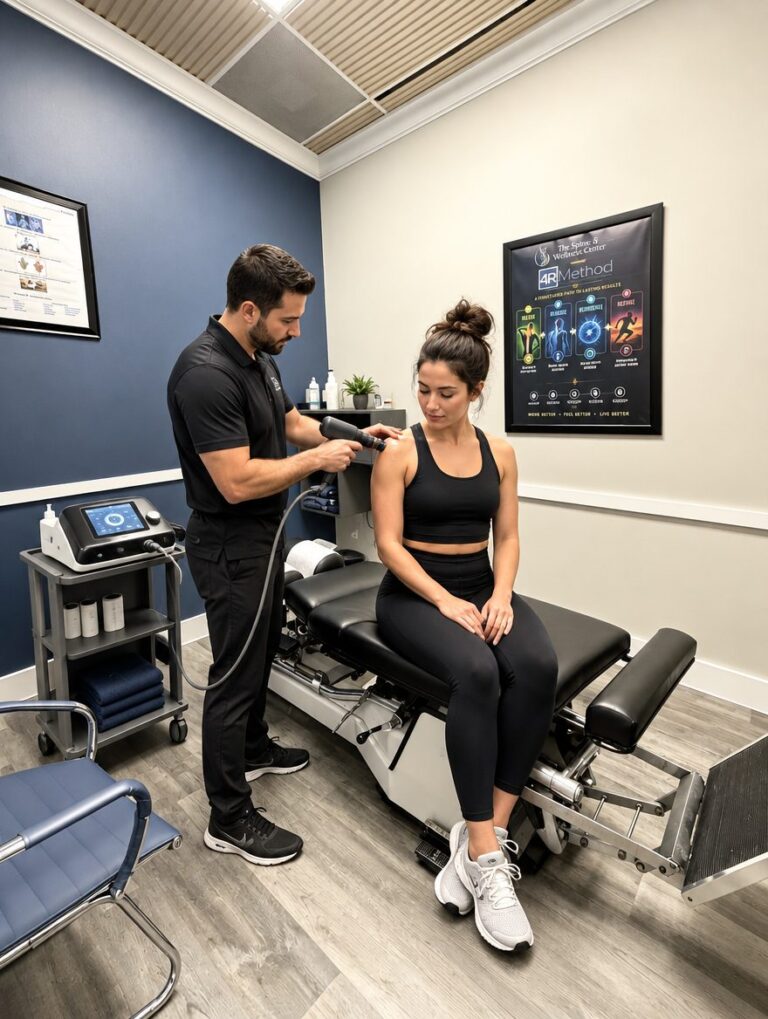
- Deliver the pulses. The applicator is held against the skin and delivers roughly 2,000 to 3,000 pulses, starting at a low setting and increasing to a level you can comfortably tolerate.
- Move. You walk out and continue normal activity; there is no downtime.
The sensation is a rapid, deep tapping or thumping over the sore spot. On a chronic tendon it is uncomfortable for the first minute, then typically dulls as the nerve endings adapt. We adjust the energy so it is tolerable; the treatment does not have to be painful to work. Afterward, many people notice the area feels looser and less tender, and some feel mild soreness or a dull ache for 24 to 48 hours.
How many sessions does a course take?
A typical course is three to six sessions spaced about a week apart. Tendons remodel slowly, so improvement often continues for 6 to 12 weeks after the last session. We measure pain and function at each visit and re-evaluate after the third session; if nothing has changed by then, we revisit the diagnosis rather than keep treating.
Where does shockwave therapy fit in the 4R Method?
Every plan at The Spine and Wellness Center follows the 4R Method — Repair, Rebuild, Regenerate, Refine. It bridges the first two phases.
R1 · Repair — settle the pain
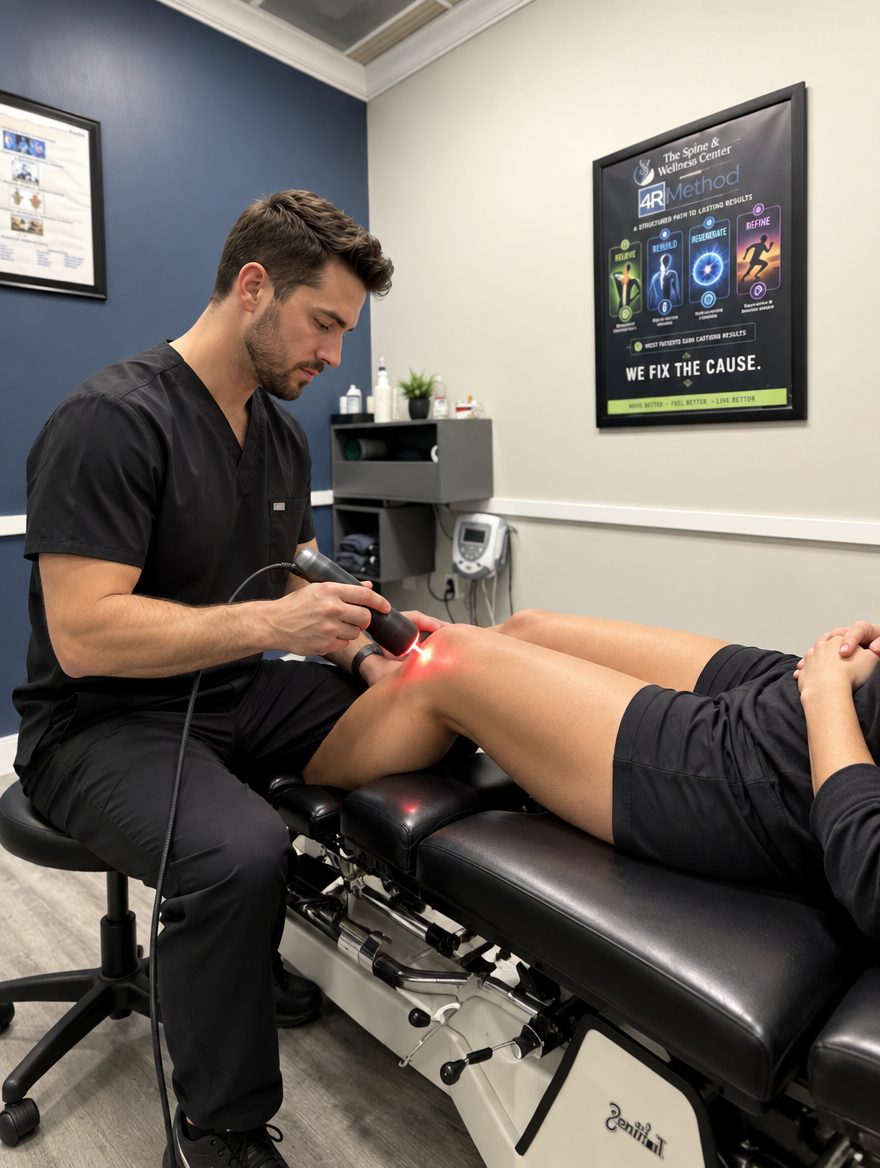
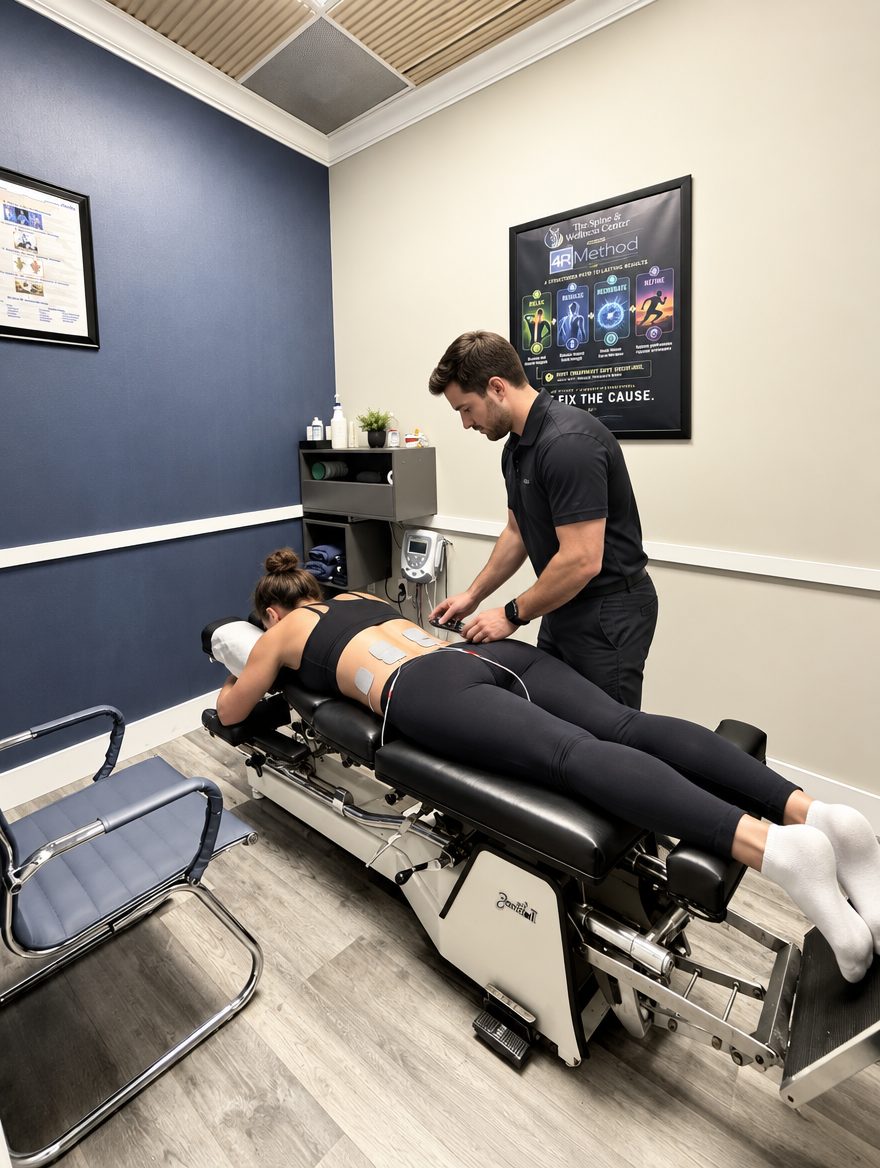
In the Repair phase (3–5 visits a week for 4–8 weeks) the first shockwave sessions calm the tendon’s pain signaling while adjustments restore motion to the joints that were overloading it, and cold laser therapy or electrical muscle stimulation address the surrounding muscle guarding. Shockwave itself is applied once a week during this phase, never daily.
R2 · Rebuild — remodel the tendon
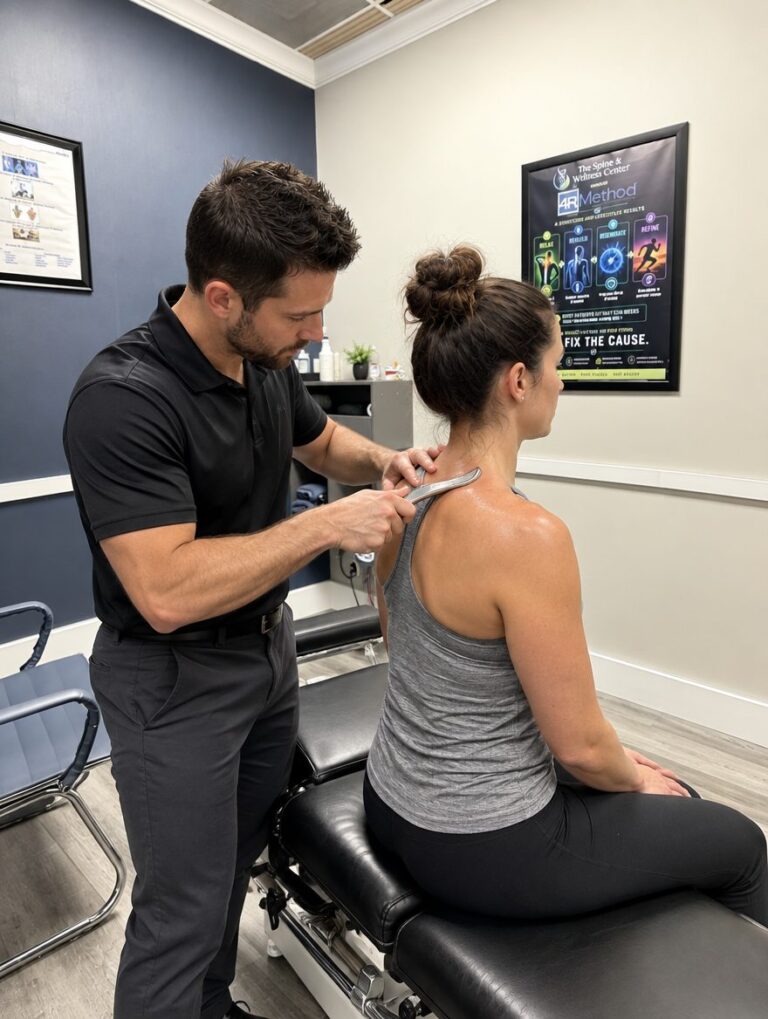
The Rebuild phase (2–3 visits a week for 8–16 weeks) is where the tendon actually changes. The new blood vessels and collagen the pulses triggered need load to organize, so each session is paired with a progressive strengthening program through physical therapy — slow, heavy, controlled exercises for the calf, patellar tendon or forearm. Graston Technique work on the surrounding fascia often runs alongside it.
By the Regenerate and Refine phases the tendon should be taking load without complaint. Shockwave is then held in reserve for a flare-up or a pre-season tune-up rather than used routinely.
Graston Technique
Instrument-assisted soft tissue work for the fascia around the tendon.
Learn morePhysical therapy
The loading program that turns a shockwave response into a durable tendon.
Learn moreCold laser therapy
Painless light therapy for inflammation and nerve irritation in the Repair phase.
Learn moreSports injury rehab
Return-to-play programs for runners, racquet athletes and golfers.
Learn moreIs shockwave therapy safe? Evidence and contraindications
Extracorporeal shockwave therapy has one of the larger evidence bases among the soft-tissue tools we use. A review published in the Journal of Orthopaedic Surgery and Research summarizes clinical and laboratory studies showing ESWT promotes neovascularization and tissue regeneration in tendons and can be effective for chronic plantar fasciitis, lateral epicondylitis and calcific shoulder tendinopathy (Wang, PMC). Results vary between studies and protocols, and we tell patients that roughly two in three chronic tendinopathies respond meaningfully; some do not.
Side effects are usually minor and short-lived: redness, mild swelling, bruising or soreness at the treatment site for a day or two. Serious complications are rare when energy levels are appropriate and the treatment is kept away from the structures below.
When we do not use shockwave therapy
- Over the lungs, heart, brain or spine, or over a growth plate in a child or teenager.
- During pregnancy, or over a known tumor or infection.
- On people with bleeding disorders or taking blood thinners, without their physician’s clearance.
- Within six weeks of a corticosteroid injection at the same site.
- On an acute tendon rupture or a fresh, swollen injury — shockwave is for chronic, degenerated tissue, not a new tear.
- Over a nerve or major blood vessel close to the surface.
Your first-visit exam and, when needed, imaging screen for every item on this list before the applicator ever touches skin.
What to expect at your first two visits
We measure before we treat. Shockwave is prescribed for a specific, confirmed tendon or fascia problem, not applied to whatever hurts.
Visit one — we measure (and usually begin care)
- A real conversation about how long the pain has lasted, what makes it worse and what you have already tried — including any injections.
- A hands-on structural exam: palpation of the tendon, loading tests, joint range of motion, gait and posture analysis.
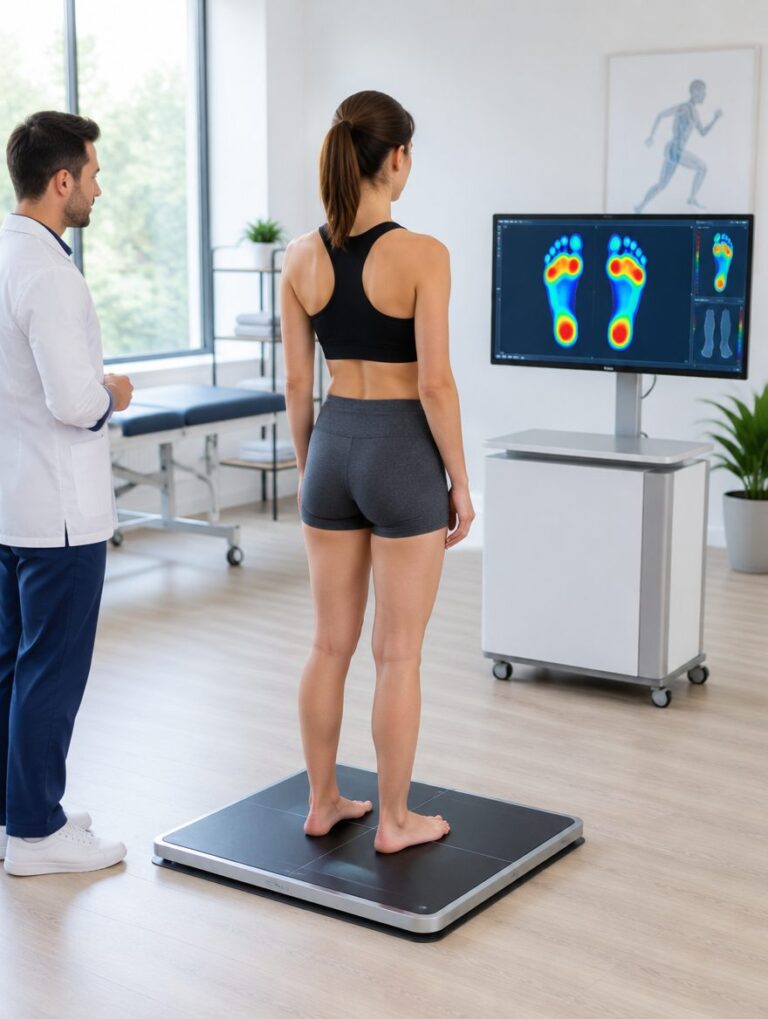
- Surface EMG and thermal scanning along the spine to map muscle guarding and compensation patterns that may be overloading the tendon.
- Digital X-rays when indicated — particularly for calcific tendinopathy and heel spurs, where the deposit changes the protocol.
Visit two — your findings and your plan
We explain what we found and lay out your 4R plan, including how many shockwave sessions we expect, what we will pair them with, and the milestones we will measure against. Treatment begins at this visit. For a head start, take the 60-second spine assessment online.
Home care during a shockwave course
- Stay active but do not overload. Walk and do your prescribed exercises; avoid maximal sprinting or jumping for 48 hours after each session.
- Skip anti-inflammatory medication for a few days after each session unless your physician advises otherwise. The healing response the pulses trigger is a controlled inflammation, and NSAIDs may blunt it.
- Avoid ice on the treated spot for the same reason; mild heat is fine.
- Keep up the loading program. The strengthening exercises are not optional — they are what the shockwave response needs to turn into organized tendon.
- Expect gradual change. Tendons remodel over weeks; judge the result at 8 to 12 weeks, not after one session.
If you felt a sudden snap, cannot bear weight, or the area is hot, red and rapidly swelling, please see a doctor or urgent care today before any tendon therapy.
Serving shockwave therapy patients across North Broward
Our clinic at 5675 Coral Ridge Drive, Coral Springs, FL 33076 serves Coral Springs, Parkland, Coconut Creek, Margate, Boca Raton, Tamarac, Pompano Beach and Deerfield Beach. Same-day appointments are usually available — call (954) 341-2256 or book online. Most patients from Parkland and Coral Springs are here in under 15 minutes.
Medically reviewed by Dr. Jared Cohen, DC — Co-Founder & Clinical Director, The Spine and Wellness Center. Last reviewed October 2026.
Frequently asked questions
Does shockwave therapy hurt?
It is uncomfortable rather than painful — a deep, rapid tapping over the tender spot that usually dulls within the first minute as the nerves adapt. We start at a low setting and increase only to a level you can tolerate. Mild soreness for a day or two afterward is common.
How many shockwave sessions will I need?
Most chronic tendon and fascia problems are treated with three to six sessions about a week apart. Because tendons remodel slowly, improvement often continues for 6 to 12 weeks after the final session. We re-evaluate after the third session and change course if nothing has shifted.
Is this the same as the treatment for kidney stones?
It uses the same physical principle — acoustic pulses generated outside the body — but at far lower energy and with a different goal. Kidney stone lithotripsy fragments stones; musculoskeletal shockwave stimulates blood vessel growth and collagen repair in degenerated tendon and fascia.
Can I have shockwave after a cortisone injection?
We wait at least six weeks after a corticosteroid injection at the same site. Steroids can weaken tendon tissue temporarily, and combining the two too closely raises the risk of a tear. Tell us about any injections during your first visit.
Does shockwave therapy work for plantar fasciitis?
For plantar fasciitis that has lasted more than three months and has not responded to stretching and footwear changes, shockwave is one of the better-supported non-surgical options, and the AAOS lists it among the alternatives before surgery. We pair it with calf and foot strengthening and, when needed, Graston work along the arch.
Who should not have shockwave?
We do not use it during pregnancy, over growth plates in children, over the lungs, heart, spine or a tumor, on a fresh tear, or on people with bleeding disorders or on blood thinners without their physician's clearance. Your first-visit exam screens for each of these.
Do you see shockwave patients from Parkland and Boca Raton?
Yes. Our clinic on Coral Ridge Drive in Coral Springs is a short drive from Parkland, Coconut Creek, Margate, Boca Raton and Tamarac, and same-day appointments are usually available.
Same-day appointments
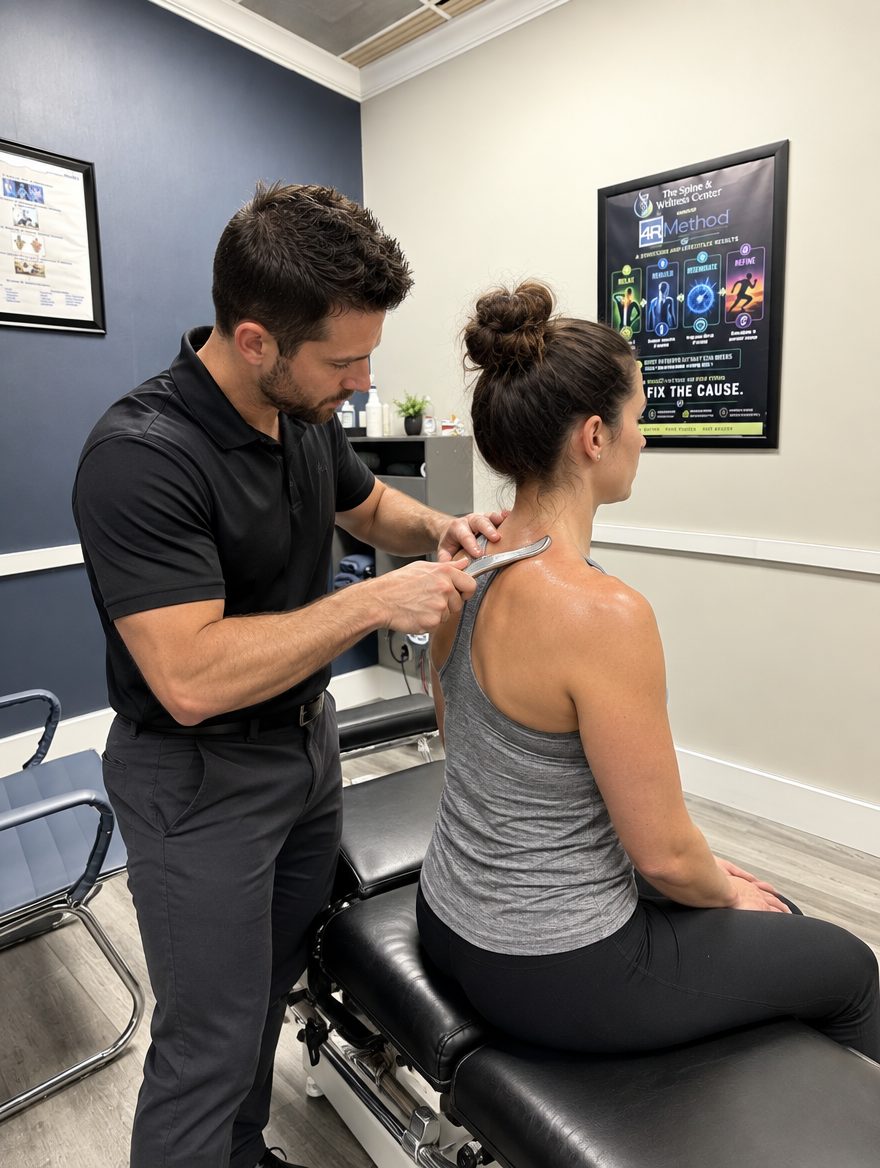
Let's fix the cause.
Measure first, then treat — a plan built on your actual structure.
- Same-day appointments are usually available
- Our team calls you back to confirm your visit
- Coral Springs, serving Parkland & North Broward since 2005
Prefer to talk now? Call or text (954) 341-2256