
Conditions · Coral Springs & Parkland
Repetitive strain injury treatment in Coral Springs
The motion you repeat ten thousand times a week — typing, scrolling, gripping a tool, swinging a paddle — quietly overloads a tendon, nerve or joint until it finally complains. We find the overuse pattern, calm the tissue, and fix the chain that caused it.
Quick answer
Repetitive strain injury treatment at our Coral Springs clinic traces the overuse pattern through the whole neck-shoulder-elbow-wrist chain rather than treating the sore spot alone. Graston Technique, cold laser and gentle mobilization calm the overloaded tendon or nerve; posture correction, ergonomics and strengthening inside the 4R Method stop the motion from re-injuring it. Drug-free, no injections.
What a repetitive strain injury actually is
Effective repetitive strain injury treatment starts with how the injury happened — slowly. A repetitive strain injury (RSI) is not one diagnosis but a family of overuse problems in tendons, nerves, muscles and joints that develop when the same motion, grip or posture is repeated faster than the tissue can recover. Tendons thicken and fray, nerves get crowded in their tunnels, joints stiffen, and muscles guard.
The National Institute of Arthritis and Musculoskeletal and Skin Diseases groups these as repetitive motion and overuse injuries — tendinitis, bursitis, carpal tunnel syndrome and related conditions caused by too much stress on a part of the body without enough recovery (NIAMS, Sports and Overuse Injuries). The ‘sport’ is often a keyboard.
In Coral Springs and Parkland the sources are predictable: eight-hour days on a laptop, a phone held and scrolled for hours, power tools and assembly work, hair and dental work, and the pickleball and golf boom. What they share is a neck-shoulder-elbow-wrist chain held in one position and loaded one way — which is why treating only the sore wrist so rarely holds.

Which RSI is it? Desk, phone and tool patterns
Where it hurts and what you do all day usually identify the pattern:
- Carpal tunnel syndrome: numb, tingling thumb, index and middle fingers, worse at night; from a wrist held bent while typing or sleeping. See our carpal tunnel page.
- Tennis and golfer’s elbow: outer or inner elbow pain with gripping and lifting; from mousing, tools, racquets and clubs. See tennis and golfer’s elbow.
- ‘Text thumb’ and De Quervain’s tenosynovitis: pain at the thumb side of the wrist with gripping, texting and lifting a baby; from phone use and new-parent lifting.
- Neck and shoulder strain (‘tech neck’): a burning ache between the shoulder blades, a tight upper trap, headaches at the base of the skull; from a forward-head posture over screens. See neck pain and upper back pain.
- Rotator cuff and shoulder impingement: pain reaching overhead or behind; from overhead tools, painting, serving. See shoulder pain.
- Cubital tunnel syndrome: numb ring and little fingers; from elbows bent on a desk or phone held to the ear.
Good to know
Most people with an RSI have more than one link in the chain involved — a stiff neck and rounded shoulders plus the sore wrist. Treating the chain is what makes repetitive strain injury treatment last.
How we approach repetitive strain injury treatment at TSAWC
Our repetitive strain injury treatment follows the 4R Method — Repair, Rebuild, Regenerate, Refine — applied to the whole chain from neck to hand. Calming the painful tissue is step one; changing the posture, ergonomics and strength that overloaded it is what keeps you out of a brace.
R1 · Repair — calm the overloaded tissue
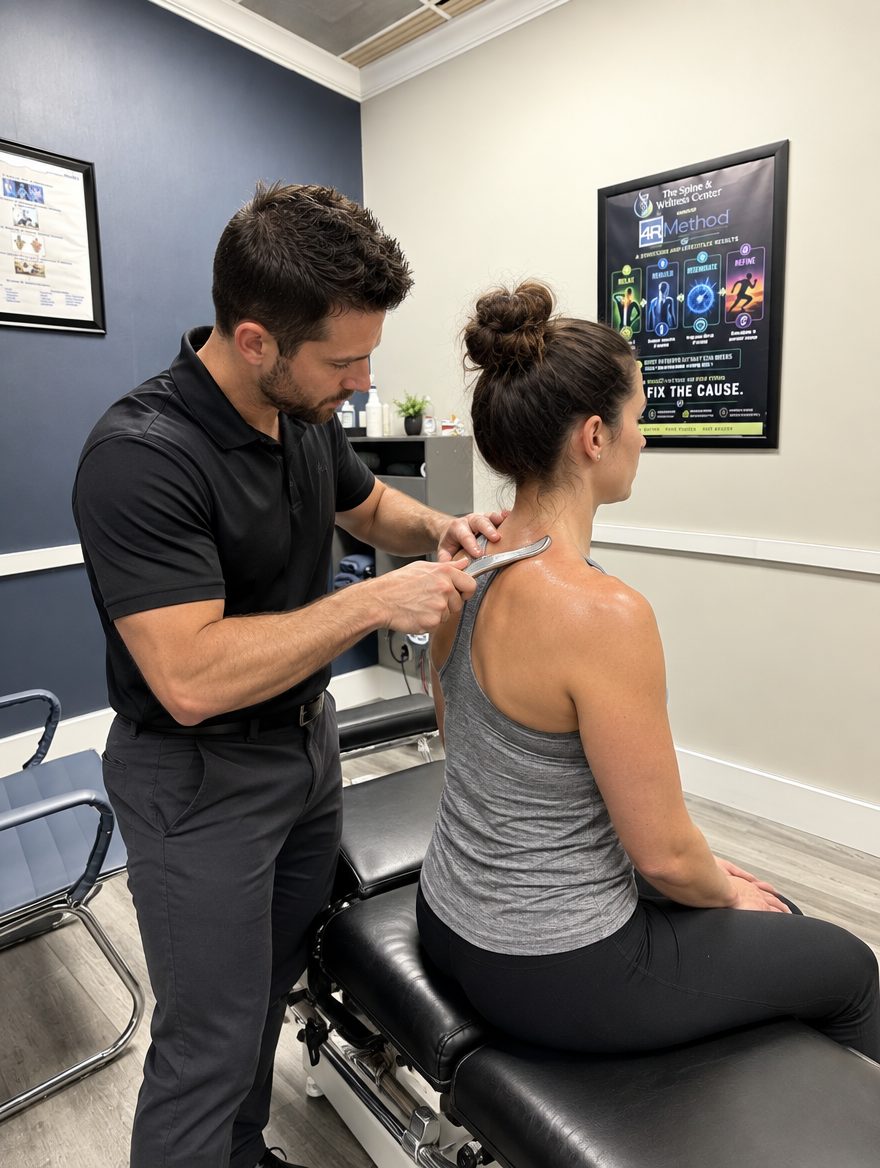
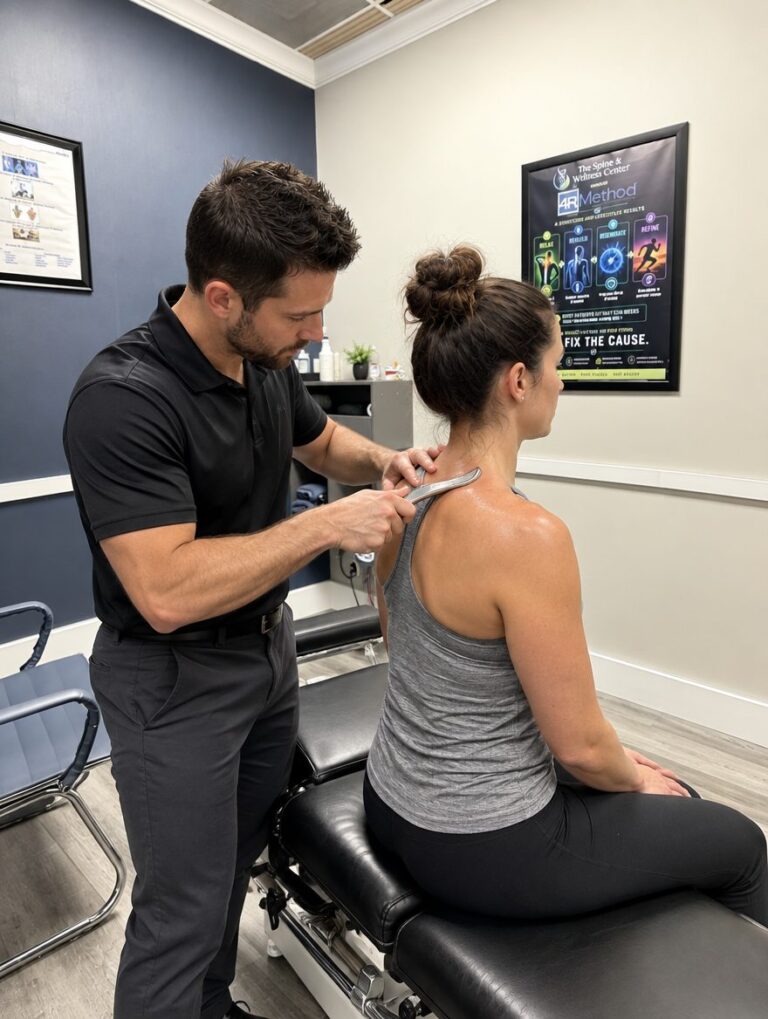
The Repair phase settles the irritated tendon, nerve or joint. Graston Technique breaks up the thickened, fibrotic tissue in the forearm, upper trap and around the shoulder blade; cold laser therapy reduces inflammation at the sore tendon or nerve; massage and cupping release the guarded neck and shoulder muscles; and gentle adjustments restore motion to the wrist, elbow, shoulder, upper back and neck. Typical commitment is 3 visits a week for 4–8 weeks, and most patients feel the sharpest symptoms ease within two to three weeks.
R2 · Rebuild — change the chain that caused it
Once the tissue is quieter, we correct the cause: posture correction for the forward-head, rounded-shoulder desk position; physical therapy to strengthen the shoulder blade stabilizers, rotator cuff, forearm and grip so the tissue can handle the daily load; and an ergonomic review of your desk, phone, tools or swing. Rebuild usually runs 2–3 visits a week for 8–16 weeks.
R3 and R4 · Regenerate and Refine
Regenerate supports tendon and nerve recovery with PEMF and red light therapy at about 2 visits a week for two months or more. Refine is a brief tune-up every month or two — especially valuable when your work keeps your hands busy and the load never fully goes away.
Graston Technique
Instrument-assisted release of the fibrotic tissue that repeated motion builds in forearms, traps and shoulders.
Learn morePosture correction
Reverses the forward-head, rounded-shoulder position that loads every link in the chain.
Learn moreCold laser therapy
Low-level laser calms inflamed tendons and irritated nerves — painless, drug-free.
Learn morePhysical therapy
Strength and endurance for the shoulder blade, cuff, forearm and grip so daily load no longer injures.
Learn more5 proven steps for repetitive strain injury (in order)
Repetitive strain injury treatment works as a sequence. This is the order that turns a recurring flare into a durable result:
- Map the motion. We watch how you actually type, hold the phone, grip the tool or swing — the strain lives in the pattern, not the body part.
- Calm the tissue. Graston, cold laser and soft-tissue work on the sore tendon or nerve, with short-term activity modification rather than total rest.
- Free the chain. Mobilize the wrist, elbow, shoulder, first rib, upper back and neck so load is shared along the arm instead of concentrated at one spot.
- Fix the setup. Screen height, chair, keyboard and mouse position, phone habits, tool grips, racquet size — small ergonomic changes remove hours of daily strain.
- Rebuild capacity. Strength and endurance for the postural muscles, cuff, forearm and grip so the tissue can do the job without breaking down again.
What is not on the list as a first step: a rigid brace worn all day, repeated cortisone injections, or surgery. A nerve with constant numbness or muscle wasting, or a tendon that has failed months of proper care, deserves a specialist opinion — and we will say so.
What to expect at your first two visits
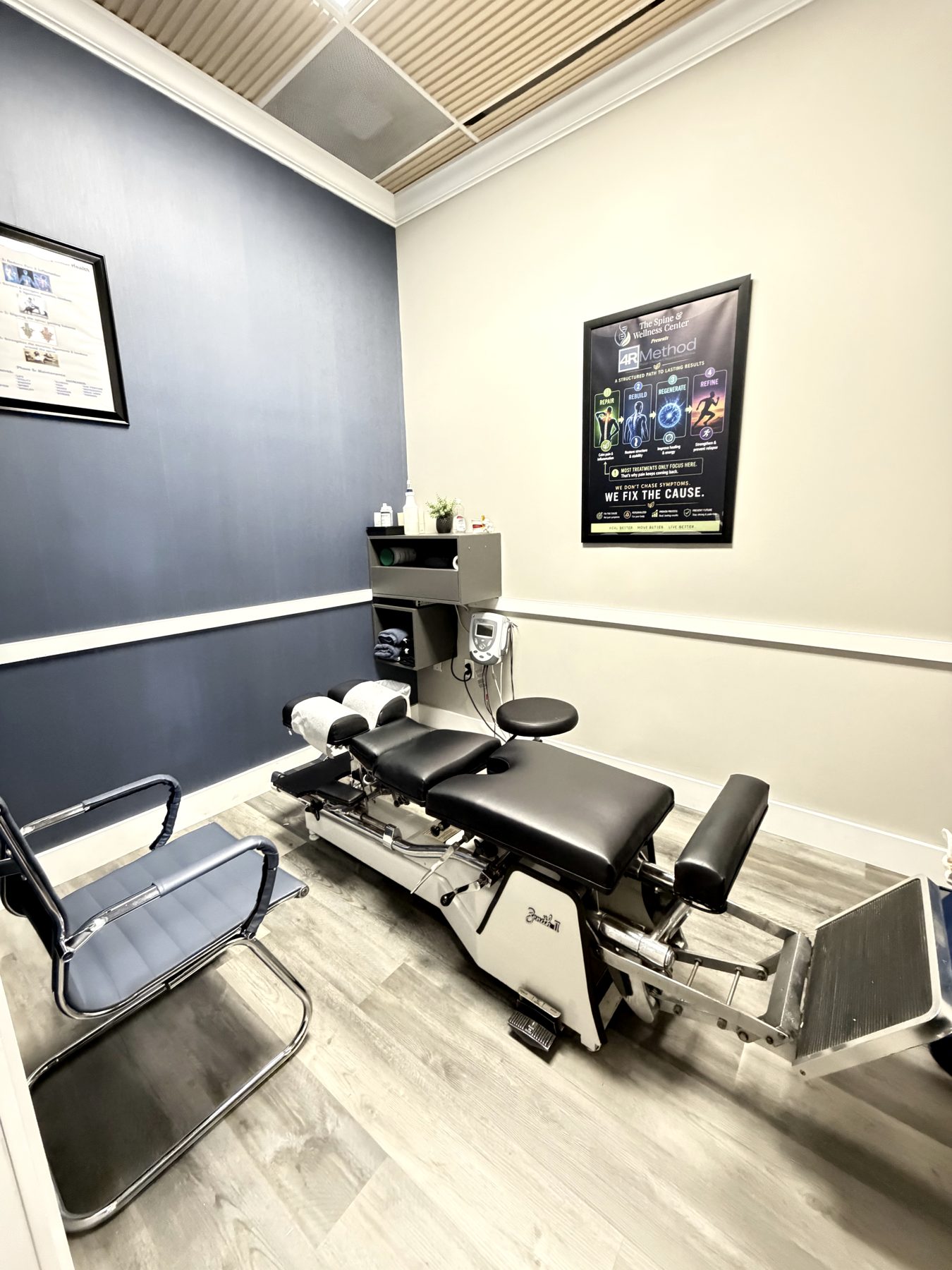
We measure before we treat, so your plan targets the tissue that is hurting and the motion that overloaded it.
Visit one — we measure (and usually begin care)
- A real conversation. What you do all day and how many hours, where and when it hurts, what you have tried, and what you want back.
- A hands-on structural exam. The whole chain: cervical range of motion and nerve root tests, shoulder blade tracking and posture, cuff and elbow tendon tests, wrist and thumb tendon tests, nerve-tension tests and grip strength.
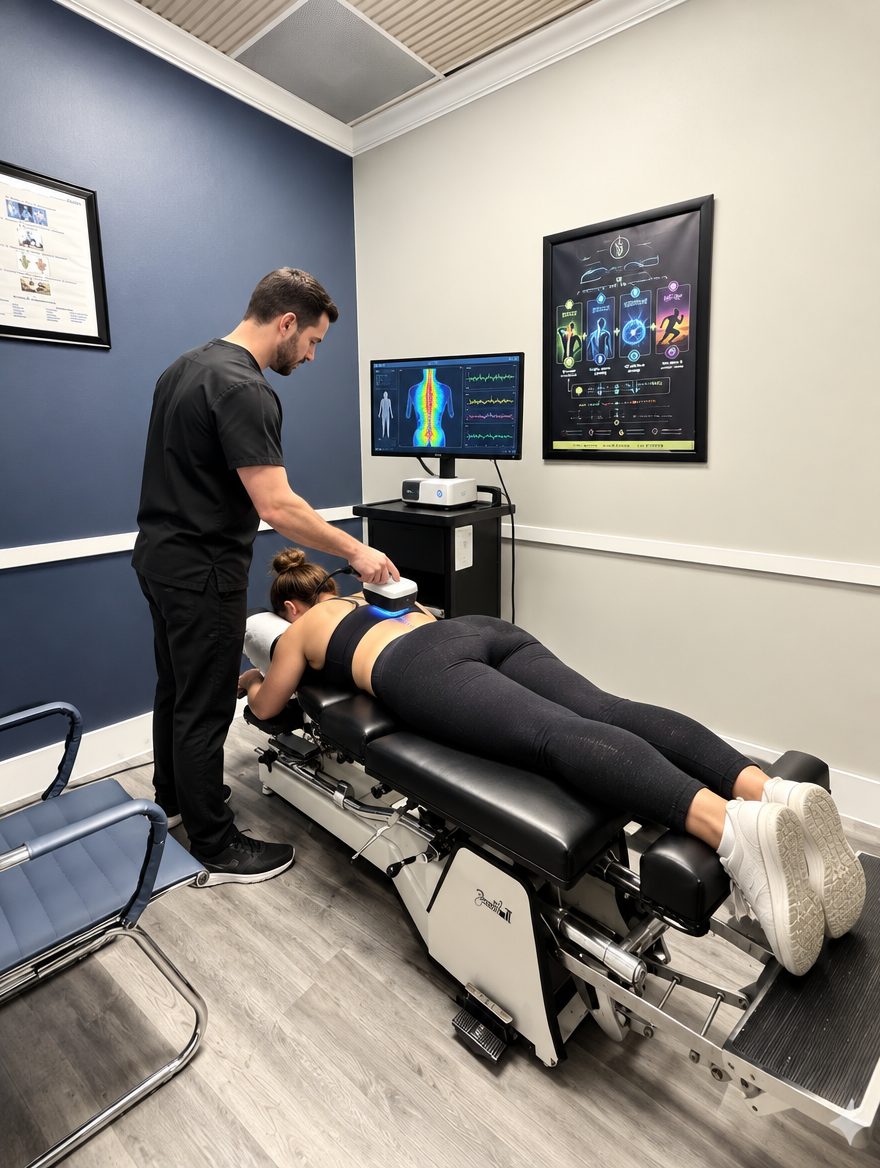
- Surface scanning: sEMG + thermal. Surface EMG shows where the muscles along the cervical and thoracic spine are guarding; thermal scanning maps nerve irritation from neck to hand. Painless and repeatable.
- Digital X-rays, when indicated. Of the neck when nerve root involvement is suspected, to see disc spacing and alignment. We review any imaging or nerve studies you bring.
Visit two — your findings and your plan
Your findings explained plainly with the scans in front of you: which tissue is overloaded, which links in the chain are contributing, and a phase-by-phase plan with ergonomic changes you can make this week. Treatment begins at this visit. For a head start, take the 60-second spine assessment.
Repetitive strain injury treatment at home: ergonomics that matter
Between visits, your setup does as much as the treatment:
- Screen at eye height, elbows at 90. A laptop on a desk forces the head forward and the wrists up — a stand and external keyboard fix both.
- Neutral wrists, loose grip. Mouse and keyboard with the wrist straight; tools, steering wheels and phones held with half the force you think you need.
- Move every 30–45 minutes. Stand, roll the shoulders, turn the head, shake out the hands. Short, frequent breaks beat one long one.
- Bring the phone up, not the head down. Scrolling with the phone at chest height and the elbows supported takes the load off the neck and thumbs.
- Do the chain exercises. Chin tucks, shoulder blade squeezes and forearm strengthening from your plan — a few minutes, most days.
When an RSI needs a doctor instead
Some symptoms need medical evaluation rather than overuse care: constant numbness that no longer comes and goes, visible muscle wasting in the hand, rapidly progressing weakness, a hot, red, swollen joint with fever, or arm symptoms with chest pressure or shortness of breath. If any of these apply, please see a doctor or urgent care today.
For the far more common picture — the forearm that aches by noon, the thumb that hurts scrolling, the burning between the shoulder blades, the elbow that flares every pickleball weekend — this is routine work for us with repetitive strain injury patients across Coral Springs and Parkland. If your RSI came from sport, our sports injury rehab program is the next step.
Serving repetitive strain injury patients across North Broward
Our clinic at 5675 Coral Ridge Drive, Coral Springs, FL 33076 serves Coral Springs, Parkland, Coconut Creek, Margate, Boca Raton, Tamarac, Pompano Beach and Deerfield Beach. Same-day appointments are usually available — call (954) 341-2256 or book online. Most patients from Parkland and Coral Springs are here in under 15 minutes.
Medically reviewed by Dr. Jared Cohen, DC — Co-Founder & Clinical Director, The Spine and Wellness Center. Last reviewed October 2026.
Frequently asked questions
What is a repetitive strain injury?
A repetitive strain injury (RSI) is overuse damage to a tendon, nerve, muscle or joint from a motion, grip or posture repeated faster than the tissue can recover. Carpal tunnel syndrome, tennis and golfer's elbow, De Quervain's tenosynovitis, rotator cuff tendinopathy and 'tech neck' are all common RSIs.
Can a chiropractor treat repetitive strain injuries?
Yes. Repetitive strain injury treatment combines soft-tissue work such as Graston Technique, cold laser, gentle mobilization of the wrist, elbow, shoulder and neck, posture correction and strengthening. The aim is to calm the overloaded tissue and change the chain of mechanics that keeps re-injuring it, without medication or surgery.
Why does my RSI keep coming back?
Because the motion that caused it has not changed. Rest and a brace calm the symptoms, but if the posture, ergonomics and weak supporting muscles are the same, the first full week back re-injures the tissue. Fixing the setup and rebuilding strength along the neck-shoulder-wrist chain is what makes recovery hold.
Should I wear a brace for a repetitive strain injury?
A splint or counterforce strap can help short-term — a neutral wrist splint at night for carpal tunnel, a strap during activity for tennis elbow. Wearing a rigid brace all day weakens the tissue you are trying to strengthen, so braces are a bridge in the Repair phase, not the plan.
How long does repetitive strain injury treatment take?
The sharpest symptoms usually ease within two to three weeks of the Repair phase. Rebuilding the strength and posture that prevent recurrence takes a further two to three months, and longer for nerves that have been compressed for a long time. We map a realistic timeline after your evaluation.
Do you see RSI patients from Parkland and Coconut Creek?
Yes. Our clinic on Coral Ridge Drive in Coral Springs is minutes from Parkland, Coconut Creek, Margate and Tamarac, and same-day appointments are usually available for repetitive strain injury treatment.
Same-day appointments
Let's build your plan.
Find out what's actually going on and get a clear path forward. Same-day appointments available.
- Same-day appointments are usually available
- Our team calls you back to confirm your visit
- Coral Springs, serving Parkland & North Broward since 2005
Prefer to talk now? Call or text (954) 341-2256