

Conditions · Coral Springs & Parkland
Migraine treatment in Coral Springs (drug-free support)
Migraine is a neurological condition — and for many people the neck and upper spine are a trigger that medication never addresses. We measure and treat those structural triggers, drug-free, and work alongside your physician or neurologist rather than instead of them.
Quick answer
Drug-free migraine treatment at The Spine and Wellness Center supports, rather than replaces, medical migraine care. We identify neck, posture and nerve-related triggers — upper cervical joint irritation, forward head posture, tight suboccipital muscles — and treat them with gentle adjustments, cervical decompression, soft-tissue work and posture rehab inside the 4R Method. Many patients report fewer or milder attacks within the first few weeks.
What is a migraine, and where does the neck fit in?
Migraine treatment is more than headache treatment. A migraine is a neurological event — throbbing, usually one-sided pain, often with nausea, sensitivity to light and sound, and sometimes a visual aura — that can sideline you for hours or days. The National Institute of Neurological Disorders and Stroke describes migraine as a complex condition with genetic and environmental triggers, managed medically with acute and preventive medication and trigger control (NINDS, Migraine).
Where the neck fits: the upper three cervical nerves share a relay station in the brainstem with the trigeminal nerve that carries migraine pain. Irritated upper neck joints, tight suboccipital muscles and forward head posture feed signals into that relay, which can lower the threshold for an attack or start one outright. Neck pain is reported by most migraine sufferers before or during attacks.
That is the piece our migraine treatment in Coral Springs addresses. We evaluate the structural and postural triggers that may be feeding your migraines and work to correct them — drug-free, measured, and coordinated with your physician or neurologist rather than in place of them.

Migraine, tension headache or cervicogenic headache? How to tell
Three kinds of head pain overlap, and the distinction changes what migraine treatment should include:
- Migraine: moderate to severe throbbing pain, usually one-sided, worse with activity, with nausea or light and sound sensitivity; 4–72 hours; may have aura. Often has a family history and clear triggers (sleep loss, certain foods, hormones, stress let-down).
- Tension-type headache: dull, band-like pressure on both sides, mild to moderate, no nausea, usually linked to stress, posture and long desk days. See our headache treatment guide.
- Cervicogenic headache: pain that starts in the neck or base of the skull and spreads forward to one side of the head, triggered by neck movement or sustained positions, with reduced neck motion. Frequently misdiagnosed as migraine — and the type most responsive to structural care.
- Mixed patterns are common: a true migraine sufferer whose neck lowers the attack threshold, so treating the neck reduces frequency without changing the diagnosis.
Good to know
If pressing on the muscles at the base of your skull reproduces your head pain, or your headaches reliably follow long desk days, the neck is involved — regardless of what the headache is called.
How we approach migraine treatment with the 4R Method
Our drug-free migraine treatment follows the 4R Method — Repair, Rebuild, Regenerate, Refine — aimed at the triggers we can measure and change.
R1 · Repair — calm the upper neck
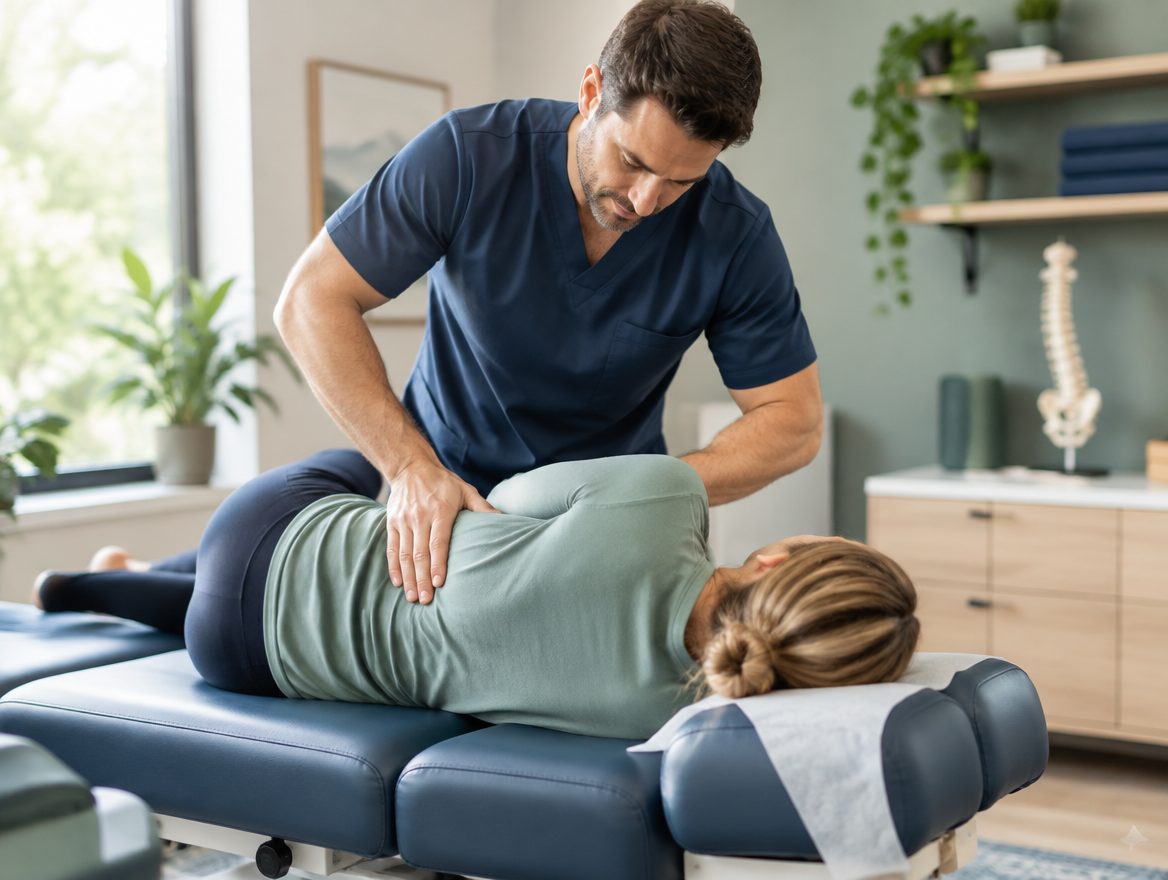
Gentle, specific upper cervical adjustments to restore motion to the C1–C3 joints, cervical decompression on the Triton DTS table when neck discs and nerves are involved, cold laser and soft-tissue release for the suboccipital and upper trapezius muscles. Typically 2–4 visits a week for 4–8 weeks; many patients notice fewer or milder attacks within the first few weeks.
R2 · Rebuild — remove the postural trigger
Posture correction and physical therapy to restore the cervical curve, retrain the deep neck flexors and unwind forward head posture — the daily load that keeps the upper neck irritated. Graston and massage therapy for the chronically tight tissue. Usually 2–3 visits a week for 8–16 weeks.
R3 and R4 · Regenerate and Refine
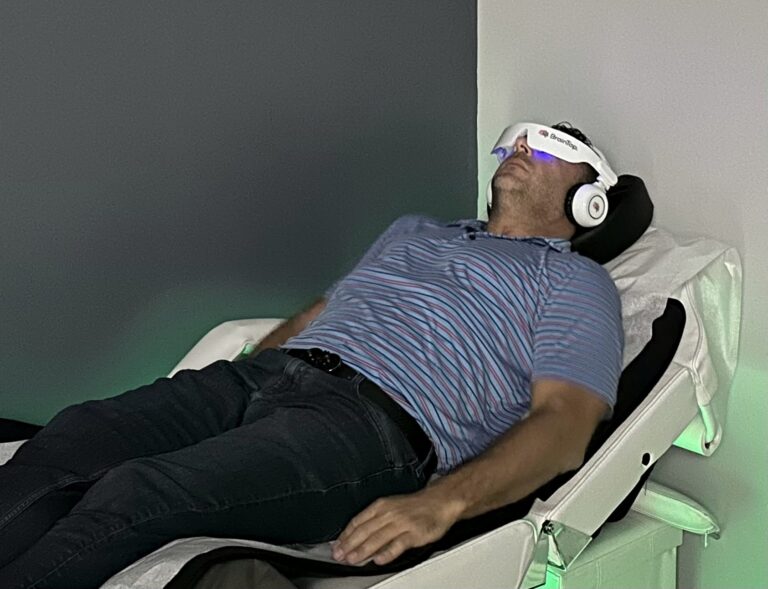
BrainTap and red light for stress and sleep regulation — two of the strongest migraine triggers — at about 2 visits a week, then a brief tune-up every month or two. Throughout, you keep a headache diary so we can see frequency and intensity changing on paper.
Chiropractic adjustments
Gentle upper cervical work to ease the joint irritation feeding the trigeminal relay.
Learn morePosture correction
Unwind forward head posture — the daily load behind most neck-related migraines.
Learn moreMassage therapy
Release the suboccipital and upper trapezius tension that refers pain into the head.
Learn moreBrainTap therapy
Guided relaxation and light-sound sessions that support sleep and stress regulation.
Learn moreWorking with your neurologist: what we do and what we do not
We are careful about scope. Migraine is a medical diagnosis, and our migraine treatment is supportive care that sits alongside medical management:
- We do not diagnose migraine or manage medication. If you have not been evaluated by a physician for recurring severe headaches, we will ask you to be, and we are glad to coordinate.
- We do treat the musculoskeletal triggers — upper cervical joint dysfunction, suboccipital tension, forward head posture, cervical disc irritation — that medical care typically does not address.
- We refer promptly for new or changing patterns: a ‘worst ever’ headache, headaches after a head injury, headaches with fever, stiff neck, confusion, weakness or vision loss, new headaches after 50, or a pattern that is escalating. Please see a doctor or urgent care today if any of these apply.
- We share findings. With your permission, your scans and progress notes go to your neurologist so your preventive plan reflects what is changing.
Patients often arrive after years of medication alone. The combination — medical management plus drug-free migraine treatment that removes the structural trigger — is usually what finally moves the needle. It is also why we ask every new migraine patient to keep a headache diary from day one: frequency, duration and intensity are the outcomes that matter, and they should be visible on paper, not just remembered.
A note on cervical decompression: when the exam and imaging show irritated cervical discs or narrowed nerve openings in the neck, decompression on the Triton DTS table is added to the Repair phase. It is gentle, computer-controlled, and takes about 20 minutes; most patients find it relaxing rather than uncomfortable.
What to expect at your first two visits
Visit one — we measure (and usually begin care)
- A real conversation. Attack frequency, duration and features, aura, triggers, medications, prior imaging, and how often your neck hurts before an attack.
- A hands-on structural exam. Upper cervical joint motion, palpation of the suboccipital muscles, posture and forward-head measurement, cervical range of motion, and neurological screening.
- Surface EMG and thermal scanning. A painless scan showing where the neck and upper back muscles are guarding and where nerve irritation is present.
- Digital X-rays when indicated. Cervical curve, alignment and disc spacing; we review any MRI you already have.
Visit two — your findings and your plan
We show you the structural triggers we found, explain how the four phases of the 4R Method apply, and set a realistic timeline with your headache diary as the scorecard. Your full plan starts here — and in most cases care already began on visit one. The 60-second spine assessment gives us a head start.
Reducing migraine triggers at home
- Keep the diary. Date, duration, intensity, sleep, food, screen time and neck pain — patterns appear within a month.
- Fix the screen. Monitor at eye level, phone raised, a two-minute posture break every 30–45 minutes.
- Protect sleep. Consistent bed and wake times, one supportive pillow, no stomach sleeping.
- Hydrate and eat regularly. Dehydration and skipped meals are two of the most common avoidable triggers.
- Ease the neck, don’t crank it. Gentle chin tucks and upper trapezius stretches help; self-cracking the neck does not.
If your head pain is mostly on both sides and tied to posture, start with our headache treatment guide; if it is clearly neck-driven, see neck pain treatment. For migraine with a neck component — the pattern we see most in Coral Springs and Parkland — this page is the right place to start.
Serving migraine patients across North Broward
Our clinic at 5675 Coral Ridge Drive, Coral Springs, FL 33076 serves Coral Springs, Parkland, Coconut Creek, Margate, Boca Raton, Tamarac, Pompano Beach and Deerfield Beach. Same-day appointments are usually available — call (954) 341-2256 or book online. Most patients from Parkland and Coral Springs are here in under 15 minutes.
Medically reviewed by Dr. Jared Cohen, DC — Co-Founder & Clinical Director, The Spine and Wellness Center. Last reviewed October 2026.
Frequently asked questions
Can a chiropractor help with migraines?
For many people, yes — as a supportive treatment. When migraines are linked to upper neck joint irritation, muscle tension or forward head posture, gentle adjustments, cervical decompression and soft-tissue care may reduce the frequency and intensity of attacks. We treat the structural triggers and coordinate with your physician on the medical side.
Is migraine treatment at a chiropractor a replacement for my neurologist?
No. Migraine is a medical diagnosis and medication decisions belong with your physician or neurologist. Our drug-free care addresses the neck, posture and nerve triggers that medical care typically does not, and we share findings with your doctor with your permission.
How is a cervicogenic headache different from a migraine?
A cervicogenic headache starts in the neck or base of the skull and spreads forward to one side of the head, triggered by neck movement or sustained positions. A migraine is a neurological event with throbbing pain, nausea and light or sound sensitivity. The two are often confused, and many people have both.
How soon could I notice fewer migraines with drug-free migraine treatment?
Some patients notice fewer or milder attacks within the first few weeks of the Repair phase; lasting change usually takes the Rebuild phase, because posture is what keeps the upper neck irritated. Your headache diary shows the trend honestly, and we set expectations at your second visit.
When should a headache be seen by a doctor urgently?
A sudden 'worst ever' headache, a headache after a head injury, headache with fever and stiff neck, confusion, weakness, vision loss or trouble speaking, or a new headache pattern after age 50 — please see a doctor or urgent care today for any of these before seeking chiropractic care.
Do you see migraine patients from Parkland and Coconut Creek?
Yes. Our clinic on Coral Ridge Drive in Coral Springs is minutes from Parkland, Coconut Creek, Margate and Tamarac, and same-day appointments are usually available for new headache and migraine patients.
Same-day appointments
Let's build your plan.
Find out what's actually going on and get a clear path forward. Same-day appointments available.
- Same-day appointments are usually available
- Our team calls you back to confirm your visit
- Coral Springs, serving Parkland & North Broward since 2005
Prefer to talk now? Call or text (954) 341-2256