
Service Areas · Coral Springs & Parkland
Pinched Nerve Treatment in Parkland, FL
Non-surgical care for radiating pain, tingling and numbness at The Spine and Wellness Center, about 5 to 10 minutes from Parkland straight down Coral Ridge Drive or University Drive — same-day appointments most days.
Quick answer
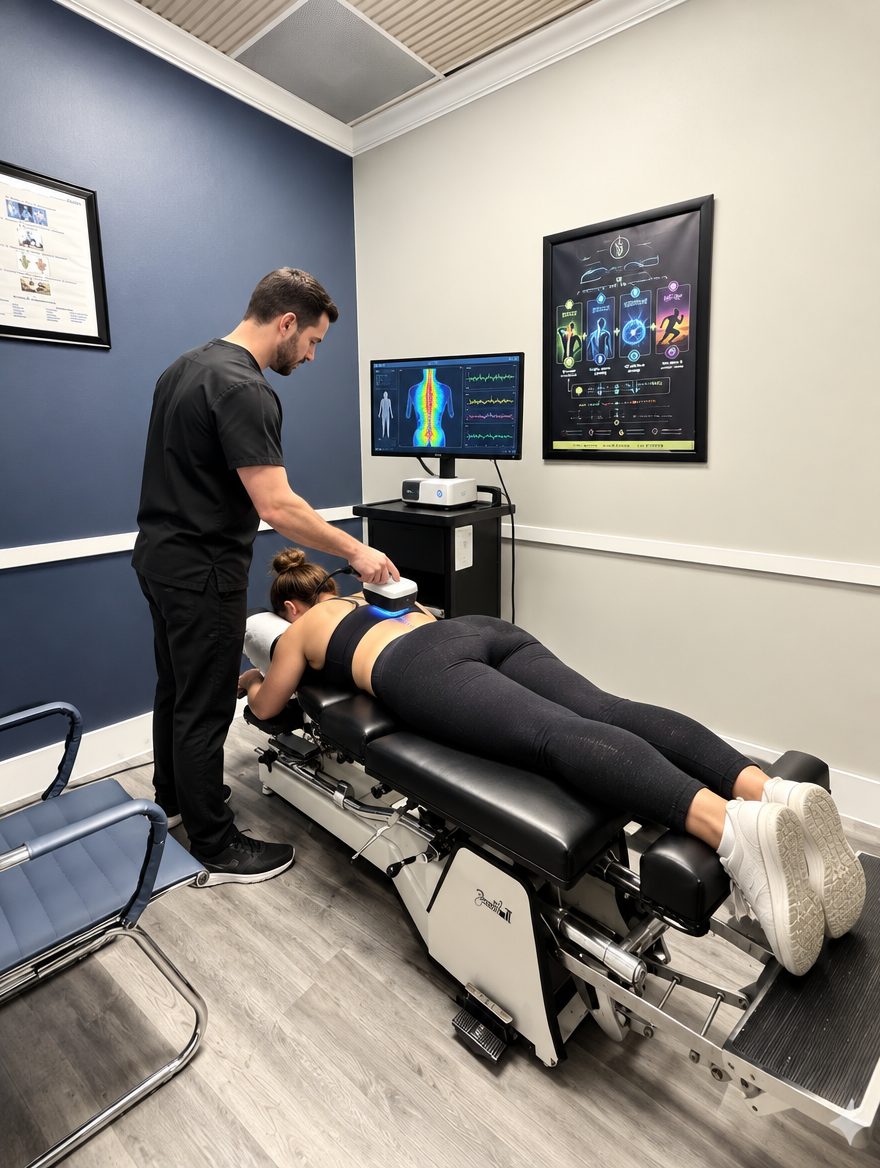
The closest clinic for measured, non-surgical pinched nerve treatment near Parkland is The Spine and Wellness Center at 5675 Coral Ridge Drive, Coral Springs, about 5 to 10 minutes from Parkland. The first visit is a nerve-focused exam with surface EMG, thermal scanning and X-rays when indicated; the second is your report of findings, where treatment — typically decompression on the Triton DTS table — begins.
Why Parkland patients choose us for pinched nerve treatment
The Spine and Wellness Center has cared for Parkland families since 2005. Here is why they keep choosing us for pinched nerve treatment in Parkland rather than a clinic down the street.
- Close enough to be routine. The clinic is about 5 to 10 minutes from Parkland straight down Coral Ridge Drive or University Drive. Free parking is at the door, and we schedule follow-ups around your commute so the drive stays a non-issue.
- Hours built for working people. Open until 7:00 pm three evenings a week (Monday, Tuesday, Thursday), plus Wednesday afternoons and Friday mornings.
- Care that fits Parkland life. We regularly treat Parkland families and youth athletes from Pine Trails Park, golfers from Heron Bay and Parkland Golf & Country Club, and parents juggling long days behind a desk and the carpool line. That experience shapes everything from the exam to the home-care plan.
What does a pinched nerve actually mean?
If you are looking for pinched nerve treatment in Parkland, you have probably already noticed the odd thing about this injury: the pain is not where the problem is. A compressed nerve root in the neck hurts in the arm; one in the lower back hurts in the leg. The spine is the source, the limb is the messenger.
Four ways a nerve gets compressed
- Disc bulge or herniation — the most common cause. Disc material presses on the nerve root as it exits the spine.
- Foraminal stenosis — the opening the nerve passes through narrows, usually from disc thinning and wear.
- Bone spurs — osteoarthritic growth that crowds the nerve, often alongside stenosis.
- Soft-tissue entrapment — the nerve is squeezed further along its path, as in carpal tunnel syndrome at the wrist or piriformis syndrome in the hip.
Each cause responds to a different treatment, so the label ‘pinched nerve’ on its own is not enough to plan care. Since 2005, our clinic on Coral Ridge Drive — about 5 to 10 minutes from Parkland — has built every nerve plan on measurement first, under the clinical direction of Dr. Jared Cohen, DC. Start with our herniated disc guide if you have been told a disc is involved.

Is it your neck, your lower back, or somewhere else? How to tell
The pattern of your symptoms usually points to the level before any image does. Here is how the three most common pinched-nerve patterns show up in Parkland patients:
- Neck (cervical radiculopathy, usually C5–C7): pain from the neck into the shoulder blade and down the arm; tingling in the thumb and index finger (C6), middle finger (C7) or ring and little fingers (C8); worse turning the head or looking up. Often paired with a loss of the normal neck curve.
- Lower back (lumbar radiculopathy, usually L4–S1): pain from the buttock down the back or side of the leg, often below the knee — the pattern called sciatica. Numbness on the top of the foot or the outer calf; worse sitting, bending or coughing.
- Peripheral entrapment: carpal tunnel syndrome produces numb thumb, index and middle fingers that wake you at night; piriformis syndrome produces buttock pain and leg tingling that mimics sciatica but tests normal at the spine.
Weakness is the symptom that matters most. Trouble gripping, a foot that slaps when you walk, or an arm that tires quickly means the nerve’s motor fibers are affected, and that changes how urgently we take the pressure off. According to the Mayo Clinic, most people recover from a pinched nerve with conservative care, while progressive weakness or symptoms that fail to settle are reasons to seek further evaluation (Mayo Clinic, Pinched nerve).
How pinched nerve treatment in Parkland works: take the pressure off, then correct the cause
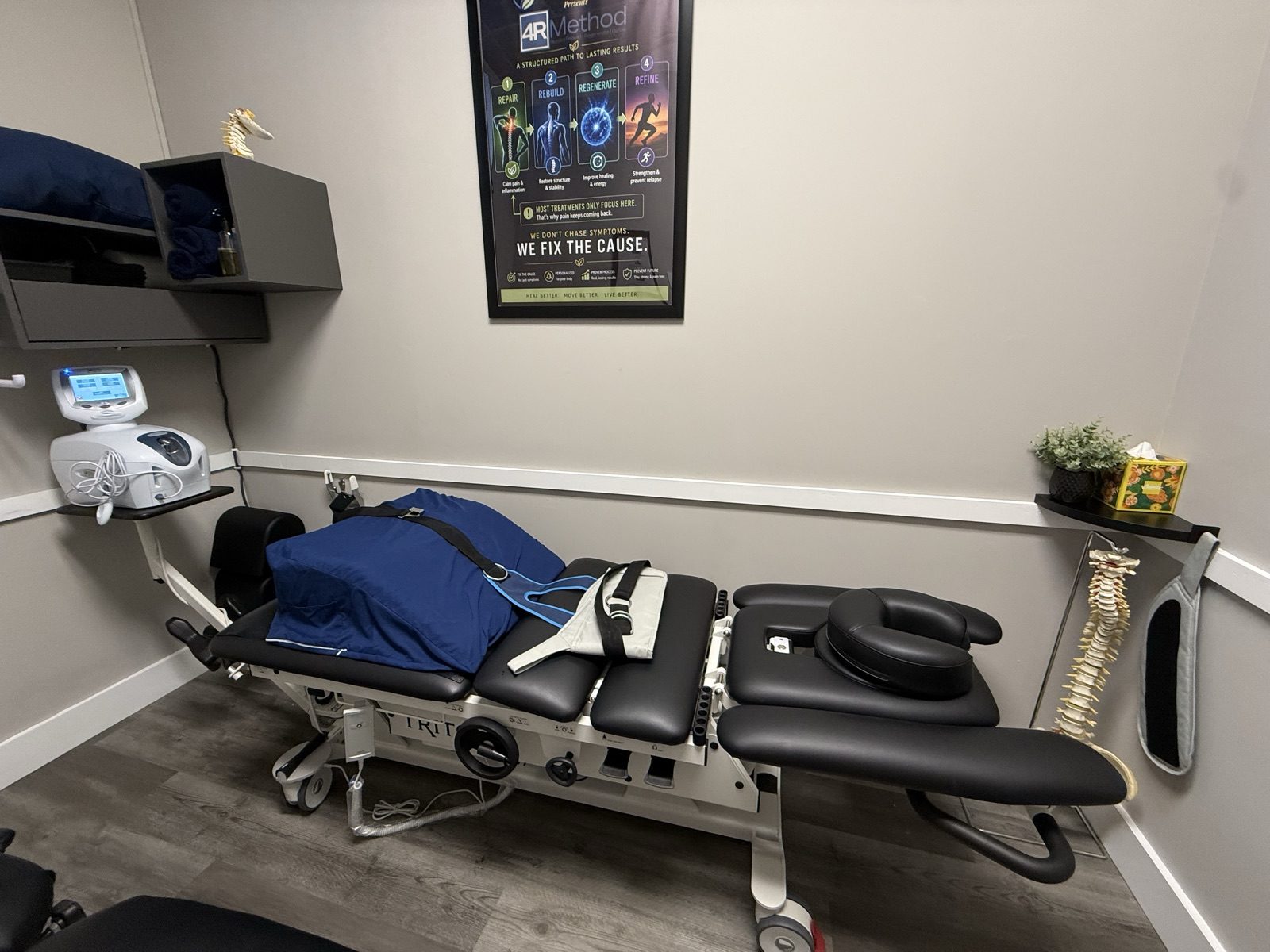
Every nerve plan we build follows the 4R Method — Repair, Rebuild, Regenerate, Refine — in that order. The first job is mechanical: create room around the nerve. The second is structural: make sure the room stays.
- Repair (3–5 visits a week, 4–8 weeks). Non-surgical decompression on the Triton DTS table gently separates the vertebrae and draws disc material away from the nerve root. Specific adjustments restore motion at the compressed level; cold laser and therapeutic ultrasound calm the inflamed tissue around the nerve.
- Rebuild (2–3 visits a week, 8–16 weeks). Corrective chiropractic protocols to restore the neck or lumbar curve, physical therapy for the deep stabilizers, Graston work for fibrotic tissue. This is what keeps the opening around the nerve from narrowing again.
- Regenerate (about twice a week, 2+ months). Red light, PEMF and IHHT oxygen therapy to support nerve recovery and tissue repair.
- Refine (monthly). Short structural tune-ups to protect the result.
Why not just stretch or medicate? Stretching cannot move a disc off a nerve, and anti-inflammatories lower the signal without changing the compression. In our experience, decompression inside the full 4R sequence — rather than a few sessions in isolation — is what produces nerve relief that lasts past the final appointment.
What happens at your first two visits?
A pinched nerve is a measurement problem before it is a treatment problem. Your first visit finds the level; your second visit explains the plan and begins care.
Visit one — we measure (and usually begin care)
- A real conversation. Where the pain travels, what makes it worse, how long it has been there, and what you need to get back to.
- A neurological screen. Reflexes, muscle strength and skin sensation along each nerve’s territory, plus nerve-tension tests for the arm and leg.
- A hands-on structural exam. Posture, neck and lumbar range of motion, and orthopedic tests that isolate the level of compression.
- Surface EMG and thermal scanning. Painless scans along the spine that show where muscles are guarding and where temperature changes point to nerve irritation.
- Digital X-rays, when indicated. Disc spacing, foraminal narrowing, curvature and spurs. We review any MRI you already have.
Visit two — findings and plan
We walk you through your scans and images, name the nerve and the structure compressing it, and lay out the 4R plan: phase, frequency, duration. Treatment begins at this visit. For a head start, take the 60-second spine assessment before you leave Parkland.
What helps a pinched nerve at home — and when to see a doctor instead
Your plan will include the right movements at the right stage, but a few principles apply to almost every compressed nerve from day one:
- Position is pressure. Sustained bending, sitting or looking down narrows the space around the nerve. Move frequently; make neutral posture the default.
- Stretching is not decompression. Forcing a stretch on an irritated nerve usually increases tingling. The nerve needs room, not tension.
- Motion, not rest. Gentle walking several times a day beats a day on the couch, which stiffens the spine and weakens the stabilizers.
- Protect your sleep position. Neck neutral on a supportive pillow; lower back unloaded on your side with a pillow between the knees.
- Ice first, heat later. Ice over the spine during the first 48 hours of a flare, heat for muscle tightness afterwards.
And know the warning signs that need a doctor today rather than a chiropractor: progressive weakness in an arm or leg, numbness in the groin or inner thighs, any change in bladder or bowel control, or nerve symptoms after a serious fall or accident. Please see a doctor or urgent care today if any of those apply. For everything else — the tingling, the radiating pain, the disc you were told might need surgery — see our guides to lower back pain relief and carpal tunnel treatment, then call us.
Getting to our Coral Springs clinic from Parkland
From Heron Bay or Parkland Golf & Country Club, head south on Coral Ridge Drive across the Sawgrass Expressway; the clinic is on Coral Ridge Drive just south of the expressway, before Wiles Road. From east Parkland, take Hillsboro Boulevard west to Coral Ridge Drive, then south.
Free parking is right at the door — no garage, no meters. Same-day appointments are usually available: call (954) 341-2256 or book online, and we will find a slot that fits your Parkland schedule.
| Monday | 9:00 am – 7:00 pm |
|---|---|
| Tuesday | 9:00 am – 7:00 pm |
| Wednesday | 3:00 pm – 7:00 pm |
| Thursday | 9:00 am – 7:00 pm |
| Friday | 9:00 am – 12:00 pm |
| Saturday – Sunday | Closed |
The Spine and Wellness Center
5675 Coral Ridge Drive, Coral Springs, FL 33076
Phone: (954) 341-2256
Get directions from Parkland on Google Maps
What patients say
A Google review from a patient who, like you, comes to us from Parkland:
“I love this place! They treat you like family and stand by you every step of the way.”
Related care for Parkland residents
Start with the full guide to pinched nerve treatment, then explore the other care we provide for Parkland patients.
Herniated discs — the full guide
The most common reason a spinal nerve gets pinched, and how decompression gives the disc room to retract.
Learn moreNeck pain relief — the full guide
When the pinched nerve is in the neck: arm pain, hand tingling and the cervical disc behind it.
Learn moreChiropractic care for Parkland
Your Parkland hub: everything we treat, directions, hours and what to expect on your first visit.
Learn moreCar accident injury treatment in Parkland
Car accident injury treatment for Parkland patients, from our Coral Springs clinic.
Learn moreHeadache & migraine treatment in Parkland
Headache & migraine treatment for Parkland patients, from our Coral Springs clinic.
Learn moreAll service areas
Every community we serve from Coral Springs, with drive times and the care available for each.
Learn moreServing pinched nerve patients from Parkland across North Broward
Our clinic at 5675 Coral Ridge Drive, Coral Springs, FL 33076 serves Coral Springs, Parkland, Coconut Creek, Margate, Boca Raton, Tamarac, Pompano Beach and Deerfield Beach. Same-day appointments are usually available — call (954) 341-2256 or book online. Most patients from Parkland and Coral Springs are here in under 15 minutes.
Medically reviewed by Dr. Jared Cohen, DC — Co-Founder & Clinical Director, The Spine and Wellness Center. Last reviewed October 2026.
Frequently asked questions
Can a pinched nerve heal without surgery?
In most cases, yes. The majority of compressed nerve roots improve with conservative care once the pressure comes off — which is what non-surgical spinal decompression, precise adjustments and corrective rehab are designed to do. Surgery is generally reserved for progressive weakness, loss of bladder or bowel control, or symptoms that fail to respond to other treatment.
How long does a pinched nerve take to get better?
Many patients notice tingling and radiating pain begin to recede within the first two to three weeks of the Repair phase. Full recovery depends on finishing the Rebuild phase, which corrects the posture, curve or pelvic imbalance that narrowed the nerve's opening. We re-scan along the way so progress is measured rather than guessed.
Is a pinched nerve the same as sciatica?
Sciatica is a pinched nerve in the lower back — usually at L4, L5 or S1 — that sends pain, tingling or numbness down the leg. 'Pinched nerve' is the broader term and also covers compressed nerves in the neck, which produce arm and hand symptoms, and peripheral entrapments such as carpal tunnel syndrome.
Do you offer same-day appointments for Parkland patients?
Usually, yes. Same-day appointments are often available at our Coral Springs clinic, about 5 to 10 minutes from Parkland, so pinched nerve treatment in Parkland can start the week you call. Your first visit is a measurement visit — exam, surface EMG and thermal scans, X-rays when indicated — and your plan and treatment begin on visit two, typically within a few days.
Is there parking at the clinic?
Yes. Free parking is right outside the door at 5675 Coral Ridge Drive — no garage, no meters, no validation. Most Parkland patients find it simpler than parking near the coast or at a medical tower, and you walk straight into reception.
Which Parkland neighborhoods do you serve?
All of them. We regularly see patients from Heron Bay, Parkland Golf & Country Club, Pine Trails Park, MiraLago and Terramar Park and across the 33067 and 33076 ZIP codes. Wherever you are in Parkland, the drive is about 5 to 10 minutes straight down Coral Ridge Drive or University Drive, and we schedule follow-ups around your commute.

Same-day appointments
Let's build your plan.
Find out what's actually going on and get a clear path forward. Same-day appointments available.
- Same-day appointments are usually available
- Our team calls you back to confirm your visit
- Coral Springs, serving Parkland & North Broward since 2005
Prefer to talk now? Call or text (954) 341-2256