
Conditions · Coral Springs & Parkland
Posture correction treatment in Coral Springs
Forward-head posture, rounded shoulders and a tilted pelvis are not cosmetic problems — they are the daily load behind most chronic neck and back pain. We measure posture on visit one and correct it in the Rebuild phase.
Quick answer
Posture correction is a structured program that restores the spine's natural curves and retrains the muscles that hold them. At The Spine and Wellness Center we measure posture objectively on visit one, then combine corrective chiropractic, physical therapy, Graston Technique and a short daily home routine in the Rebuild phase of the 4R Method — typically 8–16 weeks at 2–3 visits a week.
What is posture correction, and why does posture drive pain?
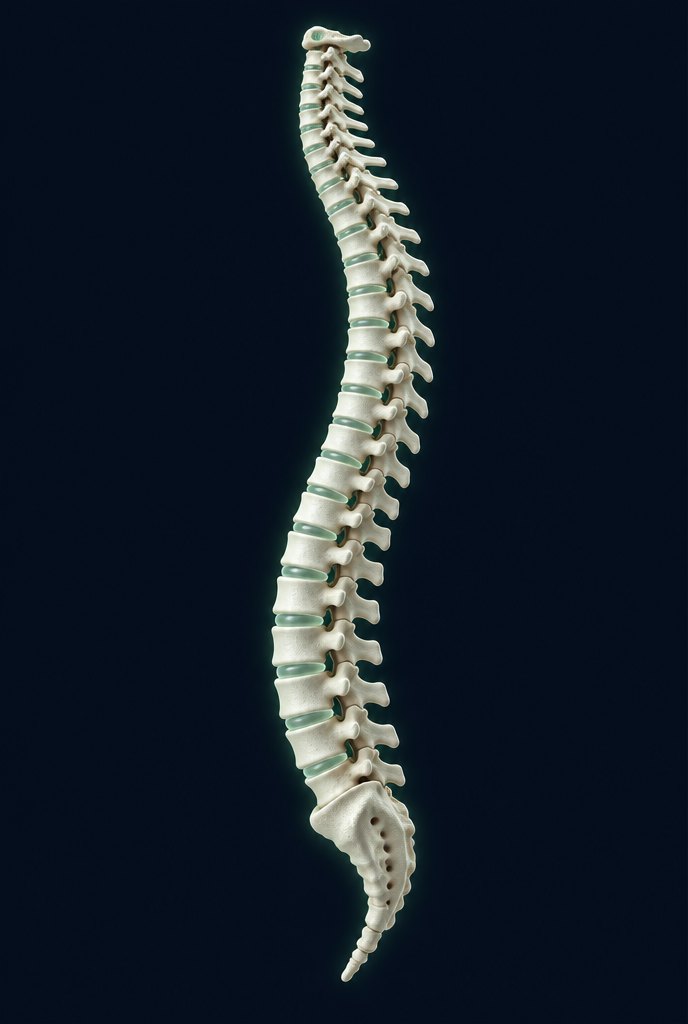
Posture correction is the process of restoring the spine’s natural curves — the inward curve of the neck and low back, the gentle outward curve of the mid-back — and retraining the muscles that hold them, so the body carries its own weight through its structure instead of through its joints, discs and ligaments. Posture is not about standing up straight; it is about load. Where your head, shoulders and pelvis sit all day decides which tissues are overworked.
The numbers make the point. The head weighs roughly 10–12 pounds in a neutral position. As it drifts forward over a phone or laptop, the effective load on the cervical spine climbs steeply — a widely cited biomechanical model estimates roughly 27 pounds at 15 degrees of flexion and about 60 pounds at 60 degrees. Hold that for eight hours a day in Coral Springs or Parkland traffic and at a desk, and the neck, upper back and shoulders do not stand a chance.
That is why posture correction sits at the center of long-term results at our clinic. Dr. Jared Cohen can decompress a disc and adjust a locked joint, but if the posture that compressed the disc and locked the joint goes uncorrected, the problem returns. Posture is the cause we fix in the Rebuild phase so the Repair phase holds.
The three posture patterns we see most (and the pain each one causes)
Almost every posture problem that walks into our Coral Springs clinic is a combination of three patterns. Identifying which ones you have — and in what proportion — is the first step of posture correction.
1. Forward-head posture (‘tech neck’)
The ears sit in front of the shoulders, the cervical curve flattens or reverses, and the muscles at the base of the skull (suboccipitals) and the upper trapezius work overtime to keep the eyes level. Typical complaints: neck stiffness, headaches at the base of the skull, tightness between the shoulder blades, and in time cervical disc degeneration and nerve irritation into the arms.
2. Rounded shoulders (upper crossed syndrome)
The shoulders roll forward and the upper back rounds as the chest muscles (pectorals) and upper trapezius tighten while the deep neck flexors and lower trapezius weaken — a predictable ‘cross’ of tight and weak muscles. The thoracic spine stiffens, breathing becomes shallow, and the shoulder joint loses the space it needs: rotator cuff irritation and impingement often start here.
3. Anterior pelvic tilt (lower crossed syndrome)
The pelvis tips forward, the low back arches excessively, and the belly pushes out. Tight hip flexors and low back extensors pair with weak glutes and deep abdominals — hours of sitting are the usual cause. The lumbar facet joints are compressed with every step and the hamstrings are chronically pulled tight; the result is low back pain that is worse standing, and hip and hamstring strains for golfers and runners.
Good to know
These patterns feed each other. A tilted pelvis shifts the trunk forward; the upper back rounds to compensate; the head comes forward to keep the eyes level. Correcting only the neck without the pelvis is why so many posture programs fail.
How we measure posture before we correct it (visit 1)
Posture correction only works when it is measured, because the eye is a poor judge of a few degrees — and a few degrees is the difference between a neck that hurts and one that does not. Your first visit establishes an objective baseline:
- Digital posture analysis. Front and side photographs analyzed for head position relative to the shoulders, shoulder height and rotation, pelvic tilt and the alignment of the ear, shoulder, hip, knee and ankle. Measured in degrees and inches, not eyeballed.
- A hands-on structural exam. Range of motion of the neck, thoracic spine and hips; muscle length tests for the pectorals, hip flexors and hamstrings; strength tests for the deep neck flexors, lower trapezius, glutes and deep core.
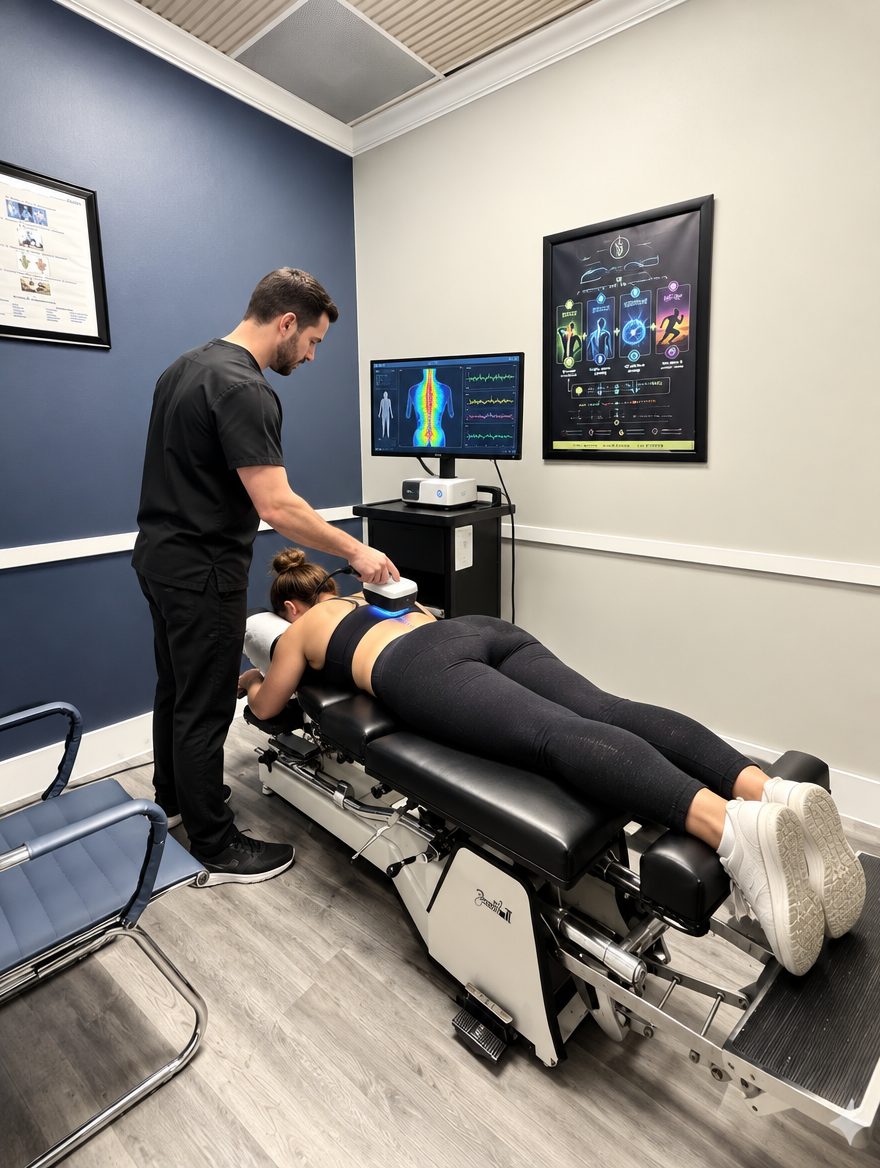
- Surface EMG and thermal scanning. A painless scan showing which muscles along the spine are overworking to hold you up — the objective signature of a posture problem — and where nerve irritation is present.
- Digital X-rays when indicated. The cervical and lumbar curves measured directly, and any degeneration the posture has already caused.
Visit two is your report of findings: your posture images, scans and X-rays side by side with what normal looks like, and a plan with a specific frequency and duration. Treatment begins that day. For a head start, take the 60-second spine assessment.
Our posture correction program: chiropractic, PT, Graston and a home routine
Posture correction is not a single treatment — it is four tools working on the same problem from different directions. Tight tissue has to be released, stiff joints have to move, weak muscles have to be strengthened, and the new position has to be practiced until it is the default. Remove any one and the others do not hold.
Corrective chiropractic
Specific adjustments restore motion to the segments that have locked into the bad position — most often the upper cervical joints, the stiff mid-thoracic spine and the sacroiliac joints — and corrective protocols work toward restoring the cervical and lumbar curves. Joints that cannot move cannot be retrained, so this comes first.
Physical therapy and corrective exercise
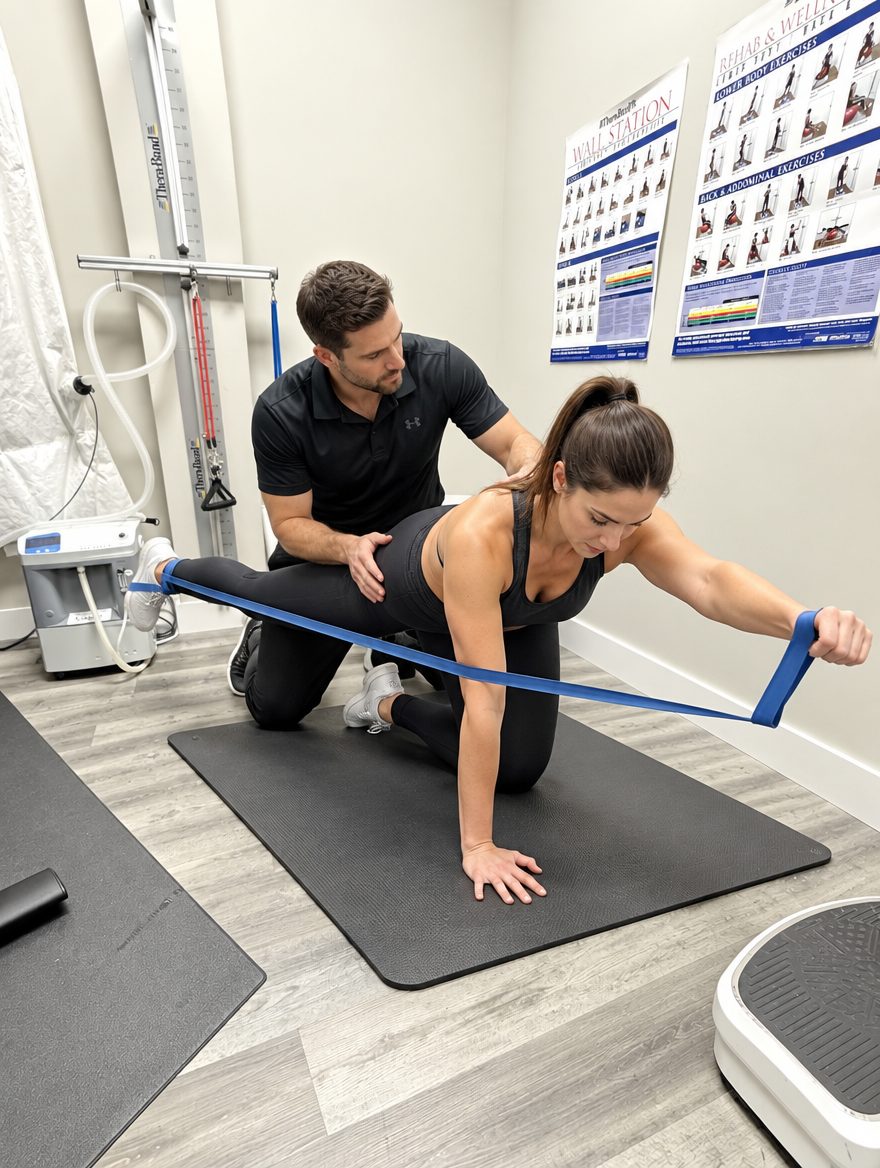
Physical therapy strengthens the weak side of each ‘cross’: deep neck flexors and lower trapezius for the upper body, glutes and deep abdominals for the pelvis. Exercises are few, specific and progressed — chin tucks, wall angels, thoracic extension, hip-flexor lengthening and glute bridges are typical starting points, not a 40-minute gym routine.
Graston Technique and soft tissue release
Years in one position leave the pectorals, upper trapezius, suboccipitals and hip flexors short and fibrotic. Graston Technique and therapeutic massage release that tissue so the joints can reach the corrected position and the strengthening can take hold.
The daily home routine
Five to ten minutes a day, built from your exam: typically two mobility drills, two strengthening drills and a set of environment fixes — monitor at eye level, phone raised rather than head lowered, a lumbar support in the car for the Sawgrass commute, and a two-minute posture reset every 30–45 minutes of sitting. Posture correction happens in the other 23 hours as much as in the clinic.
Chiropractic care
Restore motion to the locked cervical, thoracic and pelvic segments so the spine can reach a corrected position.
Learn morePhysical therapy
Strengthen the deep neck flexors, lower traps, glutes and core that hold good posture without effort.
Learn moreGraston Technique
Release the short, fibrotic pecs, upper traps and hip flexors that pull you back into the old position.
Learn moreSpinal decompression
When posture has already irritated a disc or nerve, decompression comes first in the Repair phase.
Learn moreHow long does posture correction take? Realistic timelines
Posture correction lives in the Rebuild phase of the 4R Method — typically 2–3 visits a week for 8–16 weeks — and the honest answer is that it takes months, not weeks, because you are changing tissue length, joint motion and motor habits that took years to form.
- If you are in pain now: the Repair phase comes first (3–5 visits a week for 4–8 weeks) to calm the irritated disc, joint or nerve. Correcting posture on an inflamed spine does not hold.
- Weeks 1–4 of Rebuild: joints start moving, tight tissue releases, and most people feel ‘taller’ and less stiff. Re-scans begin to show overworking muscles quieting.
- Weeks 4–8: strength catches up; holding the corrected position stops taking effort. Headaches and between-the-shoulder-blade pain usually reduce substantially in this window.
- Weeks 8–16: the corrected posture becomes the default. We re-measure posture and curves and compare them to visit one.
- After: Regenerate (about 2 visits a week for 2+ months) supports tissue quality with red light and PEMF, and Refine — a brief monthly tune-up — keeps the correction for desk workers whose daily load has not changed.
What posture correction cannot do is reverse established degeneration or fully straighten a structural scoliosis; it can reduce the load on those areas and the pain they produce. Nor is there evidence that posture braces or ‘posture shirts’ retrain muscles on their own — they tend to do the holding for you, which is the opposite of what the muscles need.
Is posture really the cause of neck and back pain? What the evidence says
Sustained awkward posture is a recognized risk factor for neck and low back pain, particularly when combined with prolonged sitting and repetitive tasks. The National Institute of Neurological Disorders and Stroke lists poor posture, prolonged sitting and lack of exercise among the factors that contribute to back pain, and recommends posture-conscious habits, regular movement and strengthening of the core as part of prevention (NINDS, Back Pain).
The clinical nuance is that there is no single ‘perfect’ posture, and the best posture is the next one — the body is built to move. The goal of posture correction is not to freeze you in a textbook position but to give you a neutral default you can return to easily, the mobility to move away from it, and the strength to hold it without thinking. That is what makes the correction stick on the golf course, at the pickleball courts and at the desk alike.
If posture has already produced a specific problem — a cervical disc, chronic headaches, upper back pain between the shoulder blades, or low back and hip pain from a tilted pelvis — our neck pain treatment, upper back pain and lower back pain pages explain how the condition is treated first, with posture correction as the phase that keeps it from returning.
Serving posture correction patients across North Broward
Our clinic at 5675 Coral Ridge Drive, Coral Springs, FL 33076 serves Coral Springs, Parkland, Coconut Creek, Margate, Boca Raton, Tamarac, Pompano Beach and Deerfield Beach. Same-day appointments are usually available — call (954) 341-2256 or book online. Most patients from Parkland and Coral Springs are here in under 15 minutes.
Medically reviewed by Dr. Jared Cohen, DC — Co-Founder & Clinical Director, The Spine and Wellness Center. Last reviewed October 2026.
Frequently asked questions
Can posture really be corrected as an adult?
Yes. Joint motion, muscle length and strength all respond to training at any age, and most postural patterns are muscular and habitual rather than fixed in bone. Established degeneration and structural scoliosis set limits on how much the shape changes, but even then the load — and the pain — can be reduced substantially.
How long does posture correction take?
Plan on 8–16 weeks of Rebuild-phase care at 2–3 visits a week, plus a five-to-ten-minute daily home routine. People in pain usually need a 4–8 week Repair phase first. Most patients feel less stiff within the first month; measurable changes in head position, shoulder alignment and pelvic tilt show up on re-measurement at eight to sixteen weeks.
Do posture braces or posture shirts work?
Not on their own. A brace holds you in position, which lets the muscles that should be doing the holding stay weak. Short-term use as a reminder can help some people, but posture correction depends on restoring joint motion, releasing tight tissue and strengthening the deep stabilizers — none of which a brace does.
What is tech neck?
Tech neck is forward-head posture driven by hours looking down at phones and laptops. The head drifts forward, the cervical curve flattens and the muscles at the base of the skull and across the upper back overwork. Neck stiffness, headaches and tightness between the shoulder blades are the usual results, and cervical disc problems can follow over years.
Is posture correction included in treatment for neck or back pain?
Posture correction is built into the Rebuild phase of most neck and back pain plans at our clinic, because uncorrected posture is the most common reason pain returns. On visit two we explain exactly which treatments are recommended and for how long, so you know the full plan before you begin.
What can I do at home to improve posture today?
Raise your screen to eye level, bring the phone up rather than the head down, stand or walk for two minutes every 30–45 minutes, and sleep on your side or back rather than your stomach. Chin tucks and thoracic extension over a rolled towel are safe starting drills; your exam will tell us which others you need.

Same-day appointments
Let's build your plan.
Find out what's actually going on and get a clear path forward. Same-day appointments available.
- Same-day appointments are usually available
- Our team calls you back to confirm your visit
- Coral Springs, serving Parkland & North Broward since 2005
Prefer to talk now? Call or text (954) 341-2256