
Treatment · Coral Springs & Parkland
Massage Therapy in Parkland, FL
Therapeutic massage prescribed from your exam and scans, paired with chiropractic and decompression, about 5 to 10 minutes from Parkland straight down Coral Ridge Drive or University Drive. Same-day appointments most days.
Quick answer
Massage therapy near Parkland is available at The Spine and Wellness Center, 5675 Coral Ridge Drive, Coral Springs — about 5 to 10 minutes from Parkland. Your first visit is a measurement visit: hands-on exam, surface EMG and thermal scans, X-rays when indicated. Treatment — targeted clinical massage scheduled right before your adjustment or decompression — usually starts on visit one; your full plan follows at visit two.
Why Parkland patients choose us for massage therapy
Plenty of Parkland residents could find a chiropractor closer to home. They make the drive to us for massage therapy in Parkland for three practical reasons.
- It is a straightforward drive. Our clinic at 5675 Coral Ridge Drive is about 5 to 10 minutes from Parkland straight down Coral Ridge Drive or University Drive, with free parking at the door. Patients from Heron Bay, Parkland Golf & Country Club and Pine Trails Park are here every week.
- Hours that fit a working week. We are open until 7:00 pm on Monday, Tuesday and Thursday, with Wednesday afternoon and Friday morning hours, so you can come after work or before the commute without using a vacation day.
- We already know Parkland. We typically see Parkland families and youth athletes from Pine Trails Park, golfers from Heron Bay and Parkland Golf & Country Club, and parents juggling long days behind a desk and the carpool line. Your plan is built around how you actually spend your days, not a generic template.
Clinical massage versus a spa massage: what Parkland patients should expect
If you are searching for massage therapy in Parkland, it helps to know which kind you are looking for. A spa massage is designed to feel good for an hour. The therapeutic massage we provide at The Spine and Wellness Center is designed to change something — the resting tone of the muscles beside an irritated joint, the knot in the upper trapezius pulling your neck forward, the tight hip flexors tilting your pelvis.
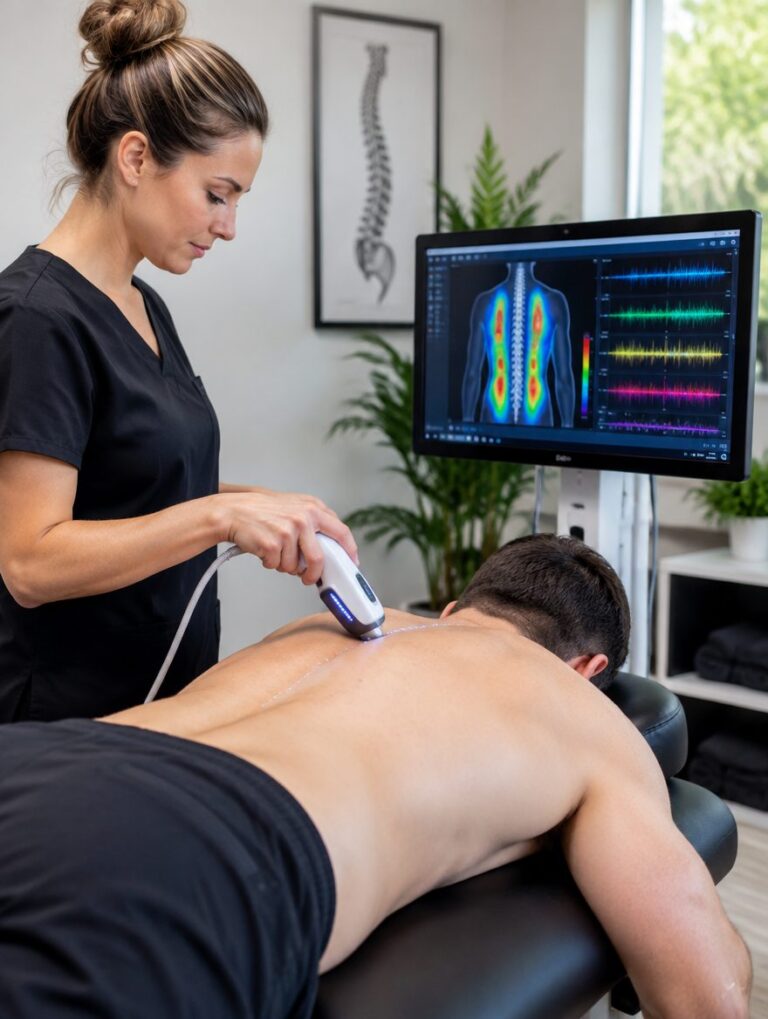
That is why it lives inside a chiropractic clinic. Our therapist works from the same exam findings and surface EMG scans Dr. Jared Cohen, DC uses, so the muscles being treated are the ones the scans show are guarding — not a full-body routine. Sessions are focused, sometimes more intense than a spa session, and judged by what your spine does the next day rather than how you feel on the table.
We have cared for Parkland families since 2005, and between golf at Parkland Golf & Country Club and Heron Bay and long days behind a desk or a steering wheel there is no shortage of tight backs and shoulders to work on. Start with our main massage therapy guide for the full picture; this page covers what matters for Parkland patients specifically.

How does massage release guarding, trigger points and fascia?
A muscle in spasm is doing a job: splinting a joint or a disc it thinks is in danger. The trouble is that it keeps doing the job long after the danger has passed. Clinical massage is how we talk it out of that, and the technique depends on what the tissue is doing.
Guarding and spasm
Slow, sustained pressure along the lumbar or cervical paraspinals drops their resting tone. This is the most common prescription for Parkland patients in acute pain — the back so tight they cannot stand straight after youth soccer and baseball at Pine Trails Park.
Trigger points and referral
A trigger point is a taut band that sends pain elsewhere: upper traps into the temple, suboccipitals behind the eye, piriformis down the leg like sciatica. Held pressure on the band itself, not the place it hurts, is what releases it.
Fascia, and when hands are not enough
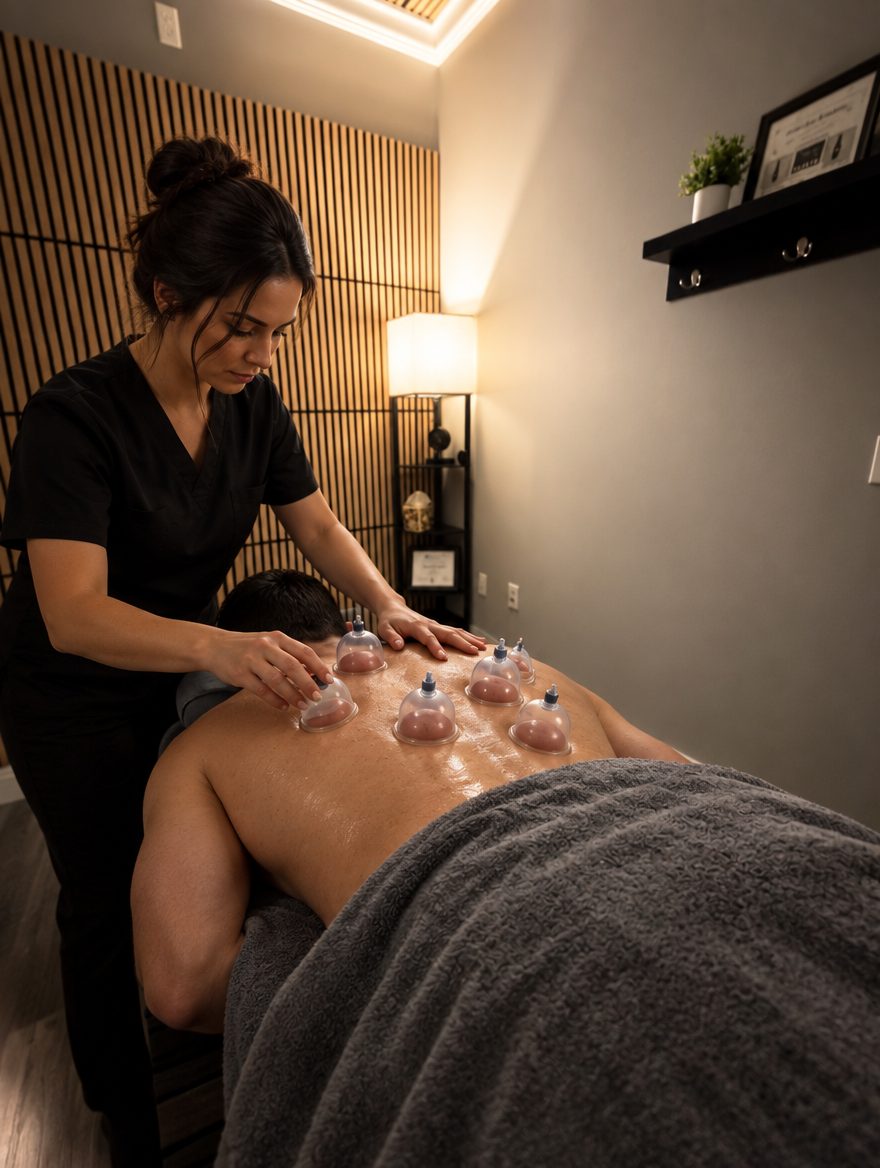
Myofascial release stretches thickened connective tissue slowly and at low load. Cupping lifts tissue by suction where compression has stopped working. For the fibrotic adhesions around an old injury we hand off to Graston Technique, whose instruments reach what fingers cannot.
NCCIH reports that massage may help short-term with low back and neck pain and is generally safe from a trained professional (NCCIH, Massage Therapy: What You Need To Know) — which is precisely the window we use it in.
Why pair massage therapy in Parkland with adjustments and decompression?
Ask anyone who has had an adjustment that felt great for a day and then ‘went back’: the muscles put it back. That is the whole argument for scheduling massage and chiropractic together, and it is why we book them back-to-back in the same visit for Parkland patients.
- Before the adjustment: releasing guarding lets the joint move with less force, which is more comfortable and holds longer.
- Before decompression: relaxed lumbar paraspinals let the Triton DTS table separate the vertebrae instead of fighting braced muscle.
- After a hard visit: a short session calms soreness and keeps the segment moving between appointments.
- Alongside Graston: massage handles tone and guarding; Graston Technique handles the fibrotic adhesions underneath.
The pattern repeats across conditions. For neck pain it is upper traps and suboccipitals before a cervical adjustment. For low back and sciatica it is lumbar paraspinals, glutes and piriformis before decompression. For hip and SI pain it is hip flexors and glutes before the pelvis is leveled. Massage is rarely the treatment; it is what makes the chiropractic treatment stick.
Where does massage fit in the 4R Method?
Every plan at The Spine and Wellness Center follows the 4R Method — Repair, Rebuild, Regenerate, Refine — and massage therapy in Parkland shows up in more than one phase, with a different job in each.
Repair — support (3–5 visits a week, 4–8 weeks)
In Repair, massage is a support tool. Its job is to release guarding so adjustments and decompression can do their work, and so you sleep — many Parkland patients in acute pain have not slept through the night in weeks. Sessions are shorter and highly targeted.
Rebuild and Regenerate — as needed
Once the pain has settled and rehab takes over (2–3 visits a week for 8–16 weeks, then about twice a week in Regenerate), massage drops to as-needed: a session when physical therapy loading leaves the hips or mid-back tight, or when the surface EMG re-scan shows a region guarding again.
Refine — recovery (monthly)
In Refine, massage becomes recovery. A monthly 60-minute session alongside your structural tune-up keeps tissue supple, catches new trigger points early, and — for the golfers, pickleball players and desk workers of Parkland — is often the difference between a tight week and a flare-up.
What is a session like, who benefits most, and what happens at your first two visits?
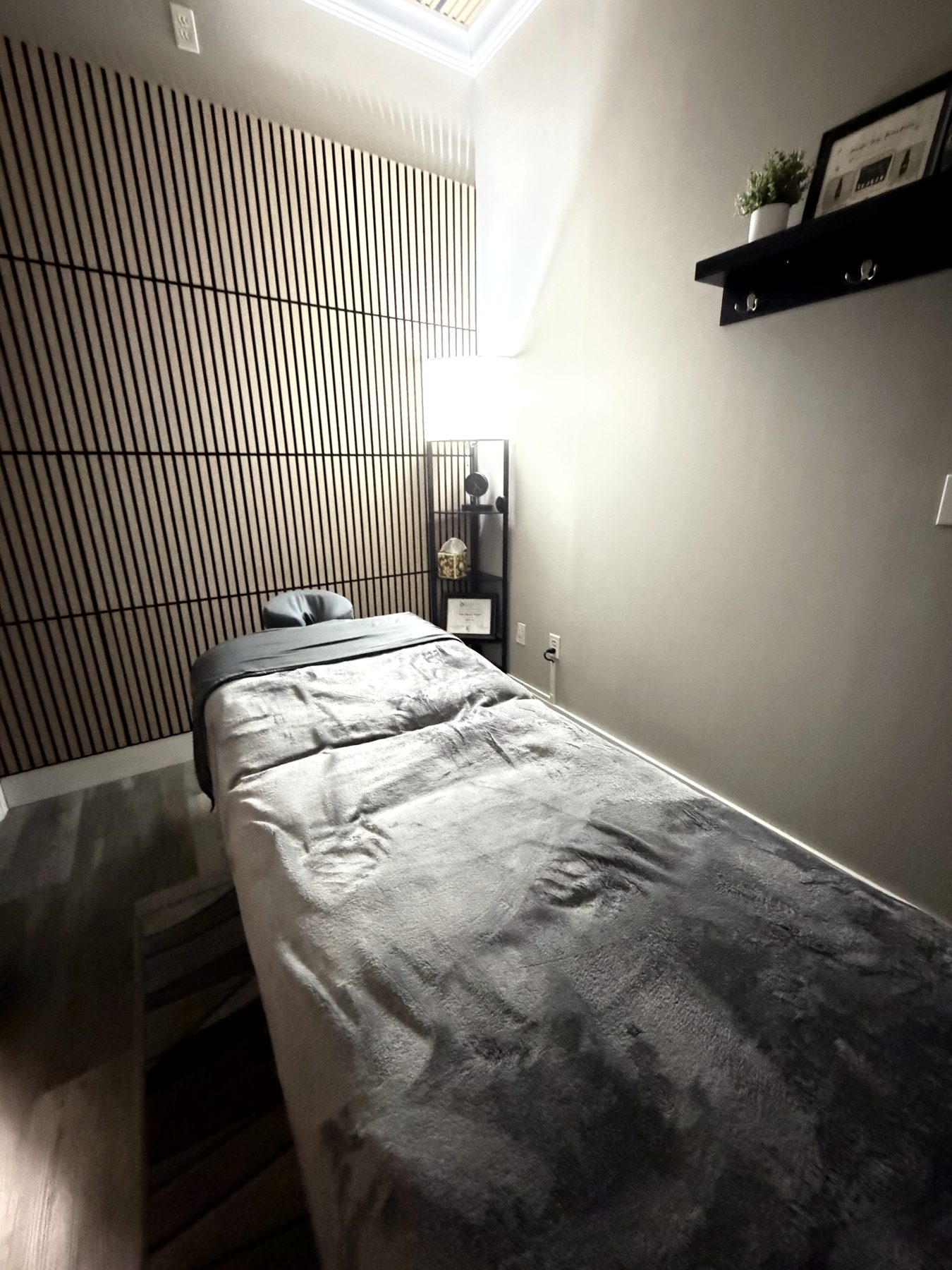
Sessions are 30 or 60 minutes depending on the plan, in a private room, and focused on the regions your findings call for. A typical session for a Parkland patient runs like this:
- Check-in. The therapist reviews your current symptoms and the latest scan findings and asks about pressure tolerance.
- Targeted work. Guarding release and trigger point therapy on the regions driving your pain — commonly the lumbar paraspinals and glutes, or the upper traps and suboccipitals.
- Pressure you control. Clinical does not mean painful. Deep work should feel like a ‘good hurt’ you can breathe through; say the word and it eases.
- Hand-off. Massage is usually scheduled right before your adjustment, so you walk from the massage room to the treatment room.
Afterward, drink water, move gently and expect mild soreness for up to a day in areas that were very tight. Tell us about skin conditions, blood thinners, recent surgery or pregnancy before your session so the approach can be adapted. Massage changes the trajectory most for acute low back pain with heavy guarding, tension headaches from desk posture, hip and SI pain with tight flexors, athletes between training sessions, and stress-driven shoulder tension.
Like everything here, massage is prescribed after your first two visits. Visit one is a measurement visit: a conversation, a hands-on structural exam, surface EMG and thermal scanning, and digital X-rays when indicated. Visit two is your report of findings with Dr. Jared Cohen, DC, and Most patients have already begun care on visit one; this is where the full plan takes over. Take the 60-second spine assessment before you leave Parkland for a head start. If you have loss of bladder or bowel control, rapidly worsening weakness, or back pain with fever, please see a doctor or urgent care today.
Getting to our Coral Springs clinic from Parkland
From Heron Bay or Parkland Golf & Country Club, head south on Coral Ridge Drive across the Sawgrass Expressway; the clinic is on Coral Ridge Drive just south of the expressway, before Wiles Road. From east Parkland, take Hillsboro Boulevard west to Coral Ridge Drive, then south.
Park free in the lot outside the clinic. If you need to be seen quickly, call (954) 341-2256 — we hold same-day slots most days, and we will tell you exactly when to leave Parkland to arrive on time.
| Monday | 9:00 am – 7:00 pm |
|---|---|
| Tuesday | 9:00 am – 7:00 pm |
| Wednesday | 3:00 pm – 7:00 pm |
| Thursday | 9:00 am – 7:00 pm |
| Friday | 9:00 am – 12:00 pm |
| Saturday – Sunday | Closed |
The Spine and Wellness Center
5675 Coral Ridge Drive, Coral Springs, FL 33076
Phone: (954) 341-2256
Get directions from Parkland on Google Maps
What patients say
A Google review from a patient who, like you, comes to us from Parkland:
“My first time seeing a chiropractor I was nervous, but the whole office is welcoming and the doctors were so helpful. I trusted them enough to fix me — they make you feel brand new.”
Related care for Parkland residents
Start with the full guide to massage therapy, then explore the other care we provide for Parkland patients.
Massage therapy — the full guide
Clinical versus spa massage, trigger point and myofascial work, cupping, and where massage sits in the 4R Method.
Learn moreChiropractic care for Parkland
Your Parkland hub: everything we treat, directions, hours and what to expect on your first visit.
Learn moreSpinal decompression in Parkland
Spinal decompression for Parkland patients, from our Coral Springs clinic.
Learn moreWhiplash treatment in Parkland
Whiplash treatment for Parkland patients, from our Coral Springs clinic.
Learn moreAll service areas
Every community we serve from Coral Springs, with drive times and the care available for each.
Learn moreServing massage therapy patients from Parkland across North Broward
Our clinic at 5675 Coral Ridge Drive, Coral Springs, FL 33076 serves Coral Springs, Parkland, Coconut Creek, Margate, Boca Raton, Tamarac, Pompano Beach and Deerfield Beach. Same-day appointments are usually available — call (954) 341-2256 or book online. Most patients from Parkland and Coral Springs are here in under 15 minutes.
Medically reviewed by Dr. Jared Cohen, DC — Co-Founder & Clinical Director, The Spine and Wellness Center. Last reviewed October 2026.
Frequently asked questions
Should I get massage before or after my adjustment?
Usually before. Releasing the guarding muscles first lets the adjustment go in with less force and hold longer. In some Refine-phase visits it is scheduled after, as recovery. Your plan sets the order, and the two are typically booked back-to-back in the same visit so you walk from one room to the next.
How often should I get massage therapy?
In the Repair phase it is often weekly or more, as a support for adjustments and decompression. In Rebuild and Regenerate it drops to as needed — after a hard rehab session or when a re-scan shows new guarding. In Refine, a monthly session alongside your structural tune-up is the most common pattern for ongoing recovery.
Can I book massage therapy on its own?
Massage here is part of a treatment plan built from your exam on visit one and your report of findings on visit two, because the regions treated are chosen from your scans. Established patients in the Refine phase can book standalone recovery sessions alongside their monthly tune-up.
Do you offer same-day appointments for Parkland patients?
Usually, yes. Same-day appointments are often available at our Coral Springs clinic, about 5 to 10 minutes from Parkland, so massage therapy in Parkland can start the week you call. Your first visit is a measurement visit — exam, surface EMG and thermal scans, X-rays when indicated — and your plan and treatment begin on visit two, typically within a few days.
Do you take patients from Parkland?
Yes. We have treated Parkland patients since 2005, including families from Heron Bay, Parkland Golf & Country Club and Pine Trails Park. Our clinic at 5675 Coral Ridge Drive in Coral Springs is about 5 to 10 minutes from Parkland straight down Coral Ridge Drive or University Drive, and the 33067 and 33076 ZIP codes are all inside our normal service area.
How far is the clinic from Heron Bay?
From Heron Bay, plan on about 5 to 10 minutes to 5675 Coral Ridge Drive, Coral Springs, FL 33076 — straight down Coral Ridge Drive or University Drive. The clinic is on Coral Ridge Drive just south of the Sawgrass Expressway, with free parking at the door.
Same-day appointments
Let's fix the cause.
Measure first, then treat — a plan built on your actual structure.
- Same-day appointments are usually available
- Our team calls you back to confirm your visit
- Coral Springs, serving Parkland & North Broward since 2005
Prefer to talk now? Call or text (954) 341-2256