
Conditions · Coral Springs & Parkland
Scoliosis treatment & management in Coral Springs
A curved spine does not have to mean a life of pain and limitation. We do not claim to straighten a structural curve — we help you stand taller, move easier, hurt less, and know exactly when a specialist should be involved.
Quick answer
Conservative scoliosis treatment focuses on pain, posture, strength and function, not on 'correcting the curve'. For adolescents, the priority is monitoring curve progression and timely bracing referral; for adults, it is managing the degenerative pain and stiffness that a curve creates. We combine gentle adjustments, posture rehab, physical therapy and decompression inside the 4R Method, and coordinate with orthopedic specialists when a curve needs more.
What is scoliosis, and what can treatment realistically do?
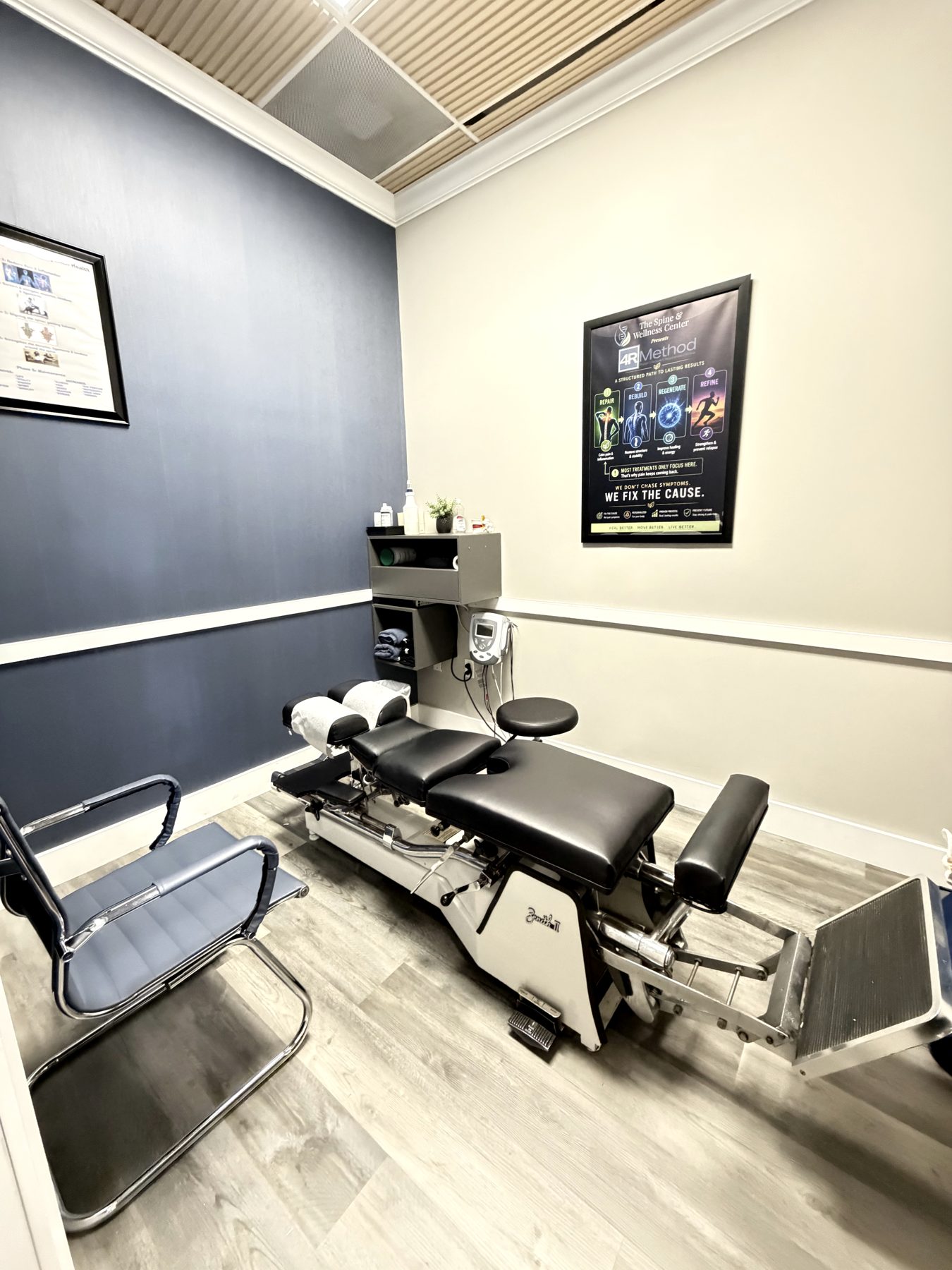
Honest scoliosis treatment begins with an honest definition. Scoliosis is a sideways, usually rotating curve of the spine — shaped like a ‘C’ or an ‘S’ — measured on an X-ray as a Cobb angle of 10 degrees or more. It shows up in children, in teenagers during growth spurts, and in adults as the spine changes with age. Most cases are idiopathic, meaning no single cause is identified.
For many people a curve brings uneven shoulders or hips, a visible rib hump when bending forward, one-sided muscle fatigue, and back pain. In adults, the curve concentrates wear on the discs and facet joints along its concave side, which is where disc degeneration, stenosis and sciatica tend to develop.
What conservative scoliosis treatment — chiropractic and physical therapy — can do: reduce pain, improve posture and mobility, strengthen the muscles that support a curve, and keep you active. What they cannot do: straighten a structural curve or stop adolescent progression on their own. Our scoliosis treatment in Coral Springs is built on that distinction, and we will always be honest about which side of it your spine is on.
Adolescent vs adult scoliosis: two different problems
The same word describes two conditions with different priorities:
- Adolescent idiopathic scoliosis (AIS) appears between about 10 and 18, usually during the growth spurt, and is more common in girls. It is often painless at first. The central question is whether the curve will progress while the skeleton is still growing — which is a monitoring and specialist question, not a treatment-with-adjustments question.
- Adult scoliosis is either an adolescent curve carried into adulthood or a ‘de novo’ degenerative curve that develops after 50 as discs and joints wear unevenly. Progression is slow (often about 1 degree a year), and the central question is pain, stiffness, nerve symptoms and function. This is where conservative care has the most to offer.
- Other causes — congenital vertebral differences, neuromuscular conditions, leg-length differences — are identified on the first visit and may need co-management.
Good to know
A leg-length difference or pelvic tilt can create a ‘functional’ curve that straightens when the cause is corrected. Distinguishing a functional curve from a structural one is one of the first things the exam does.
Monitoring and bracing: when a curve needs a specialist
For a growing adolescent, timing matters more than anything else in scoliosis treatment. The American Academy of Orthopaedic Surgeons describes the standard thresholds: curves under about 25 degrees in a growing child are observed with repeat X-rays every 4–6 months; curves of roughly 25–45 degrees in a still-growing patient are typically braced to prevent progression; and curves beyond about 45–50 degrees are evaluated for surgery (AAOS OrthoInfo, Idiopathic Scoliosis).
- Screening. The Adams forward-bend test and a scoliometer reading on visit one; a reading of 7 degrees or more, or visible asymmetry, prompts a standing X-ray.
- Measurement. We measure the Cobb angle on digital X-rays and document skeletal maturity, so the curve can be tracked over time.
- Referral. Any growing adolescent at or near the bracing threshold, any curve progressing more than 5 degrees between films, and any adult curve with progressive nerve symptoms is referred to a pediatric or spine orthopedist. We co-manage — bracing and our rehab are not either-or.
- Re-measurement. Adolescents are re-imaged on the specialist’s schedule; adults with symptomatic curves are typically re-imaged every 1–2 years or when symptoms change.
We do not promise to reduce a Cobb angle, and we are cautious about any provider who does. What we promise is accurate measurement, timely referral, and care for the pain and function that a curve creates.
How we approach scoliosis treatment with the 4R Method
Our scoliosis treatment runs on the 4R Method — Repair, Rebuild, Regenerate, Refine — with the goal of a spine that hurts less and does more, inside the limits your curve sets.
R1 · Repair — ease the pain the curve creates
Gentle, low-force adjustments to the restricted segments along the curve and the pelvis, non-surgical decompression when discs on the concave side are irritated, and cold laser or massage therapy for the chronically overworked muscles on the convex side. Typically 3–5 visits a week for 4–8 weeks for a painful adult curve; adolescents without pain usually skip straight to Rebuild.
R2 · Rebuild — strength, posture and body awareness
Physical therapy built on curve-specific, scoliosis-oriented exercise — asymmetric strengthening, breathing mechanics, and posture correction that teaches the body where neutral is. Usually 2–3 visits a week for 8–16 weeks, then a home program that continues for life. Where a leg-length difference contributes, a GaitScan assessment and orthotics can level the foundation.
R3 and R4 · Regenerate and Refine
PEMF and red light at about 2 visits a week support the joints and discs taking uneven load, and a brief tune-up every month or two keeps mobility and posture from drifting.
Physical therapy
Curve-specific strengthening and breathing mechanics — the core of conservative scoliosis care.
Learn morePosture correction
Retrain the body's sense of neutral so the curve is supported, not exaggerated, all day.
Learn moreChiropractic adjustments
Gentle, specific motion restored to locked segments along the curve and the pelvis.
Learn moreNon-surgical spinal decompression
Relief for the irritated discs and nerves on the concave side of an adult curve.
Learn moreWhat to expect at your first two visits
Visit one — we measure (and usually begin care)
- A real conversation. When the curve was first noticed, any prior X-rays or bracing, growth history for adolescents, pain pattern and nerve symptoms for adults, and your goals.
- A hands-on structural exam. Adams forward-bend test and scoliometer, shoulder and pelvic levels, leg-length assessment, rib hump measurement, spinal mobility, and neurological screening.
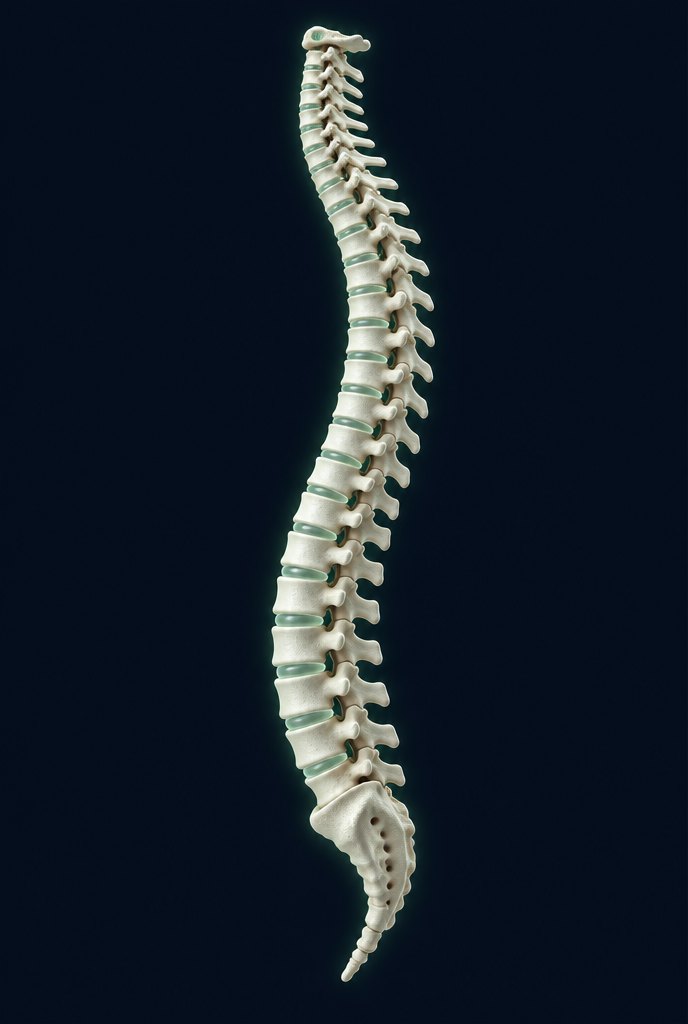
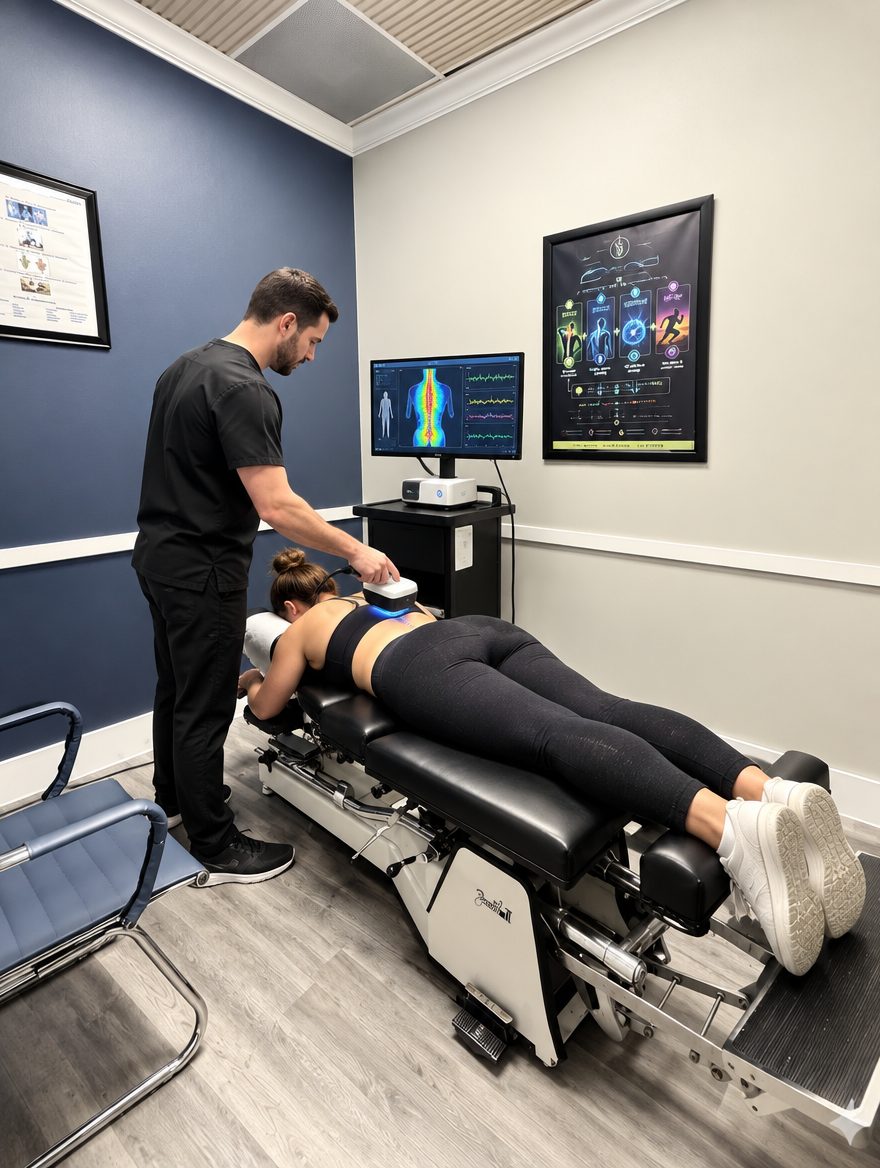
- Surface EMG and thermal scanning. A painless scan showing the asymmetric muscle activity along the curve — one of the most useful objective markers of progress in scoliosis care.
- Digital X-rays when indicated. A standing full-spine film to measure the Cobb angle and assess skeletal maturity; we review any films you already have.
Visit two — your findings and your plan
We show you the curve, explain whether it is structural or functional, where it sits relative to the monitoring and bracing thresholds, and whether a specialist should be involved now. Then we map a realistic 4R plan. Your full plan starts here — and in most cases care already began on visit one. The 60-second spine assessment gives us a head start.
Living with scoliosis: habits that protect a curved spine
- Stay active. Swimming, walking, cycling and strength training are all appropriate for most curves; activity does not worsen idiopathic scoliosis and inactivity weakens the muscles that support it.
- Do the home program. Curve-specific exercises done daily are the part of scoliosis treatment that matters most — more than anything done once a week in a clinic.
- Set up the desk and the backpack. Monitor at eye level, both straps on the backpack, and a chair that supports the lumbar spine.
- Sleep neutral. On the back or side with a supportive mattress; avoid stomach sleeping.
- Keep appointments for re-measurement. For adolescents, the schedule the orthopedist sets; for adults, when symptoms change.
Please see a doctor or urgent care today if you develop sudden weakness in the legs, loss of bladder or bowel control, numbness in the groin, or shortness of breath linked to a large thoracic curve. For the everyday work of living well with scoliosis — the pain, the posture, the stiffness — conservative scoliosis treatment is what we do in Coral Springs and Parkland. If your main symptom is low back pain, start with our lower back pain guide.
Serving scoliosis patients across North Broward
Our clinic at 5675 Coral Ridge Drive, Coral Springs, FL 33076 serves Coral Springs, Parkland, Coconut Creek, Margate, Boca Raton, Tamarac, Pompano Beach and Deerfield Beach. Same-day appointments are usually available — call (954) 341-2256 or book online. Most patients from Parkland and Coral Springs are here in under 15 minutes.
Medically reviewed by Dr. Jared Cohen, DC — Co-Founder & Clinical Director, The Spine and Wellness Center. Last reviewed October 2026.
Frequently asked questions
Can a chiropractor fix scoliosis?
No — chiropractic care does not straighten a structural curve, and we never promise to. What conservative care can do is reduce pain, improve posture and mobility, strengthen the muscles that support the spine, and help you stay active. We measure the curve accurately and refer to a specialist when bracing or surgery should be considered.
When does scoliosis need a brace?
For a growing adolescent, orthopedic guidelines generally recommend bracing for curves of roughly 25–45 degrees to prevent progression, observation for smaller curves, and surgical evaluation above about 45–50 degrees. Bracing is an orthopedic decision; we screen, measure and refer promptly, then co-manage pain and strength alongside the brace.
Does scoliosis get worse in adults, and does scoliosis treatment help?
Adult curves tend to progress slowly, often around a degree a year, faster when degeneration is advanced. Symptoms, however, depend far more on strength, posture and joint health than on the exact angle, which is why conservative care helps even when the curve itself does not change.
Is scoliosis treatment painful?
No. Our care uses gentle, low-force adjustments, curve-specific exercise, soft-tissue work and decompression chosen for your spine. Treatment is designed to relieve discomfort, not add to it, and we adjust the plan to keep every visit comfortable.
Should my teenager be screened for scoliosis?
Yes, especially during the growth spurt between about 10 and 15. A forward-bend test and scoliometer reading take two minutes on the first visit, and a standing X-ray is ordered only if the screen is positive. Early detection is what makes bracing effective.
Do you see scoliosis patients from Parkland and Boca Raton?
Yes. Our clinic on Coral Ridge Drive in Coral Springs is minutes from Parkland, Coconut Creek, Margate and Boca Raton, and we see adolescents and adults with scoliosis from across North Broward, with same-day appointments usually available.
Keep reading
From the blog
Same-day appointments
Let's build your plan.
Find out what's actually going on and get a clear path forward. Same-day appointments available.
- Same-day appointments are usually available
- Our team calls you back to confirm your visit
- Coral Springs, serving Parkland & North Broward since 2005
Prefer to talk now? Call or text (954) 341-2256