
Treatment · Coral Springs & Parkland
Spinal Decompression in Margate, FL
Computer-controlled disc decompression for herniated discs, sciatica and pinched nerves — The Spine and Wellness Center, about 15 minutes from Margate up University Drive or Rock Island Road, with same-day appointments most days.
Quick answer
The closest clinic offering Triton DTS spinal decompression to Margate is The Spine and Wellness Center at 5675 Coral Ridge Drive, Coral Springs, about 15 minutes from Margate. The first visit is an exam with surface EMG, thermal scanning and X-rays when indicated; the second is your report of findings, where decompression — about 20 relaxed minutes per session — begins.
Why Margate patients choose us for spinal decompression
When someone from Margate calls about spinal decompression in Margate, three things usually settle the decision to come to Coral Springs instead of somewhere closer.
- The drive is easier than it sounds. It is about 15 minutes up University Drive or Rock Island Road, and parking is free, right outside the door. We see patients from Firefighters Park, the Margate Sports Complex and Calypso Cove at Royal Palm Park every week.
- Evening and early slots. Monday, Tuesday and Thursday run until 7:00 pm; Wednesday afternoons and Friday mornings round out the week. Most Margate patients can fit visits around work and school runs.
- We understand who lives in Margate. Our typical Margate patients are Margate families, youth-league parents from the Margate Sports Complex, golfers from Oriole Golf Club and commuters who use Atlantic Boulevard and the Turnpike — and the plan reflects those loads, not a template.
What is spinal decompression and how does the Triton DTS table work?
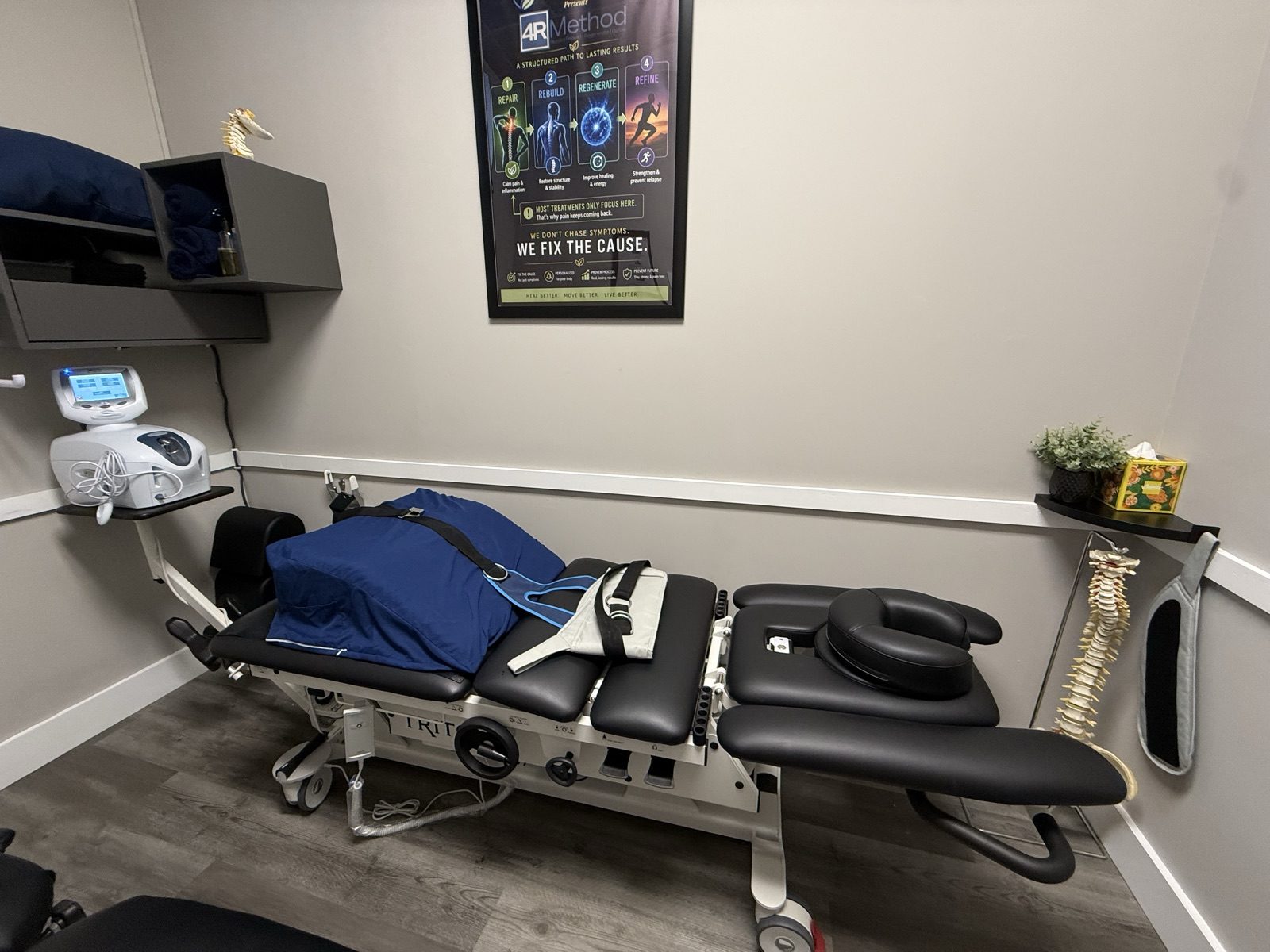
If you are weighing spinal decompression in Margate against an injection or a surgical consult, start with what the treatment actually does. On the Triton DTS table at our Coral Springs clinic, a computer applies a precisely controlled pull along the spine, holds it, then releases — in repeating cycles targeted to the disc that is causing trouble. The aim is to reduce the pressure inside that disc so a bulge can move away from the nerve.
That matters because disc pain is really nerve pain. A herniated or bulging disc at L4–L5 or L5–S1 presses on the root that runs down the leg; in the neck, a C5–C7 disc presses on the root that runs into the shoulder and arm. Pills quiet the signal for a few hours. Decompression works on the cause of the signal.
Patients from Firefighters Park and the Margate Sports Complex often tell us they expected a clinic version of hanging from a bar. It is nothing like that. The table does the work, the computer keeps the force smooth, and most people describe the sessions as relaxing. For the engineering details and the research behind it, read our main spinal decompression therapy guide.

Who is spinal decompression in Margate for — and is it the same as traction?
The strongest signal that decompression is the right tool is a symptom that travels. Leg pain, foot tingling, arm numbness, a weak grip — these mean a nerve is being compressed, and nerve compression responds to taking pressure off far better than to more stretching or stronger medication.
Among Margate patients, the typical candidates are a herniated or bulging lumbar disc (see our herniated disc page), sciatica from L4–L5 or L5–S1, a cervical disc pinching a nerve into the arm, degenerative disc disease from decades of desk and windshield time, and the frustrating group who already tried injections and are looking for something that addresses the disc itself.
People often ask whether this is just traction with a nicer name. It is not. Traction pulls steadily; the paraspinal muscles sense that and tighten, so much of the force never reaches the disc. The Triton DTS ramps force up and down in programmed cycles and adjusts to your resistance, keeping the muscles quiet and the separation at the disc. That difference is why patients from Firefighters Park describe sessions as relaxing rather than uncomfortable.
What does a 20-minute decompression session feel like?
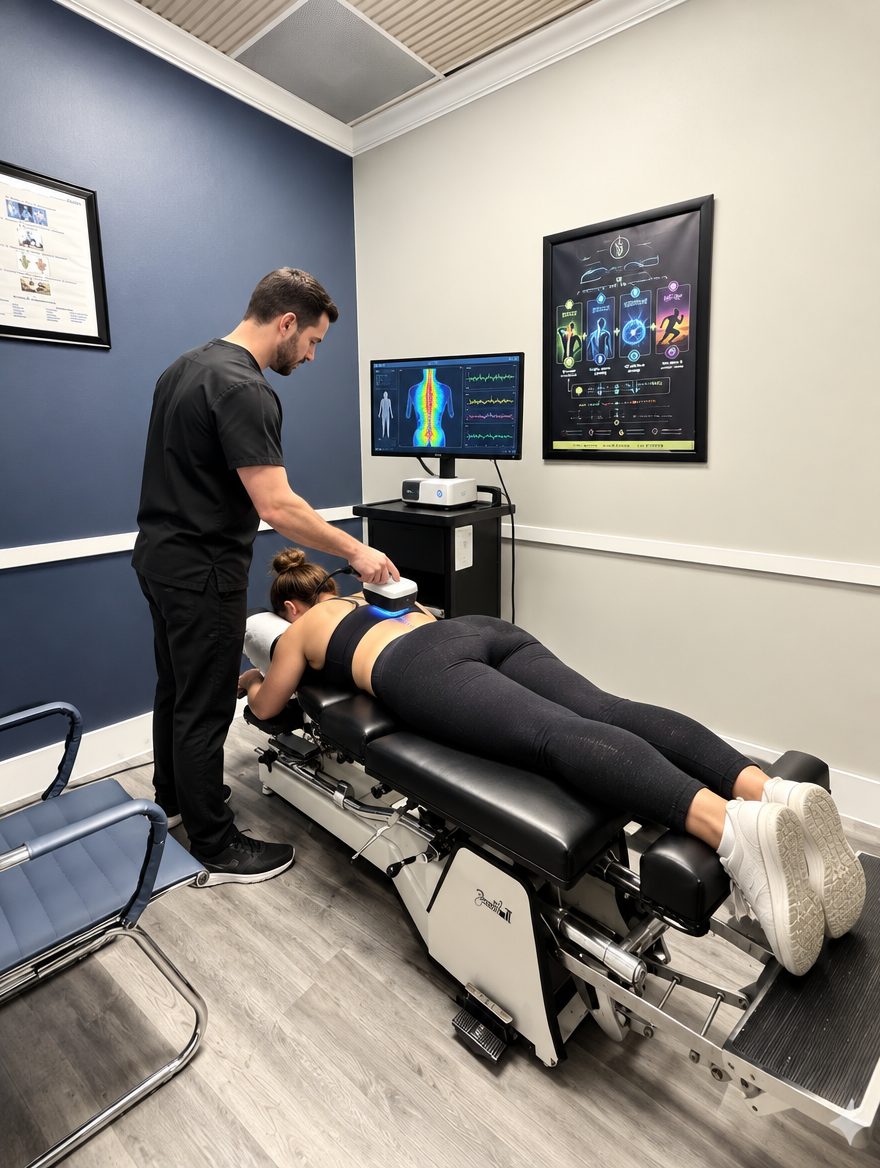
A session on the Triton DTS takes about 20 minutes, and most Margate patients find it relaxing enough to close their eyes. Here is the sequence:
- Harnessing. You lie on the table — face up for the lower back, with a padded cervical cradle for the neck. A pelvic harness and a chest harness hold you so the pull reaches the spine, not the legs.
- Programming. Dr. Cohen sets the angle of pull, the target force and the cycle pattern for your disc level. Force builds over the first sessions rather than starting at full strength.
- Cycles. The table pulls smoothly, holds for about a minute, then eases back for a rest period. This repeats for roughly 20 minutes while you breathe and relax.
- Support therapy. Most sessions are paired with a specific chiropractic adjustment, cold laser or PEMF in the same visit to calm inflammation.
Afterward, some people feel lighter immediately; others notice a mild, pleasant soreness like the day after a good stretch. We ask you to avoid heavy lifting and long sitting for the rest of the day — which, for Margate patients, usually means timing the drive home before the commute. That is what spinal decompression in Margate looks like, session by session.
Where does decompression sit in the 4R Method?
Every plan at The Spine and Wellness Center follows the 4R Method — Repair, Rebuild, Regenerate, Refine — and decompression belongs to the first phase. Its job is to take pressure off the nerve and calm the inflammation, so the rest of the plan has a stable spine to work with.
Repair — a structured decompression program
A typical disc program runs 3–5 visits a week for 4–8 weeks. Decompression anchors each visit, paired with adjustments, cold laser or PEMF. Most Margate patients notice meaningful change in the first two to three weeks, and we re-scan with surface EMG and thermal imaging to confirm the nerve is quieting objectively, not just by feel.
Rebuild — decompression tapers, stabilization takes over
As symptoms settle, decompression steps back and Rebuild takes over: corrective chiropractic protocols, physical therapy to retrain the deep core and hip stabilizers, and Graston work for the fibrotic tissue around the old injury. This phase runs 2–3 visits a week for 8–16 weeks and is the reason the relief holds when you go back to golf at Oriole Golf Club.
Regenerate and Refine
Regenerate supports healing with red light and PEMF at about two visits a week for two or more months. Refine is a brief tune-up every month or two — and for patients with degenerative discs, a short decompression session can be part of it to stay ahead of flare-ups.
What does the evidence say, who should not have it, and what happens at your first two visits?
The evidence base for decompression is encouraging and still developing, and we say so plainly. A retrospective cohort in BMC Musculoskeletal Disorders found that patients completing a non-surgical spinal decompression program showed restored disc height on imaging, associated with less discogenic low back pain (Apfel et al., 2010). The broader literature supports conservative-first care: the National Institute of Neurological Disorders and Stroke notes that most low back pain improves without surgery (NINDS, Back Pain).
Who should not have decompression
We screen for pregnancy, spinal fracture or significant osteoporosis, spinal tumor or infection, unstable spondylolisthesis, recent spinal surgery with hardware at the treated level, abdominal aortic aneurysm or a hernia a harness could aggravate, and severe neuropathy. Previous surgery without hardware, such as a microdiscectomy, is often fine once healed. If you have loss of bladder or bowel control, numbness in the groin, rapidly worsening weakness, or back pain with fever, please see a doctor or urgent care today before booking.
Visit one — we measure (and usually begin care); visit two — your full plan
Visit one for Margate patients is an evaluation, not a session on the table: a real conversation, a hands-on structural exam with nerve-tension and neurological tests, surface EMG and thermal scanning, and digital X-rays when indicated (we also review any MRI you bring). Visit two is your report of findings, where Dr. Jared Cohen, DC maps your decompression program to the 4R phases and Most patients have already begun care on visit one; this is where the full plan takes over. That is how spinal decompression in Margate starts — with data. Take the 60-second spine assessment before you drive in.
Getting to our Coral Springs clinic from Margate
From Firefighters Park, take Royal Palm Boulevard west to University Drive, head north to Wiles Road, turn west to Coral Ridge Drive and then north; the clinic is on Coral Ridge Drive just south of the Sawgrass Expressway.
There is free parking at the door and no building to navigate — you walk straight into reception. For a same-day appointment, call (954) 341-2256 before you leave Margate, or book online.
| Monday | 9:00 am – 7:00 pm |
|---|---|
| Tuesday | 9:00 am – 7:00 pm |
| Wednesday | 3:00 pm – 7:00 pm |
| Thursday | 9:00 am – 7:00 pm |
| Friday | 9:00 am – 12:00 pm |
| Saturday – Sunday | Closed |
The Spine and Wellness Center
5675 Coral Ridge Drive, Coral Springs, FL 33076
Phone: (954) 341-2256
Get directions from Margate on Google Maps
What patients say
We do not have a published review from a Margate patient yet, so here is one from a Coral Springs patient — the same clinic and the same team you would see:
“Professional, friendly, highly knowledgeable and trustworthy. After years of chronic pain, their precise adjustments resolved the issue and restored proper alignment. Highly recommend.”
Related care for Margate residents
Start with the full guide to spinal decompression, then explore the other care we provide for Margate patients.
Spinal decompression therapy — the full guide
How the Triton DTS works, who it helps, what the research says and where it sits in the 4R Method.
Learn moreChiropractic care for Margate
Your Margate hub: everything we treat, directions, hours and what to expect on your first visit.
Learn moreHerniated disc treatment in Margate
Herniated disc treatment for Margate patients, from our Coral Springs clinic.
Learn moreIHHT oxygen therapy in Margate
IHHT oxygen therapy for Margate patients, from our Coral Springs clinic.
Learn moreAll service areas
Every community we serve from Coral Springs, with drive times and the care available for each.
Learn moreServing spinal decompression patients from Margate across North Broward
Our clinic at 5675 Coral Ridge Drive, Coral Springs, FL 33076 serves Coral Springs, Parkland, Coconut Creek, Margate, Boca Raton, Tamarac, Pompano Beach and Deerfield Beach. Same-day appointments are usually available — call (954) 341-2256 or book online. Most patients from Parkland and Coral Springs are here in under 15 minutes.
Medically reviewed by Dr. Jared Cohen, DC — Co-Founder & Clinical Director, The Spine and Wellness Center. Last reviewed October 2026.
Frequently asked questions
Does spinal decompression hurt?
No. Most patients describe a slow, gentle lengthening along the spine and find the session relaxing — many close their eyes or read. The computer adjusts the force to your muscle resistance so there is no jerking or bracing. Mild, pleasant soreness the next day is common early on and settles as the program continues.
How many decompression sessions will I need?
It depends on the disc, the nerve and how you respond. A typical Repair-phase program runs 3–5 visits a week for 4–8 weeks, with decompression at most visits, then tapers as Rebuild takes over. We re-scan with surface EMG and thermal imaging at set points so the number of sessions follows your progress rather than a fixed package.
Can decompression help a herniated disc without surgery?
Often, yes. Decompression is designed to lower the pressure inside a herniated or bulging disc so the material can move away from the nerve and the disc can rehydrate. Most low back pain, including many disc herniations, improves with conservative care; surgery is generally reserved for progressive neurological loss or pain that does not respond to other treatment.
Do you offer same-day appointments for Margate patients?
Usually, yes. Same-day appointments are often available at our Coral Springs clinic, about 15 minutes from Margate, so spinal decompression in Margate can start the week you call. Your first visit is a measurement visit — exam, surface EMG and thermal scans, X-rays when indicated — and your plan and treatment begin on visit two, typically within a few days.
Is there parking at the clinic?
Yes. Free parking is right outside the door at 5675 Coral Ridge Drive — no garage, no meters, no validation. Most Margate patients find it simpler than parking near the coast or at a medical tower, and you walk straight into reception.
Which Margate neighborhoods do you serve?
All of them. We regularly see patients from Firefighters Park, the Margate Sports Complex, Calypso Cove at Royal Palm Park and Oriole Golf Club and across the 33063 and 33068 ZIP codes. Wherever you are in Margate, the drive is about 15 minutes up University Drive or Rock Island Road, and we schedule follow-ups around your commute.

Same-day appointments
Let's fix the cause.
Measure first, then treat — a plan built on your actual structure.
- Same-day appointments are usually available
- Our team calls you back to confirm your visit
- Coral Springs, serving Parkland & North Broward since 2005
Prefer to talk now? Call or text (954) 341-2256