
Service Areas · Coral Springs & Parkland
Herniated Disc Treatment in Tamarac, FL
The Spine and Wellness Center, Coral Springs — about 15 to 20 minutes from Tamarac up University Drive or the Sawgrass Expressway. Same-day appointments are usually available.
Quick answer
The closest clinic for measured, non-surgical herniated disc treatment near Tamarac is The Spine and Wellness Center at 5675 Coral Ridge Drive, Coral Springs, about 15 to 20 minutes from Tamarac. The first visit is an exam with nerve testing, surface EMG, thermal scanning and X-rays when indicated; the second is your report of findings, where decompression on the Triton DTS table begins.
Why Tamarac patients choose us for herniated disc treatment
When someone from Tamarac calls about herniated disc treatment in Tamarac, three things usually settle the decision to come to Coral Springs instead of somewhere closer.
- The drive is easier than it sounds. It is about 15 to 20 minutes up University Drive or the Sawgrass Expressway, and parking is free, right outside the door. We see patients from Kings Point, the Woodlands and Colony West Golf Club every week.
- Evening and early slots. Monday, Tuesday and Thursday run until 7:00 pm; Wednesday afternoons and Friday mornings round out the week. Most Tamarac patients can fit visits around work and school runs.
- We understand who lives in Tamarac. Our typical Tamarac patients are active retirees from Kings Point and the Woodlands, golfers from Colony West, and Tamarac families who want care close to home — and the plan reflects those loads, not a template.
What is a herniated disc, and how is it different from a bulge?
Herniated disc treatment in Tamarac should begin with a clear picture of the disc itself, because the plan depends on it. Each disc has a firm outer ring and a soft center. Age, sitting load and repeated bending weaken the ring; a bulge is the ring sagging outward, a herniation is the soft center breaking through it, and a sequestration is a piece of that center breaking loose. All three can press on the nerve root that exits beside the disc.
The symptoms follow the nerve, not the disc. A lumbar herniation at L4–L5 or L5–S1 produces back pain with a line of pain, tingling or numbness down one leg — sciatica. A cervical herniation at C5–C6 or C6–C7 produces neck pain with symptoms into the shoulder, arm or hand. Weakness in the foot or the grip means the nerve is being compressed hard enough to affect its motor fibers, which moves the case up our priority list.
Our clinic on Coral Ridge Drive has treated Tamarac disc patients since 2005. Dr. Jared Cohen, DC built the approach around a simple idea that the evidence supports: most herniations retract and heal when given space and time, so our job is to create the space and protect the time. Read the herniated disc guide for the full background.

Why the disc needs room and time, not a push
Patients often arrive asking us to “put the disc back.” We cannot, and neither can anyone else — the material that pushed through the ring is under pressure, and pressure is the only lever that moves it. The good news is that pressure is exactly what non-surgical spinal decompression controls.
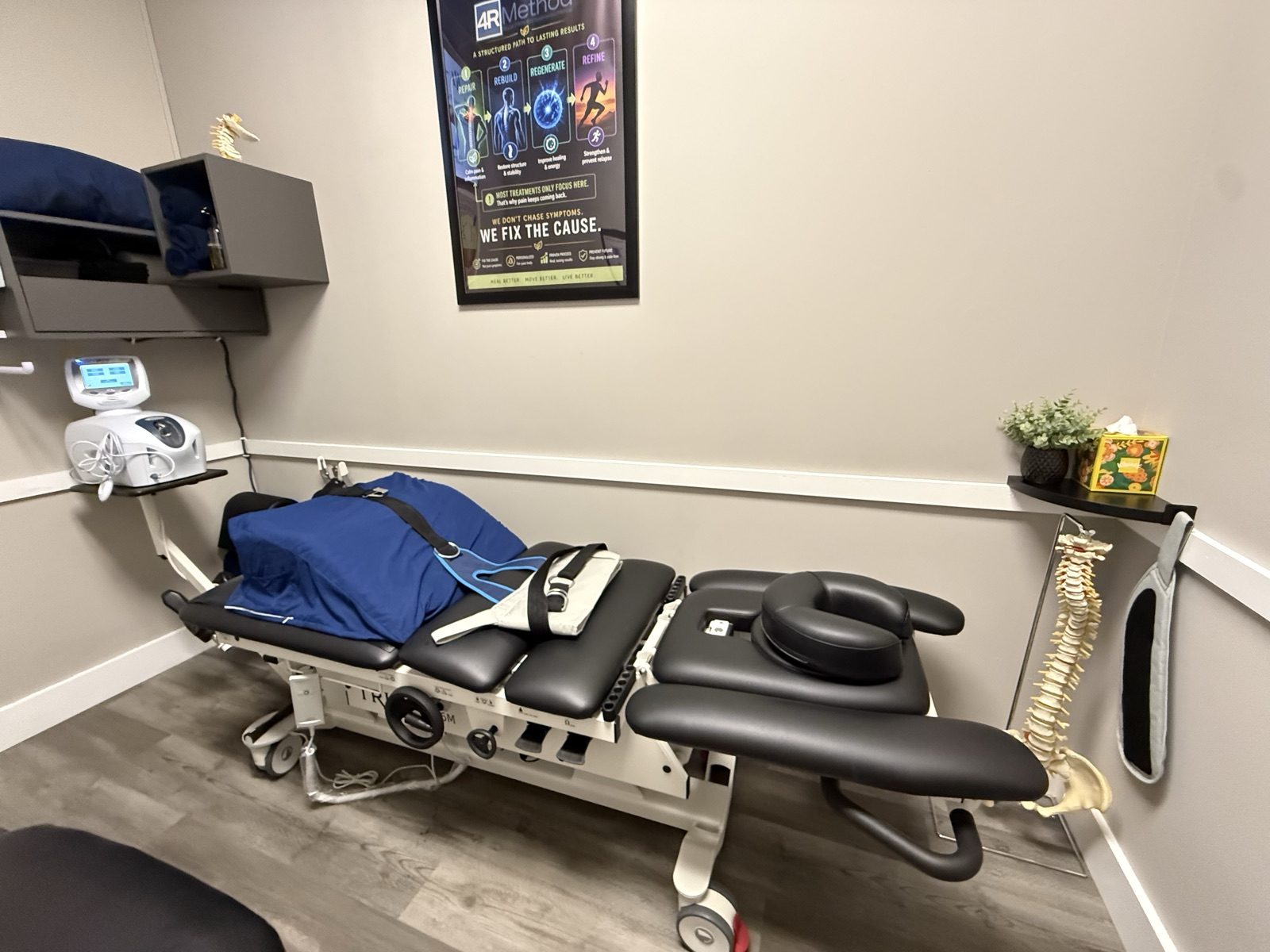
The Triton DTS table separates the vertebrae above and below the disc in gentle, computer-controlled cycles. Old-style traction pulled continuously and the back muscles fought it; cycled decompression keeps them relaxed, so the force actually reaches the disc. Inside the disc, pressure falls toward negative. Herniated material is drawn inward, off the nerve root, and fluid and nutrients are pulled into a tissue that has no blood supply of its own. Session by session — about 20 minutes each — the disc rehydrates and the herniation retracts.
That mechanism is why we tell Tamarac patients that time is on their side. The American Academy of Orthopaedic Surgeons reports that most herniated lumbar discs improve without surgery over weeks to months, and that surgery is reserved for symptoms that persist or for progressive weakness (AAOS OrthoInfo, Herniated Disk in the Lower Back). Our plan is built to make those weeks count.
What is herniated disc treatment in Tamarac like at The Spine and Wellness Center?
Every plan follows the 4R Method: Repair, Rebuild, Regenerate, Refine. For a disc the order is not negotiable — the herniation has to be unloaded before the structure that overloaded it can be corrected.
Repair — unload the disc and calm the nerve
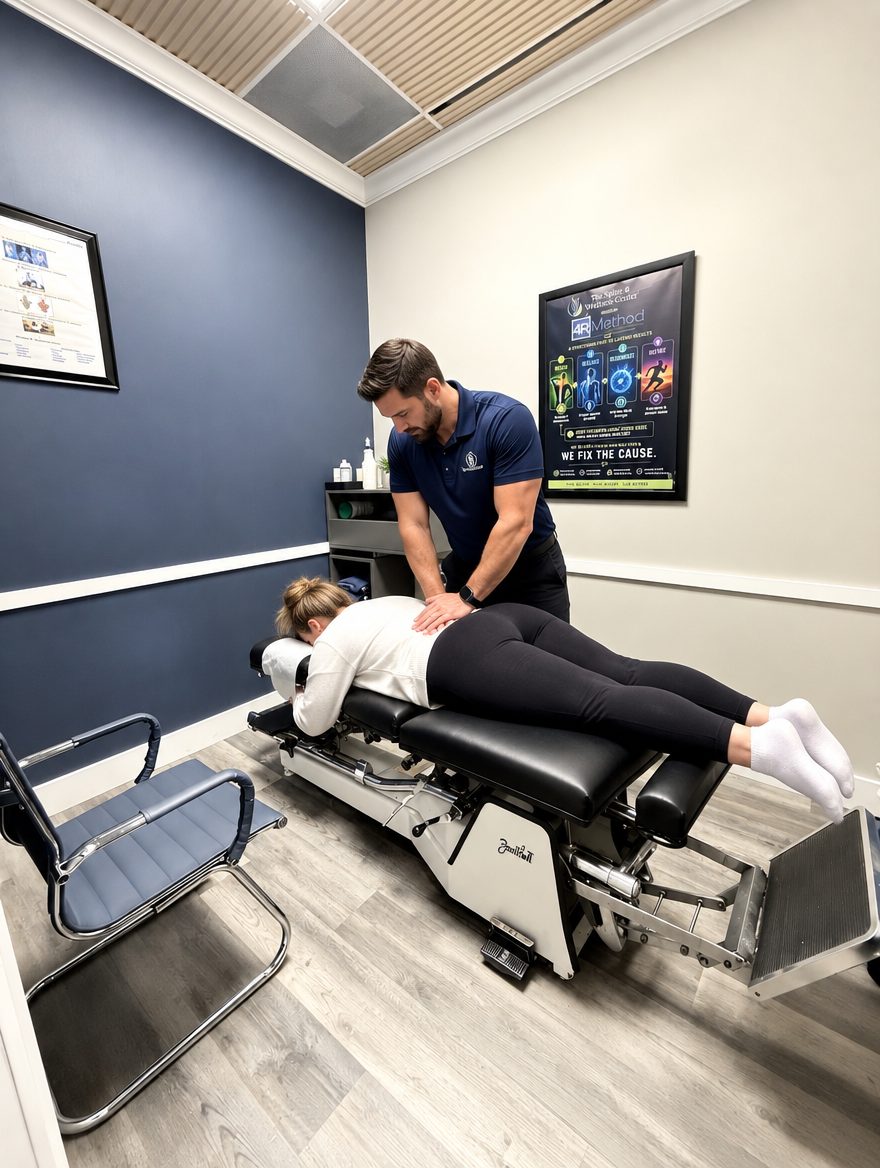
Decompression on the Triton DTS table leads, about 20 minutes per session, paired with precise adjustments at the segments above and below the disc and cold laser or therapeutic ultrasound for inflammation around the nerve. Typically 3–5 visits a week for 4–8 weeks. Most patients notice a change in the leg or arm symptoms within the first two to three weeks.
Rebuild — correct what loaded the disc
Once the nerve is quiet, we correct the architecture that let the disc fail: the lumbar or cervical curve, pelvic balance, and the deep stabilizers that switched off. Corrective care, physical therapy and Graston soft-tissue work, 2–3 visits a week for 8–16 weeks. This is the phase most clinics skip, and why their disc patients come back.
Regenerate and Refine — protect the disc
Regenerate adds red light, PEMF and IHHT oxygen therapy to support disc and nerve recovery, about twice a week for two months or more. Refine is a brief tune-up roughly monthly so the disc stays unloaded through desk work, travel and sport.
Do I need an MRI? What happens at your first two visits
You do not need an MRI before your first visit. Imaging is useful — bring any you have — but a herniation on a scan is common in people with no symptoms, so the scan alone cannot say what is causing your pain. The first appointment is built to answer that, and it begins with a proper examination — and, when appropriate, your first treatment.
Visit one: measurement
Expect a proper conversation about where the symptoms run and what provokes them, then a hands-on exam built around the disc and the nerve: posture and range of motion, orthopedic tests that load and unload the disc, nerve-tension tests, and a neurological screen of reflexes, strength and sensation that identifies the level involved. Surface EMG and thermal scanning along the spine then map muscle guarding and likely nerve irritation in a way we can re-scan later. If the exam calls for it, digital X-rays show disc spacing, curvature and alignment, and we correlate any MRI with what we found.
Visit two: your report of findings
We sit down with your images and scans and explain which disc and which nerve are involved, which 4R phase you start in, how often you will come and for how long. Then Most patients have already begun care on visit one; this is where the full plan takes over. If you would rather arrive informed, the 60-second spine assessment gives us your Spine Score and likely pattern before you leave Tamarac.
What helps a herniated disc at home — and when to see a doctor instead
Between visits, the goal is simple: keep pressure off the disc. These are the habits that matter most:
- Walk, don’t rest. Short, frequent walks keep the disc nourished and the nerve gliding; bed rest beyond a day or two stiffens the joints and weakens the stabilizers.
- Break up sitting. Sitting is the highest-pressure position for a lumbar disc. Stand or walk for two minutes every 30–45 minutes, and use lumbar support in the car.
- Hinge, don’t bend. Keep loads close and hinge at the hips; rounding the spine under load is how discs herniate in the first place.
- No aggressive forward bending early. Toe-touches and deep flexion stretches push the nucleus backward toward the nerve. Your plan adds the right movements at the right stage.
- Sleep unloaded. Side-lying with a pillow between the knees, or on your back with a pillow under them; for a cervical disc, a pillow that keeps the neck level.
Ice in the first 48 hours of a flare, heat for stiffness after that. A few symptoms are not chiropractic problems and need same-day medical evaluation: new loss of bladder or bowel control, numbness in the groin or inner thighs, weakness in a leg, foot, arm or hand that is getting worse quickly, or symptoms after a serious fall or accident. If any of these apply, please see a doctor or urgent care today — we will be here for the recovery afterwards.
Getting to our Coral Springs clinic from Tamarac
Take University Drive north through Coral Springs to Wiles Road, turn west to Coral Ridge Drive, then north; or join the Sawgrass Expressway at Commercial Boulevard and follow it north and east to the Coral Ridge Drive exit, then head south. The clinic is just south of the expressway.
There is free parking at the door and no building to navigate — you walk straight into reception. For a same-day appointment, call (954) 341-2256 before you leave Tamarac, or book online.
| Monday | 9:00 am – 7:00 pm |
|---|---|
| Tuesday | 9:00 am – 7:00 pm |
| Wednesday | 3:00 pm – 7:00 pm |
| Thursday | 9:00 am – 7:00 pm |
| Friday | 9:00 am – 12:00 pm |
| Saturday – Sunday | Closed |
The Spine and Wellness Center
5675 Coral Ridge Drive, Coral Springs, FL 33076
Phone: (954) 341-2256
Get directions from Tamarac on Google Maps
What patients say
We do not have a published review from a Tamarac patient yet, so here is one from a Coral Springs patient — the same clinic and the same team you would see:
“Professional, friendly, highly knowledgeable and trustworthy. After years of chronic pain, their precise adjustments resolved the issue and restored proper alignment. Highly recommend.”
Related care for Tamarac residents
Start with the full guide to herniated disc treatment, then explore the other care we provide for Tamarac patients.
Herniated discs — the full guide
Bulge, herniation and sequestration explained, and the decompression-first 4R plan we use for the disc.
Learn moreChiropractic care for Tamarac
Your Tamarac hub: everything we treat, directions, hours and what to expect on your first visit.
Learn moreBack pain treatment in Tamarac
Back pain treatment for Tamarac patients, from our Coral Springs clinic.
Learn moreCar accident injury treatment in Tamarac
Car accident injury treatment for Tamarac patients, from our Coral Springs clinic.
Learn moreAll service areas
Every community we serve from Coral Springs, with drive times and the care available for each.
Learn moreServing herniated disc patients from Tamarac across North Broward
Our clinic at 5675 Coral Ridge Drive, Coral Springs, FL 33076 serves Coral Springs, Parkland, Coconut Creek, Margate, Boca Raton, Tamarac, Pompano Beach and Deerfield Beach. Same-day appointments are usually available — call (954) 341-2256 or book online. Most patients from Parkland and Coral Springs are here in under 15 minutes.
Medically reviewed by Dr. Jared Cohen, DC — Co-Founder & Clinical Director, The Spine and Wellness Center. Last reviewed October 2026.
Frequently asked questions
Can a herniated disc heal without surgery?
In most cases, yes. The majority of lumbar disc herniations improve with conservative care over weeks to months, and non-surgical spinal decompression gives the disc the space it needs to retract and rehydrate. Surgery is generally reserved for people with progressive weakness or pain that does not respond to other treatment.
How long does a herniated disc take to improve?
Many patients notice leg or arm symptoms easing within the first two to three weeks of the Repair phase, as decompression lowers pressure inside the disc. Full retraction and rehydration take longer — weeks to a few months — which is why the plan runs in phases and why we re-scan along the way to measure progress.
Is spinal decompression the same as traction?
No. Traction applies a constant pull that the back muscles quickly resist. Decompression on the Triton DTS table uses computer-controlled cycles of pull and release that keep the muscles relaxed, so the force reaches the disc and creates the negative pressure that draws the herniation inward. It is more precise and usually more comfortable.
Do you offer same-day appointments for Tamarac patients?
Usually, yes. Same-day appointments are often available at our Coral Springs clinic, about 15 to 20 minutes from Tamarac, so herniated disc treatment in Tamarac can start the week you call. Your first visit is a measurement visit — exam, surface EMG and thermal scans, X-rays when indicated — and your plan and treatment begin on visit two, typically within a few days.
Is there parking at the clinic?
Yes. Free parking is right outside the door at 5675 Coral Ridge Drive — no garage, no meters, no validation. Most Tamarac patients find it simpler than parking near the coast or at a medical tower, and you walk straight into reception.
Which Tamarac neighborhoods do you serve?
All of them. We regularly see patients from Kings Point, the Woodlands, Colony West Golf Club, the Tamarac Sports Complex and Caporella Park and across the 33319 and 33321 ZIP codes. Wherever you are in Tamarac, the drive is about 15 to 20 minutes up University Drive or the Sawgrass Expressway, and we schedule follow-ups around your commute.

Same-day appointments
Let's build your plan.
Find out what's actually going on and get a clear path forward. Same-day appointments available.
- Same-day appointments are usually available
- Our team calls you back to confirm your visit
- Coral Springs, serving Parkland & North Broward since 2005
Prefer to talk now? Call or text (954) 341-2256