
Discs & Nerves · 7 min read
Numbness and Tingling in Hands and Feet: What It Means
That pins-and-needles feeling usually traces back to a nerve under pressure — in the spine or out in the limb. Here is how we tell the difference, and what to do about it.

Quick answer
Numbness and tingling in the hands or feet (paresthesia) almost always means a nerve is being compressed or irritated somewhere along its path. The most common sources are a pinched nerve root in the neck or low back, carpal tunnel at the wrist, and peripheral neuropathy. Finding the exact spot is what makes treatment work.
What numbness and tingling actually mean
Numbness and tingling in the hands or feet is easy to dismiss. Your fingers fall asleep at the keyboard, your toes buzz for no reason, and you shake it off. The medical term is paresthesia, and while it is rarely an emergency, it is almost always a sign that a nerve somewhere is being irritated or compressed. I see patients from Coral Springs and Parkland every week who have lived with it for months before asking what it means.
A nerve is a signal cable. When it is pinched, stretched or inflamed it fires abnormally, and the brain reads that as buzzing, prickling, burning, or a limb that feels asleep. The sensation can come and go or become constant, and it usually follows the path of the specific nerve involved. That path is the clue we use to find the source.
The source can be in the spine, where nerve roots exit between the vertebrae, or out in the limb, where a nerve passes through a tight tunnel at the wrist, elbow or ankle. Sorting spinal from peripheral causes is the first thing we do, because the treatments are different. The National Institute of Neurological Disorders and Stroke notes that chronic paresthesia is most often a symptom of an underlying nerve problem rather than a condition on its own.
5 common causes of numbness and tingling in hands and feet
These five explain most of the cases we evaluate. Several can overlap in the same person, which is one reason home guesses so often miss.
- A pinched nerve root in the neck (cervical radiculopathy). A bulging disc, a bone spur or a narrowed opening presses on a nerve as it leaves the spine. Tingling runs down the arm into specific fingers — thumb and index for C6, middle finger for C7, ring and little fingers for C8. Turning or tilting the head often changes it. See our pinched nerve treatment page.
- A pinched nerve root in the low back (lumbar radiculopathy / sciatica). The same mechanism at L4–S1 sends numbness into the foot, often the big toe or the outer edge of the foot, with pain through the buttock and leg. We cover the leg pattern in sciatica treatment.
- Carpal tunnel syndrome. The median nerve is compressed at the wrist. Classic signs: thumb, index and middle fingers tingle, it is worse at night or while gripping a phone or steering wheel, and shaking the hand helps. Our carpal tunnel treatment page explains the conservative options.
- Other peripheral entrapments. The ulnar nerve at the elbow (ring and little finger tingling, worse with a bent elbow) and the tibial nerve at the ankle (tarsal tunnel, burning in the sole) are the usual suspects.
- Peripheral neuropathy. Diabetes, vitamin B12 deficiency, thyroid problems, chemotherapy and some medications damage the small nerves themselves. The pattern is both feet (or both hands) at once, stocking-and-glove style, rather than one limb along one nerve line.

Is it coming from the spine or the wrist? How to tell
The pattern of your symptoms says a lot before any test does. Here is how we read it:
- Spine clue: the tingling follows a band from the neck or back down the limb, and neck or back pain, or moving the spine, changes it.
- Wrist clue: symptoms are confined to the hand, worse at night, and improve when you shake it out.
- Neuropathy clue: both feet or both hands, symmetrical, with a slow, creeping onset.
- Double crush: a mildly irritated nerve root in the neck makes the same nerve more vulnerable at the wrist. Many ‘carpal tunnel’ cases have a neck component — we wrote about it in carpal tunnel or neck problem? and signs your arm pain might be coming from your neck.
Weakness matters more than tingling. A dropping foot, a grip that fails, or a hand that fumbles buttons means the nerve is losing motor signal, not just sensation, and it moves evaluation to the top of the list.
When to see a doctor today
Sudden numbness on one side of the body, numbness with slurred speech, facial drooping or confusion, numbness after a head or neck injury, or new numbness in the groin and inner thighs with bladder or bowel changes — please see a doctor or urgent care today. Those are not patterns we treat in the office.
How we evaluate and treat numbness and tingling in Coral Springs
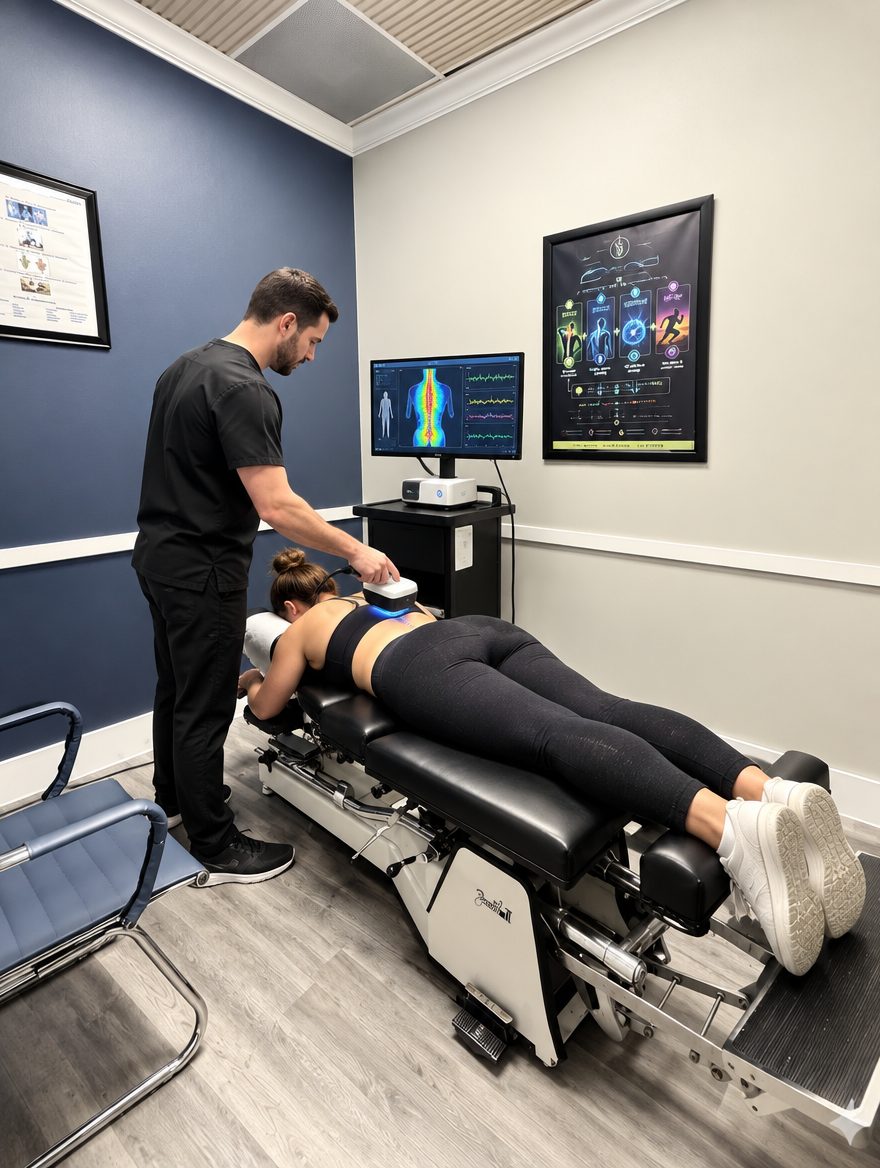
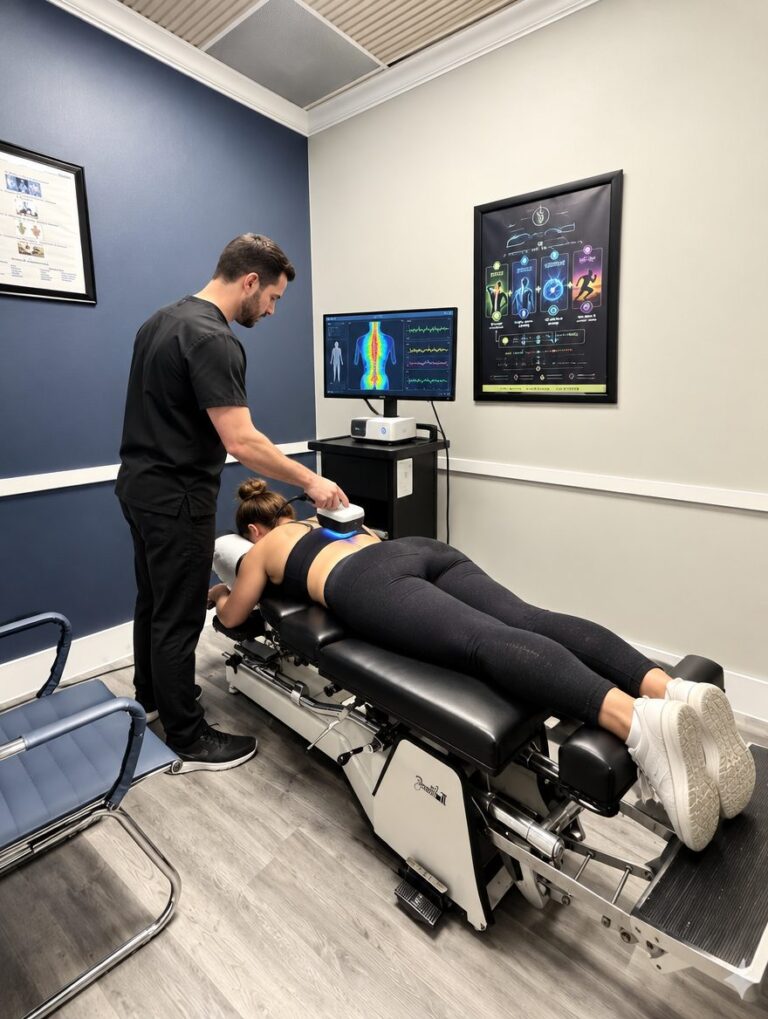
We measure before we treat, because numbness and tingling has too many possible sources to guess at. Your first visit is a conversation about where, when and how long, followed by a hands-on structural exam, neurological screening (reflexes, strength, sensation by nerve level), surface EMG and thermal scanning, and digital X-rays when indicated. Visit two is your full report of findings and plan, and Most patients have already begun care on visit one; this is where the full plan takes over.
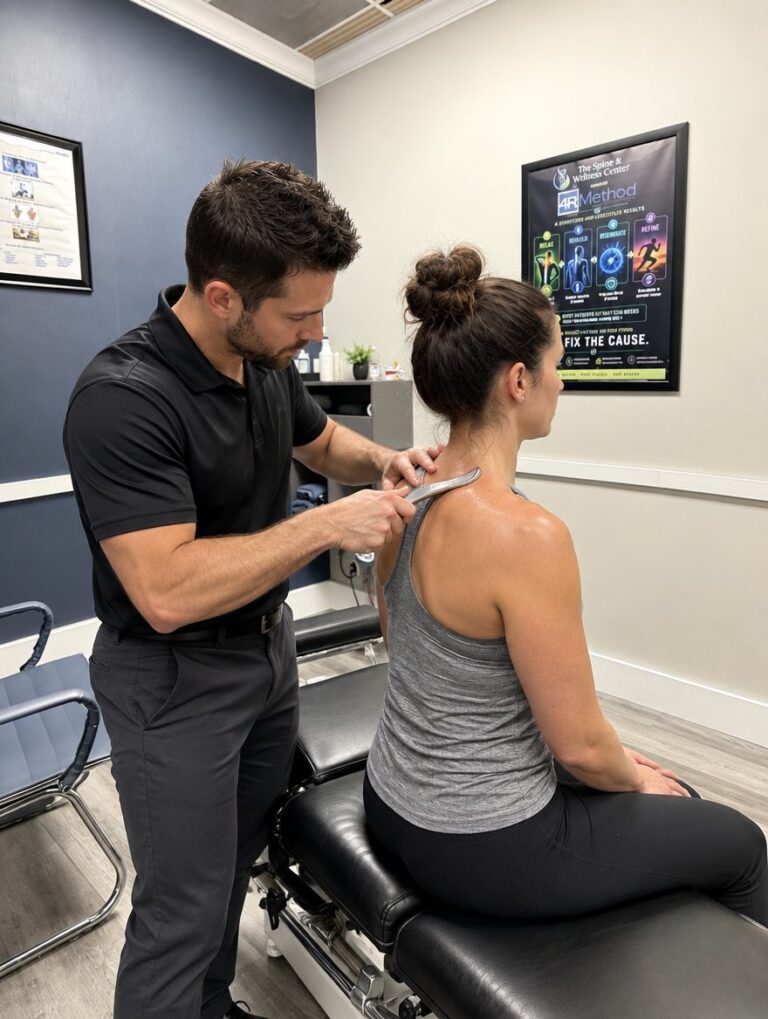
Treatment then follows the 4R Method. In the Repair phase we take pressure off the nerve: non-surgical spinal decompression on the Triton DTS table for disc-driven nerve root compression, specific adjustments to restore motion at the involved level, cold laser to quiet inflammation, and soft-tissue work at the wrist or elbow when the entrapment is peripheral. In Rebuild we correct posture and strengthen the neck, shoulder girdle or core so the nerve stays free. Regenerate and Refine protect the result.
We also look at the whole picture. If the pattern points to neuropathy, we coordinate with your physician for blood work rather than treating a problem that is not mechanical. Our goal in Coral Springs and Parkland is the right care, not just our care.
Pinched nerve treatment
Decompression, adjustments and nerve-gliding for radiating arm and leg symptoms.
Learn moreCarpal tunnel treatment
Conservative care for median-nerve compression at the wrist — and the neck component many people miss.
Learn moreSpinal decompression therapy
Computer-controlled decompression on the Triton DTS table for disc-related nerve pressure.
Learn moreSciatica treatment
When the numb foot and the aching leg start at a lumbar nerve root.
Learn moreWhat you can do at home while you wait for your visit
A few habits reduce nerve irritation while we sort out the cause. None of them replace an evaluation, but they often lower the volume.
- Keep the wrists neutral: raise the laptop, use an external keyboard, and loosen the death-grip on the phone and steering wheel.
- Change position every 30 minutes. Sustained neck flexion and slumped sitting narrow the openings nerves pass through — see our guide to pinched nerves in the neck.
- Sleep with the neck supported and the elbows straighter; a bent elbow all night irritates the ulnar nerve.
- Walk daily. Gentle movement improves nerve blood flow and is especially helpful for early neuropathy.
- Note what triggers it. Which fingers, which time of day, which activities — that record shortens the exam.
Stop any stretch or activity if numbness spreads, weakness appears, or pain radiates further down the limb, and please see a doctor or urgent care today for the red-flag symptoms listed above. For everything else, the sooner a compressed nerve gets room, the faster sensation usually returns.
Serving numbness and tingling patients across North Broward
Our clinic at 5675 Coral Ridge Drive, Coral Springs, FL 33076 serves Coral Springs, Parkland, Coconut Creek, Margate, Boca Raton, Tamarac, Pompano Beach and Deerfield Beach. Same-day appointments are usually available — call (954) 341-2256 or book online. Most patients from Parkland and Coral Springs are here in under 15 minutes.
Medically reviewed by Dr. Jared Cohen, DC — Co-Founder & Clinical Director, The Spine and Wellness Center. Last reviewed October 2026.
Frequently asked questions
Why do my hands go numb when I sleep?
Night-time hand numbness is most often carpal tunnel syndrome, because the wrist curls and pressure inside the tunnel rises. A bent elbow can do the same to the ulnar nerve. A neck problem can also flare in certain pillow positions. If it is consistent, an exam can tell which nerve is involved and where it is being compressed.
Can a pinched nerve in the neck cause tingling in the fingers?
Yes. Each cervical nerve root supplies a specific area of the hand, so a pinched nerve at C6 tends to tingle the thumb and index finger, C7 the middle finger, and C8 the ring and little fingers. Neck movement often changes the symptom, which helps distinguish it from carpal tunnel.
When is numbness and tingling serious?
Sudden one-sided numbness, numbness with trouble speaking or facial drooping, numbness after an injury, or numbness in the groin with bladder or bowel changes should be seen by a doctor or urgent care today. Gradual, position-related tingling is usually mechanical and responds well to conservative care.
Does chiropractic care help numbness and tingling?
When the cause is a compressed nerve root or a mechanical entrapment, taking pressure off the nerve with decompression, adjustments and soft-tissue work often reduces tingling as the nerve recovers. When the cause is neuropathy from diabetes or a vitamin deficiency, we coordinate with your physician instead of treating it as a spinal problem.

Same-day appointments
Reading about it is step one.
Step two is a measurement. Visit one we measure — and usually begin care; visit two you get your full findings and plan.
- Same-day appointments are usually available
- Our team calls you back to confirm your visit
- Coral Springs, serving Parkland & North Broward since 2005
Prefer to talk now? Call or text (954) 341-2256